

Bitcoin Miners Pivot to AI Data Centers: A New Revenue Model for Crypto Infrastructure

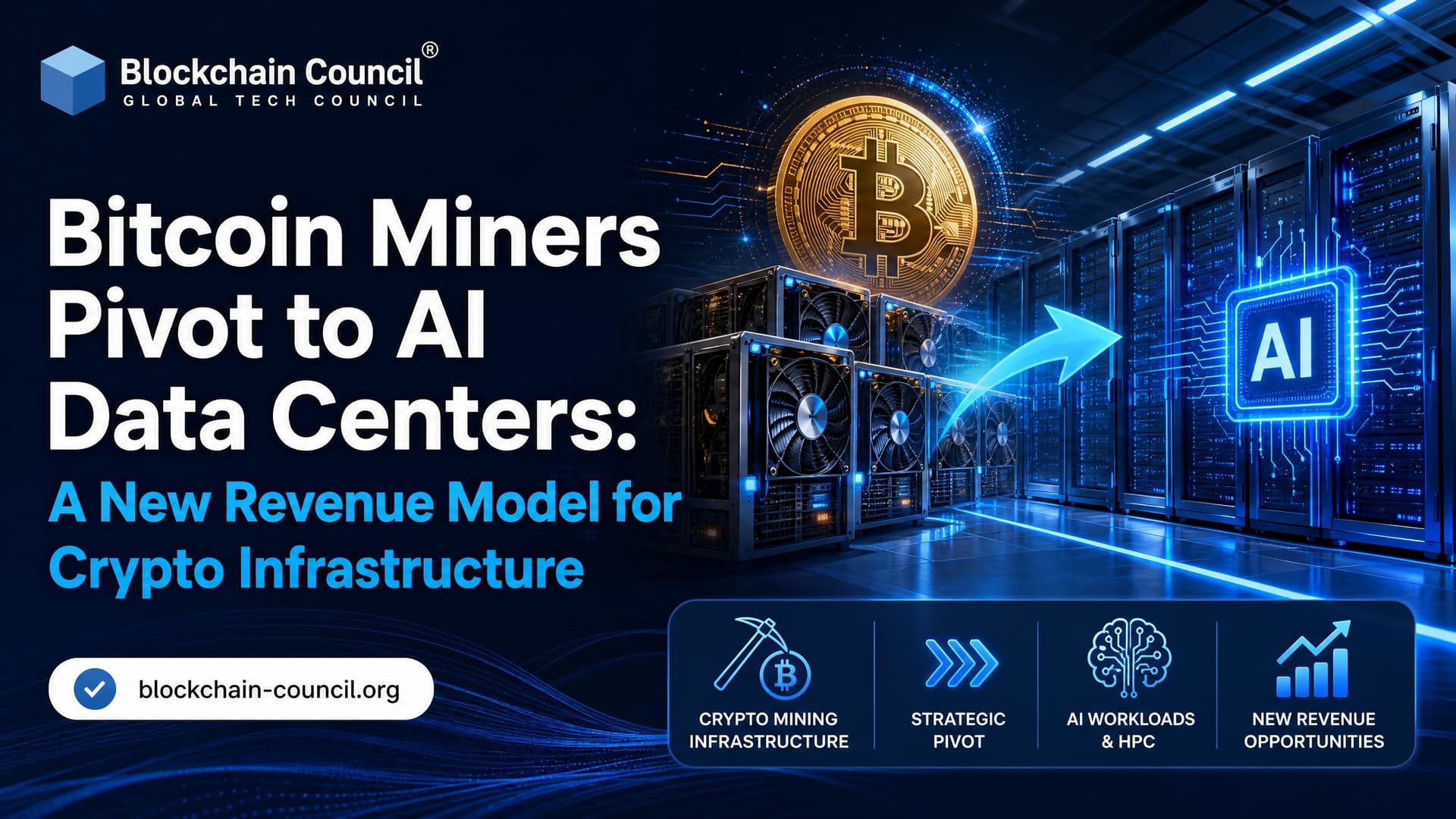
Bitcoin miners pivot to AI data centers because the economics changed. Hashing Bitcoin is still a serious business, but power-dense AI hosting now offers longer contracts, dollar-based revenue, and, in many cases, better profit per megawatt than mining alone.
This is not a small side experiment. CoinShares research cited in late 2024 reporting found that listed miners had disclosed more than 43 billion dollars in AI and high-performance computing contracts. By early 2026, market assessments put signed AI and HPC contracts by Bitcoin miners above 70 billion dollars. That is a major shift in crypto infrastructure.

Why Bitcoin Miners Are Moving Into AI Infrastructure
The first reason is simple. Mining margins got tighter. The 2024 Bitcoin halving cut block rewards, while network difficulty and energy costs kept pressure on operators. When the Bitcoin price is strong, miners can look healthy. When price falls or difficulty rises, weak balance sheets show up fast.
CoinShares reported in late 2024 that only a small fraction of the largest publicly traded miners remained profitable at prevailing Bitcoin prices. That is the kind of data point boards do not ignore.
The second reason is AI demand. Training large models and running inference at scale need land, power, cooling, and network connectivity. Those are exactly the assets large miners already spent years assembling.
Goldman Sachs Research forecasts that United States data center power demand could grow at roughly a 15% compound annual growth rate through 2030, driven heavily by AI workloads. For miners sitting on approved power capacity and large campuses, the opportunity is obvious.
From Hashrate to Hosting: The Business Model Shift
Bitcoin mining revenue is variable by design. It depends on BTC price, network difficulty, block rewards, transaction fees, equipment efficiency, and power pricing. You can run the same ASIC fleet for a month and get very different financial results depending on market conditions.
AI and HPC hosting works differently. Customers pay for power, cooling, rack space, network availability, and service commitments. Contracts are often multi-year and dollar-denominated. That matters. It turns a miner from a commodity producer into something closer to an industrial infrastructure operator.
Bitcoin Mining vs AI/HPC Hosting
- Revenue type: Bitcoin mining is variable and BTC-linked. AI hosting is usually fixed and dollar-based.
- Contract length: Mining pays block by block. AI tenants often sign five-year or longer agreements.
- Cash flow: Mining cash flow is cyclical. Hosting cash flow is more predictable if the operator meets service levels.
- Profit per megawatt: Current industry analysis suggests GPU hosting can produce higher returns per unit of energy than Bitcoin hashing.
- Valuation: Galaxy research notes that miners often trade at 6 to 12 times EV/EBITDA, while leading data center operators can trade around 20 to 25 times.
That valuation gap explains why public miners are eager to be seen as compute infrastructure companies, not just Bitcoin beta. To be blunt, some of them need that re-rating to justify the capital they are raising.
Which Bitcoin Miners Are Pivoting?
Over the past 18 months, at least eight publicly traded mining firms have announced partial or full moves into AI and HPC services. The list includes IREN, Core Scientific, Riot Platforms, TeraWulf, CleanSpark, Marathon Digital, and Bitfarms.
IREN
IREN has become one of the most watched names in this transition. Sector commentary highlights its multi-year AI/HPC partnership with Microsoft, projected to generate around 1.94 billion dollars in annualized revenue at an estimated 85% project-level EBITDA margin. That is why investors started treating IREN less like a pure miner and more like a data center platform.
Core Scientific
Core Scientific has been even more direct. Industry reporting has described the company as preparing to leave Bitcoin mining entirely in favor of AI and HPC data center services. Its leadership has called the conversion of mining assets into AI infrastructure one of the greatest opportunities available to miners.
Bitfarms
Bitfarms is repositioning sites for high-performance computing and AI workloads, with public statements pointing toward a full transition around 2027. Management has argued that HPC produces far more value per unit of energy across multi-year periods than adding more Bitcoin mining capacity.
The Technical Reality: Mining Sheds Are Not AI Data Centers
Here is where the story gets less glamorous. You cannot just pull out ASICs, roll in GPUs, and call it a Tier III data center.
ASIC mining farms are built for airflow, power efficiency, and fast deployment. AI data centers need far stricter uptime, redundancy, fire suppression, network design, access controls, and customer reporting. A Bitcoin miner can tolerate short curtailment windows if power markets make it profitable. An AI tenant running model training jobs under a service-level agreement usually cannot.
Power density is also changing fast. Galaxy research notes that NVIDIA GB200 NVL72 systems can require more than 132 kW per rack. Older enterprise data centers often planned around roughly 40 kW per rack or less. That difference changes everything: busways, transformers, coolant loops, floor loading, and emergency power planning.
If you have ever worked around GPU clusters, you know the small failures are rarely small. A misconfigured InfiniBand fabric can throw NCCL WARN NET/IB : No device found during distributed training. One bad top-of-rack switch can waste an expensive training window. That is a different operating culture from replacing hashboards and tuning ASIC firmware.
What Miners Must Upgrade
- Liquid or hybrid cooling for dense GPU racks
- Redundant power distribution with A/B feeds
- High-capacity fiber, low-latency networking, and secure cross-connects
- Physical security, monitoring, and compliance processes
- Operational teams trained for enterprise SLAs, not just mining uptime
This is why execution risk is real. The miners with land and power have an advantage, but the winners will be the ones that can operate like disciplined data center companies.
What This Means for Bitcoin Network Security
The pivot has mixed effects for Bitcoin. On one hand, diversified revenue may make miners more resilient. Charles Schwab analysis argues that miners with AI/HPC cash flows may be less likely to sell Bitcoin under stress, which could reduce forced selling during downturns.
On the other hand, multi-year AI contracts lock in energy capacity. That means less flexible hashrate can rush back into Bitcoin mining when the BTC price spikes. BitGo's institutional research frames miners as moving from protocol servants to energy arbitrageurs and general compute providers. That phrase is accurate. Miners are learning to allocate power to the workload with the best risk-adjusted return.
This does not necessarily weaken Bitcoin. It may make the mining sector less fragile. But it does mean the clean old model, where public miners were rough proxies for Bitcoin price exposure, is fading.
Enterprises and Developers Should Watch the Contract Structure
If you are an AI company looking for capacity, miner-operated campuses can be attractive. They often have power approvals, land, cooling options, and industrial teams already in place. Build-to-suit models let tenants commit before construction is complete, which can speed delivery compared with greenfield data center projects.
Still, ask hard questions before you sign:
- What uptime standard is actually contracted? Do not accept vague claims about Tier III readiness. Ask for redundancy design and maintenance procedures.
- Who owns the GPUs? Some deals are colocation. Others bundle hardware, hosting, and managed services.
- What is the power price exposure? Fixed hosting fees are only useful if energy risk is properly allocated.
- How concentrated is the tenant base? A miner dependent on one hyperscaler may look stable until that renewal risk appears.
- Can the operator support your workload? AI inference, batch training, and HPC simulation do not stress infrastructure in the same way.
Investment Implications: Not Pure Bitcoin Proxies Anymore
For investors, the old shortcut is becoming less useful. A mining equity is no longer just a leveraged bet on BTC. It may be part miner, part data center developer, part energy company, and part AI infrastructure contractor.
That can improve resilience, but it also adds new risks. Capital expenditure is heavy. Equity dilution is common. Debt can become dangerous if projects slip. Some miners have sold Bitcoin reserves to fund AI expansion, speeding the decline of the HODL miner model.
The key question is not, Which miner has the most hashrate? It is now, Which operator can convert megawatts into contracted compute revenue without missing delivery deadlines?
Skills Professionals Need as Mining and AI Converge
This transition creates new career paths. Mining companies now need people who understand both crypto infrastructure and enterprise compute. That includes data center engineers, AI infrastructure architects, energy analysts, cybersecurity teams, network specialists, and blockchain professionals who can read mining economics properly.
If you are building expertise here, treat it as a cross-domain stack. Learn Bitcoin mining fundamentals, but do not stop there. Study AI workloads, data center availability, GPU networking, and energy markets.
For structured learning, consider Blockchain Council programs such as Certified Bitcoin Expert™, Certified Blockchain Expert™, Certified Blockchain Developer™, and Certified Artificial Intelligence (AI) Expert™. Professionals working on secure infrastructure may also benefit from cybersecurity-focused training, since AI data centers face enterprise-grade security expectations.
What Comes Next
By the end of 2026, sector analysts expect AI and HPC to represent about 70% of revenue for transformed miners that execute major contracts. That is a dramatic change for an industry built around SHA-256 hashpower.
The best miners will become hybrid compute operators, using AI hosting for stable cash flow and Bitcoin mining for upside exposure. The weaker ones will discover that data center operations are less forgiving than crypto cycles.
If you work in blockchain, AI, or infrastructure, start by mapping the economics per megawatt. Then build the technical base: Bitcoin mining mechanics, GPU cluster operations, data center SLAs, and energy contracting. That is where the next generation of crypto infrastructure careers is forming.
Related Articles
View All
News
Bitcoin Miners Pivot to AI Infrastructure: Inside the Data Center Shift
Bitcoin miners are turning power-heavy mining sites into AI and HPC data centers as halving pressure and GPU compute demand reshape mining economics.

News
From Bitcoin Mining to AI Data Centers: A New Model for Crypto Miners
Crypto miners are turning power-rich mining campuses into AI and HPC data centers as halvings, difficulty, and energy costs pressure margins.

News
CleanSpark's $6.6 Billion AI Deal Signals a New Era for Crypto Mining Infrastructure
CleanSpark's $6.6B AI data center lease turns a Bitcoin mining campus into long-term digital infrastructure and may reshape miner economics for years ahead.
Trending Articles

Can DeFi 2.0 Bridge the Gap Between Traditional and Decentralized Finance?
The next generation of DeFi protocols aims to connect traditional banking with decentralized finance ecosystems.
How to Install Claude Code
Learn how to install Claude Code on macOS, Linux, and Windows using the native installer, plus verification, authentication, and troubleshooting tips.
Blockchain in Supply Chain Provenance Tracking
Supply chains are under pressure to prove not just efficiency, but also authenticity, sustainability, and fairness. Customers want to know if their coffee really is fair trade, if the diamonds are con