

Oracle Revokes Campus Placement Offers at IITs: What It Means for Freshers and Tech Hiring
 Suyash Raizada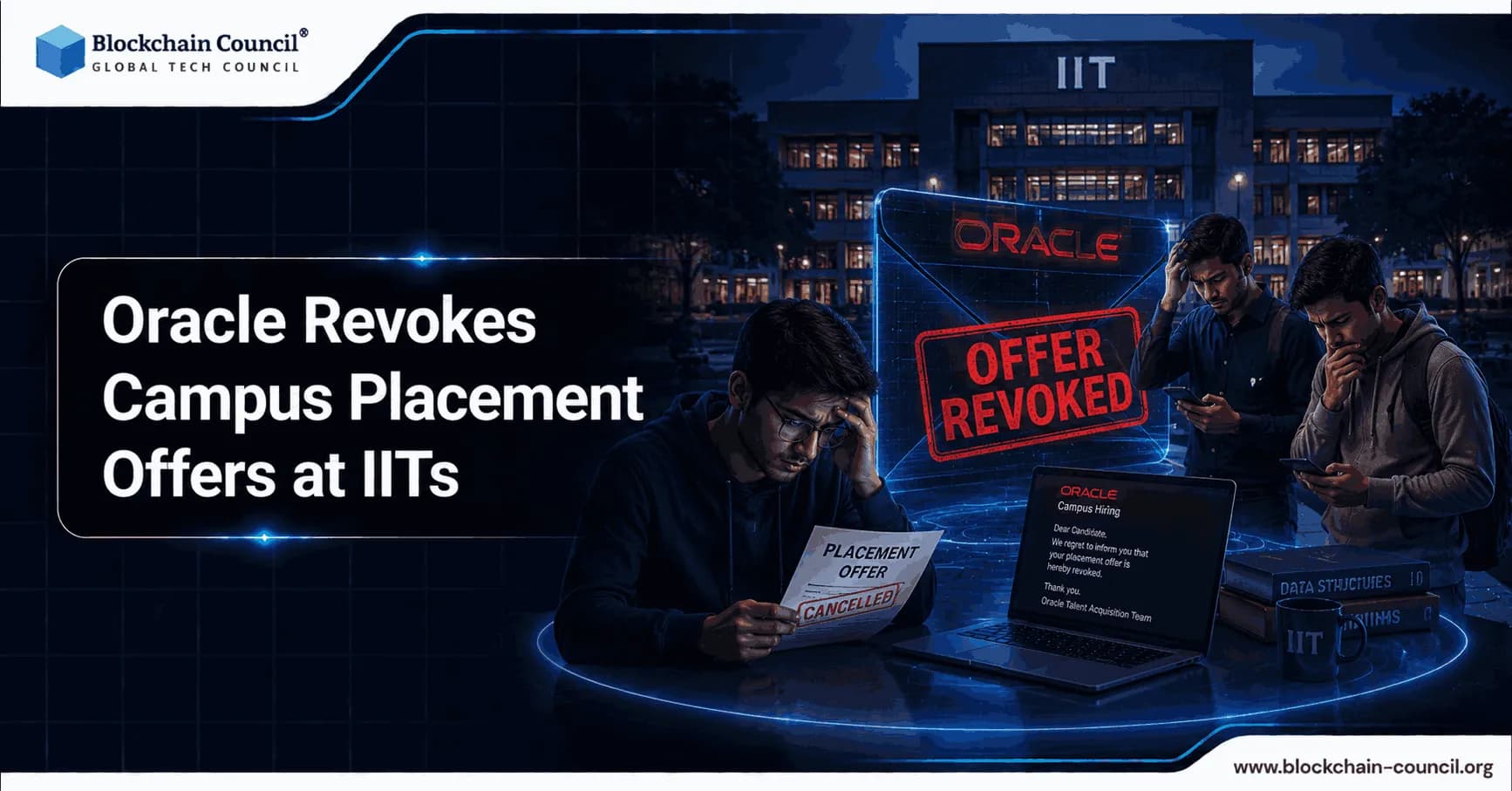
Oracle revokes campus placement offers at IITs and other top Indian engineering institutes, a development that has put freshers, placement cells, and employers on notice. Reports published on May 14, 2026 by Moneycontrol, India Today, and The Economic Times indicate that Oracle cancelled a set of campus placement and pre-placement offers (PPOs) across IITs and NITs, citing global restructuring and layoffs. While the total number of impacted students has not been officially confirmed, the incident has become a high-visibility example of how volatile entry-level tech hiring has become, even at elite campuses. Understand how automation, hiring slowdowns, and changing enterprise priorities are reshaping campus recruitment and tech hiring trends in 2026 by gaining expertise through an AI certification, building job-ready development projects using a Python certification, and improving professional visibility with a Digital marketing course.
This article breaks down what happened, why it matters, how it intersects with institute placement rules, and what freshers can do now to reduce career risk in an uncertain hiring market.

What Happened: Oracle Offer Revocations Across IITs and NITs
According to multiple media reports published in mid-May 2026, Oracle revoked campus placement and PPO offers made to final-year students at several premier institutes. Colleges reported as affected include NIT Warangal, VNIT Nagpur, IIT Roorkee, IIT Hyderabad, and IIT (BHU) Varanasi, among others. Students reportedly received communication around May 13-14 stating that the offers were cancelled, with references to restructuring or closure of specific business units.
Two aspects stand out:
Both full-time campus offers and PPOs were affected, meaning even students who converted internships into expected full-time roles were impacted.
Public details from Oracle were limited at the time of reporting, with media queries reportedly not receiving a detailed response.
Why It Happened: Layoffs, Restructuring, and Business Unit Closures
The timing aligns with significant job cuts and organizational changes at Oracle. Media reports indicated that Oracle laid off approximately 30,000 employees globally in April 2026 as part of a large restructuring. In India, reported cuts were around 12,000 roles, estimated to be close to half of Oracle's local workforce.
Placement officials quoted in business media indicated Oracle cited:
Business restructuring
Closure of certain business units that originally hired these students
Limited ability to absorb all candidates into other teams
In practical terms, this reflects a well-known hiring risk: campus offers were extended under one set of workforce assumptions, then withdrawn after the business environment and internal priorities shifted.
Why the Impact Is Worse on Campuses: The "One Student, One Job" Rule
Many IITs, NITs, and comparable institutions follow a "one student, one offer" or "one student, one job" placement policy. Once a student accepts an offer, they are typically barred from participating in subsequent placement rounds. The goal is fairness and distribution, but the policy carries a structural vulnerability: it assumes accepted offers remain stable until the joining date.
When a company revokes offers months later, affected students face a double disadvantage:
They lose access to on-campus opportunities that were available earlier in the season.
They re-enter the market late, when most structured fresher hiring cycles are already closed.
This is one reason the notion that campus offers are no longer inherently safe is resonating across placement communities. A late-stage revocation can force students into off-campus search cycles alongside not only their graduating batch, but also experienced professionals displaced by layoffs.
How Big Is It: What We Know and What Remains Uncertain
Exact nationwide numbers have not been publicly verified. Moneycontrol reported it could not independently confirm the total number of revoked offers across the country. The Economic Times described the impact as affecting dozens of offers. Social media estimates have suggested higher counts across IITs and NITs, but those figures remain anecdotal.
The profile of affected roles is clearer. India Today and student accounts described offers that were:
Day 0 or Day 1 roles with high campus prestige
High compensation packages, with some reported at 35 LPA or above
PPO conversions following internships in some cases
This challenges a common assumption: that top-tier offers at top-tier campuses carry naturally low risk. Even highly competitive candidates are exposed when macro conditions change.
The Human Side: Student Narratives and Social Media as a Job-Search Channel
One widely circulated example reported in the media involved a student from NIT Warangal who described losing an Oracle PPO and publicly shared their achievements, ranging from entrepreneurial outcomes to competitive performance records. Similar accounts across LinkedIn and student communities show a recurring pattern: when formal placement pathways collapse, students rapidly turn to public professional networks.
LinkedIn in particular is being used as an emergency channel for:
Referrals and warm introductions
Visibility for portfolios and projects
Rapid distribution of resumes to hiring managers and founders
For freshers, the lesson is direct: treat your online professional presence as professional infrastructure, not as an optional extra.
What It Means for Freshers: Immediate Career Implications
If you are an affected candidate, the immediate impact is not only losing a role but losing time and optionality. Reports suggested some students declined other opportunities because the Oracle offer appeared stronger on brand, compensation, and career trajectory. When that anchor disappears late in the academic year, candidates face:
Fewer open fresher roles compared to the main placement season
Higher competition from peers, previous batches, and laid-off professionals
Increased risk of underemployment or prolonged search cycles
There is also a psychological cost: a loss of trust in the stability that elite-campus placements and brand-name employers were long assumed to provide.
What Freshers Can Do Now: A Practical Response Plan
Offer revocations are disruptive, but they can be managed with a structured approach. Below is a tactical playbook that balances speed, credibility, and long-term employability.
1) Stabilize Your Profile in 72 Hours
Update LinkedIn with a clear headline, targeted skills, and a portfolio link.
Clean up GitHub: pin three to five strong repositories, add READMEs, and include demos or test coverage where possible.
Publish a single-page portfolio highlighting projects, internships, and measurable outcomes.
2) Use Networking as a System, Not a Hope
Message alumni and seniors with a specific ask: a referral, a hiring manager introduction, or resume feedback.
Build a target list of 30 to 50 companies and track outreach systematically.
Ask faculty and placement offices about special permissions to re-enter placements if your institute enforces a one-offer rule.
3) Target Domains with Sustained Demand
Hiring demand shifts, but some areas continue to show resilience due to business necessity and regulatory pressure:
Cloud and DevOps: platform engineering, SRE fundamentals, Kubernetes, observability
AI and data engineering: data pipelines, vector databases, model evaluation, MLOps basics
Cybersecurity: SOC fundamentals, application security, IAM, cloud security posture
Fintech and enterprise SaaS: integrations, reliability, compliance-aware engineering
Learn how freshers can stay competitive in modern hiring markets through automation skills, intelligent systems knowledge, and practical software development expertise by mastering autonomous workflows through an Agentic AI Course, developing scalable applications using a Node JS Course, and strengthening personal branding using an AI powered marketing course.
4) Consider Bridge Roles Without Stigma
In a volatile market, bridge options can preserve momentum:
Paid internships with high conversion rates
Contract-to-hire roles
Fellowships and apprenticeship programs
Freelance projects with strong references and documented deliverables
What It Signals for the Future of Tech Hiring
The Oracle incident fits into broader structural changes in how tech companies plan and execute headcount decisions.
1) Cyclical Hiring Is Now Visible to Freshers
Tech hiring surged during 2020 to 2022 and corrected through layoffs and tighter budgets in the years that followed. A 2026 restructuring that reaches campus offers shows that the cycle is no longer confined to mid-career professionals. Entry-level pipelines are now exposed to the same business volatility.
2) A Shift from Volume Hiring to Skill-Precision Hiring
Many companies have reduced bulk fresher intake and increased focus on immediate job readiness. Candidates who can demonstrate applied skills in cloud infrastructure, AI, data platforms, cybersecurity, and enterprise engineering are better positioned than those relying primarily on institute brand or generalist preparation.
Better hiring decisions start with clear role requirements, consistent evaluation criteria, and evidence of a candidate’s relevant capabilities. Assessments can complement interviews and background reviews when used appropriately. Employers can explore HireValid as one option for bringing more structure to candidate evaluation.
3) Offer Letters Before Joining Provide Limited Certainty
HR and legal commentary in India has long noted that pre-joining offer letters often function as statements of intent rather than binding guarantees. While revocations carry employer branding costs, they remain possible during restructuring. For candidates, this reinforces a necessary mindset shift: treat an offer as progress, not as closure.
How Institutes May Respond: Placement Policies Under Pressure
The "one student, one offer" model is designed for fairness, but the Oracle revocations highlight the need for contingency planning. Debates in placement ecosystems are increasingly considering options such as:
Allowing re-entry into placements if an accepted offer is revoked or joining is deferred beyond a defined threshold.
Conditional placement locks that activate only after a student joins or clears a final confirmation stage.
Recruiter reliability tracking to inform Day 0 and Day 1 slot allocation and future MoU terms.
Even incremental policy changes can materially reduce downside risk for students when market shocks occur late in the placement cycle.
Conclusion: What Oracle's Campus Offer Revocations Mean Going Forward
The news that Oracle revokes campus placement offers at IITs has become more than a single-company story. It marks a new reality: even elite campus outcomes can be destabilized by global restructuring, and early-career professionals must build redundancy through skills, professional networks, and credible proof of work.
For freshers, the path forward requires process over panic: strengthen portfolios, target resilient domains, leverage alumni networks, and validate skills through projects and recognized credentials. For institutes, the moment calls for placement policy resilience. For employers, it is a reminder that workforce decisions made at scale can reshape trust in the campus hiring market for years to come.
FAQs
1. Why did Oracle revoke campus placement offers at IITs and NITs?
Oracle reportedly revoked offers due to global restructuring and large-scale layoffs across business units. Some departments that originally hired students were shut down or reorganized. This affected both campus placements and pre-placement offers.
2. Which institutes were affected by Oracle’s offer cancellations?
Reports mentioned institutes such as IIT Roorkee, IIT Hyderabad, IIT BHU, NIT Warangal, and VNIT Nagpur. Several students from premier engineering colleges were impacted. The total number of affected candidates has not been officially confirmed.
3. What is a pre-placement offer (PPO)?
A PPO is a full-time job offer given to interns before they graduate. Companies usually extend these offers based on internship performance. Many affected students had already accepted PPOs from Oracle.
4. Why is the impact severe for freshers?
Freshers often depend heavily on campus placements for their first job opportunities. Once students accept an offer, many institutes restrict them from attending further placement rounds. Late offer revocations leave them with limited hiring options.
5. What is the “one student, one job” placement rule?
This rule prevents students from participating in additional placements after accepting one offer. It is designed to ensure fair job distribution among students. However, revoked offers expose weaknesses in this system.
6. How did Oracle’s layoffs influence campus hiring?
Oracle reportedly conducted large-scale global layoffs and restructuring in 2026. Business units connected to campus hiring were affected during this process. As priorities shifted, some fresher roles were cancelled.
7. Why are campus offers no longer considered fully secure?
Economic uncertainty and restructuring can affect hiring plans even after offers are released. Companies may change workforce strategies based on financial conditions. This has reduced confidence in long-term hiring stability.
8. How are affected students responding to the situation?
Many students are turning to LinkedIn, alumni networks, and public professional communities for support. They are actively sharing resumes, portfolios, and project achievements online. Networking has become a critical survival strategy.
9. Why is LinkedIn important for freshers now?
LinkedIn helps freshers increase visibility among recruiters and hiring managers quickly. It also supports networking, referrals, and portfolio sharing. A strong online presence improves access to hidden job opportunities.
10. What immediate steps should affected students take?
Students should quickly update their resumes, LinkedIn profiles, and GitHub repositories. They should also create project portfolios and begin targeted networking efforts. Fast action improves their chances of securing alternative opportunities.
11. Why is GitHub important for engineering freshers?
GitHub demonstrates practical coding skills and real project experience to recruiters. Strong repositories with documentation and test coverage improve credibility. Employers increasingly value proof of work over academic reputation alone.
12. Which technology domains still show strong hiring demand?
Cloud computing, cybersecurity, AI, data engineering, and enterprise SaaS continue to show resilience. These areas remain important due to business and security needs. Candidates with applied skills in these domains are in better positions.
13. How can certifications help freshers in uncertain markets?
Professional certifications provide externally verified proof of technical skills and specialization. They help candidates strengthen resumes and stand out during hiring processes. Certifications also support faster skill development in growing fields.
14. What are bridge roles in the job market?
Bridge roles include internships, apprenticeships, contract positions, and freelance opportunities. These roles help candidates maintain experience and industry exposure during uncertain periods. They can also lead to permanent employment later.
15. How is tech hiring changing overall?
Tech hiring is shifting from mass recruitment toward skill-focused and role-specific hiring. Companies now prefer candidates with practical expertise and immediate productivity. General academic credentials alone are becoming less sufficient.
16. Why are applied skills becoming more important than institute brand names?
Employers increasingly prioritize practical abilities that directly support business operations and projects. Strong portfolios, coding skills, and technical knowledge now carry significant value. This reduces dependence on institutional reputation alone.
17. Are offer letters legally guaranteed employment?
In many cases, offer letters function more as employment intentions than binding guarantees. Companies may still revoke offers during restructuring or market downturns. This creates uncertainty for job seekers before joining dates.
18. What policy changes are institutes considering after this incident?
Institutes are discussing flexible placement policies for students whose offers are revoked. Some proposals include allowing re-entry into placement processes under certain conditions. These changes aim to reduce career risks for students.
19. What lesson does this incident teach freshers?
Freshers should avoid depending entirely on one offer or one recruitment channel. Building strong skills, networks, and portfolios creates greater career resilience. Career security increasingly depends on adaptability and continuous learning.
20. What is the article’s main conclusion about Oracle’s offer revocations?
The article concludes that tech hiring has become more volatile, even for top-tier engineering graduates. Freshers must strengthen professional networks, practical skills, and proof of work. Long-term employability now depends on flexibility and preparedness rather than assumptions of stability.
Related Articles
View All
News
Apple vs OpenAI Lawsuit: What It Means for AI Talent Competition in Big Tech
Apple's lawsuit against OpenAI could reshape AI hiring, trade secret controls, and hardware competition across Big Tech.

News
Investors Revive AI Trade, Sparking Tech Rally: What It Means for Markets
AI-linked tech and chip stocks are leading markets higher again as earnings, lower rate pressure, and infrastructure demand revive investor confidence.

News
Visa's Open USD Stablecoin Platform: What It Means for Digital Payments
Visa's backing of Open USD through VSP could make stablecoins a core layer for settlement, treasury, cross-border payments, and enterprise finance.
Trending Articles
The Role of Blockchain in Ethical AI Development
How blockchain technology is being used to promote transparency and accountability in artificial intelligence systems.
How Blockchain Secures AI Data
Understand how blockchain technology is being applied to protect the integrity and security of AI training data.

Can DeFi 2.0 Bridge the Gap Between Traditional and Decentralized Finance?
The next generation of DeFi protocols aims to connect traditional banking with decentralized finance ecosystems.