

NVIDIA Declares AGI Arrived: What Jensen Huang Means and Why It Matters
 Suyash Raizada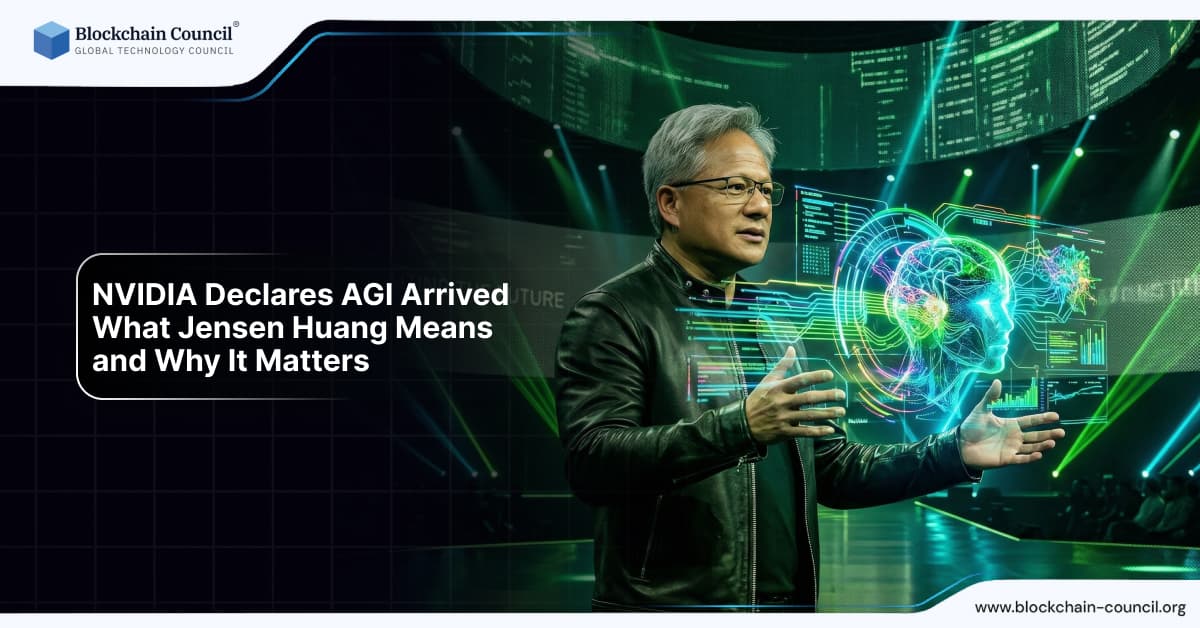
NVIDIA Declares AGI Arrived is the headline claim coming out of a March 2026 interview where CEO Jensen Huang argued that artificial general intelligence is effectively here. The statement immediately sparked debate because it contrasts with more conservative AGI timelines from other AI leaders and researchers. It also raises a practical question for enterprises and developers: if this is AGI, what can it do today, and what is still missing?
This article breaks down what Huang said, how his definition differs from broader research usage, what NVIDIA unveiled at GTC 2026, and what professionals should do next to stay ahead of rapid adoption.

Evaluate what AGI means in terms of reasoning autonomy, safety risks, and enterprise deployment by building expertise through an AI Security Certification, implementing intelligent systems using a Python certification, and translating AGI innovations into business strategies with a Digital marketing course.
What Happened: Jensen Huang's AGI Claim
In a Lex Fridman podcast interview on March 23, 2026, Jensen Huang said, "I think it's now. I think we've achieved AGI." This marks a notable shift from his earlier public expectation in 2024 that AGI would arrive within about five years, which implied a timeframe closer to 2029.
The context matters. Huang was not claiming that AI has reached fully human-level reasoning across all domains. Instead, he linked his AGI framing to specific capabilities, particularly agentic AI systems that can execute complex workflows, write code, and operate parts of a technology business with limited supervision.
How Jensen Huang Defines AGI (and Why That Definition Is Contested)
Many AI researchers use AGI to mean human-level general intelligence across open-ended tasks and environments, including robust reasoning, planning, transfer learning, and long-horizon reliability. Huang's framing is narrower. In his comments, he highlighted benchmarks such as matching humans on standardized tests or functioning as business-operating agents.
Even while arguing that AGI has arrived in this narrower sense, Huang acknowledged meaningful limitations. He stated that current agents are not yet capable of independently running a complex company at NVIDIA's scale, describing the odds as essentially zero. That caveat aligns with a common technical criticism: modern agentic systems can appear highly capable in short, structured tasks, but they still struggle with:
Long-term stability across days or weeks of execution
Reliable autonomy without compounding errors
Objective alignment when goals are ambiguous or shifting
Accountability in high-stakes decisions such as finance, hiring, and compliance
Because of these gaps, many researchers and analysts interpret the claim as a redefinition of AGI rather than the achievement of a universally accepted milestone. The dispute is not only philosophical. It changes how businesses assess risk, readiness, and return on investment.
Why the Timing Matters: GTC 2026 and NVIDIA's Platform Narrative
The AGI declaration did not happen in isolation. It followed NVIDIA's GTC 2026 conference (March 16-19, 2026), where Huang presented a broad platform view of AI that he described as a multi-layer stack. The central theme: AI is becoming a new industrial layer, and NVIDIA intends to be foundational across infrastructure, tooling, and deployment.
At GTC 2026, NVIDIA announced major hardware and platform updates designed to scale training and inference workloads:
Vera Rubin GPU (announced with shipment expectations in 2027)
Kyber Rack Architecture with dense configurations of 144 GPUs per tray (targeting 2027)
Groq acquisition reported at approximately $20 billion, enabling an NVIDIA Groq 3 LPU chip expected around Q3 2026
DLSS 5 for neural rendering and real-time photoreal 4K graphics
The AGI claim is also, in part, a narrative about compute scaling and software maturity. NVIDIA's business is tightly coupled to AI expansion, and Huang has repeatedly emphasized that the AI infrastructure buildout may be one of the largest capital investment cycles in modern history.
Agentic AI Is the Real Signal Behind the AGI Claim
Rather than focusing on abstract intelligence, Huang pointed to practical agentic systems that can act, not just respond. He referenced open-source and integration work around agentic tooling, including projects described as OpenClaw and add-ons such as NemoClaw for agent workflows tied to coding tools like Anthropic's Claude Code.
For developers and enterprises, the important shift is this: agentic AI systems increasingly combine multiple capabilities in a single execution loop:
Planning - breaking goals into discrete tasks
Tool use - running commands, calling APIs, querying databases
Execution - writing code, deploying changes, generating reports
Verification - running tests, linting, monitoring, and evaluation prompts
This makes "AGI" feel tangible to business operators because the output resembles a junior analyst or developer who can close tickets quickly. However, reliability and governance still determine whether these systems can be trusted beyond supervised environments.
Economic and Market Context: Why NVIDIA's Voice Carries Weight
NVIDIA is not a neutral commentator. By March 2026, its market capitalization was reported above $3 trillion, and its chips power a significant share of advanced AI training and inference workloads globally. Industry reporting also cited an AI infrastructure backlog on the order of $1 trillion through 2027, driven by demand for Blackwell-class platforms and next-generation roadmaps such as Vera Rubin.
That scale matters because when NVIDIA declares AGI has arrived, the statement can shape:
Enterprise roadmaps for automation and AI deployment
Public market narratives about productivity and growth
Talent strategy as teams reorganize around AI toolchains
Adjacent ecosystems, including AI-crypto projects
Post-GTC reporting noted AI-crypto token price increases in the approximate 8 to 20 percent range across several tokens associated with decentralized compute, AI agents, and AI training narratives. Whether or not those moves were justified by fundamentals, it illustrates how major platform announcements can spill into broader markets.
What This Means for Business Leaders: Treat "AGI" as an Operational Maturity Claim
For CEOs, CTOs, and product leaders, the most productive interpretation is to treat this declaration as a statement about operational maturity, not a declaration that machines can replace all knowledge work.
Practical Near-Term Impacts (Next 12 to 24 Months)
Routine role disruption accelerates in areas like customer support triage, reporting, basic data analysis, and software maintenance.
AI oversight roles become more valuable: evaluation, red-teaming, workflow design, model governance, and compliance.
Process redesign outperforms tool adoption alone: organizations that re-architect workflows around human approval gates and measurable quality metrics will see the strongest returns.
What to Implement Now
Pick 2 to 3 high-volume workflows to automate with agents - for example, internal IT tickets, sales development research, or weekly analytics reporting.
Define guardrails such as allowed tools, data boundaries, and required human approvals for financial or customer-impacting actions.
Measure reliability with pass rates, rollback rates, hallucination or defect incidence, and time-to-resolution.
Invest in AI literacy across teams, not only in engineering.
For professionals looking to formalize these skills, Blockchain Council offers structured learning pathways including the Certified Artificial Intelligence (AI) Expert, Certified Machine Learning Expert, and role-aligned tracks covering AI governance, deployment, and security.
What Developers Should Take Away: Agents Need Evaluation, Not Just Prompts
Developers building with agentic AI should focus less on one-off demos and more on repeatable engineering practices. Current agents can be impressive in coding and operations tasks, but they are brittle without strong scaffolding. Key practices include:
Tool permissioning - least-privilege API keys, scoped credentials, sandboxed execution
Deterministic pipelines where possible - structured outputs, schemas, function calling
Automated evaluation using test suites, golden datasets, and regression checks
Observability - traces, prompts, tool calls, and error taxonomies
For those working at the intersection of AI and security, Blockchain Council's Certified Cybersecurity Expert can complement AI training by strengthening threat modeling for agent tool use, data exfiltration risks, and supply chain vulnerabilities.
Is This AGI, or Strong Narrow Intelligence at Scale?
The debate remains unresolved because "AGI" is not a single technical checklist. Huang's view emphasizes real-world capability: can AI systems perform economically valuable tasks at human-comparable levels, particularly in business and software contexts? Many researchers instead emphasize broader generality: can an AI system reliably transfer across domains, learn continuously, and handle open-ended goals without frequent human intervention?
A balanced reading is that the industry has reached a new phase of agentic automation that can resemble general intelligence in constrained settings. The remaining gap to widely accepted AGI, however, includes robust autonomy, long-horizon planning, and consistent reasoning under uncertainty.
Understand the implications of AGI on industries, governance, and real-world systems by mastering advanced AI safety through an AI Security Certification, building scalable applications via a Node JS Course, and promoting AI transformation strategies using an AI powered marketing course.
Conclusion: What the AGI Claim Actually Means for Your Roadmap
Jensen Huang's declaration is best understood as a signal that agentic AI has crossed a practical threshold: it can now execute meaningful business and engineering workflows with limited supervision. At the same time, even Huang concedes that today's systems are not ready to autonomously run a complex enterprise end-to-end.
For enterprises and builders, the path forward is clear: deploy agents where they deliver measurable returns, wrap them in rigorous evaluation and security controls, and invest in workforce upskilling. Whether you classify it as AGI or not, the operational impact of agentic AI is already material. Organizations that adapt their processes now will be best positioned for the next hardware and software wave led by NVIDIA and the broader ecosystem.
FAQS
1. What did NVIDIA mean by declaring AGI has arrived?
NVIDIA’s statement suggests that AI systems have reached a level of capability comparable to general intelligence in certain domains. It reflects rapid progress in large models and AI infrastructure.
2. What is AGI in simple terms?
Artificial General Intelligence (AGI) refers to AI that can perform a wide range of tasks at a human-like level. It goes beyond narrow AI, which is limited to specific functions.
3. Has true AGI actually been achieved?
Most experts believe true AGI has not yet been fully achieved. Current systems are powerful but still limited in reasoning, understanding, and autonomy.
4. Why did Jensen Huang say AGI has arrived?
Jensen Huang likely refers to the practical impact of AI systems becoming broadly useful. His statement emphasizes real-world capabilities rather than strict technical definitions.
5. How is AGI different from current AI models?
AGI would be able to learn and adapt across tasks without retraining. Current AI models are specialized and require training for specific purposes.
6. What technologies are driving progress toward AGI?
Key technologies include large language models, advanced GPUs, and massive datasets. These enable more complex and scalable AI systems.
7. Why does NVIDIA play a major role in AI development?
NVIDIA provides GPUs and infrastructure that power most modern AI systems. Its hardware is essential for training and deploying large models.
8. What are the implications of AGI for businesses?
Businesses could automate complex tasks and improve decision-making. This may increase efficiency but also require new governance and oversight.
9. How could AGI impact jobs and the workforce?
AGI could automate many roles while creating new opportunities. Workers may need to adapt by learning new skills and working alongside AI.
10. What industries will be most affected by AGI?
Industries like healthcare, finance, education, and technology will see major changes. AI can enhance productivity and innovation in these sectors.
11. What are the risks of AGI development?
Risks include misuse, bias, and lack of control. Ensuring safety and ethical use is critical as AI becomes more advanced.
12. How does AGI relate to generative AI?
Generative AI is a step toward AGI but is still limited. AGI would have broader capabilities beyond content generation.
13. What role do GPUs play in AGI development?
GPUs provide the computational power needed for training large AI models. They enable faster processing and scalability.
14. How should companies prepare for AGI?
Companies should invest in AI skills, infrastructure, and governance. Preparing for change helps them stay competitive.
15. What is the difference between hype and reality in AGI claims?
Hype often exaggerates current capabilities. Reality shows that AI is advancing but still has limitations.
16. How can governments regulate AGI development?
Governments can create policies for safety, transparency, and accountability. Regulation helps manage risks while supporting innovation.
17. What does AGI mean for everyday users?
Users may experience smarter tools and automation in daily tasks. AI-powered services will become more integrated into daily life.
18. How does AGI affect data privacy concerns?
More advanced AI systems require large amounts of data. This increases the need for strong privacy protections and policies.
19. What are the challenges in achieving true AGI?
Challenges include general reasoning, adaptability, and understanding context. Technical and ethical barriers remain significant.
20. What is the future outlook for AGI after NVIDIA’s statement?
AI will continue to evolve rapidly, but full AGI is still a work in progress. Ongoing innovation and regulation will shape its development.
Related Articles
View All
News
Visa's Open USD Stablecoin Platform: What It Means for Digital Payments
Visa's backing of Open USD through VSP could make stablecoins a core layer for settlement, treasury, cross-border payments, and enterprise finance.

News
DTCC Tokenized Securities Trading Goes Live: What It Means for Capital Markets
DTCC's live tokenized securities trading marks a major shift in U.S. market infrastructure, with real DTC-held assets moving on-chain.

News
Why Institutional Investors Are Shifting Capital Toward AI and What It Means for Crypto Markets
Institutional investors are moving capital toward AI, but crypto remains a strategic allocation. Here is how the rotation affects Bitcoin, tokens, and AI-crypto infrastructure.
Trending Articles
What is AWS? A Beginner's Guide to Cloud Computing
Everything you need to know about Amazon Web Services, cloud computing fundamentals, and career opportunities.
Claude AI Tools for Productivity
Discover Claude AI tools for productivity to streamline tasks, manage workflows, and improve efficiency.
How to Install Claude Code
Learn how to install Claude Code on macOS, Linux, and Windows using the native installer, plus verification, authentication, and troubleshooting tips.