

Oracle layoffs: What the 2026 restructuring means for employees and the AI pivot
 Suyash Raizada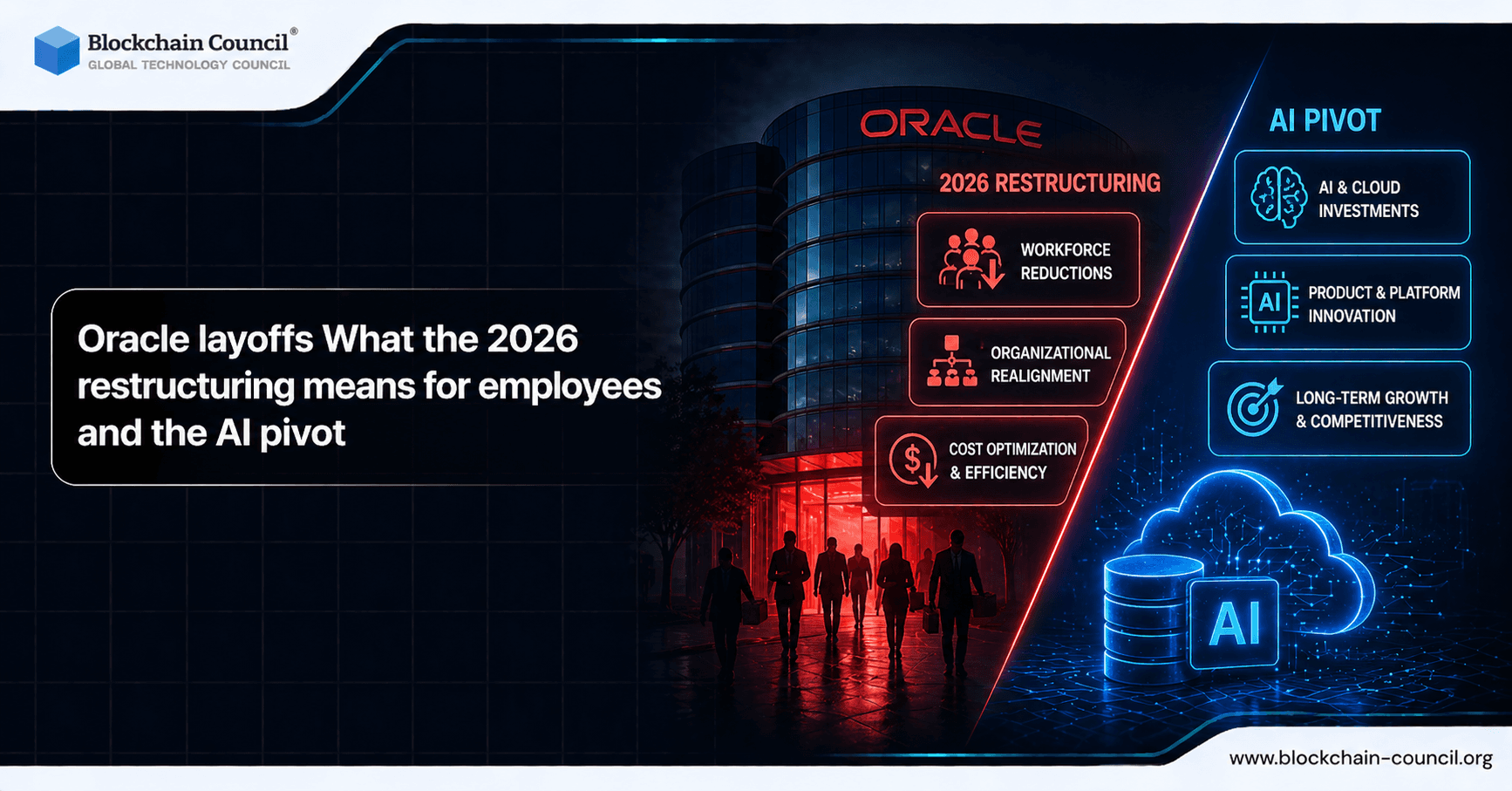
Oracle layoffs became a major technology industry story after Oracle began a large round of job cuts on March 31, 2026. Reports indicate thousands of employees globally received email notifications stating their roles were eliminated as part of a broader organizational change. The restructuring is widely framed as a cost-control measure while Oracle increases spending on AI infrastructure and data center capacity, including large-scale projects that require significant capital.
As AI continues to reshape workforce planning, technology investments, and enterprise operations, many professionals are pursuing an AI Certification to strengthen their understanding of AI systems, automation strategies, governance frameworks, and the business implications of large-scale AI adoption.

This article summarizes what is known so far, why it is happening, what it could mean for teams in engineering and cloud, and how professionals can respond in a market where AI investment and workforce reshaping are occurring simultaneously.
What we know about the Oracle layoffs (as of early April 2026)
According to multiple public accounts from impacted employees and reporting on the company's restructuring plans, Oracle initiated layoffs starting Tuesday, March 31, 2026. Employees received notifications by email indicating that their role had been eliminated due to current business needs and broader organizational change. In many cases, the notice specified the recipient's last working day.
Which roles were impacted?
Public posts and direct accounts suggest that impacted roles include positions in software engineering and cloud computing. Because Oracle operates across database products, enterprise applications, and cloud infrastructure, a global restructuring can affect both product and go-to-market functions, although the most visible reports have centered on technical roles.
How large is the layoff?
Early descriptions characterize the layoffs as affecting thousands of employees initially. Separate estimates cited by analysts and research coverage suggest a broader potential reduction in the range of 20,000 to 30,000 positions. Oracle reported approximately 162,000 full-time employees as of May 2025, so even mid-range estimates would represent a meaningful reshaping of the organization.
What costs has Oracle disclosed?
The restructuring is expected to incur up to $2.1 billion in fiscal 2026 costs, largely related to severance and associated expenses. This signals that the company is undertaking a significant program rather than isolated, small reductions.
Why Oracle is doing this: AI infrastructure spending meets cost discipline
The central narrative behind the Oracle layoffs is resource reallocation. Oracle is investing heavily in AI infrastructure and data centers, a capital-intensive shift that pressures margins if operating costs do not adjust accordingly.
AI infrastructure and data center expansion
AI workloads are driving a new kind of cloud demand, particularly for high-performance compute, storage, and networking. These deployments require major investments in data center buildouts and hardware capacity. Reporting around Oracle's recent financing activity points to the scale of these investments, including major debt issuance and involvement in large AI infrastructure initiatives.
Moving resources from legacy operations to AI-driven growth
For large software and cloud companies, the transition to AI is not only about adding new products. It also requires shifting spending away from lower-growth or mature areas. In practice, that can mean:
Reducing headcount in functions tied to slower-growing product lines
Consolidating overlapping teams after reorganizations
Redirecting budget toward infrastructure engineering, platform reliability, and AI-focused cloud services
Automation as a force multiplier in IT operations
Industry experts note that AI can automate parts of IT operations such as monitoring and provisioning, enabling leaner teams. However, this does not eliminate the need for human accountability. The operating model still requires people who understand risk, reliability, security, and governance. The challenge for IT leaders and CIOs is designing how humans and automation share responsibility, rather than treating headcount reduction as the entire strategy.
Market reaction: why layoffs can move the stock
Oracle's stock experienced notable volatility leading into late March 2026 amid broader concerns about AI-related competition and software sector sell-offs. Around the layoff news, the stock reportedly rallied in the low single digits, reflecting a common market pattern: investors often interpret headcount reduction as a sign of near-term cost control and operating margin protection, especially when paired with continued investment in growth areas like AI infrastructure.
However, stock movement does not resolve the underlying execution challenge. Oracle must balance:
Funding long-horizon AI infrastructure expansion
Maintaining reliability and customer support for current enterprise clients
Delivering competitive AI capabilities without disrupting core revenue streams
Oracle layoffs in India: what is confirmed and what is not
Search interest in oracle layoffs in India is high, but current reports do not provide specific, verified numbers or site-level details for India. The layoffs are described as global, which means Oracle's international operations could be affected, but it is important not to assume scope without confirmation.
How to evaluate India impact responsibly
If you are an Oracle employee or a professional tracking workforce changes in India, focus on verifiable signals:
Official Oracle communications to employees in-region
Local labor law filings or statutory disclosures where applicable
Role-based indicators, such as reductions in specific teams or hiring freezes
Recruiting patterns and internal mobility changes
How severance and notifications appear to be handled
Based on accounts tied to the initial wave, employees received mass email notifications indicating role elimination and last working day. Severance packages were described as contingent on signing termination paperwork, which is standard practice in large-company restructurings.
If you receive a notice, practical steps include:
Request written details about severance, benefits continuation, equity treatment, and rehire eligibility.
Clarify timelines for device returns, access cutoff, and final pay.
Review agreements carefully, especially clauses related to confidentiality, non-disparagement, and claims release.
Document accomplishments and capture work artifacts you are permitted to retain, such as sanitized project summaries.
Industry context: not an Oracle-only story
The Oracle layoffs are part of a broader wave of tech workforce reductions occurring alongside heavy AI spending. Several large technology companies have reduced headcount in recent periods while redirecting investment toward AI platforms, infrastructure, and model development. This reflects a structural shift: AI initiatives require both significant capital expenditure and the reprioritization of teams.
What this signals for the next 12 months
As AI infrastructure costs rise, many enterprises will continue reassessing headcount and operating models. Likely trends include:
More frequent reorganizations as AI products mature and platform teams consolidate
Higher demand for cloud and AI infrastructure skills, especially in reliability, security, data engineering, and cost optimization
Greater emphasis on measurable outcomes, such as latency, throughput, unit cost, and customer retention
What affected professionals can do next: skill alignment for an AI-first market
Layoffs are disruptive, but they also clarify which skills the market is rewarding. For professionals navigating the aftermath of Oracle layoffs, the most resilient approach is to align with the work companies are still funding: cloud infrastructure, AI deployment, security, and governance.
High-leverage skill areas to prioritize
Cloud architecture and operations: capacity planning, cost management, SRE practices
AI and data fundamentals: data pipelines, model deployment basics, monitoring and evaluation
Security: cloud security posture, identity and access management, threat modeling
Governance and compliance: risk controls for AI systems, audit readiness, data privacy
Certification paths worth considering
If you are formalizing skills for hiring pipelines, structured learning and credential validation can strengthen your profile. Relevant Blockchain Council certification options include programs such as Certified Artificial Intelligence (AI) Expert, Certified Cloud Security Expert, and Certified Data Science Expert, along with role-aligned cybersecurity certifications depending on your target domain. Pairing a certification with a portfolio of hands-on projects - architecture diagrams, cost models, incident postmortems, or deployment runbooks - can improve interview outcomes.
Many professionals also pursue a Tech Certification to strengthen their understanding of emerging technologies, cloud platforms, and enterprise systems, while a Marketing Certification can help develop communication, stakeholder management, and business strategy skills that are increasingly valuable in technical leadership roles.
Conclusion: what Oracle layoffs reveal about enterprise tech in 2026
The Oracle layoffs that began March 31, 2026 reflect an industry-wide reality: AI is reshaping spending priorities, and companies are making difficult trade-offs to fund data centers, compute, and AI-driven product roadmaps. Restructuring costs of up to $2.1 billion underscore the scale of the change, while early estimates suggesting tens of thousands of affected roles highlight how significant the shift could become.
For employees and job seekers, this moment signals where enterprise technology is heading. Roles closest to AI infrastructure, cloud efficiency, security, and governance are likely to remain strategically important. For those tracking Oracle layoffs in India, the most responsible approach is to rely on confirmed regional updates and official communications, as current reporting does not provide precise India-specific figures.
FAQs
1. What are the Oracle layoffs in 2026?
The Oracle layoffs in 2026 refer to workforce reductions as part of a broader restructuring strategy. The company is shifting focus toward AI and cloud services. This has impacted multiple roles and departments.
2. Why is Oracle restructuring its workforce in 2026?
Oracle is realigning its business to prioritize AI-driven products and cloud infrastructure. This requires different skill sets and resource allocation. Restructuring helps the company stay competitive.
3. Which departments are most affected by Oracle layoffs?
Roles in legacy systems, support functions, and non-core operations are more likely affected. Teams not aligned with AI and cloud priorities face higher risk. Impact varies by region and business unit.
4. How many employees are affected by the Oracle layoffs?
The exact number may vary depending on internal decisions and reporting. Layoffs typically affect a portion of the workforce rather than the entire company. Official statements provide the most accurate figures.
5. What is Oracle’s AI pivot in 2026?
Oracle is investing heavily in artificial intelligence, machine learning, and cloud-based AI services. The goal is to enhance enterprise solutions. This pivot aligns with broader industry trends.
6. How does the AI pivot impact Oracle employees?
Employees may need to reskill or transition to AI-related roles. Those in outdated roles may face layoffs. Training and internal mobility can help mitigate impact.
7. What skills are in demand at Oracle after the restructuring?
Skills in AI, machine learning, cloud computing, and data engineering are in high demand. Knowledge of automation and DevOps is also valuable. These align with Oracle’s future direction.
8. Are layoffs at Oracle permanent or temporary?
Layoffs are typically permanent role eliminations. However, some employees may be rehired for new roles. This depends on business needs and employee skills.
9. How can affected employees respond to Oracle layoffs?
Employees should update their skills, resume, and professional network. Exploring opportunities in AI and cloud sectors is beneficial. Career transition planning is important.
10. Does Oracle provide support for laid-off employees?
Companies often offer severance packages, career counseling, or job placement support. Specific benefits depend on location and employment terms. Employees should review official communications.
11. How does Oracle’s restructuring compare to other tech companies?
Many tech companies are restructuring to focus on AI and automation. Oracle’s actions reflect a broader industry shift. Similar trends are seen across major firms.
12. What does the restructuring mean for Oracle customers?
Customers may see improved AI-driven services and cloud solutions. However, short-term disruptions are possible. Long-term benefits include better technology offerings.
13. How does Oracle’s AI strategy affect its market position?
The AI pivot strengthens Oracle’s competitiveness in enterprise technology. It positions the company against other cloud and AI providers. This could drive future growth.
14. What roles are likely to grow at Oracle after layoffs?
Roles in AI engineering, data science, cloud architecture, and cybersecurity are expected to grow. These areas align with the company’s strategic focus. Demand for these skills will increase.
15. How can employees prepare for AI-driven changes in the workplace?
Employees should invest in learning AI, cloud, and automation technologies. Continuous learning is essential. Adapting to new tools improves job security.
16. What are the risks of Oracle’s restructuring strategy?
Risks include employee morale issues and potential loss of experienced talent. Rapid changes can disrupt operations. Execution quality will determine success.
17. How does restructuring impact company culture?
Layoffs can reduce morale and increase uncertainty among employees. Clear communication and support are important. Culture may shift toward innovation and agility.
18. What is the long-term outlook for Oracle after the layoffs?
The long-term outlook depends on the success of its AI and cloud strategy. If executed well, it could drive growth and innovation. Market response will be a key factor.
19. Are there opportunities for new hires at Oracle after restructuring?
Yes, new opportunities may arise in AI and cloud-related roles. Hiring often continues in strategic areas. Candidates with relevant skills have better chances.
20. What lessons can professionals learn from Oracle layoffs?
Professionals should stay adaptable and continuously update their skills. Industry trends like AI can reshape job markets quickly. Preparing for change is essential for career stability.
Related Articles
View All
News
Institutional Tokenized Asset Adoption Hits New Milestones in 2026
Institutional tokenized asset adoption is moving from pilots to production, led by tokenized treasuries, stablecoins, private credit, and real estate.

News
AI and Blockchain Integration in 2026: Enterprise Use Cases Moving Into Production
AI and blockchain integration in 2026 is moving into production across finance, supply chain, healthcare, identity, and decentralized AI infrastructure.

News
Bitcoin Miners Pivot to AI Infrastructure: Inside the Data Center Shift
Bitcoin miners are turning power-heavy mining sites into AI and HPC data centers as halving pressure and GPU compute demand reshape mining economics.
Trending Articles
The Role of Blockchain in Ethical AI Development
How blockchain technology is being used to promote transparency and accountability in artificial intelligence systems.

Top 5 DeFi Platforms
Explore the leading decentralized finance platforms and what makes each one unique in the evolving DeFi landscape.
How Blockchain Secures AI Data
Understand how blockchain technology is being applied to protect the integrity and security of AI training data.