

Web3 in War 2026: Decentralized Communications, Resilient Identity, and Censorship-Resistant Coordination

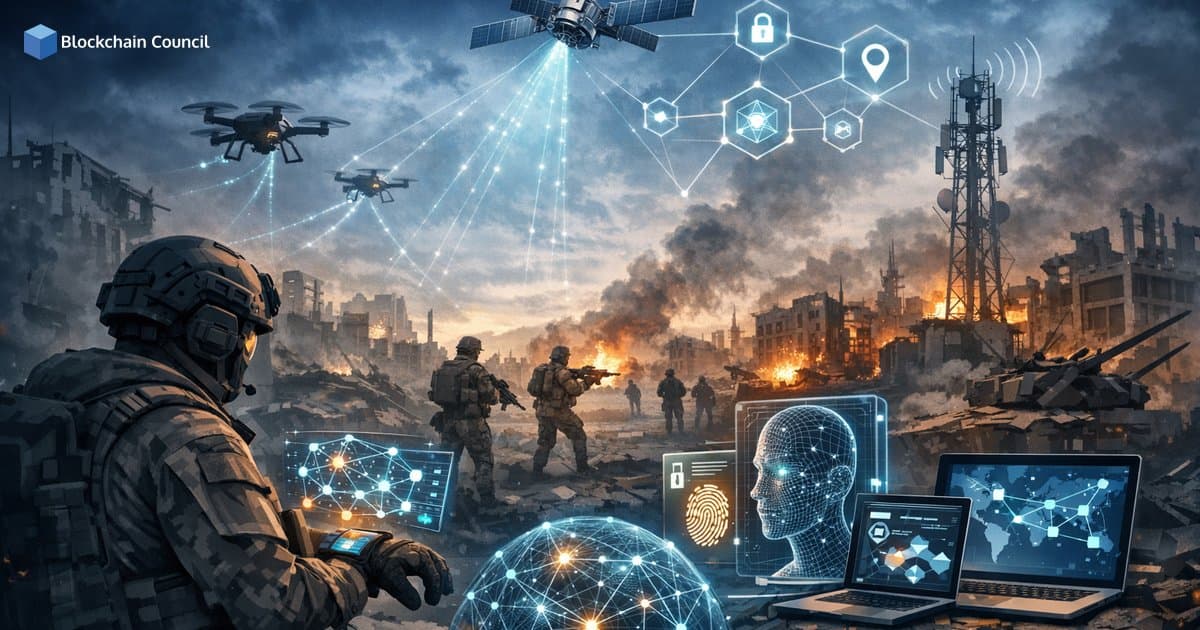
Web3 in war 2026 is no longer a theoretical discussion about speculative tokens. Decentralized systems are increasingly evaluated as resilient digital infrastructure for communications, identity continuity, and coordination when traditional systems are disrupted, censored, or weaponized. As contemporary conflicts blend kinetic operations with cyber attacks, disinformation, sanctions pressure, and infrastructure sabotage, decentralized architectures offer a concrete advantage: they can keep functioning when centralized points of control fail.
This article examines three pillars of Web3 in wartime contexts: decentralized communications, resilient identity, and censorship-resistant coordination. It also addresses the security risks and governance challenges that determine whether these tools improve safety or introduce new vulnerabilities.

Why Web3 Matters in Conflict Settings
Modern conflict involves more than battlefield outcomes. Civilian services, population registries, telecom backbones, financial rails, and media channels are now contested terrain. This creates demand for specific capabilities:
Communications that survive outages and censorship when centralized internet or telecom services are degraded.
Identity systems that remain usable if state registries are compromised, destroyed, or used for repression.
Coordination and funding mechanisms that are difficult to seize, freeze, or block across borders.
Research on Web 3.0 and digital governance frames Web3 as a structural shift in how value and governance are organized, with direct implications for security and conflict dynamics, including identity and ownership frameworks that can outlast institutional disruptions.
Web3 in 2026: Infrastructure Readiness, Not Experimentation
A critical factor for Web3 applicability in conflict is maturity. Recent analyses indicate that Web3 is increasingly deployed as foundational infrastructure across industries, supported by production-grade scaling, interoperability, and operational patterns that extend well beyond speculative use cases.
Scaling and Interoperability in Crisis Settings
Two 2026 developments are directly relevant to crisis environments:
Layer 2 scaling enables high-volume, low-cost activity, including micro-transactions and large-scale coordination with minimal fees.
Cross-chain interoperability and messaging reduce fragmentation and support data and asset movement across networks without relying on a single centralized bridge.
In conflict environments where bandwidth may be constrained and platforms can be disrupted, these improvements make on-chain workflows more practical for logistics, aid coordination, and transparent reporting.
AI, Oracles, and Smart Contracts as Operational Tools
Smart contracts are increasingly connected to real-world signals through decentralized oracle networks and may incorporate machine learning-driven decision logic. AI agents can interact with smart contracts using on-chain data as tamper-resistant input. This expands what automated coordination can accomplish during crises, while also raising legitimate concerns around autonomy, accountability, and governance.
Market Adoption Signals Sustained Commitment
The Web 3.0 blockchain market is projected to grow from approximately USD 9.2 billion in 2026 to USD 39.23 billion by 2030, reflecting expanding enterprise and institutional interest in resilient blockchain infrastructure. This trajectory indicates that the underlying technology is being built for durability, not just experimentation.
Decentralized Communications in Conflict
Communications are often the first target in war: towers are destroyed, ISPs face pressure to comply with censorship orders, and platforms are blocked. Decentralized communications aim to preserve messaging and connectivity through peer-to-peer and community-operated infrastructure that reduces dependence on any single operator.
Decentralized Telecom Networks and Community Infrastructure
Web3 is redefining connectivity through decentralized infrastructure ownership, blockchain-based billing, token incentives, and programmable governance. In these models, users and local operators can build and run parts of the network, earning rewards for contributing coverage or relay capacity. Smart contracts and DAO governance can automate revenue sharing, maintenance incentives, and service rules.
Helium: A decentralized wireless network where individuals deploy hotspots and earn tokens for providing coverage. Originally focused on IoT use cases, it has expanded into 5G and Wi-Fi in select regions.
Pollen Mobile and similar models: Community-driven 4G/5G infrastructure supported by token incentives and on-chain governance.
In wartime or contested zones, these models can provide alternative connectivity when centralized infrastructure is disabled and reduce reliance on a single operator that may be subject to censorship or surveillance mandates.
Physical and Security Limitations
Decentralized networks do not eliminate wartime risk. Key weaknesses include:
Physical vulnerability: hotspots, antennas, and power supplies can be kinetically targeted.
Privacy and encryption gaps: if traffic is not strongly protected, adversaries can monitor or disrupt participants.
Token and governance instability: incentive models can fail under extreme volatility or deliberate manipulation.
Privacy Communities as an Enabling Layer
Projects focused on censorship-resistant networking and privacy-preserving services continue to mature, supported by developer communities working on decentralized internet infrastructure. These efforts contribute building blocks for anonymous overlays, distributed services, and resilience primitives that can be adapted for humanitarian and crisis communications.
Resilient Identity: When Registries Become Targets
Identity systems can become a direct instrument of warfare. Population registries and property records can be destroyed, altered, or weaponized for surveillance and repression. Centralized databases create a single point of failure, and the damage can persist for decades into reconstruction.
Self-Sovereign Identity Principles in Wartime
Web3 identity approaches emphasize user control through cryptographic keys, decentralized verification, and selective disclosure. Under the self-sovereign identity (SSI) model, individuals hold credentials and prove attributes without relying on a single platform or registry. This design becomes critical when the institutions that normally manage identity cannot be trusted or accessed.
DIDs and Verifiable Credentials for Continuity
Decentralized identifiers (DIDs) and verifiable credentials, aligned with W3C standards, can be anchored on blockchains to provide tamper-evident resolution and cross-border verification. Practical applications include:
Refugee credential continuity: educational or professional records remain verifiable even if the issuing institution is disrupted or destroyed.
Privacy-preserving aid eligibility: humanitarian organizations can issue credentials that confirm status while limiting unnecessary personal data exposure.
Post-conflict restitution: property and entitlement records anchored on-chain support later dispute resolution when paper archives are lost.
Academic analysis of Web3 value and governance highlights how decentralized identity and ownership frameworks can restructure trust and verification in digital systems, which becomes especially significant when institutions are under sustained stress.
Censorship-Resistant Coordination and Financing
Coordination under sanctions, capital controls, or platform blocking requires systems that function across borders with minimal reliance on centralized intermediaries. Web3 provides coordination primitives applicable to legitimate humanitarian support, though the same tools carry risks of misuse for illicit financing or influence operations.
Key Primitives: Smart Contracts, DAOs, and DeFi
Smart contracts: enforce rules and automate workflows without a central administrator.
DAOs: on-chain governance structures that can allocate resources transparently and with an auditable record.
DeFi: decentralized financial tools that support exchange, lending, and treasury management without traditional banking infrastructure.
Enterprise analysis shows Web3 is increasingly used for real operational revenue and coordination across domains such as logistics and insurance, indicating that these mechanisms can be adapted for crisis operations when governed carefully.
Operational Smart Contracts with Oracles
Oracle networks deliver real-world inputs to contracts, enabling conditional execution when specified conditions are met. In conflict or disaster response, this can support:
Conditional fund release when multiple independent sources confirm delivery of aid.
Tokenized bounties for verified repair work, validated reporting, or confirmed security improvements.
Transparent procurement where milestones and payments are auditable by authorized stakeholders.
The tradeoff is that oracle manipulation or unreliable data sources can cause contracts to execute incorrectly at the worst possible moment. Governance design and redundancy are not optional in high-stakes deployments.
DAO Governance in War and Reconstruction
DAOs can be geographically dispersed and produce auditable on-chain records, which can help diaspora communities coordinate reconstruction funds or manage community-owned infrastructure such as decentralized telecom networks. However, DAOs face documented challenges:
Governance attacks such as vote buying or token concentration by hostile actors.
Legal uncertainty and potential classification risks in certain jurisdictions.
Operational security challenges when participants are individually targeted or under surveillance.
Security and Privacy: Resilience vs. Observability
Web3 systems reduce single points of failure and create tamper-evident audit trails replicated across many nodes. These properties are genuinely valuable in conflict settings. At the same time, public ledgers are inherently transparent, and in wartime that transparency can become a liability:
Transaction graph analysis can deanonymize participants when combined with off-chain intelligence gathering.
Gateway pressure on exchanges, stablecoin issuers, and infrastructure providers can reduce censorship resistance for mainstream users.
Smart contract and oracle vulnerabilities can produce catastrophic, irreversible failures at scale.
Zero-knowledge proofs and other privacy-enhancing technologies have matured significantly through 2025 and 2026, but deploying them correctly remains a specialized engineering and governance challenge that requires deliberate investment.
Practical Patterns for Web3 in Conflict Contexts
Based on the 2024-2026 development trajectory, several application patterns are becoming clearer:
Decentralized connectivity as a contingency layer: community-built networks can supplement damaged telecom infrastructure, particularly in underserved or contested areas.
Identity continuity for displaced populations: DIDs and verifiable credentials can preserve education, work, and entitlement records when institutions fail or are deliberately targeted.
Transparent, rule-based aid allocation: smart contracts can enforce allocation policies while audit trails support accountability to donors and affected communities.
Evidence anchoring and documentation: tamper-evident timestamps and replicated records can support later verification and legal proceedings, provided privacy and participant safety are addressed in the design.
Programmable logistics and insurance: oracle-driven contracts can automate milestone verification and payouts in supply chains, though oracle trust and data quality remain constraints.
Skills and Governance: What Professionals Should Prioritize
For developers, security teams, and policy stakeholders working on crisis resilience, the most important competencies are engineering and governance capabilities rather than token mechanics:
Threat modeling for public ledgers: privacy analysis, metadata leakage, and operational security under adversarial conditions.
Smart contract security: audits, formal verification where appropriate, and incident response planning.
Identity architecture: DID and verifiable credential lifecycle management, key recovery, selective disclosure, and cross-border interoperability.
Interoperability design: cross-chain messaging assumptions, failure modes, and governance of protocol upgrades.
Professionals looking to build validated expertise in these areas can explore Blockchain Council programs such as the Certified Blockchain Expert, Certified Smart Contract Developer, Certified Web3 Professional, and Certified Blockchain Security Expert tracks, which cover the technical and governance foundations relevant to resilience and compliance planning.
Conclusion: Web3 in War 2026 Is About Survivability
Web3 in war 2026 is best understood as a set of design properties that keep essential functions running under stress: decentralized communications when networks are censored or destroyed, resilient identity when registries are compromised, and censorship-resistant coordination when traditional financial rails are blocked. The same properties that provide resilience also introduce distinct dangers, including ledger-based surveillance, smart contract exploits, oracle manipulation, and governance capture by hostile actors.
In 2026, the central question is not whether Web3 can be applied in conflict settings - it already is. The question is whether practitioners can deploy it with rigorous security engineering, privacy-preserving design, and governance models that reduce harm while improving continuity for civilians, responders, and institutions under pressure.
Related Articles
View All
News
Why Enterprise Blockchain Adoption Is Outpacing Retail Web3 Innovation in 2026
Enterprise blockchain adoption is beating retail Web3 in 2026 as regulated institutions scale tokenization, CBDCs, payments, and supply chain use cases.

News
Institutional Tokenized Asset Adoption Hits New Milestones in 2026
Institutional tokenized asset adoption is moving from pilots to production, led by tokenized treasuries, stablecoins, private credit, and real estate.

News
AI and Blockchain Integration in 2026: Enterprise Use Cases Moving Into Production
AI and blockchain integration in 2026 is moving into production across finance, supply chain, healthcare, identity, and decentralized AI infrastructure.
Trending Articles
AWS Career Roadmap
A step-by-step guide to building a successful career in Amazon Web Services cloud computing.

Top 5 DeFi Platforms
Explore the leading decentralized finance platforms and what makes each one unique in the evolving DeFi landscape.
What is AWS? A Beginner's Guide to Cloud Computing
Everything you need to know about Amazon Web Services, cloud computing fundamentals, and career opportunities.