

Bitcoin Miners Pivot to AI Infrastructure: Inside the Data Center Shift
 Suyash Raizada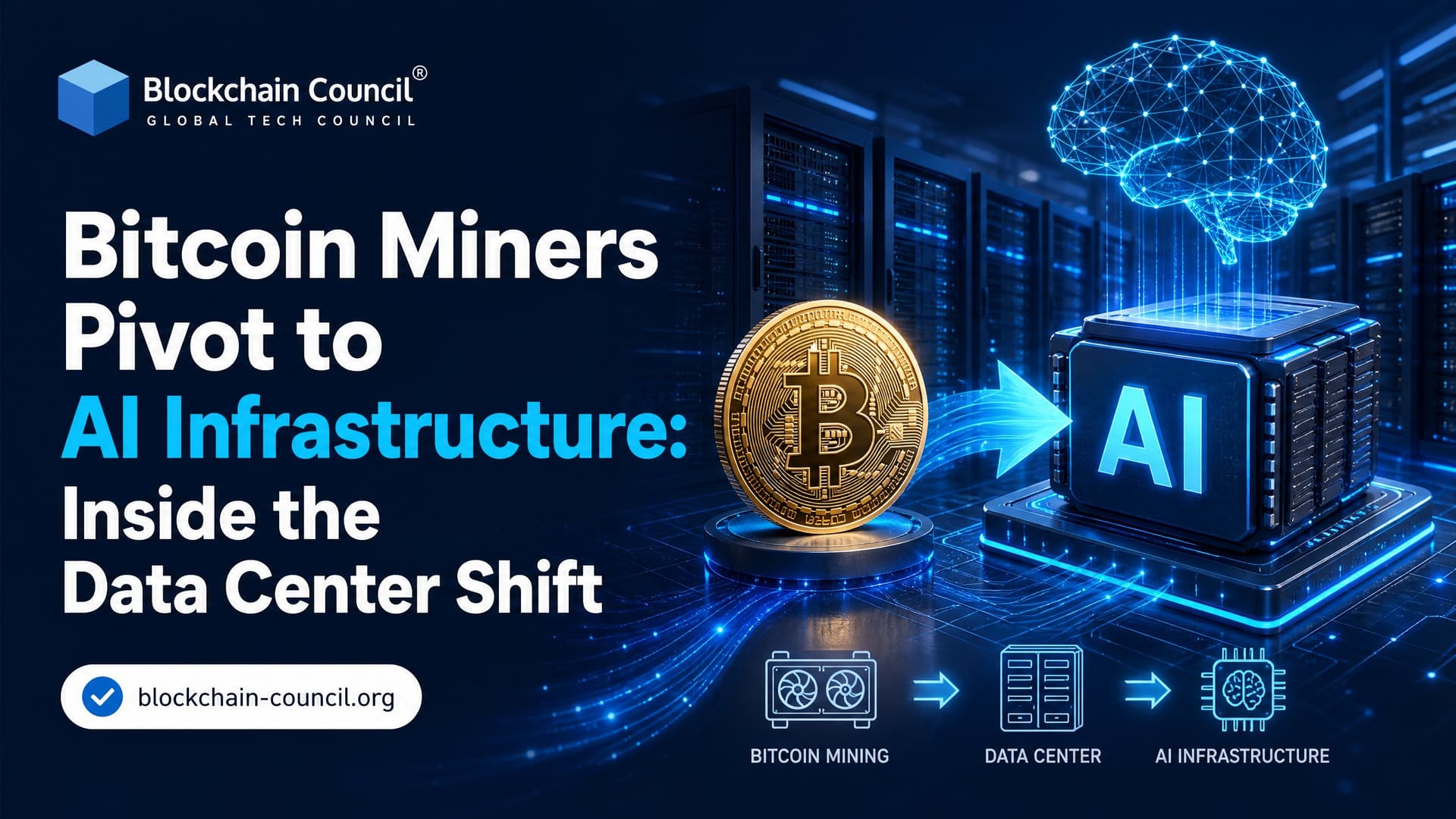
Bitcoin miners pivot to AI infrastructure because the economics have changed. After the 2024 Bitcoin halving cut the block subsidy from 6.25 BTC to 3.125 BTC, mining firms started looking at their biggest assets differently: power contracts, land, substations, cooling layouts, and operating teams. Those assets can now support GPU-based AI and high performance computing workloads that may earn several times more revenue per megawatt than Bitcoin hashing.
This is not a branding exercise. Public miners such as Bitdeer, TeraWulf, Riot, Cipher Mining, Iris Energy, Hut 8, and Core Scientific have announced AI or HPC strategies. Industry reports now estimate tens of billions of dollars in AI data center contracts across the sector, with some forecasts suggesting AI and HPC could make up as much as 70 percent of listed miners' revenue by the end of 2026.

As Bitcoin mining evolves into a broader compute infrastructure business, professionals need a solid understanding of mining economics, ASIC hardware, power markets, and blockchain networks. A Certified Bitcoin Mining Expert credential helps build practical expertise in these areas, making it easier to evaluate how mining companies are adapting to changing market conditions.
Why Bitcoin Mining Economics Forced a Rethink
Bitcoin mining has always been a power business with a crypto revenue line. The problem is that revenue can move sharply while energy costs, debt payments, and machine depreciation do not wait.
The April 2024 halving reduced new Bitcoin issuance per block by 50 percent. At the same time, network difficulty and global hashrate kept climbing. That means miners needed more efficient ASIC fleets, lower power prices, or a higher Bitcoin price just to hold their margins.
For operators paying higher electricity rates, the squeeze was immediate. Hashprice, the expected dollar revenue per unit of hashrate, became harder to defend. Debt-heavy firms had less room to wait out the cycle. AI compute offered a different proposition: fixed dollar-denominated contracts, longer customer commitments, and demand from enterprises that are not tied to Bitcoin's price chart.
AI Infrastructure Pays Differently Per Megawatt
The central reason Bitcoin miners pivot to AI infrastructure is simple. Megawatts can be more valuable when pointed at GPUs than ASICs.
HIVE Digital Technologies has estimated that 10 MW of Nvidia H100 GPUs can produce revenue comparable to 100 MW of Bitcoin mining. Iris Energy has reported that a relatively small Nvidia GPU deployment grew into roughly 10 percent of corporate earnings and delivered a 3 to 4 times economic uplift versus self-mining on equivalent power.
That does not mean every mining site should become an AI data center. To be blunt, many sites are not suitable. A remote mining shed with cheap power but weak fiber, limited redundancy, and poor physical security is fine for SHA-256 hashing. It is not fine for an enterprise customer training models on expensive H100 clusters.
Successfully operating AI infrastructure also requires expertise in machine learning, AI workloads, model deployment, GPU computing, and enterprise AI governance. A Certified Artificial Intelligence (AI) Expert credential helps professionals develop these skills, enabling them to better understand the technical and business requirements of large-scale AI infrastructure.
From ASIC Farms to GPU Data Centers
Bitcoin ASICs are single-purpose machines. They calculate SHA-256 hashes and have almost no use outside Bitcoin mining. AI workloads need GPUs such as Nvidia A100s, H100s, and newer accelerators, plus high-bandwidth networking, storage, orchestration software, and tighter uptime guarantees.
This is where the hard work starts.
Power and Redundancy
Mining farms are built for high power draw, but many are not built for cloud-grade service levels. AI clients expect redundancy, uninterruptible power systems, stronger monitoring, and predictable maintenance windows. A Bitcoin miner can curtail machines during grid stress. A customer running inference for a production application may not accept that kind of interruption.
Cooling and Rack Density
ASICs tolerate harsher conditions than GPU clusters. H100-class deployments need controlled airflow, hot aisle and cold aisle containment, and in many high-density builds, liquid cooling. Small mistakes show up fast. Anyone who has commissioned GPU clusters has hit problems that never appear in a mining container, such as NCCL WARN NET/IB : No device found when InfiniBand drivers or fabric settings are wrong. The machine is powered. The GPUs are visible. Training still fails.
Networking and Storage
AI training is not just compute. Clusters need low-latency interconnects such as InfiniBand or high-performance Ethernet fabrics. They also need storage systems that can feed data fast enough to keep GPUs busy. A Bitcoin ASIC does not care about east-west network traffic. A multi-node training job does.
Major Company Moves Show the Pivot Is Real
The strongest signal is capital allocation. Core Scientific signed a multi-billion dollar agreement to operate AI-focused data centers, marking one of the clearest shifts from pure mining to contracted compute infrastructure. Bitdeer has reported AI cloud revenue and targets that point toward hundreds of megawatts of AI capacity. Hut 8 has also been repositioning parts of its infrastructure from ASIC mining fleets toward GPU-based services.
CoreWeave is a useful comparison, even though it is not best described today as a Bitcoin miner. Its path from crypto-linked GPU operations to specialist AI cloud infrastructure helped show investors what a successful compute transition can look like. Its large OpenAI compute deal, reported at 11.9 billion dollars over five years, gave the broader market a reference point for how valuable GPU capacity can become when demand is strong.
Investors have noticed. A mid-2024 analysis of 14 major mining companies found their combined market capitalization rose about 22 percent, or roughly 4 billion dollars, after AI pivot announcements gained traction. The message was clear. The market is placing a premium on miners that can cut pure Bitcoin exposure.
What This Means for the Bitcoin Network
The pivot has mixed effects on Bitcoin itself.
On one hand, if miners lock power into multi-year AI hosting contracts, that power cannot instantly return to Bitcoin mining during a bull market. This could reduce flexible hashrate and slow how quickly the network expands in periods of high mining profitability.
On the other hand, diversified miners may be more resilient. Schwab research has argued that AI and HPC revenue can reduce structural risk because operators are less likely to become forced sellers during downturns. A miner with contracted AI income may keep staff, maintain sites, and avoid distress even when hashprice weakens.
So the better framing is not abandonment. It is professionalization. Many miners are becoming energy-anchored compute operators, with Bitcoin mining and AI hosting as two revenue lines competing for power.
Risks Behind the AI Data Center Boom
The AI pivot is promising, but it is not risk-free.
Capex risk: Upgrading a mining site into a Tier 3 style data center is expensive. Power distribution, cooling, security, and networking all require serious capital.
GPU supply risk: AI infrastructure depends on semiconductor availability, vendor pricing, and deployment lead times.
Customer concentration: Large AI contracts can stabilize revenue, but a small number of hyperscaler or enterprise customers can create negotiation risk.
Energy regulation: Communities and utilities that questioned Bitcoin mining power use may scrutinize AI data centers just as closely.
AI demand risk: If compute pricing falls later in the decade, highly leveraged GPU projects could face margin pressure.
The wrong move is to assume every mining campus automatically becomes valuable AI infrastructure. The right sites have cheap power, grid access, fiber, permits, expansion room, and management teams that understand uptime. Miss one of those, and the spreadsheet gets ugly fast.
Beyond blockchain and AI expertise, organizations also benefit from capabilities in cloud infrastructure, cybersecurity, networking, enterprise architecture, and data center operations. A Tech Certification helps professionals strengthen these complementary technical skills, supporting the reliable deployment and management of high-performance computing and AI infrastructure.
Career and Enterprise Takeaways
For professionals, this shift creates a new skill market at the intersection of blockchain, AI, energy, and data center operations. You do not need to be only a Solidity developer or only a machine learning engineer. The useful people now understand how compute economics work across systems.
If you are building a career around this trend, focus on:
Bitcoin mining economics, including hashprice, difficulty adjustment, and halving cycles.
GPU infrastructure basics, including CUDA, cluster networking, cooling, and workload scheduling.
Energy procurement, demand response, and power purchase agreements.
Cloud contract structures for AI training, inference, and HPC hosting.
Security and compliance expectations for enterprise data center customers.
For internal learning paths, Blockchain Council readers may pair Certified Bitcoin Expert™ with Certified Artificial Intelligence (AI) Expert™ to understand both sides of the transition. Professionals working on broader architecture or enterprise strategy can also consider Certified Blockchain Expert™ as a foundation for blockchain business models and decentralized infrastructure.
Where the Miner-to-Data-Center Shift Goes Next
By 2027, analysts expect roughly 20 percent of Bitcoin miner power capacity may be dedicated to AI workloads. By 2030, AI inference could account for more than half of total data center demand, according to Schwab's infrastructure outlook. If those forecasts hold, former mining firms will not be minor players. They will own part of the physical layer behind AI adoption.
Still, the best operators will keep optionality. Bitcoin bull markets can make hashing attractive again. AI contracts can create steady cash flow. HPC can fill capacity between major training demand cycles. The winners will not be the loudest companies. They will be the ones that price power correctly, build real data center reliability, and avoid over-borrowing against a single market story.
Your next step: study one public miner's latest earnings report and separate Bitcoin revenue from AI or HPC revenue. Then map the infrastructure behind each line item. That exercise will teach you more than any headline about the future of mining.
As AI infrastructure services become a growing business opportunity, organizations also need professionals who can effectively communicate the value of AI hosting, blockchain infrastructure, and enterprise technology solutions to customers and stakeholders. A Marketing Certification helps develop expertise in strategic communication, product positioning, customer engagement, and go-to-market planning, complementing technical knowledge of AI and blockchain infrastructure.
FAQs
1. Why are Bitcoin miners shifting toward AI infrastructure?
Many Bitcoin mining companies are exploring AI infrastructure to diversify their business models and make better use of existing power capacity, land, and data center facilities. Growing enterprise demand for AI computing has created new opportunities beyond cryptocurrency mining, although the required investments and technical capabilities differ significantly.
2. What is AI infrastructure?
AI infrastructure consists of the hardware, software, networking, storage, cooling systems, and power resources needed to train and deploy artificial intelligence models. It typically includes GPU clusters, high-speed interconnects, cloud platforms, and advanced data center management technologies.
3. Why is AI infrastructure demand growing in 2026?
The rapid adoption of generative AI, large language models, enterprise automation, scientific computing, and AI-powered applications has significantly increased global demand for high-performance computing (HPC). Organizations across industries are investing in scalable AI infrastructure to support expanding workloads.
4. How are Bitcoin mining facilities similar to AI data centers?
Both require reliable electricity, large physical facilities, cooling systems, network connectivity, and operational expertise in managing high-density computing environments. However, AI data centers typically require more sophisticated networking, GPU hardware, storage architecture, and enterprise-grade service capabilities.
5. Can Bitcoin mining hardware be used for AI?
Generally, no. Bitcoin mining primarily relies on application-specific integrated circuits (ASICs) optimized for blockchain mining, while AI workloads require GPUs or specialized AI accelerators designed for machine learning and high-performance computing tasks.
6. Why do mining companies have an advantage in AI expansion?
Many mining operators already possess valuable infrastructure, including access to large-scale power, cooling systems, industrial facilities, and experienced operations teams. These existing assets may reduce some development barriers, although substantial upgrades are often necessary for enterprise AI services.
7. How does energy availability influence this transition?
Power availability is one of the most critical factors for both cryptocurrency mining and AI computing. Companies with long-term electricity agreements, renewable energy sources, or scalable energy infrastructure may be better positioned to support expanding AI workloads.
8. What role do GPUs play in AI infrastructure?
Graphics Processing Units (GPUs) perform the parallel computing tasks required for training and running modern AI models. They have become essential components of AI data centers because they can efficiently process the large computational workloads used in machine learning.
9. How are AI data centers different from traditional cloud data centers?
While both provide computing resources, AI data centers are specifically optimized for intensive machine learning workloads using specialized hardware, high-speed networking, advanced cooling, and software designed for distributed AI model training and inference.
10. Which industries use AI infrastructure?
Healthcare, financial services, manufacturing, automotive, biotechnology, retail, telecommunications, education, cybersecurity, media, scientific research, and government organizations all rely increasingly on AI infrastructure to support advanced computing applications.
11. How can AI improve Bitcoin mining operations?
AI can help optimize energy consumption, predict equipment failures, automate maintenance scheduling, improve cooling efficiency, enhance cybersecurity, analyze operational data, and support more efficient infrastructure management.
12. What challenges do mining companies face when entering AI markets?
Organizations may encounter challenges including significant capital investment, GPU procurement, enterprise customer acquisition, networking upgrades, software integration, specialized workforce requirements, cybersecurity expectations, and competition from established cloud providers.
13. What role does sustainability play in AI infrastructure?
Energy efficiency, renewable power, advanced cooling technologies, waste heat recovery, water conservation, and carbon management are becoming increasingly important considerations for AI infrastructure operators and enterprise customers.
14. Could AI infrastructure reduce dependence on Bitcoin prices?
Diversifying into AI services may provide additional revenue opportunities that are less directly tied to cryptocurrency market cycles. However, the financial success of diversification depends on customer demand, operational execution, market competition, and infrastructure utilization.
15. How are financial markets responding to this trend?
Investors are closely monitoring mining companies that announce AI infrastructure initiatives, evaluating their ability to execute long-term diversification strategies. Market performance depends on numerous factors and should not be interpreted as evidence of future investment returns.
16. What skills are valuable for professionals working in AI infrastructure?
Relevant skills include cloud computing, GPU cluster management, networking, cybersecurity, AI and machine learning, data center operations, electrical engineering, DevOps, infrastructure automation, and enterprise IT architecture.
17. What regulations may affect AI infrastructure providers?
Depending on the jurisdiction, providers may need to comply with cybersecurity requirements, environmental regulations, data protection laws, energy policies, privacy rules, export controls, and industry-specific standards for enterprise computing services.
18. What trends are shaping AI infrastructure in 2026?
Major trends include liquid cooling, AI-specific chips, energy-efficient computing, AI cloud services, high-performance networking, sovereign AI infrastructure, enterprise AI platforms, automation, and increasing collaboration between technology companies and digital infrastructure providers.
19. Does entering AI infrastructure guarantee better financial performance for miners?
No. While AI infrastructure may offer new business opportunities, success depends on capital allocation, customer demand, operational efficiency, competition, technology adoption, financing, and broader economic conditions. Diversification reduces concentration risk but does not eliminate business risk.
20. What is the long-term outlook for Bitcoin miners entering AI infrastructure?
The convergence of cryptocurrency mining and AI infrastructure reflects a broader shift toward maximizing the value of large-scale computing and energy assets. Companies that successfully modernize facilities, develop enterprise capabilities, maintain strong cybersecurity, and adapt to evolving technology markets may be better positioned for long-term growth across multiple digital infrastructure sectors. Sometimes the biggest upgrade is realizing your data center can do more than solve one very specific math problem all day.
Related Articles
View All
News
Bitcoin Miners Pivot to AI Data Centers: A New Revenue Model for Crypto Infrastructure
Bitcoin miners are converting power-rich mining sites into AI and HPC data centers, creating stable contracts and a new crypto infrastructure model.

News
CleanSpark AI Data Center Deal: What $6.6 Billion Means for Bitcoin Mining and AI Infrastructure
CleanSpark's $6.6 billion AI data center lease signals a major shift in bitcoin mining economics and AI infrastructure supply.

News
CleanSpark AI Data Center Agreement: $6.6B Lease Signals a Major Miner Pivot
CleanSpark's $6.6B AI data center lease in Georgia signals a major shift from bitcoin mining toward long-term AI and HPC infrastructure revenue.
Trending Articles
The Role of Blockchain in Ethical AI Development
How blockchain technology is being used to promote transparency and accountability in artificial intelligence systems.

Top 5 DeFi Platforms
Explore the leading decentralized finance platforms and what makes each one unique in the evolving DeFi landscape.
What is AWS? A Beginner's Guide to Cloud Computing
Everything you need to know about Amazon Web Services, cloud computing fundamentals, and career opportunities.