

AI and Blockchain Integration in Enterprises: Real-World Use Cases Driving Adoption
 Suyash Raizada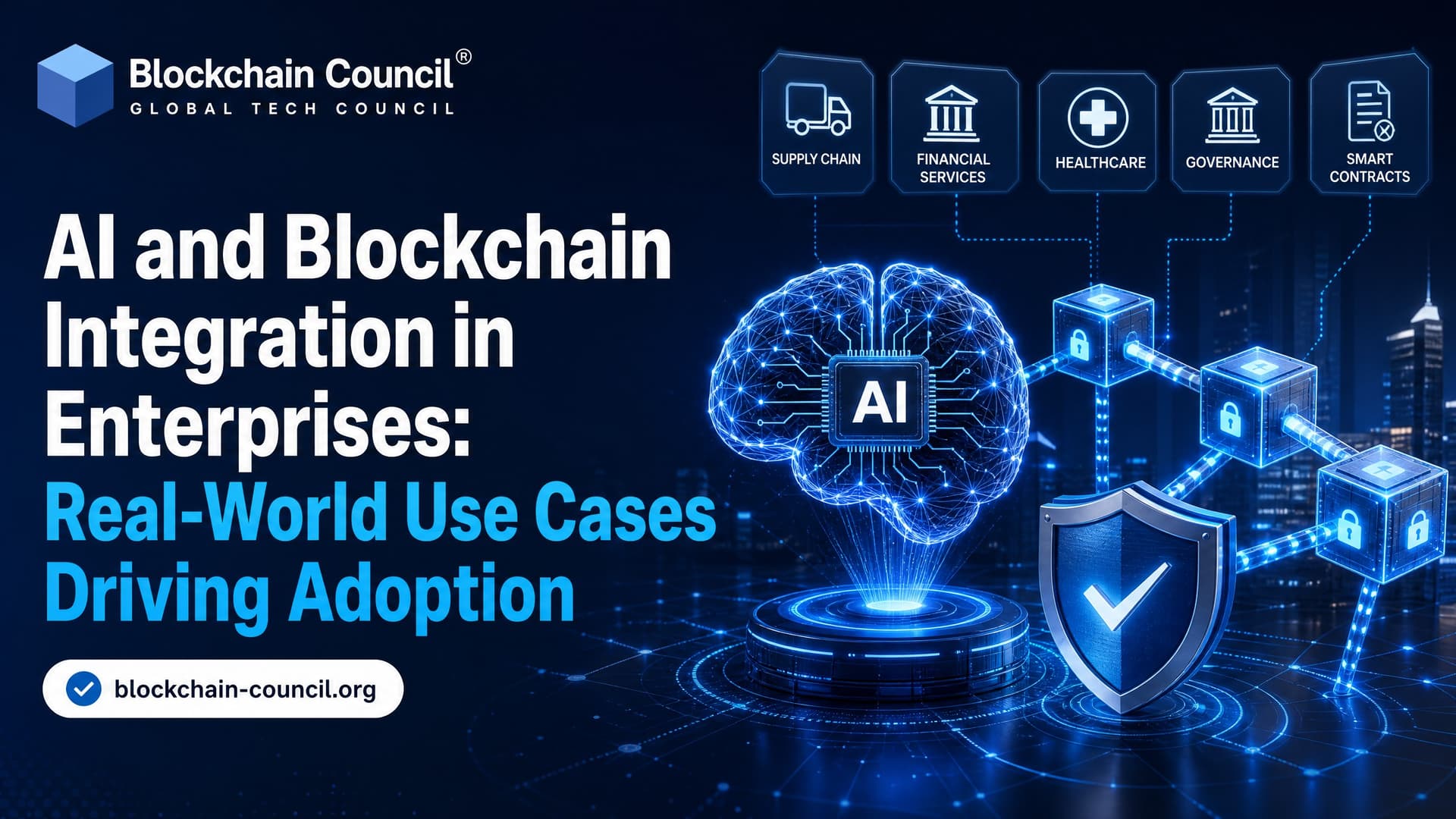
AI and blockchain integration in enterprises is no longer a lab exercise. Companies run it across supply chains, finance, healthcare, identity, energy, and compliance, wherever trusted data and automated decisions carry direct business value. The pattern is simple. AI finds signals, predicts outcomes, and automates workflows. Blockchain records who did what, when it happened, and whether the data was changed.
That combination matters because enterprise AI has a trust problem. A model is only as good as the data behind it. Blockchain does not turn bad data into good data, but it can make data provenance, approvals, access rights, and transaction history much harder to fake. For regulated teams, that is often the difference between a clever demo and a system that passes audit.

As enterprises increasingly combine AI with blockchain technologies, professionals need practical knowledge of machine learning, AI governance, intelligent automation, and enterprise AI deployment. A Certified Artificial Intelligence (AI) Expert credential helps build these capabilities, enabling organizations to implement AI solutions that are scalable, secure, and aligned with business objectives.
Why Enterprises Are Combining AI and Blockchain
AI and blockchain solve different problems. AI is probabilistic. It classifies, predicts, summarizes, and recommends. Blockchain is deterministic. A smart contract either executes or it does not. A transaction is either final under network rules or it is not.
That contrast is useful in production systems:
AI improves decisions: forecasting demand, flagging fraud, scoring risk, detecting anomalies, and reading documents at scale.
Blockchain improves accountability: recording transactions, data access, consent, identity attestations, supply chain events, and model outputs.
Smart contracts reduce manual handoffs: payments, purchase orders, insurance payouts, and approvals can fire when trusted conditions are met.
Oracles connect off-chain data: weather, prices, sensor readings, shipping data, and inspection results can feed smart contracts once verified.
One practical warning. Do not try to run large AI models directly inside an Ethereum Virtual Machine smart contract. It is the wrong place. Gas costs, deterministic execution, and block limits make that approach impractical. In real systems, AI runs off-chain, then a signed result, hash, proof, or oracle message is written on-chain. If you have tested this in Hardhat or Foundry, you have probably hit errors like ProviderError: nonce too low during repeated deployments, or watched a transaction fail because a contract call tried to do too much work on-chain. Keep computation off-chain. Put verification and settlement on-chain.
Supply Chain: Traceability, Forecasting, and Fraud Reduction
Supply chain is one of the clearest use cases here. Goods pass through farms, factories, ports, warehouses, retailers, and regulators. Every handoff creates room for delay, loss, counterfeiting, or paperwork disputes.
Food Traceability and Recall Response
Walmart and IBM Food Trust are often cited because the operational problem is easy to understand. Food traceability that once took roughly seven days was cut to seconds, with one reported case narrowing the trace time to 2.2 seconds. Blockchain records the movement of goods through the chain, while AI analyzes expiry risk, demand patterns, and contamination signals.
Some case studies point to food waste reductions of around 20 percent when AI-driven expiry predictions are combined with blockchain-based tracking. Treat that as directional, not a universal benchmark. Waste reduction depends heavily on product type, sensor quality, data capture discipline, and supplier participation.
Anti-Counterfeit and Provenance
Luxury goods, pharmaceuticals, seafood, timber, coffee, and minerals all face provenance issues. Bext360, for example, has applied AI and blockchain in supply chains covering coffee, seafood, timber, and minerals. AI can evaluate product quality or sustainability indicators. Blockchain records provenance claims and transactions so buyers and auditors get a tamper-evident trail.
This is where blockchain helps but is not magic. If a supplier enters false data at the source, the chain preserves the lie. Enterprises still need physical controls: QR tags, tamper-resistant packaging, IoT sensors, independent inspections, and supplier audits.
Successfully deploying blockchain-powered enterprise solutions also requires a solid understanding of distributed ledger technology, smart contracts, governance frameworks, and blockchain architecture. A Certified Blockchain Expert credential helps professionals develop these skills, providing valuable insight into designing secure, transparent, and compliant blockchain ecosystems.
Financial Services: Fraud Detection, Risk, and Tokenized Assets
Banks and fintech firms already use AI for fraud detection, credit scoring, trade surveillance, and customer onboarding. Blockchain adds a transaction record that supports auditability and reduces manipulation.
Industry reports through 2025 point to supply chain and finance as two areas where AI-blockchain deployments deliver measurable cost and fraud benefits. A Gartner analysis cited in industry coverage reported logistics cost reductions of up to 23 percent and fraud reductions of 30 percent in supply chain settings using AI plus blockchain. Do not copy those figures into a business case without local validation, but they explain why board-level interest has climbed.
Document Review and Loan Controls
J.P. Morgan's COiN platform is a useful reference point for AI-assisted legal document review. Reported analyses say it cut manual review time by roughly 90 percent. Some reports also connect blockchain-backed records with better traceability and fewer fraudulent loan approvals. The lesson is not that every bank needs the same platform. It is that AI document extraction becomes far more valuable when document versions, approvals, and exceptions are recorded in a verifiable system.
AI-Backed Smart Contracts
Smart contracts can automate credit workflows, trade finance, insurance claims, purchase orders, and derivatives settlement when the input data is trusted. AI can score risk or detect anomalies. Blockchain can record the final decision and execute agreed rules.
For developers, the hard part is not writing an ERC-20 or ERC-721 contract. It is designing the off-chain workflow: oracle trust, model versioning, fallback rules, key management, and dispute handling. If the AI model changes silently, your audit trail must still show which model version influenced which transaction.
Healthcare: Privacy-Preserving Data Sharing and AI Diagnostics
Healthcare has a strong case for AI and blockchain, and higher stakes. Patient data is sensitive. Models need large datasets. Regulators expect access controls, consent records, and data minimization.
Platforms such as Medicalchain and BurstIQ have been discussed for blockchain-based health record control, where patients grant access to encrypted records. AI systems can then analyze anonymized or permissioned datasets for diagnostics, population health, or clinical research.
Ocean Protocol is another example often cited in decentralized data sharing. It uses blockchain mechanisms to manage data access, usage conditions, and payments. For AI teams, this matters because training data rights are now a governance issue, not just a storage issue. If you cannot show where data came from, who approved it, and how it was used, your model risk process is incomplete.
Identity, KYC, and Access Control
Identity is a natural fit. AI checks documents, detects liveness, compares faces, and spots suspicious behavior. Blockchain stores verifiable credentials, attestations, and proof that an onboarding event happened.
In fintech, telecom, and government services, this can cut repeated KYC checks while still giving regulators an audit trail. A user should not have to upload the same passport scan to ten different firms. A verifiable credential can confirm that a trusted party has checked the person, while AI keeps monitoring for account takeover, synthetic identity patterns, or unusual access attempts.
Be careful with biometrics. Once a faceprint or fingerprint template leaks, the user cannot rotate it like a password. Store only what is necessary, encrypt aggressively, and consider zero-knowledge proof patterns where they fit the workflow.
Data, AI Infrastructure, and Oracles
Enterprise AI needs data, compute, and governance. Blockchain can coordinate access, payments, consent, and audit records across organizations that do not fully trust each other.
AI-Enhanced Oracles
Oracle networks such as Chainlink discuss AI-enhanced smart contracts where off-chain systems process real-world data and deliver refined signals to blockchains. This applies to parametric insurance, DeFi risk controls, logistics automation, weather-based contracts, and industrial IoT.
A practical example: an insurer can use AI to process weather and satellite data, then an oracle submits a signed event to a smart contract that triggers a payout. The blockchain does not decide whether the crop failed. It records and executes the agreed payout rule after the trusted data process produces a result.
Decentralized AI Marketplaces
Data marketplaces and decentralized compute networks are another emerging enterprise pattern. Blockchain records access rights and payments. AI teams train or run models against distributed datasets or GPU capacity. This is promising, but it is not a shortcut around data quality, privacy law, or model evaluation.
Cybersecurity, Compliance, and Content Integrity
AI now detects malware behavior, insider threats, abnormal transactions, and manipulated media. Blockchain can anchor logs, content fingerprints, and compliance evidence so records are harder to alter after the fact.
Deepfake detection is a good example. AI can flag manipulated audio or video. Blockchain can store a content hash, timestamp, creator credential, or provenance record. That does not solve misinformation on its own, but it gives investigators and platforms stronger evidence.
For compliance teams, the value is clear. AI monitoring agents can watch activity logs and flag policy breaches. Critical events can be written to a permissioned ledger, creating tamper-evident records for audits, ESG reporting, healthcare access logs, or financial controls.
Enterprise AI and blockchain initiatives also rely on strong capabilities in cybersecurity, cloud computing, API integration, enterprise architecture, and data governance. A Tech Certification helps professionals strengthen these complementary technical skills, supporting the successful implementation and long-term management of digital transformation projects.
What Enterprises Should Build First
Start where trust gaps cost money. Do not begin with a vague AI-blockchain platform. Pick a workflow with measurable loss, delay, fraud, or audit cost.
Map the decision: identify where AI will classify, predict, or recommend.
Map the record: decide what blockchain must store, whether hashes, attestations, approvals, credentials, payments, or full transaction events.
Keep private data off-chain: store sensitive data in secure systems. Put hashes, proofs, or access records on-chain.
Version the model: record model version, data source, approval status, and inference timestamp.
Plan for disputes: AI can be wrong. Build human review, rollback logic, and exception handling.
If your team needs structured upskilling, Blockchain Council's Certified Blockchain Expert™ fits business and architecture leaders. Developers building smart contract workflows should look at Certified Blockchain Developer™ or Certified Smart Contract Developer™. For teams working on model governance and enterprise AI systems, Certified AI Expert™ is a relevant learning path.
The Next Phase of Enterprise Adoption
By 2030, expect AI and blockchain integration in enterprises to get more industry-specific. Finance will focus on fraud, tokenized assets, model auditability, and compliance. Healthcare will focus on consent, research data access, and privacy-preserving analytics. Supply chains will combine AI forecasting, IoT sensors, digital twins, and blockchain provenance. Energy systems will use AI for load prediction and blockchain for peer-to-peer trading records.
The winning systems will not be the flashiest. They will be the ones that answer three questions cleanly. Where did the data come from? Which model made the decision? Who approved or executed the transaction?
Choose one workflow this quarter, such as recall tracking, KYC verification, invoice fraud detection, or maintenance records. Build a small production-grade prototype with real users, real audit requirements, and real failure handling. That is where AI and blockchain stop being a concept and start becoming enterprise infrastructure.
As AI and blockchain solutions become integral to enterprise operations, organizations also need professionals who can effectively communicate their value to customers, partners, investors, and internal stakeholders. A Marketing Certification helps develop expertise in strategic communication, product positioning, customer engagement, and go-to-market planning, complementing technical knowledge of emerging technologies.
FAQs
1. What does AI and blockchain integration mean for enterprises?
AI and blockchain integration combines artificial intelligence with distributed ledger technology to improve business processes, automate workflows, and strengthen trust in digital transactions. AI provides analytics, prediction, and automation, while blockchain offers transparent, tamper-resistant records and programmable business logic through smart contracts.
2. Why are enterprises adopting AI and blockchain together?
Organizations are increasingly combining these technologies to improve operational efficiency, enhance data integrity, strengthen cybersecurity, automate compliance, and enable secure collaboration across multiple stakeholders. Many businesses are moving beyond pilot projects into production deployments where measurable business value can be evaluated.
3. Which industries are leading AI and blockchain adoption?
Financial services, healthcare, manufacturing, logistics, retail, insurance, energy, telecommunications, government, life sciences, and supply chain management are among the sectors implementing enterprise AI and blockchain solutions.
4. What are the most common real-world enterprise use cases?
Organizations use AI and blockchain for fraud detection, digital identity management, supply chain traceability, predictive maintenance, smart contract automation, asset tokenization, regulatory compliance, secure document management, and cross-border payment processing.
5. How does blockchain improve AI applications?
Blockchain provides verifiable and tamper-resistant data that can improve AI transparency, auditability, and trust. It also supports secure data sharing, model governance, and traceable decision records across distributed business environments.
6. How does AI enhance blockchain systems?
AI helps optimize blockchain performance by detecting fraud, monitoring smart contracts, identifying cybersecurity threats, analyzing blockchain transactions, forecasting network demand, and automating operational processes.
7. How are financial institutions using AI and blockchain?
Banks and financial institutions deploy these technologies for digital payments, anti-money laundering (AML) monitoring, fraud detection, customer identity verification, tokenized assets, automated compliance reporting, and operational risk management.
8. How is supply chain management benefiting from AI and blockchain?
Blockchain creates transparent records of product movement, while AI analyzes operational data to forecast demand, optimize inventory, identify disruptions, and improve logistics planning. Together, they can enhance visibility throughout global supply chains.
9. How are healthcare organizations implementing these technologies?
Healthcare providers are using AI for diagnostics, workflow optimization, and predictive analytics while exploring blockchain for secure medical record management, pharmaceutical traceability, patient consent management, and authorized data sharing.
10. How do smart contracts support enterprise automation?
Smart contracts automatically execute predefined business rules when agreed conditions are met. AI can supply insights and trigger appropriate actions, while blockchain records every transaction and workflow step in a transparent and verifiable manner.
11. How do AI and blockchain strengthen cybersecurity?
Blockchain protects data integrity through distributed recordkeeping, while AI continuously analyzes network activity to detect anomalies, identify threats, automate incident response, and improve security monitoring across enterprise environments.
12. How can AI improve blockchain compliance?
AI can automate transaction monitoring, sanctions screening, regulatory reporting, document analysis, customer due diligence, and anomaly detection. Human oversight remains essential to validate results and ensure compliance with applicable legal requirements.
13. What challenges do enterprises face during implementation?
Organizations often encounter integration complexity, cybersecurity concerns, regulatory uncertainty, interoperability limitations, workforce skill gaps, legacy system modernization, governance requirements, and infrastructure investment challenges.
14. Why is governance important for AI and blockchain projects?
Governance establishes clear policies for data management, AI model oversight, smart contract security, access controls, regulatory compliance, risk management, and operational accountability. Strong governance supports responsible technology adoption at scale.
15. What regulations should enterprises consider?
Depending on the jurisdiction and industry, organizations may need to comply with privacy laws, cybersecurity regulations, financial services requirements, anti-money laundering (AML) rules, know-your-customer (KYC) obligations, intellectual property protections, and emerging AI governance frameworks.
16. What skills are needed for successful enterprise deployment?
Organizations benefit from professionals with expertise in AI, machine learning, blockchain architecture, cybersecurity, cloud computing, software engineering, DevOps, enterprise integration, compliance, data governance, and project management.
17. How does cloud computing support AI and blockchain integration?
Cloud platforms provide scalable computing resources, AI accelerators, managed blockchain services, secure storage, networking, monitoring, and automation tools that help organizations deploy and manage enterprise-grade solutions efficiently.
18. What trends are driving enterprise adoption in 2026?
Major trends include AI agents, tokenized real-world assets (RWAs), decentralized identity, confidential computing, AI-assisted compliance, blockchain interoperability, enterprise digital wallets, zero-trust security, and increased automation of business processes.
19. How should organizations evaluate AI and blockchain investments?
Enterprises should assess business objectives, expected operational benefits, total cost of ownership, scalability, security requirements, vendor capabilities, interoperability, regulatory obligations, governance maturity, and workforce readiness before making long-term technology investments.
20. What is the future of AI and blockchain integration in enterprises?
AI and blockchain are expected to become increasingly complementary technologies as organizations pursue digital transformation, automation, and trusted data sharing. Enterprises that prioritize secure architecture, responsible AI governance, regulatory compliance, and interoperable blockchain solutions may be better positioned to realize sustainable business value as adoption continues to expand. Technology keeps promising to simplify business, then politely introduces two new acronyms for every problem it solves.
Related Articles
View All
News
AI and Blockchain Integration: Enterprise Use Cases Driving Market Growth
AI and blockchain integration is moving into production across supply chain, finance, identity, compliance, insurance, and healthcare.

News
AI and Blockchain Integration in 2026: Enterprise Use Cases Moving Into Production
AI and blockchain integration in 2026 is moving into production across finance, supply chain, healthcare, identity, and decentralized AI infrastructure.

News
Institutional Tokenization Explained: How Real-World Assets Are Driving Enterprise Blockchain Adoption
Institutional tokenization explained: how RWAs are moving treasuries, funds, credit, and real estate onto blockchain rails for enterprise settlement, collateral, and reporting.
Trending Articles
The Role of Blockchain in Ethical AI Development
How blockchain technology is being used to promote transparency and accountability in artificial intelligence systems.
How Blockchain Secures AI Data
Understand how blockchain technology is being applied to protect the integrity and security of AI training data.

Can DeFi 2.0 Bridge the Gap Between Traditional and Decentralized Finance?
The next generation of DeFi protocols aims to connect traditional banking with decentralized finance ecosystems.