

Institutional Tokenization Explained: How Real-World Assets Are Driving Enterprise Blockchain Adoption

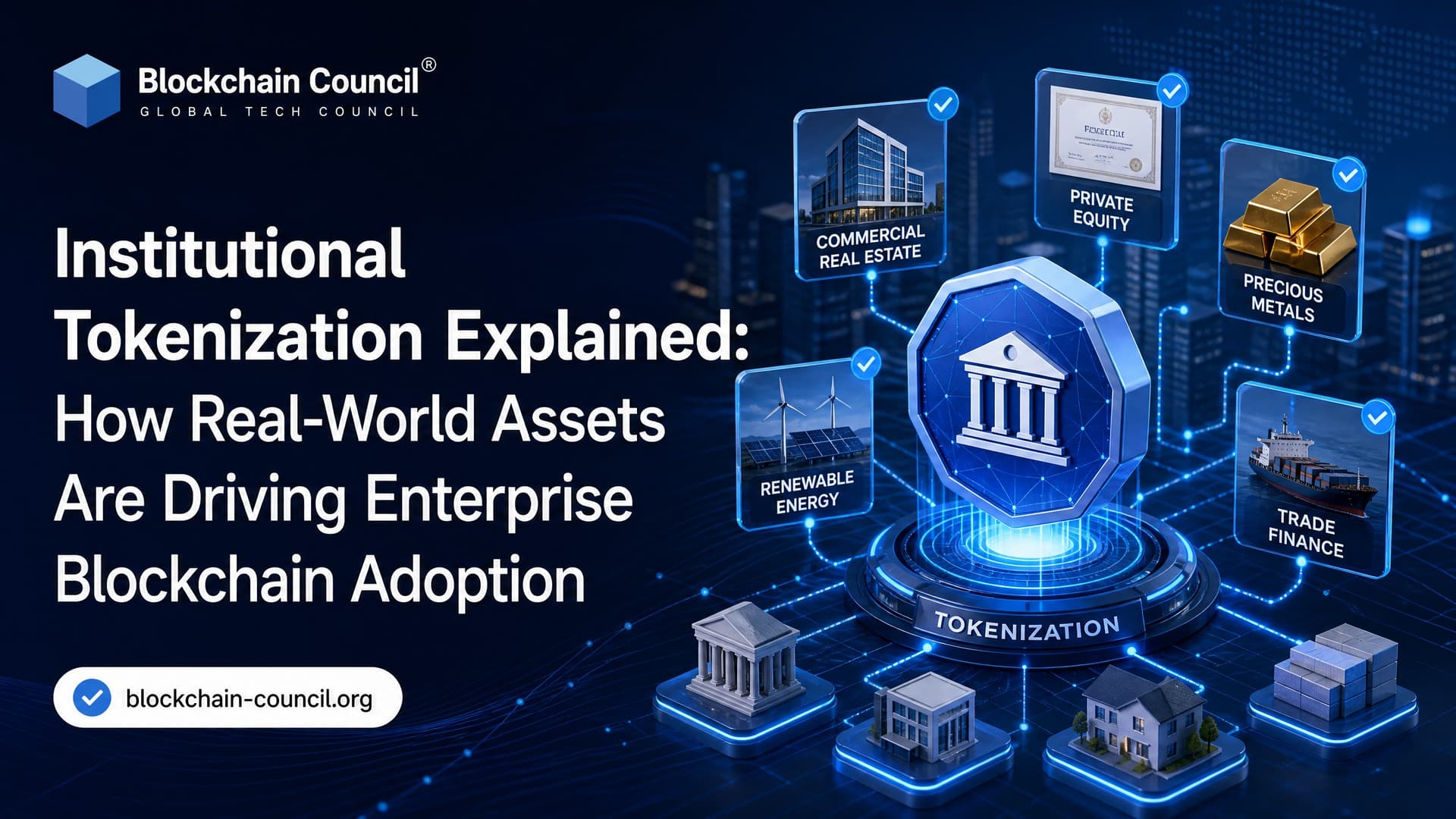
Institutional tokenization has moved from conference slides to production systems. Banks, asset managers, custodians, and fund administrators are putting real-world assets on blockchain rails because the business case is practical: faster settlement, better collateral movement, cleaner reporting, and programmable controls for regulated assets.
The early crypto story was about speculation. This one is not. Tokenized U.S. Treasuries, money market funds, private credit, fund shares, and real estate are assets institutions already understand. The blockchain layer only changes how ownership, transfer, and settlement get managed.

What Is Institutional Tokenization?
Institutional tokenization is the digital representation of rights to a financial or physical asset as a token on a blockchain network. The token might represent a fund unit, a debt instrument, a deposit claim, a property interest, or another legally defined right.
Here is the part people miss. The asset still needs legal backing. A tokenized fund share is not valuable because it is a token. It is valuable because the token maps to enforceable rights in the fund structure, transfer records, custody arrangements, and investor agreements.
Common institutional real-world assets include:
- U.S. Treasuries and sovereign bonds used for treasury management and collateral.
- Money market funds with on-chain subscription, redemption, and transfer workflows.
- Private credit and receivables with predictable cash flows and reporting needs.
- Tokenized fund shares for regulated investor onboarding and transfer control.
- Real estate and infrastructure where fractional ownership can reduce friction in capital raising and secondary transfers.
For technical teams, the distinction matters. A plain ERC-20 token is usually not enough for regulated securities. You need allowlists, transfer restrictions, identity checks, issuer controls, and audit trails. Standards such as ERC-1400 and ERC-3643 were designed with security tokens and permissioned transfers in mind, though implementations still vary across platforms.
How Big Is the Tokenized RWA Market?
Market estimates differ because analysts count different things. Some include stablecoins. Some count only distributed on-chain value. Others include represented asset value, which can be much larger than liquid on-chain balances.
The direction, though, is clear. Industry trackers and advisory firms now place tokenized real-world assets in the tens-of-billions-of-dollars range. Reported figures show growth from roughly 6 billion dollars in 2022 to well over 30 billion dollars by 2025, excluding stablecoins. Read any single number with a grain of salt, but the trend is where enterprise blockchain adoption is actually happening.
Forecasts run higher. McKinsey has projected a tokenized asset market of around 2 trillion dollars by 2030 in its base case. Boston Consulting Group has published estimates in the range of 2 to 4 trillion dollars by 2030, with more aggressive upside scenarios later in the decade. Treat the biggest numbers carefully. They assume regulatory and infrastructure progress that has not fully landed yet.
Why RWAs Are Driving Enterprise Blockchain Adoption
Enterprises rarely adopt new infrastructure because it is fashionable. They adopt it when it fixes expensive workflow problems. Real-world asset tokenization does that in four areas.
1. Faster Settlement
Traditional securities settlement often depends on batch processing, intermediaries, and reconciliation across multiple ledgers. Tokenized assets can settle on-chain in minutes or seconds, depending on the network and the compliance checks involved.
That reduces counterparty exposure. It also frees capital sooner. For institutions running large balance sheets, that matters more than a clever user interface.
2. Better Collateral Mobility
Tokenized treasuries and money market fund units can move between approved venues without the operational drag of traditional collateral transfers. That is why short-duration government debt and cash-equivalent products are leading categories.
If you work in trading, repo, derivatives, or treasury operations, this is the use case to watch. Moving collateral at 10 p.m. on a Sunday is not a crypto novelty. It is an operational advantage.
3. Programmable Compliance
Regulated assets cannot be freely transferred to anyone with a wallet. Tokenization lets issuers embed rules such as investor eligibility, jurisdiction limits, lock-up periods, and transfer approvals directly into smart contracts.
Here is a detail that trips up many development teams. If you build a restricted asset with a plain ERC-20 pattern and bolt on whitelist checks later, integrations break in strange ways. A custodian may only see execution reverted or AccessControl: account is missing role when a transfer fails. Good institutional contracts need clear revert reasons, event logs, and off-chain compliance APIs that operations teams can actually use.
4. Lower Back-Office Cost
Reconciliation is expensive. So are manual transfer agency processes, paper-heavy subscription workflows, and fragmented reporting. Roland Berger has estimated that tokenized RWA workflows in equity trading could save roughly 4.6 billion euros in transaction costs by 2030 through process simplification and fewer intermediaries.
The saving is not magic. It comes from cutting duplicate records, automating lifecycle events, and making settlement data available to authorized participants in near real time.
Where Institutions Are Using Tokenization First
The strongest adoption is not in exotic assets. It is in boring, high-volume financial products. That is a good sign.
Tokenized Treasuries and Money Market Funds
Tokenized U.S. Treasury exposure and money market funds are popular because they combine regulatory familiarity with operational usefulness. They can support cash management, on-chain collateral, and yield-bearing settlement balances.
BlackRock's BUIDL fund and Franklin Templeton's blockchain-based money market fund are two widely cited examples of traditional asset managers putting fund units on-chain. These products show that tokenization can coexist with regulated fund structures rather than replacing them overnight.
Private Credit and Structured Receivables
Private credit is a natural fit because cash flows can be tracked digitally, while secondary liquidity has historically been thin. Asset-backed credit has become one of the fastest-growing institutional RWA categories, reaching meaningful market value faster than several retail-focused tokenized segments.
The hard part is off-chain truth. Borrower data, collateral values, payment performance, and legal documents all have to be accurate. A beautiful smart contract cannot fix bad credit underwriting.
Real Estate and Infrastructure
Real estate tokenization usually focuses on fractional exposure, transfer efficiency, and access to high-value properties or portfolios. Tokenized REIT-like structures and property shares can cut friction, but legal enforceability is the key issue.
Do not confuse a token with a title deed. In serious institutional structures, the token points to rights defined in legal documents, special purpose vehicles, fund agreements, or regulated registries.
Public Chains, Permissioned Networks, or Both?
Ethereum remains the main public infrastructure for many tokenized asset projects, partly because of its developer base, wallet support, and mature smart contract standards. Ethereum mainnet uses chain ID 1, and many RWA teams still test on public test networks before moving to controlled production environments.
Public blockchains are not always the right answer, though. Banks and large enterprises often use permissioned or consortium networks where privacy, access control, and regulatory reporting can be designed in from the start. The likely future is hybrid: permissioned workflows for sensitive operations, public networks for interoperability and liquidity where regulation allows it.
To be blunt, enterprises should not tokenize an asset just to say they did. If the workflow does not need shared settlement, programmable transfer rules, or multi-party reconciliation, a conventional database may be cheaper and safer.
Regulatory Issues Institutions Cannot Avoid
Regulation is not a side topic here. It defines the product.
The questions that matter most:
- Is the token a security, deposit, fund unit, commodity interest, or something else?
- Who is the regulated issuer, transfer agent, custodian, and administrator?
- How are AML, KYC, sanctions screening, and travel rule obligations handled?
- What happens if a wallet key is lost or a smart contract has a defect?
- Which jurisdiction's investor protection and disclosure rules apply?
The EU's MiCA framework has reduced uncertainty for some crypto-asset categories, especially stablecoin-like instruments, but tokenized securities and fund units still sit within broader financial regulation. In the United States, classification and enforcement remain more fragmented. Institutions are responding with sandboxes, restricted investor bases, and products that start with simple buy-and-hold use cases.
What Professionals Should Learn Next
If you work in finance, compliance, blockchain development, or enterprise architecture, institutional tokenization is now a practical skill area. You need to understand both sides: smart contract mechanics and traditional asset workflows.
Useful learning paths include:
- Business and strategy teams: study tokenized treasuries, fund administration, custody models, and regulatory classification.
- Developers: learn Solidity 0.8.x, token standards, access control patterns, smart contract testing with Hardhat or Foundry, and secure upgrade design.
- Compliance teams: focus on identity, transfer restrictions, audit trails, AML controls, and jurisdiction-specific reporting.
Use this topic as a bridge into programs such as the Certified Blockchain Expert, Certified Blockchain Developer, Certified Smart Contract Developer, and Certified Web3 Expert. If your role touches tokenized securities or digital asset operations, pair blockchain training with a solid review of securities law and custody requirements in your market.
The Enterprise Adoption Signal Is Clear
Institutional tokenization is driving enterprise blockchain adoption because it connects blockchain infrastructure to assets that already sit inside bank, asset manager, and corporate balance sheets. The strongest use cases are not abstract. They are treasuries, money market funds, private credit, fund shares, real estate, and settlement infrastructure.
Start with one workflow. Map the legal asset, the ownership record, the transfer rules, the custody model, and the settlement process. Then ask whether tokenization makes that workflow faster, safer, or cheaper. If the answer is yes, build a small controlled proof of concept before touching production capital. Want a structured foundation first? Begin with a blockchain certification, then build a restricted token prototype that includes identity checks, transfer controls, and real audit logs.
Related Articles
View All
News
Institutional Tokenization in 2026: Enterprise Blockchain Adoption Trends
Institutional tokenization is shifting from pilots to production in 2026, led by Treasuries, stablecoins, tokenized deposits, and enterprise blockchain rails.

News
AI and Blockchain Integration in Enterprises: Real-World Use Cases Driving Adoption
AI and blockchain integration in enterprises is moving into production across supply chain, finance, healthcare, identity, compliance, and data infrastructure.

News
Tokenized Real-World Assets: Why Institutions Are Accelerating Blockchain Adoption
Tokenized real-world assets are driving institutional blockchain adoption through faster settlement, compliant DeFi access, and familiar assets like Treasuries.
Trending Articles

Top 5 DeFi Platforms
Explore the leading decentralized finance platforms and what makes each one unique in the evolving DeFi landscape.
How Blockchain Secures AI Data
Understand how blockchain technology is being applied to protect the integrity and security of AI training data.

Can DeFi 2.0 Bridge the Gap Between Traditional and Decentralized Finance?
The next generation of DeFi protocols aims to connect traditional banking with decentralized finance ecosystems.