

AI and Blockchain Integration in 2026: Enterprise Use Cases Moving Into Production
 Suyash Raizada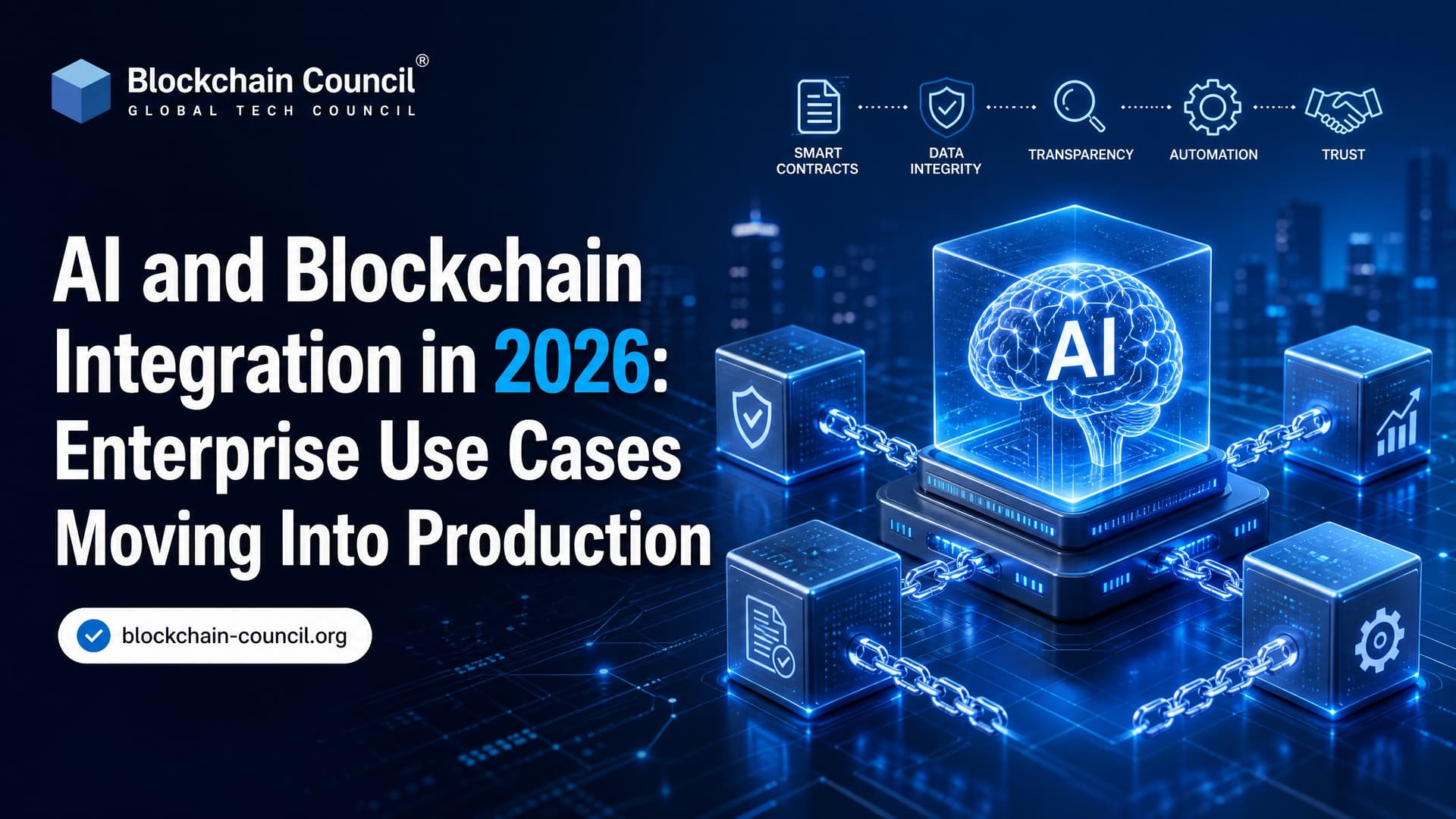
AI and blockchain integration in 2026 is no longer a lab discussion. The pattern showing up in enterprise deployments is simple. AI makes or recommends a decision, blockchain records and verifies the state change, and programmable payments settle the action through stablecoins, tokenized assets, or smart contracts.
That matters because enterprises do not buy technology for novelty. They buy lower fraud, faster reconciliation, fewer disputes, better audit trails, and cheaper operations. The current wave of adoption is strongest where those outcomes can be measured: finance, supply chain, healthcare, digital commerce, and decentralized infrastructure.

As AI becomes increasingly integrated with enterprise blockchain systems, professionals need a strong understanding of machine learning, AI governance, automation, and intelligent decision-making. A Certified Artificial Intelligence (AI) Expert credential helps build these practical capabilities, enabling organizations to implement AI solutions that are secure, scalable, and aligned with business objectives.
What Changed in 2026?
The shift is practical. In earlier pilots, blockchain was often used as a tamper-resistant database and AI sat beside it as an analytics layer. Now the two systems are increasingly part of the same workflow.
Think of the stack in three layers:
AI agents evaluate data, forecast outcomes, detect anomalies, or recommend actions.
Blockchain networks preserve state, verify permissions, and create audit trails.
Tokenized settlement executes payments, rewards, fees, or ownership transfers.
This is why agentic AI with on-chain wallets is getting serious attention. An enterprise agent can pay for an API, settle an invoice, rebalance a treasury position, or renew a software subscription within policy limits. The policy layer matters. Without spend limits, allowlists, circuit breakers, and human approval thresholds, an AI wallet is a liability.
A small detail from real smart contract work: many teams discover this the hard way when an automation script fails with VM Exception while processing transaction: reverted with reason string 'Ownable: caller is not the owner'. That error is annoying in testing, but it is a useful reminder. Autonomous execution must respect access control. Agents should not be treated as magic users with unlimited permissions.
Market Signals Behind Enterprise Adoption
MarketsandMarkets has estimated the global AI-blockchain market at about 703 million dollars in 2024, with projections above 3.27 billion dollars by 2030 at a 24.06 percent compound annual growth rate. Other analyst firms, including Spherical Insights, have projected strong growth for the AI and blockchain intersection over the next decade.
The more useful numbers, though, are operational. Enterprise integration studies report outcomes such as:
About 35 percent reduction in counterfeit incidents when blockchain supply chain tracking is combined with AI analytics.
25 to 40 percent faster dispute resolution in logistics workflows that use shared ledgers and automated evidence trails.
Up to 95 percent accuracy in some AI-blockchain fraud detection systems for financial services.
Around 60 percent faster healthcare data reconciliation when AI record matching works against verified data trails.
18 to 22 percent higher e-commerce conversion rates in reported cases where authenticity and attribution are verified.
These figures are early and should be evaluated case by case. Still, they explain why boards are approving production budgets instead of another proof of concept.
Successfully deploying AI-powered blockchain applications also requires expertise in distributed ledger technology, smart contracts, blockchain governance, and enterprise implementation strategies. A Certified Blockchain Expert credential helps professionals develop these skills, providing the technical foundation needed to build compliant and reliable blockchain solutions.
Key Use Cases Driving AI and Blockchain Integration in 2026
Financial Services, Fraud Detection, and Programmable Payments
Finance is the clearest adoption path. The data is structured, the value at risk is high, and auditability is non-negotiable.
Banks, payment companies, and fintech platforms use AI models to scan wallet behavior, transaction flows, smart contract interactions, and counterparty risk signals. Blockchain supplies a shared transaction history. AI spots patterns that static rules miss.
Common deployments include:
Real-time anti-money laundering monitoring
Fraud detection across wallet clusters and payment rails
AI-assisted credit scoring using verifiable transaction histories
Automated B2B invoice settlement with stablecoins
Dynamic DeFi risk controls for collateral, liquidity, and pricing
To be blunt, not every DeFi workflow needs AI. If a rule is simple and deterministic, write a smart contract rule. Use AI where uncertainty exists: fraud signals, liquidity forecasting, credit scoring, market stress prediction, or anomaly detection.
Supply Chain, Logistics, and Anti-Counterfeit Systems
Supply chains benefit because many parties need the same truth but do not fully trust each other. Blockchain records product movement, custody changes, certificates, and inspection events. AI analyzes images, sensor readings, route data, demand signals, and exception patterns.
In pharmaceuticals, luxury goods, defense components, and high-value manufacturing, the value is direct. A counterfeit part is not just a revenue problem. It can become a safety issue, a legal issue, or a national security issue.
AI can verify product images at checkpoints, flag unusual shipment routes, forecast maintenance delays, and predict inventory gaps. Blockchain makes those claims harder to alter after the fact. Supply chain research suggests AI can reduce forecasting errors by 20 to 50 percent, while shared ledger visibility can cut disputes and stockout-related losses.
The wrong use case? Putting every low-value event on a public chain. For most enterprise logistics workflows, a permissioned network or hybrid architecture is more practical, especially when shipment data is commercially sensitive.
Healthcare Data Exchange and Record Reconciliation
Healthcare has a boring but expensive problem: records do not match cleanly across systems. Names vary. Dates get entered differently. Provider systems store data in incompatible formats. AI helps reconcile those records. Blockchain helps prove which record was created, updated, accessed, or shared.
Hospitals, insurers, and research organizations are exploring permissioned ledgers for medical records, consent logs, clinical trial evidence, and data access governance. AI models can then work on verified datasets rather than messy, untrusted extracts.
This is also where privacy-preserving techniques matter. Zero-knowledge proofs, secure multi-party computation, and strict smart contract based access rules are becoming part of the design conversation. You do not want raw patient data floating around a blockchain. You want proofs, hashes, permissions, and audit logs.
Identity, KYC, and Verifiable Credentials
Identity workflows are changing too. AI checks documents, biometrics, behavioral signals, and fraud patterns. Blockchain stores attestations, credential hashes, and reusable verification proofs.
For financial onboarding, this can reduce duplicated KYC checks. A customer who has already completed verification with one institution may be able to reuse a trusted attestation elsewhere, without exposing all raw documents again.
The same model applies to education and hiring. Universities and training providers can issue tamper-resistant credentials. Employers can verify them quickly. AI can help detect inconsistencies across resumes, certificates, and claimed work history. If you want to build expertise here, Blockchain Council's Certified Blockchain Expert™ and Certified Artificial Intelligence (AI) Expert™ are natural learning paths to explore.
Decentralized AI Infrastructure and Tokenized Compute
Training and running AI models is expensive. That cost has pushed interest in decentralized AI infrastructure, including tokenized compute, GPU marketplaces, and model-sharing networks.
Projects such as Bittensor and Fetch.ai point toward a broader market where compute providers, model builders, data owners, and application developers coordinate through tokens and smart contracts. Blockchain tracks contribution, reputation, payments, and usage rights. AI workloads run across distributed resources.
This is not a fit for every enterprise workload. Regulated data, latency-sensitive inference, and proprietary model training may still belong in controlled cloud or on-premise environments. But for marketplace-style AI services, open model coordination, and incentive-driven compute networks, blockchain provides an economic layer that conventional cloud platforms do not offer by default.
E-Commerce, Marketing Attribution, and Customer Trust
Digital commerce teams use AI for personalization, fraud scoring, campaign optimization, and product recommendations. Blockchain adds verifiable authenticity and attribution.
A marketplace can record product provenance, creator royalties, warranty status, or influencer campaign events on-chain. AI can then analyze trusted events instead of fragmented platform data. Reported cases show 18 to 22 percent higher conversion rates where authenticity and attribution improve buyer confidence.
There is a trade-off here too. Customers do not want a lecture about blockchain at checkout. The value must be invisible: fewer fake products, cleaner loyalty rewards, faster warranty claims, and better consent controls.
Verifiable AI Is Becoming the Trust Layer
One of the most important enterprise trends is verifiable AI inference. If an AI model approves a loan, flags a shipment, denies access, or triggers a payment, the business needs evidence. Which model version ran? Which data was used? Who approved the policy? Was the output changed?
Blockchain can record model hashes, input commitments, access permissions, approval events, and output attestations. Not every calculation belongs on-chain. In fact, most AI inference should stay off-chain for cost and performance reasons. The chain should store proofs and critical state changes.
Ethereum, Hyperledger Fabric, and Corda-style enterprise DLT systems are all used in different ways for this purpose. Public Ethereum is useful when open settlement and composability matter. Hyperledger Fabric is often a better fit for private consortium workflows. Corda remains common in financial settings where parties need shared facts without broadcasting data broadly.
Building enterprise-grade AI and blockchain solutions also depends on broader expertise in cybersecurity, cloud computing, API integration, enterprise architecture, and data governance. A Tech Certification helps professionals strengthen these complementary technical skills, supporting the secure deployment and long-term management of digital transformation initiatives.
Skills Enterprises Need Now
Teams working on AI-blockchain systems need mixed skills. Smart contract developers must understand model risk. AI engineers must understand wallets, keys, oracles, and transaction finality. Compliance teams must understand what is stored on-chain and what is not.
If you are planning a learning path, pair blockchain fundamentals with AI governance and smart contract development. Blockchain Council's Certified Blockchain Developer™, Certified Smart Contract Developer™, and Certified Artificial Intelligence (AI) Expert™ are relevant options for professionals preparing for these roles.
What to Build Next
Start with a workflow where auditability and automation both matter. A strong first project is an AI-assisted invoice approval system: use AI to score invoice risk, write approvals and hashes to a permissioned ledger, and trigger payment only when policy conditions are met.
Keep the design narrow. Add wallet limits. Log model versions. Store sensitive data off-chain. Test failure cases, including bad oracle data and revoked permissions. Make that small system reliable, and you will understand the real promise of AI and blockchain integration in 2026 far better than by reading another trend report.
As AI and blockchain solutions become mainstream across industries, organizations also need professionals who can clearly communicate the value of these technologies to customers, partners, and business stakeholders. A Marketing Certification helps develop expertise in strategic communication, product positioning, customer engagement, and go-to-market planning, complementing technical knowledge of AI and blockchain innovation.
FAQs
1. What does AI and blockchain integration mean?
AI and blockchain integration combines artificial intelligence with distributed ledger technology to create more intelligent, automated, and trustworthy digital systems. AI analyzes data, makes predictions, and automates decisions, while blockchain provides transparent, tamper-resistant records and programmable transactions through smart contracts.
2. Why is AI and blockchain integration gaining momentum in 2026?
Many enterprises have moved beyond pilot projects and are deploying AI and blockchain in production environments to improve operational efficiency, automate workflows, strengthen data integrity, and support secure digital ecosystems. Advances in cloud computing, AI models, and blockchain infrastructure have accelerated adoption.
3. Which industries are leading enterprise adoption?
Financial services, healthcare, supply chain, manufacturing, logistics, insurance, energy, retail, telecommunications, government, and life sciences are among the industries actively implementing AI and blockchain solutions in production environments.
4. What are the primary enterprise use cases?
Organizations are using AI and blockchain for fraud detection, digital identity, supply chain visibility, predictive maintenance, automated compliance, smart contract management, financial settlements, asset tokenization, cybersecurity, and secure data sharing across multiple stakeholders.
5. How does blockchain improve AI systems?
Blockchain can enhance AI by providing verifiable data sources, secure audit trails, decentralized data sharing, transparent model governance, and tamper-resistant records. These capabilities help improve trust, accountability, and traceability throughout the AI lifecycle.
6. How does AI improve blockchain applications?
AI can optimize blockchain network performance, detect fraud, automate smart contract monitoring, improve cybersecurity, forecast network demand, analyze blockchain transactions, enhance customer service, and streamline compliance processes.
7. What role do smart contracts play in AI-powered enterprise systems?
Smart contracts automatically execute predefined business rules when specified conditions are met. AI can support these systems by analyzing data, identifying events, and triggering automated workflows while blockchain records each transaction in a transparent and verifiable manner.
8. How is AI and blockchain transforming supply chains?
Organizations use blockchain to record product movements and AI to optimize inventory, forecast demand, identify disruptions, and improve logistics planning. Together, these technologies can enhance transparency, operational efficiency, and decision-making across global supply chains.
9. How are financial institutions using AI and blockchain?
Banks and financial institutions are deploying AI and blockchain for payment processing, fraud prevention, anti-money laundering (AML) monitoring, digital identity verification, tokenized assets, regulatory reporting, and automated compliance workflows.
10. How do AI and blockchain support cybersecurity?
Blockchain protects data integrity through decentralized recordkeeping, while AI identifies anomalies, detects cyber threats, automates incident response, and strengthens threat intelligence. Combining both technologies can improve enterprise security strategies.
11. What role does AI play in tokenized asset platforms?
AI can support portfolio analytics, compliance automation, transaction monitoring, customer onboarding, fraud detection, and risk analysis for tokenized assets. Blockchain records ownership and transactions while AI enhances operational intelligence.
12. How are healthcare organizations adopting AI and blockchain?
Healthcare providers are exploring AI for diagnostics, workflow optimization, and predictive analytics while using blockchain to improve medical record integrity, consent management, pharmaceutical traceability, and secure information sharing among authorized participants.
13. What challenges do enterprises face during implementation?
Organizations often encounter challenges related to system integration, cybersecurity, regulatory compliance, interoperability, data governance, scalability, talent shortages, infrastructure modernization, and organizational change management.
14. How do governance frameworks support AI and blockchain adoption?
Governance frameworks establish policies for security, privacy, compliance, risk management, model oversight, data quality, smart contract controls, and operational accountability. Strong governance is essential for scaling enterprise deployments responsibly.
15. What regulations should enterprises consider?
Depending on the industry and jurisdiction, organizations may need to comply with data protection laws, cybersecurity regulations, anti-money laundering (AML) requirements, know-your-customer (KYC) rules, financial regulations, intellectual property laws, and emerging AI governance frameworks.
16. What skills are needed for enterprise AI and blockchain projects?
Successful teams often combine expertise in artificial intelligence, machine learning, blockchain architecture, cloud computing, cybersecurity, software engineering, DevOps, enterprise integration, compliance, data governance, and project management.
17. How does cloud infrastructure support production deployments?
Cloud platforms provide scalable computing resources, AI acceleration, managed blockchain services, storage, networking, security controls, and monitoring capabilities that help enterprises deploy and operate production-grade AI and blockchain solutions.
18. What trends are shaping enterprise AI and blockchain in 2026?
Key trends include AI agents, tokenized real-world assets (RWAs), decentralized identity, AI-assisted compliance, blockchain interoperability, enterprise digital wallets, confidential computing, zero-trust security, and automation of complex business workflows.
19. What should organizations evaluate before moving into production?
Enterprises should assess business objectives, return on investment, security requirements, regulatory obligations, scalability, vendor capabilities, interoperability, governance policies, operational resilience, and workforce readiness before expanding beyond pilot programs.
20. What is the long-term outlook for AI and blockchain integration?
AI and blockchain are expected to become increasingly complementary technologies within enterprise digital transformation strategies. Organizations that invest in secure infrastructure, responsible AI governance, interoperable blockchain platforms, and workforce development may be better positioned to deliver scalable production solutions as the technologies mature. Building the technology is challenging, but persuading every legacy system to cooperate remains one of modern engineering's favorite endurance sports.
Related Articles
View All
News
AI and Blockchain Integration: Enterprise Use Cases Driving Market Growth
AI and blockchain integration is moving into production across supply chain, finance, identity, compliance, insurance, and healthcare.

News
AI and Blockchain Integration in Enterprises: Real-World Use Cases Driving Adoption
AI and blockchain integration in enterprises is moving into production across supply chain, finance, healthcare, identity, compliance, and data infrastructure.

News
AI and Blockchain Integration in 2026: Why Enterprises Are Moving Fast
Enterprises are moving AI-blockchain systems into production for auditability, agent wallets, stablecoin settlement, tokenization, and lower operating cost.
Trending Articles
AWS Career Roadmap
A step-by-step guide to building a successful career in Amazon Web Services cloud computing.

Top 5 DeFi Platforms
Explore the leading decentralized finance platforms and what makes each one unique in the evolving DeFi landscape.
How Blockchain Secures AI Data
Understand how blockchain technology is being applied to protect the integrity and security of AI training data.