

Why Enterprise Blockchain Adoption Is Outpacing Retail Web3 Innovation in 2026

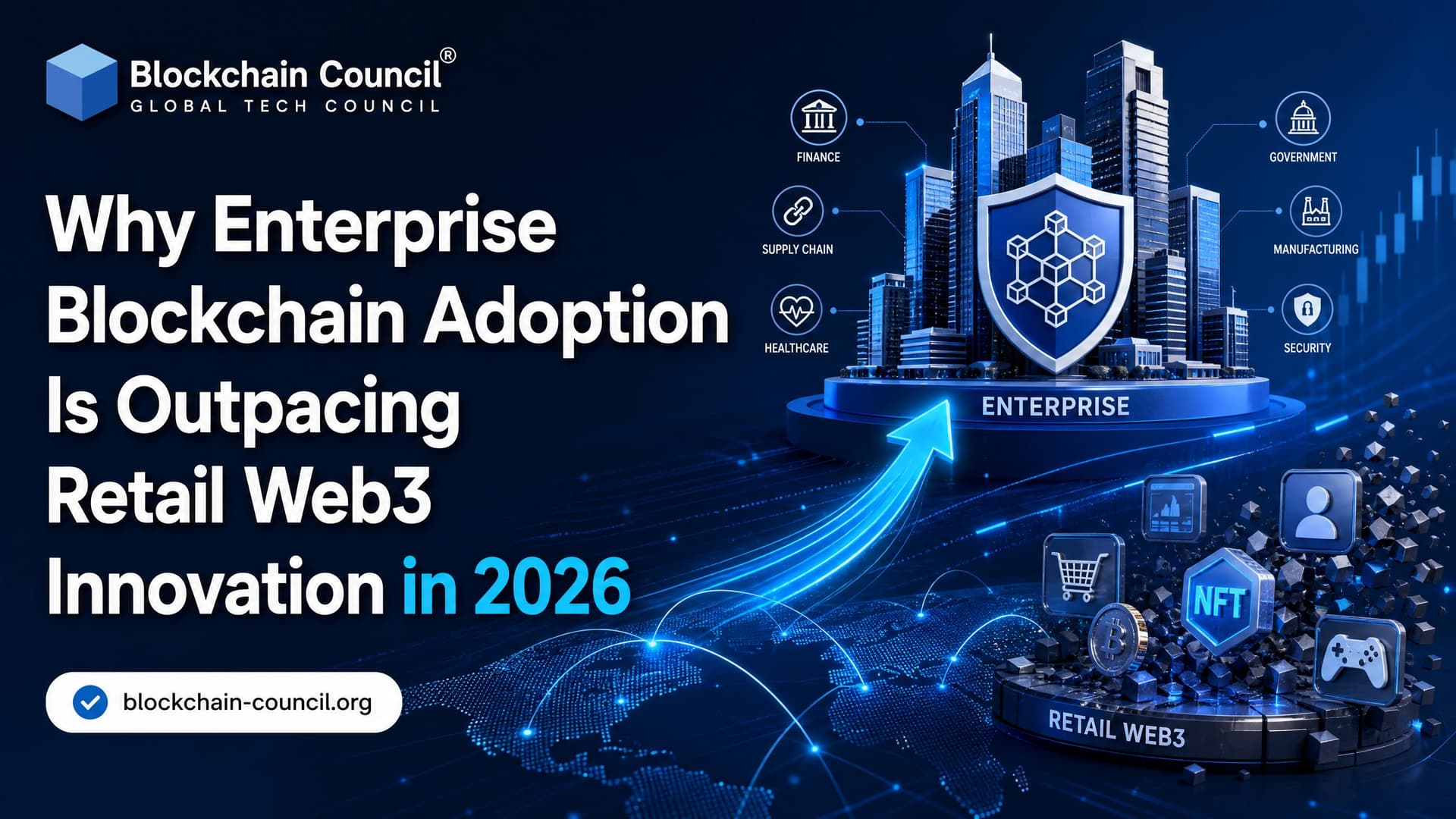
Enterprise blockchain adoption is moving faster than retail Web3 innovation in 2026 because large organizations now have three things they did not have at scale in the last cycle: clearer rules, mature infrastructure, and business cases a CFO can actually measure. Retail Web3 is still active. Consumer DeFi, gaming, and NFT communities keep shipping. But the money, the regulation, and the production deployments have shifted toward banks, supply chains, governments, and tokenized real-world assets.
That shift matters if you build, invest, audit, or plan technology strategy. The winning blockchain work in 2026 has less to do with launching another token and more to do with settlement, compliance, provenance, identity, and data integrity.

Enterprise Blockchain Has Moved From Pilot to Production
For years, enterprise blockchain was a polite experiment. Innovation labs built proofs of concept, showed a demo to leadership, and parked the project. That pattern has changed.
Gartner has estimated that around a quarter of Global 2000 companies will run blockchain in production by the end of 2026, up sharply from a much smaller share two years earlier. Financial services and supply chain account for a large slice of live deployments, which tells you where the strongest product-market fit sits.
Analysts at IBM and Deloitte describe blockchain in 2026 as a practical enterprise capability rather than a speculative bet, pointing to data integrity, reduced intermediary dependency, and operational transparency as the recurring themes.
The use cases are not theoretical anymore. Enterprises are using blockchain for:
- Cross-border payments and faster settlement.
- Supply chain traceability from factory to shelf.
- Smart contracts for workflow automation.
- Digital identity and credential verification.
- Fraud prevention in banking and insurance.
- Real-world asset tokenization, including bonds, funds, and deposits.
In production, the conversation has become more technical and less ideological. Teams care about chain finality, RPC reliability, key management, audit logs, privacy controls, and how the ledger integrates with SAP, Oracle, Salesforce, or a core banking system. Boring? Maybe. Valuable? Very.
Why Retail Web3 Is No Longer Setting the Pace
Retail Web3 has not disappeared. BNB Chain still handles high-volume consumer applications, and NFT, gaming, and social communities keep experimenting. But consumer-led Web3 is not setting the main adoption curve in 2026.
The reason is simple. Retail Web3 often depends on volatile token demand, speculative user behavior, and loose product-market assumptions. Enterprise blockchain, by contrast, targets expensive problems that already exist. Settlement delays cost money. Counterfeit goods damage brands. Manual reconciliation eats staff time. Poor auditability creates regulatory risk.
When a bank cuts settlement friction, or a logistics network reduces disputes in trade documentation, blockchain has a measurable job to do. That makes budget approval far easier.
Regulatory Clarity Now Favors Institutional Use Cases
Regulation is one of the biggest reasons enterprise blockchain is pulling ahead. The EU's MiCA regulation, which entered into force in 2023 and phased in major rules through 2024, gave firms a clearer path for crypto-asset services, stablecoins, and compliance obligations. In the United States, guidance around digital assets is still fragmented, but banks, asset managers, and payment providers now work from more structured compliance playbooks than retail token issuers had in earlier cycles.
Retail Web3 faces a harder path. Consumer protection, advertising rules, KYC, AML, securities treatment, tax reporting, and wallet risk all sit close to the user experience. That creates friction. A DeFi app aimed at retail users has to think about onboarding, jurisdiction checks, disclosures, sanctions screening, and smart contract risk. A wholesale settlement network for regulated institutions can design around known participants and permissioned access.
That distinction is why institutional DeFi is growing through compliant lending, on-chain fixed income, tokenized funds, and permissioned liquidity pools. It is still Web3. It just looks more like finance infrastructure than a retail app store.
Tokenization and CBDCs Are Pulling Capital Toward Enterprise Blockchain
Tokenization is the clearest growth engine in 2026. Industry research points to a tokenized asset market measured in the trillions of dollars by 2030. Whether the exact figure lands is less important than the direction of travel: banks, asset managers, exchanges, and governments are building toward programmable assets.
Reuters has reported that major banks are working with platforms such as R3 and Solana to tokenize equities and bonds, aiming to compress settlement from days to minutes. JPMorgan's Kinexys platform is another example, moving tokenized deposits into institutional banking workflows. BlackRock, Fidelity, and other large financial firms have built dedicated digital asset divisions.
CBDCs add another layer. More than 130 countries are in some stage of central bank digital currency work, spanning wholesale and retail pilots. Even when a CBDC does not run on a public blockchain, it pushes the financial system toward programmable settlement, digital identity, and ledger-based reconciliation.
Retail Web3 rarely attracts that level of sovereign attention. A consumer NFT marketplace can grow quickly, but it does not usually reshape treasury operations, collateral management, or central bank payment infrastructure.
The Infrastructure Finally Fits Enterprise Requirements
Enterprise teams no longer have to choose between fragile prototypes and public-chain chaos. The stack is more mature.
Ethereum remains the default enterprise smart contract environment because of its developer ecosystem, liquidity, security history, and tooling around Solidity 0.8.x, EVM compatibility, ERC-20 tokens, ERC-721 assets, and EIP-1559 fee mechanics. Polygon is widely used where teams want lower transaction costs and Ethereum alignment. Solana suits high-throughput, user-facing applications. Bitcoin is increasingly treated as a treasury and settlement asset rather than a smart contract platform.
One practitioner detail: enterprise teams still trip over the basics. I have watched testnet deployments fail because the application signed transactions for Ethereum mainnet chain ID 1 while the wallet was pointed at a Polygon test network. In Hardhat and ethers.js, that mismatch usually surfaces as a gas estimation or nonce error, not a friendly message. In a retail hackathon that is annoying. In a bank integration test it blocks release governance.
This is why enterprises prefer tested patterns: audited contracts, multi-signature administration, private key custody, monitoring, incident response, and permission controls. Novel token mechanics are less attractive than predictable operations.
Where Enterprise Blockchain Is Winning in 2026
Financial Services
Banking, financial services, and insurance are projected to command the largest share of the blockchain market in 2026. The reasons are practical: fraud prevention, smart contracts, compliance reporting, tokenized assets, collateral movement, and faster settlement. Payments are expected to lead as an application segment across the broader market.
Supply Chain and Logistics
Supply chain networks are a natural fit because they already involve many parties that do not fully trust each other. A shared ledger can track provenance, cut document disputes, and support product authenticity. Retailers, shipping companies, and manufacturers use blockchain to trace goods from origin to final sale.
Government and Public Sector
Governments are piloting and deploying blockchain for digital identity, land registries, procurement, and public records. These projects move slowly, but they carry heavy institutional weight. A national identity or land registry platform has a very different adoption profile than a consumer token campaign.
Healthcare and Life Sciences
Healthcare adoption stays cautious because HIPAA, GDPR, and patient privacy rules are strict. Even so, blockchain is being tested for clinical data integrity, pharmaceutical supply chain verification, and secure patient data exchange. Counterfeit drug prevention is a concrete use case with real public health value.
What This Means for Developers and Professionals
If you are building skills for 2026, do not treat blockchain as only a retail crypto topic. The stronger career path sits at the intersection of smart contracts, enterprise architecture, compliance, cybersecurity, and domain knowledge.
Developers, learn Solidity, EVM tooling, token standards, wallet flows, event indexing, and smart contract testing with Hardhat or Foundry. Then learn what enterprises actually care about: role-based access, upgrade patterns, key custody, audit trails, disaster recovery, and regulatory reporting.
Business and technology leaders, focus on use cases where blockchain removes reconciliation, improves trust between parties, or creates programmable financial assets. If the project cannot define a KPI before the first sprint, it is probably not ready.
You can map this shift to structured learning paths such as the Certified Blockchain Expert™, Certified Blockchain Developer™, Certified Smart Contract Developer™, and Certified Blockchain Architect™. If you work with audits, wallets, or production smart contracts, the Certified Blockchain Security Expert™ is worth adding to that path.
Retail Web3 Is Not Dead, but It Must Grow Up
Retail Web3 will keep producing interesting ideas. Some will matter. Most will not. The next durable consumer applications will likely connect to enterprise-grade rails: regulated stablecoins, bank-issued tokens, compliant DeFi pools, tokenized funds, CBDC wallets, or verified identity systems.
That is the trade-off. Retail Web3 gave blockchain its culture, open experimentation, and developer energy. Enterprise blockchain is giving it budgets, compliance, distribution, and measurable outcomes.
If you want to stay relevant, build for the production market. Start with a real workflow, not a token. Learn how Ethereum, Polygon, Solana, tokenization, CBDCs, and compliance architecture fit into enterprise systems. Then pick a certification or project that forces you to ship something testable, auditable, and useful.
Related Articles
View All
News
Institutional Tokenization in 2026: Enterprise Blockchain Adoption Trends
Institutional tokenization is shifting from pilots to production in 2026, led by Treasuries, stablecoins, tokenized deposits, and enterprise blockchain rails.

News
AI and Blockchain Integration in 2026: Enterprise Use Cases Moving Into Production
AI and blockchain integration in 2026 is moving into production across finance, supply chain, healthcare, identity, and decentralized AI infrastructure.

News
AI and Blockchain Convergence: Key Trends for Digital Innovation in 2026
AI and blockchain convergence is creating verifiable agents, adaptive smart contracts, tokenized assets, and auditable enterprise automation in 2026.
Trending Articles
How Blockchain Secures AI Data
Understand how blockchain technology is being applied to protect the integrity and security of AI training data.
What is AWS? A Beginner's Guide to Cloud Computing
Everything you need to know about Amazon Web Services, cloud computing fundamentals, and career opportunities.
Blockchain in Supply Chain Provenance Tracking
Supply chains are under pressure to prove not just efficiency, but also authenticity, sustainability, and fairness. Customers want to know if their coffee really is fair trade, if the diamonds are con