

Metaverse meaning and examples in India context
 Suyash Raizada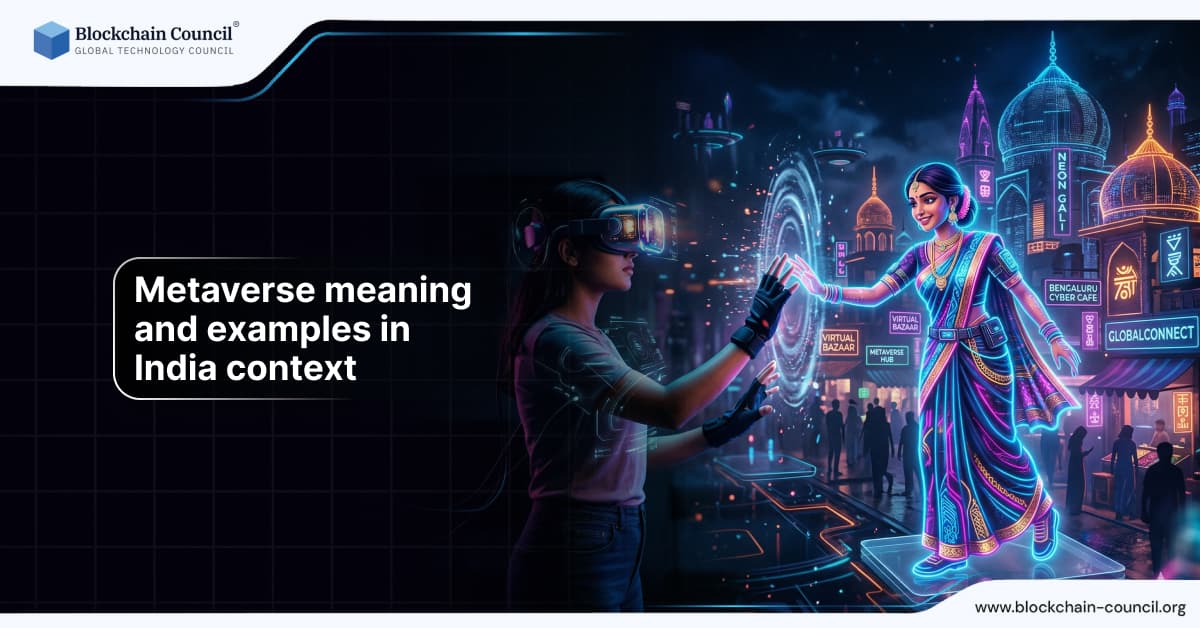
Metaverse meaning and examples are increasingly relevant in India as immersive 3D experiences move from early experimentation to practical adoption in education, commerce, and cultural engagement. In simple terms, the metaverse is a 3D extension of the internet where people interact in shared virtual environments using technologies such as virtual reality (VR), augmented reality (AR), and persistent digital spaces. India's momentum is supported by a large young population, expanding internet and smartphone access, and growing institutional interest in advanced digital learning and services.
The COVID-19 era accelerated acceptance of remote learning and online interaction, prompting a stronger push in India toward experiences that go beyond 2D video calls and static content. The metaverse introduces a sense of presence, shared space, and real-time engagement that many educators and enterprises view as the next step in digital transformation.

Understand the metaverse with real-world use cases in gaming, education, and virtual commerce by mastering Web3 systems as a Certified Blockchain Expert, building simulations via a Python Course, and scaling virtual experiences with a Digital marketing course.
Metaverse Meaning in the Indian Context
Globally, the metaverse is discussed as immersive virtual worlds for work, play, and community. In India, metaverse meaning is closely tied to three priorities:
Access: reaching learners and consumers beyond major cities
Skills: enabling hands-on training through simulations and interactive environments
Culture: supporting multilingual, geographically unrestricted participation in experiences that reflect Indian diversity
India's policy and industry signals reinforce this direction. The National Education Policy (NEP) emphasizes modern technologies including artificial intelligence in education, while private-sector initiatives have explored AR, VR, and immersive learning programs at scale. Growing research attention to learner engagement across offline, online, and hybrid formats reflects a focus on outcomes rather than novelty.
Why the Metaverse Is Gaining Traction in India
Several factors are driving adoption, particularly in education and digital commerce:
Post-pandemic behavior shifts: learners and customers expect flexible, digital-first experiences.
Smartphone and internet growth: more households can access richer media formats, including AR-enabled learning.
Demand for job-ready skills: employers want candidates with practical capabilities, and learners want employability outcomes.
A growing technology ecosystem: India's domestic developer and startup base can build localized metaverse solutions.
India's online education market is projected to grow roughly fivefold to approximately $3.5 billion. This demand creates strong pull for immersive learning models that improve engagement and practical skill-building.
Metaverse in Education: Meaning, Benefits, and Examples in India
Education is one of the clearest areas where metaverse meaning and examples translate into measurable value. Traditional e-learning often relied on one-way video and limited interaction. Metaverse-enabled learning aims to deliver two-way, real-time participation with a stronger sense of presence.
How Metaverse Learning Transforms Traditional Classrooms
In practice, metaverse education can include virtual classrooms, 3D labs, and AR overlays that let students explore concepts rather than only reading or watching them. Key benefits in India include:
Geography-independent teaching: instructors in major cities can teach students across states with richer interaction than basic video conferencing.
Immersive STEM learning: VR and AR help students visualize complex concepts in physics, chemistry, biology, and engineering through simulations.
Personalized learning journeys: interactive environments can adapt tasks and pace to individual learners and learning styles.
Skill-based training: simulations support employability-focused learning aligned with NEP priorities.
Real Metaverse Education Examples in India
India already has early implementations across schools, universities, and vocational training:
Invact University: developed an immersive platform called Metaversity focused on education and employability.
21K School: uses blockchain and NFTs to support personalized and interactive learning experiences, with plans to introduce VR components.
Skillful Craftsman: building a Meta-Factory concept for technical skills training relevant to vocational colleges and manufacturing.
Pearson collaboration: delivered immersive learning experiences at scale and explored NFT-based educational marketplaces for learners.
Closing the Urban-Rural Education Gap
A significant promise of metaverse-driven education in India is improving equity. Where connectivity and device access are addressed, immersive platforms can:
Provide consistent access to quality instruction beyond urban centers
Support multilingual learning and visual-first instruction where language barriers exist
Offer practice-based labs and simulations where physical lab infrastructure is limited
Metaverse in Commerce: Examples Relevant to Indian Enterprises
In commerce, the metaverse is less about replacing existing e-commerce and more about adding immersive layers to product discovery, consumer trust, and workforce training. Several multinational companies have experimented with virtual environments for hiring and onboarding, demonstrating that virtual spaces can support workforce processes and enterprise collaboration.
Where Indian Commerce Can Use Metaverse Experiences
Immersive product discovery: 3D showrooms for categories like apparel, jewelry, furniture, and automobiles, reducing purchase uncertainty.
Retail training and operations: VR simulations for store staff training, safety drills, and customer service practice.
Virtual events and brand communities: product launches, industry expos, and customer engagement in persistent digital venues.
Digital goods and loyalty: tokenized assets such as NFTs for memberships, collectibles, and access, subject to applicable compliance requirements.
Metaverse and Indian Culture: Language, Heritage, and Accessibility
India's cultural diversity makes it a strong candidate for metaverse experiences that support multilingual participation and geographically unrestricted access. In well-designed environments, immersive interaction can reduce dependence on text-heavy interfaces and enable visual learning, guided tours, and live demonstrations.
Cultural Metaverse Examples That Fit India's Needs
Virtual heritage experiences: guided 3D tours of monuments and museums that support school curricula and tourism interests.
Arts and crafts demonstrations: interactive workshops where artisans teach techniques to learners across regions.
Language learning and exchange: conversational practice in contextual settings that build confidence and engagement.
Festivals and community events: virtual participation for diaspora communities and those unable to travel.
Accessibility should remain central to these efforts. The most impactful cultural implementations will be those that function on widely available devices, account for bandwidth constraints, and incorporate inclusive design from the outset.
Challenges India Must Address to Scale Metaverse Adoption
Despite strong potential, metaverse growth in India depends on practical readiness and responsible implementation. Key challenges include:
Infrastructure gaps: uneven connectivity and device availability across regions.
Educator readiness: teachers need training to design immersive lessons, not only to operate tools.
Content localization: culturally relevant, curriculum-aligned experiences across languages and education boards.
Privacy and cybersecurity: identity protection, data governance, and safe-by-design interaction in shared virtual spaces.
Measuring outcomes: clear metrics for learning gains, employability impact, and enterprise ROI.
Explore metaverse applications across industries with immersive technologies and digital assets by learning blockchain fundamentals through a Blockchain Course, enhancing AI-driven environments via a machine learning course, and promoting innovations through an AI powered marketing course.
Conclusion: What Metaverse Meaning and Examples Tell Us About India's Next Digital Chapter
Metaverse meaning and examples in India point to a practical evolution of digital experiences: more immersive education, richer commerce journeys, and broader cultural access. Education stands out as a high-impact sector, with early implementations demonstrating how virtual classrooms, AR, VR, blockchain, and NFTs can support engagement and employability. Commerce and culture follow closely, particularly where immersive discovery, training, and participation address real constraints of distance, language, and access.
India's long-term success with the metaverse will depend on inclusive infrastructure, educator and workforce training, localized content, and strong governance frameworks. With policy attention, private investment, and a capable technology ecosystem, India has the foundation to build metaverse applications that are both innovative and equitable.
FAQs
1. What is the metaverse in simple terms?
The metaverse is a virtual digital world where users can interact with each other using avatars. It combines technologies like virtual reality, augmented reality, and blockchain. It allows people to work, play, and socialize in immersive environments.
2. How is the metaverse used in India?
In India, the metaverse is being used in gaming, education, real estate, and virtual events. Companies are exploring virtual offices and brand experiences. It is gradually gaining adoption across industries.
3. What are real-life examples of the metaverse in India?
Examples include virtual classrooms, digital concerts, and online exhibitions. Some brands are creating virtual stores and experiences. These use cases show practical applications of metaverse technology.
4. Is the metaverse popular in India?
The metaverse is still in the early stages but growing steadily in India. Increasing internet penetration and digital awareness are driving adoption. Interest is rising among businesses and startups.
5. What technologies power the metaverse?
The metaverse is powered by virtual reality, augmented reality, blockchain, and AI. These technologies create immersive and interactive environments. They enable real-time communication and digital ownership.
6. Can businesses use the metaverse in India?
Yes, businesses can use the metaverse for marketing, branding, and customer engagement. It allows companies to create unique virtual experiences. This helps attract and retain customers.
7. What is virtual reality in the metaverse?
Virtual reality creates fully immersive digital environments. Users can interact with these environments using VR devices. It enhances the overall metaverse experience.
8. What is augmented reality in the metaverse?
Augmented reality overlays digital elements onto the real world. It enhances user interaction without fully immersing them. AR is widely used in mobile-based metaverse experiences.
9. What is a digital avatar in the metaverse?
A digital avatar is a virtual representation of a user. It allows users to interact within the metaverse. Avatars can be customized based on preferences.
10. Is the metaverse expensive to access?
Accessing the metaverse can require devices like VR headsets, which may be costly. However, many platforms are accessible through smartphones or computers. Costs depend on the level of experience.
11. Can students use the metaverse for learning?
Yes, the metaverse enables interactive and immersive learning experiences. Students can attend virtual classes and simulations. It improves engagement and understanding.
12. What industries benefit from the metaverse in India?
Industries such as gaming, education, healthcare, and retail benefit significantly. It enables innovation and new revenue streams. Many sectors are exploring its potential.
13. Is the metaverse safe for users?
Safety depends on the platform and user behavior. Privacy concerns and data security are important factors. Users should follow best practices for online safety.
14. What is the connection between Web3 and the metaverse?
Web3 enables decentralization and digital ownership in the metaverse. It allows users to own assets like NFTs. This creates a user-controlled digital ecosystem.
15. Can people invest in the metaverse in India?
Yes, people can invest in virtual assets, NFTs, and related technologies. However, investments carry risks. Proper research is essential before investing.
16. What is virtual land in the metaverse?
Virtual land refers to digital property within virtual worlds. It can be bought, sold, and developed. Businesses use it for advertising and events.
17. Is the metaverse the future of the internet?
The metaverse is considered a potential evolution of the internet. It offers immersive and interactive experiences. However, it is still developing.
18. Can jobs be created in the metaverse?
Yes, the metaverse creates jobs in development, design, and marketing. It opens new career opportunities. Demand for skilled professionals is increasing.
19. What are the risks of the metaverse?
Risks include privacy issues, high costs, and regulatory uncertainty. Users should be cautious while engaging. Awareness helps mitigate risks.
20. What is the future of the metaverse in India?
The metaverse is expected to grow with technological advancements. Adoption will increase across industries. It has strong long-term potential.
Related Articles
View All
Metaverse
Enterprise Metaverse Use Cases: Training, Remote Collaboration, and Digital Twins With Real-World ROI
Explore enterprise metaverse use cases in training, remote collaboration, and digital twins, with practical ROI signals, examples, and KPIs to measure value.

Metaverse
Building a Metaverse App: Step-by-Step Roadmap From Concept to Launch
Learn how to build a metaverse app from concept to launch, including tool choices, interoperability standards, security, moderation, and live-ops best practices.

Metaverse
How Blockchain Enables Metaverse Economies: NFTs, Digital Identity, and Asset Portability
Learn how blockchain enables metaverse economies using NFTs for ownership, decentralized identity for trust, and cross-platform asset portability for interoperable digital value.
Trending Articles
AWS Career Roadmap
A step-by-step guide to building a successful career in Amazon Web Services cloud computing.
How Blockchain Secures AI Data
Understand how blockchain technology is being applied to protect the integrity and security of AI training data.
What is AWS? A Beginner's Guide to Cloud Computing
Everything you need to know about Amazon Web Services, cloud computing fundamentals, and career opportunities.