

How Blockchain Enables Metaverse Economies: NFTs, Digital Identity, and Asset Portability

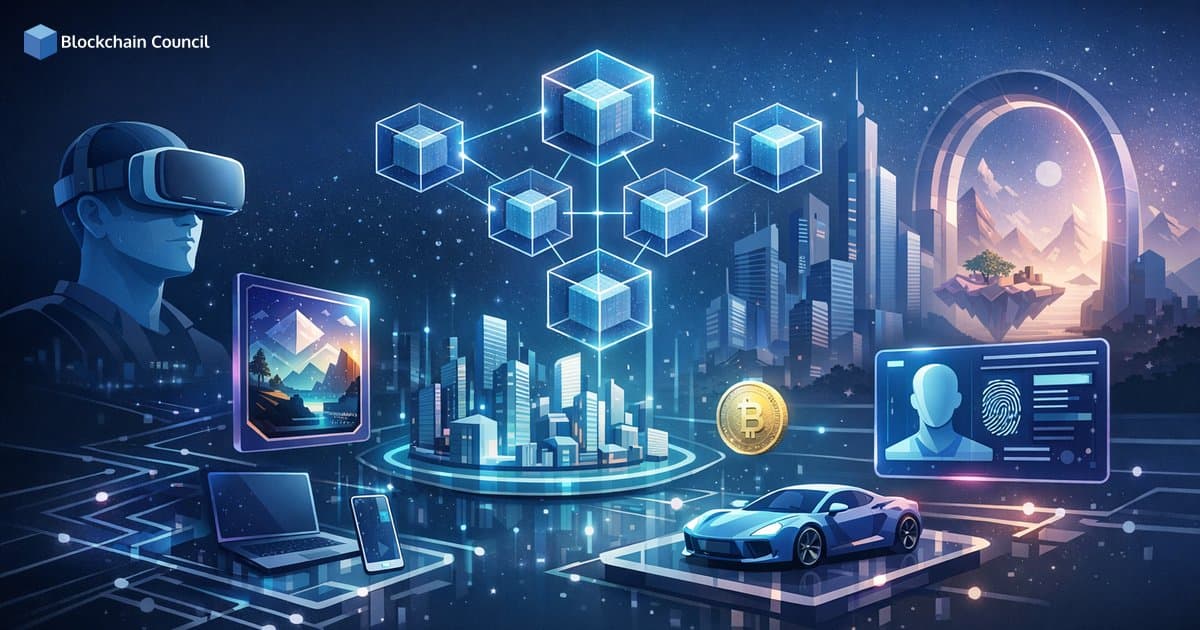
How blockchain enables metaverse economies is no longer just a theoretical discussion. As virtual worlds expand into gaming, events, education, and enterprise collaboration, blockchain provides practical building blocks for ownership, identity, and commerce across environments. NFTs make digital items verifiably ownable, wallets and decentralized identifiers help users carry identity and credentials, and smart contracts automate transactions and rights. The result is an economic layer that can function beyond any single platform, even though true interoperability remains constrained by standards, business choices, and regulation.
Why Blockchain Matters for Metaverse Economies
Most traditional virtual economies are controlled by the platform operator. Items are typically licensed rather than owned, account access can be revoked, and marketplaces can be changed unilaterally. Blockchain introduces a different model that supports a more open economic design:

Verifiable ownership through NFTs and tokenized assets
Portable digital identity through wallets, decentralized identifiers (DIDs), and verifiable credentials
Programmable transactions through smart contracts
Cross-platform value transfer through token standards and wallet interoperability
Projects such as Decentraland and The Sandbox have used NFTs for land and in-world items, demonstrating how on-chain ownership can underpin marketplace activity and creator economies. Industry reporting also shows NFTs evolving from speculative collectibles toward utility-driven roles in gaming, membership, ticketing, and access control.
NFTs: The Ownership Primitive for Virtual Goods
NFTs remain the most widely used mechanism for representing unique metaverse assets. Common examples include:
Virtual land parcels
Avatars and character skins
Wearables and digital fashion
In-game items and collectibles
Event tickets and VIP passes
Memberships and loyalty entitlements
What NFTs Add to a Metaverse Economy
An NFT records a unique token ID, an ownership history, and rules enforced by a smart contract. That supports economic behaviors that are difficult to implement credibly in closed platforms:
Secondary markets where users can trade assets peer-to-peer
Creator monetization via direct sales and contract-based royalty logic
Provenance that helps distinguish authentic assets from copies
Transferability outside a single app or server, if platforms choose to recognize the asset
Industry trackers such as DappRadar have consistently reported that NFT market activity cooled from the 2021-2022 peak, but trading continues and is increasingly focused on utility - particularly in gaming-related use cases. Ethereum remains a major hub for high-value NFTs, while networks such as Polygon, Immutable, and Solana compete on lower fees and gaming throughput.
Digital Identity: From Platform Accounts to Self-Sovereign Identity
Metaverse participants need more than just an avatar. They often require persistent identity for reputation, access control, transaction history, and credential-based participation. This is driving a shift from platform-owned accounts toward wallet-based identity and decentralized identity frameworks.
Key Identity Components Used in Metaverse Systems
Wallets as a login and account primitive (for example, wallet sign-in replacing email and password)
Decentralized identifiers (DIDs) for portable identity anchors
W3C Verifiable Credentials for claims such as membership, age verification, or qualifications
Human-readable naming systems such as ENS for discoverable identity
Privacy-preserving proofs such as zero-knowledge approaches used in systems like Polygon ID
Identity in the metaverse often requires selective disclosure. A user may need to prove they are over a certain age, hold a membership pass, or have completed a course, without revealing unnecessary personal data. Privacy-preserving identity design also aligns with modern data protection requirements, including GDPR principles.
Where Digital Identity Connects to Education and Credentials
Credentialing is a practical, non-speculative identity use case. NFT-based certificates or verifiable credentials can support portable proof of learning in virtual training environments. Professionals building expertise in this area can develop relevant skills through certifications in Blockchain, Web3, Smart Contracts, and Metaverse, as well as security and compliance tracks that map directly to real deployment needs.
Smart Contracts: Programmable Commerce and Automated Rights
Smart contracts provide the automation layer for metaverse economies. Instead of relying on manual approvals or centralized administrators, rules execute transparently on-chain. Common metaverse-aligned applications include:
Marketplace logic for listing, escrow, and settlement
Royalty and revenue sharing for creators and collaborators
Rental and leasing for virtual land or high-value assets
Event ticket validation and resale constraints
Rewards and loyalty programs tied to usage or participation
Access permissions for gated spaces and experiences
Smart contract engineering and auditing are critical competencies in this space. Many failures in Web3 economies stem from insecure contracts or poorly designed incentive models, making security-focused development skills particularly valuable for practitioners.
Cross-Platform Asset Portability: The Promise and the Reality
Cross-platform portability is one of the most frequently cited reasons for applying blockchain to metaverse economies. In principle, if a user owns a wearable NFT or a reputation credential, they should be able to use it across multiple worlds and marketplaces because the asset exists on-chain rather than inside a single company database.
Why Portability Remains Uneven
Portability is constrained by more than token transferability. Several layers must align:
Technical interoperability - another application can read the token, the chain, and the metadata.
Semantic interoperability - the receiving world understands what the asset represents and how it should behave.
Business interoperability - the platform chooses to honor external assets and allow them within its economy.
Legal interoperability - rights and responsibilities are recognized across jurisdictions and terms of service.
Blockchain addresses the first layer most directly and can partially support the second through shared metadata conventions. The third and fourth layers are often the hardest to resolve. A token can be owned on-chain, but the platform still decides whether it will render the wearable, accept the ticket, or recognize the credential.
Examples of Portability Use Cases
Wearables that appear in multiple experiences, where file formats and rigging standards align
Access passes that unlock events or premium areas across partner worlds
Reputation badges or non-transferable achievements used as trust signals
Land or property rights that can be used as collateral or rented via shared contract patterns
Real-World Metaverse Economy Patterns
Decentraland and The Sandbox: NFTs Plus Native Tokens
Decentraland uses NFT-based land parcels and assets, enabling ownership and trading through on-chain records. The Sandbox similarly supports a creator-driven model where assets can be minted as NFTs and exchanged using a native token. These examples reflect a recurring design pattern: NFTs represent unique property and items, while a fungible token supports payments, incentives, and marketplace fees.
Ticketing, Events, and Loyalty
NFT ticketing is a practical use case because it can reduce forgery, encode resale rules, and preserve attendee history for loyalty rewards or perks. This applies to both fully virtual events and hybrid experiences where attendance and entitlements require verification.
Security, Compliance, and Legal Clarity
As metaverse economies grow, risk exposure increases. Security researchers and compliance professionals have noted that NFT flows across chains and marketplaces can complicate transaction tracing. The same portability that benefits users can also enable fraud, phishing, and money laundering patterns if controls are inadequate.
Key Risk Areas to Plan For
Wallet security issues such as phishing and seed phrase theft
Smart contract exploits and unsafe marketplace integrations
Counterfeit NFTs and fraudulent storefronts
AML and sanctions compliance challenges in pseudonymous environments
Consumer protection scrutiny for virtual land and token promotions
Legal experts also emphasize that NFT ownership can be ambiguous. Holding a token does not automatically grant copyright or commercial usage rights unless terms explicitly define them. Sustainable metaverse economies require clear disclosures about what is actually being sold: the token, the underlying content license, access rights, or a combination of these.
Regulatory Direction Shaping Identity
Outside of Web3, policies such as the European Union's eIDAS 2.0 regulation and the European Digital Identity Wallet initiative are accelerating broader adoption of portable, user-controlled credentials. While not metaverse-specific, this regulatory trajectory reinforces the infrastructure assumptions behind verifiable credentials and privacy-preserving identity systems.
Future Outlook: Utility, Identity, and Standards
Multiple research and industry signals point toward a maturing market that is less driven by speculation and more focused on infrastructure:
Utility-first NFTs in gaming, access control, membership, and credentials
Identity as a core asset via portable credentials and reputation systems
Zero-knowledge proofs and selective disclosure for privacy and regulatory compliance
Layer 2 adoption to reduce cost and network congestion
Interoperability standards for metadata, credentials, and cross-chain messaging
Tokenized digital property will likely persist, but within stricter boundaries and clearer legal definitions. Users and enterprises are increasingly distinguishing between on-chain ownership of a token and the legal rights attached to the underlying content or experience.
Conclusion: A Practical Stack for Metaverse Economies
How blockchain enables metaverse economies can be understood as a three-part stack: NFTs provide the ownership layer, digital identity provides continuity and trust, and smart contracts provide automation for commerce and rights management. Cross-platform asset portability is the headline benefit, but it depends on shared standards and platform cooperation, not just token transferability.
For builders and professionals, the most durable opportunities lie in the infrastructure that makes metaverse economies function: secure smart contracts, verifiable credentials, wallet user experience, interoperable metadata, and compliance-aware design. These are the competencies that will define credible metaverse systems as the market shifts from speculation toward sustained utility.
Related Articles
View All
Metaverse
Enterprise Metaverse Use Cases: Training, Remote Collaboration, and Digital Twins With Real-World ROI
Explore enterprise metaverse use cases in training, remote collaboration, and digital twins, with practical ROI signals, examples, and KPIs to measure value.
Metaverse
Best Metaverse Crypto and Blockchain Projects
The best metaverse crypto and blockchain projects focus on virtual worlds, NFTs, gaming ecosystems, digital ownership, and Web3 experiences.

Metaverse
Building a Metaverse App: Step-by-Step Roadmap From Concept to Launch
Learn how to build a metaverse app from concept to launch, including tool choices, interoperability standards, security, moderation, and live-ops best practices.
Trending Articles
AWS Career Roadmap
A step-by-step guide to building a successful career in Amazon Web Services cloud computing.
What is AWS? A Beginner's Guide to Cloud Computing
Everything you need to know about Amazon Web Services, cloud computing fundamentals, and career opportunities.
Claude AI Tools for Productivity
Discover Claude AI tools for productivity to streamline tasks, manage workflows, and improve efficiency.