

Enterprise Metaverse Use Cases: Training, Remote Collaboration, and Digital Twins With Real-World ROI

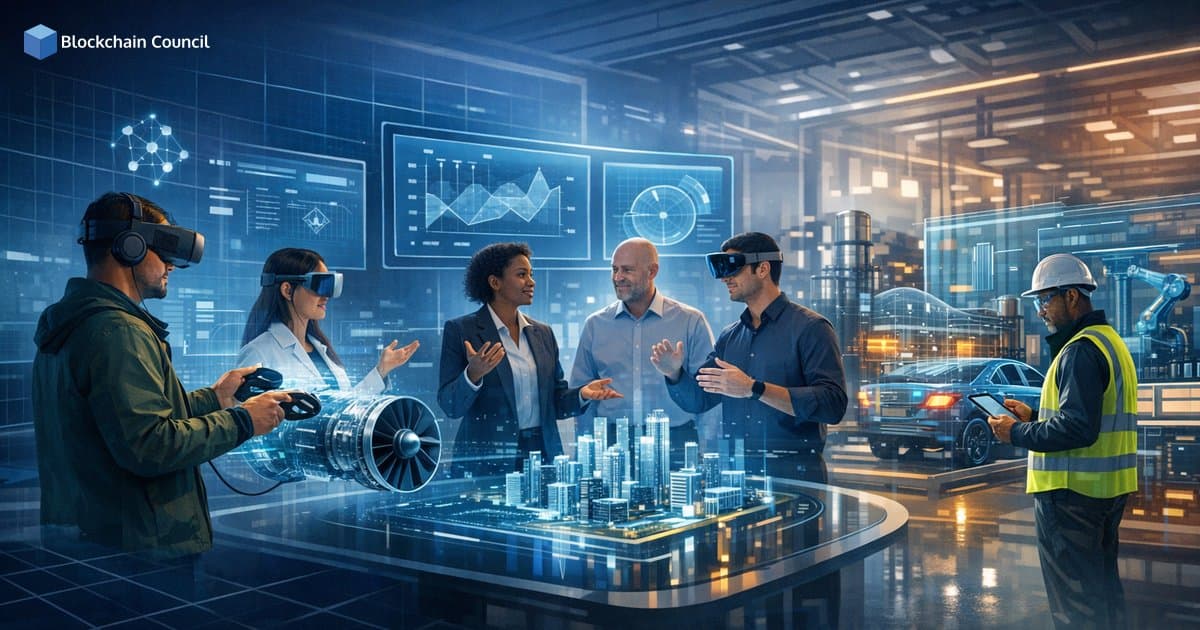
Enterprise metaverse use cases are shifting from experiments to measurable business outcomes, particularly in training, remote collaboration, and digital twins. Rather than treating the metaverse as a single destination, many enterprises now treat it as a practical technology stack connecting immersive interfaces with real operational data, simulation, and analytics. Analysts at McKinsey describe this as the ability to interact with virtual representations of physical systems in real time and run large-scale simulations using live data streams to improve decisions and performance.
This article covers the most mature enterprise metaverse use cases, the factors driving ROI, and how organizations can evaluate where immersive technology and digital twins fit into their operating model.

What the enterprise metaverse means in practice
In enterprise contexts, the metaverse is best understood as a layered set of capabilities:
Persistent 3D environments and virtual spaces for work and learning
XR interfaces including VR, AR, and mixed reality, alongside desktop and mobile access
Digital twins of assets, processes, and environments, continuously updated with live data
Real-time collaboration with spatial presence and shared 3D content
Connected data and AI for simulation, prediction, optimization, and analytics
Adoption signals suggest growing momentum. PwC reported in its 2023 US Metaverse Survey that 51 percent of companies were in some stage of metaverse-related activity, with training, onboarding, and collaboration among the leading use cases. McKinsey estimates the broader metaverse economy could reach multi-trillion-dollar value by 2030, with industrial and enterprise value driven heavily by digital twins, simulation, and collaboration. IoT Analytics projects the digital twin market could reach approximately 86 billion USD by 2028, driven by manufacturing, mobility, and energy sectors where 3D visualization is increasingly tied to training and remote operations.
Use case 1: Metaverse-based training with measurable operational impact
Training represents one of the clearest paths to ROI because it connects directly to time-to-competency, safety outcomes, procedural standardization, and travel costs. Enterprise metaverse training typically falls into two categories:
Technical and operational training for equipment, procedures, and safety protocols
Soft skills and leadership development through role-play and scenario-based practice
Why immersive training is expanding
Enterprises are using immersive environments to simulate realistic work scenarios, including hazardous tasks, complex procedures, and high-stakes customer interactions. InfoPro Learning expects metaverse environments to be used extensively for leadership development by 2026, covering emotional intelligence, conflict resolution, ethical decision making, and inclusive leadership through immersive role-play with real-time feedback.
Training ROI signals enterprises can measure
Faster training and higher confidence: PwC research on VR soft-skills training found VR learners could be trained up to four times faster than classroom learners and reported higher confidence when applying skills.
Reduced downtime and equipment dependency: Digital twin-based training avoids taking machines offline and reduces wear on physical equipment used for instruction.
Improved safety outcomes: Hazard simulation enables repeated practice of emergency procedures, lockout-tagout routines, and incident response without real-world risk.
Scalable global access: Standardized training can be delivered to distributed teams without travel, and subject-matter experts can participate remotely from any location.
Real-world training examples
Industrial operations and safety are common starting points. McKinsey notes that AR and VR experiences allow employees to interact with detailed 3D replicas of equipment for design and operations training directly from their workstations. Digital twins also enable 24/7 virtual training where workers can disassemble complex equipment virtually without disrupting production or creating safety risk.
Healthcare education is another strong fit. Anatomy digital twins and AR overlays help clinicians rehearse procedures and improve surgical planning, including collaboration with remote specialists during preparation.
Leadership and communication training increasingly relies on role-play scenarios. Immersive environments let managers practice high-stakes conversations in a psychologically safe context and receive structured feedback on behavior and decision making.
Use case 2: Remote collaboration that goes beyond video calls
Remote collaboration is evolving from static screen-sharing tools into shared 3D workspaces that support spatial presence and persistent project contexts. InfoPro Learning notes that metaverse collaboration spaces can replace conventional tools as remote and hybrid work models mature. ABI Research similarly highlights workplace collaboration as a leading enterprise metaverse use case, particularly when connected to digital twins and engineering systems.
Common forms of enterprise metaverse collaboration
Virtual headquarters and persistent offices: Digital offices that mirror physical layouts and create a sense of co-location for distributed teams.
Design and engineering reviews: Shared 3D environments for CAD review, product iteration, and cross-functional feedback with fewer coordination delays.
Remote operations support: AR-guided assistance where remote experts help on-site workers troubleshoot equipment and perform maintenance procedures.
Where ROI tends to show up
Reduced travel for design reviews, audits, and inspections while maintaining rich visual context for decision makers.
Faster problem-solving by using a shared digital twin as a single source of truth for diagnosing issues and testing fixes in simulation before applying them in production.
Shorter decision cycles in complex environments where 3D context is critical, such as factories, campuses, and infrastructure projects.
While many organizations do not publish full cost-benefit ratios, McKinsey and IoT Analytics emphasize that digital twin-enabled collaboration often pays back through reduced downtime, faster engineering cycles, and less physical prototyping.
Use case 3: Digital twins as the engine of enterprise metaverse ROI
Digital twins are central to enterprise metaverse value because they connect 3D environments to operational reality. McKinsey characterizes modern digital twins as fit-for-purpose, cross-functional representations of assets or processes that are continuously updated with live data, forming a foundation for enterprise metaverse applications. IoT Analytics frames next-generation digital twins as persistent, collaborative replicas that support monitoring, prediction, optimization, and training across multiple functions.
What digital twins enable that spreadsheets and dashboards cannot
Simulation before action: Test new configurations, maintenance plans, or process changes digitally before they affect production.
Predictive maintenance: Ingest IoT signals to detect anomalies, predict equipment failures, and schedule maintenance to minimize unplanned downtime.
Cross-functional alignment: Give engineering, operations, safety, and leadership a shared model of how a system behaves under different conditions.
Reuse across workflows: Apply the same twin to operations optimization, onboarding, emergency drills, and remote support without rebuilding from scratch.
Real-world examples of digital twin value
Mercedes-Benz has used NVIDIA Omniverse Enterprise to build a digital twin of its Rastatt plant to simulate new assembly processes for an EV line, aiming to reduce production disruption, identify bottlenecks earlier, and improve reconfiguration speed under supply chain constraints.
SoFi Stadium has used a digital twin to optimize operations including crowd flow planning, energy usage, and security scenarios, enabling testing of event configurations and emergency responses before execution.
SpaceX has used a digital twin of the Dragon capsule to monitor and adjust trajectories and system loads, supporting reliability and safety in mission-critical operations.
How to evaluate ROI: a practical enterprise checklist
Enterprises achieve more consistent results when they define ROI metrics before deployment and tie pilots to specific operational KPIs. The checklist below can help scope an enterprise metaverse initiative built for measurable value.
1) Choose a use case with clear cost drivers
High training costs driven by travel, instructor time, or equipment downtime
High incident risk involving safety or compliance exposure
High complexity collaboration such as design reviews and multidisciplinary operations
High downtime costs from maintenance and reliability constraints
2) Define measurable KPIs
Time-to-competency and training throughput
Incident rate, near-miss rate, and procedural compliance
Mean time to repair and first-time fix rate
Engineering cycle time and prototyping cost reduction
Travel reduction and avoided downtime costs
3) Treat the digital twin as a reusable asset
ROI cases improve significantly when the same model supports multiple workflows, such as training combined with remote support and process optimization. Plan for lifecycle ownership, data integration, and governance so the twin remains accurate and current over time.
Future outlook: convergence of twins, XR, and AI
The next phase of enterprise metaverse development is expected to come from the convergence of several maturing technologies:
Digital twins combined with XR for intuitive human interaction with complex physical systems
AI-enhanced simulation for predictive and prescriptive recommendations, including mass simulation under uncertainty
Interconnected system-level twins spanning factories, supply chains, logistics, and customer environments
Standardization and interoperability for 3D assets, identity, and spatial computing across vendors and platforms
In training, AI can support adaptive learning paths where scenarios adjust dynamically based on learner performance. In regulated sectors, verifiable immersive training records and standardized simulations are likely to become more important as compliance expectations increase.
Conclusion: where real-world ROI is strongest today
Enterprise metaverse use cases are most actionable today in three areas: training, remote collaboration, and digital twins. Training delivers visible impact through faster onboarding, safer practice environments, and reduced equipment downtime. Remote collaboration becomes substantially more valuable when teams can work inside shared 3D contexts and digital replicas, cutting travel costs and accelerating decisions. Digital twins are the operational backbone that makes these environments more than visualization tools, enabling simulation, optimization, predictive maintenance, and reuse across multiple business functions.
For organizations aiming to move beyond pilots, the most reliable path is to start with a KPI-driven use case, build a maintainable data-connected twin, and deploy immersive interfaces where they directly reduce cost, risk, and cycle time. Building team capability also matters - structured learning paths in metaverse technologies, AR-VR, AI, and cybersecurity help organizations implement these systems responsibly and at scale.
Related Articles
View All
Metaverse
Metaverse use cases in real life
Explore real-life use cases of the metaverse across industries like gaming, education, real estate, and business.

Metaverse
How Blockchain Enables Metaverse Economies: NFTs, Digital Identity, and Asset Portability
Learn how blockchain enables metaverse economies using NFTs for ownership, decentralized identity for trust, and cross-platform asset portability for interoperable digital value.

Metaverse
Building a Metaverse App: Step-by-Step Roadmap From Concept to Launch
Learn how to build a metaverse app from concept to launch, including tool choices, interoperability standards, security, moderation, and live-ops best practices.
Trending Articles
AWS Career Roadmap
A step-by-step guide to building a successful career in Amazon Web Services cloud computing.

Top 5 DeFi Platforms
Explore the leading decentralized finance platforms and what makes each one unique in the evolving DeFi landscape.

Can DeFi 2.0 Bridge the Gap Between Traditional and Decentralized Finance?
The next generation of DeFi protocols aims to connect traditional banking with decentralized finance ecosystems.