

Top 10 AI Innovations to Watch in 2026

Artificial intelligence is no longer a futuristic concept. It is embedded in business operations, consumer products, healthcare systems, and even creative industries. In 2026, AI is moving beyond assistance into autonomy, reasoning, and real-world interaction. These innovations are not just incremental improvements but fundamental shifts in how technology operates.
For those trying to keep up without feeling completely outdated, structured learning paths like the Agentic AI Expert Certification and the AI expert certification provide essential grounding in modern AI systems and their practical applications.

This article explores the top 10 AI innovations shaping 2026, based on recent developments, industry adoption, and real-world use cases.
Why AI Innovations in 2026 Matter
AI is evolving from reactive systems to proactive and autonomous ones. The shift is subtle but important. Earlier systems responded to inputs. Modern systems anticipate needs, make decisions, and execute tasks with minimal human involvement.
Key reasons why 2026 stands out include:
Rapid advancement in generative AI
Growth of multimodal and reasoning models
Increased enterprise adoption
Integration with physical systems like robotics and AR
This combination is what makes current innovations more impactful than previous waves.
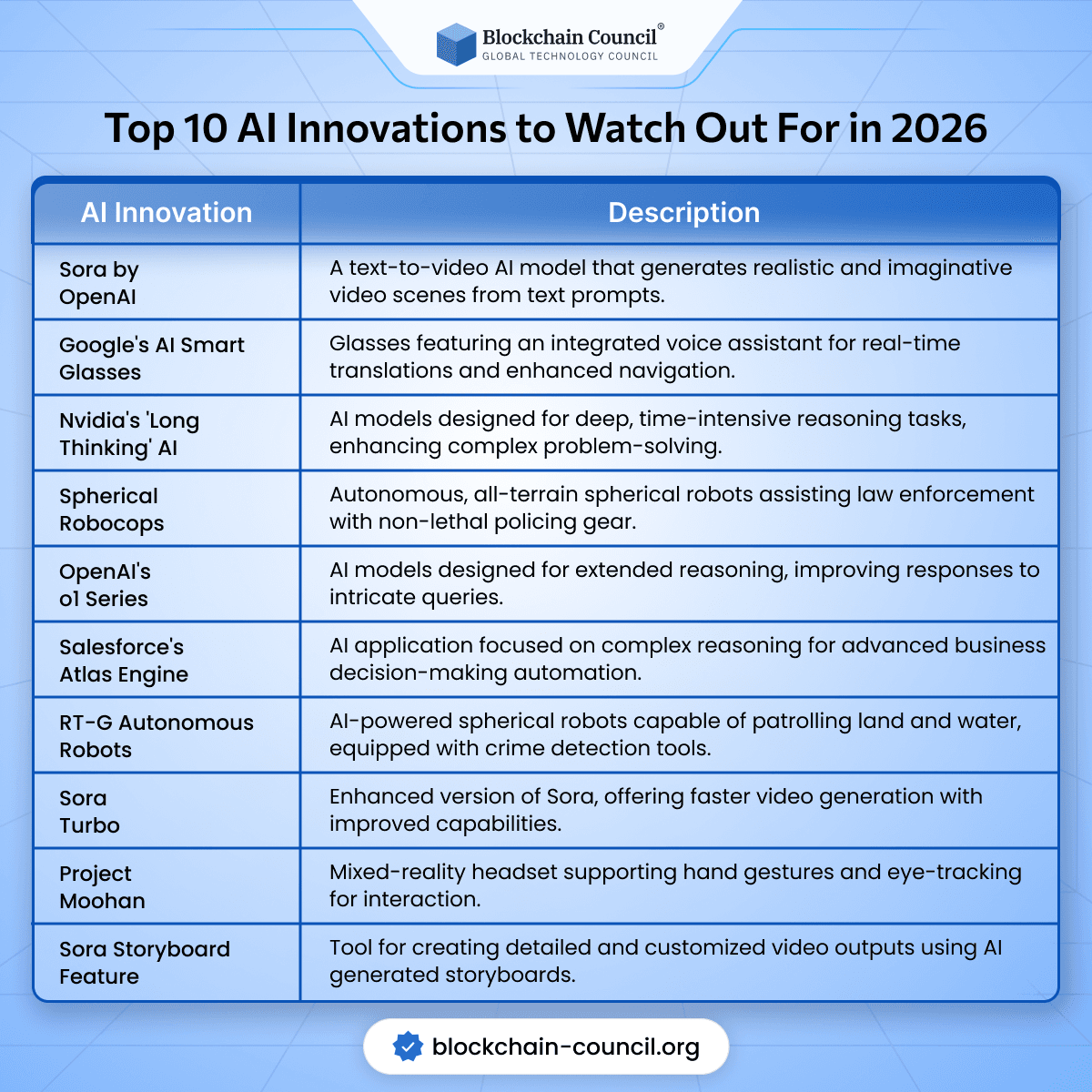
1. Sora by OpenAI: Text to Video Revolution
One of the most talked-about innovations is Sora, a text to video AI model capable of generating realistic and imaginative video scenes from simple prompts.
Key Capabilities
High-quality video generation
Scene consistency and realism
Complex motion understanding
Real-World Impact
Content creation, advertising, and filmmaking are already experimenting with Sora. A marketing team can generate promotional videos without traditional production costs, which is efficient but also slightly terrifying for anyone in video editing.
2. Google’s AI Smart Glasses
Wearable AI is finally becoming practical rather than gimmicky. Google’s AI-powered smart glasses integrate real-time voice assistance, translation, and navigation.
Features
Live language translation
Augmented navigation overlays
Hands-free AI interaction
Example
Tourists can navigate foreign cities while receiving instant translations, making language barriers far less intimidating.
3. Nvidia’s Long Thinking AI Models
Short responses are easy. Deep reasoning is not. Nvidia is focusing on AI systems designed for long, complex problem-solving tasks.
What Makes It Different
Extended reasoning capabilities
Improved contextual understanding
Better performance on multi-step tasks
Use Case
These models are being used in scientific research and engineering simulations where quick answers are useless without depth.
4. Spherical Robocops
Yes, that sounds like something from a dystopian movie, and it’s not far off. These autonomous spherical robots assist in law enforcement using non-lethal technology.
Capabilities
Autonomous navigation
Surveillance and monitoring
Crowd control support
Real-World Use
Some cities are testing these robots for public safety patrols, reducing the need for constant human presence in high-risk areas.
5. OpenAI’s O1 Series Models
The O1 series represents a new generation of AI focused on reasoning and problem-solving rather than just generating responses.
Key Improvements
Better handling of complex queries
More accurate logical reasoning
Reduced hallucination issues
Example
These models are being used in technical fields such as coding, finance, and research, where accuracy is critical.
6. Salesforce Atlas Engine
Business automation is becoming smarter with AI engines like Salesforce Atlas, designed for advanced decision-making.
Features
Predictive business analytics
Automated workflow optimization
Real-time insights
Impact
Companies can now automate complex decisions such as sales forecasting and customer segmentation with minimal manual input.
7. RT G Autonomous Robots
These robots are designed for both land and water operations, equipped with advanced AI for crime detection and surveillance.
Capabilities
Multi-environment operation
AI-based threat detection
Autonomous patrolling
Example
Security agencies are using these robots for border monitoring and maritime safety operations.
8. Sora Turbo: Faster AI Video Generation
If Sora was not fast enough, Sora Turbo improves speed and efficiency, making video generation more practical for real-time applications.
Benefits
Faster processing
Improved video quality
Enhanced scalability
Use Case
Media companies can generate video content at scale, reducing production timelines significantly.
9. Project Moohan: Mixed Reality with AI
Project Moohan introduces AI-powered mixed reality headsets that support gesture control and eye tracking.
Features
Immersive interaction
AI-driven environment adaptation
Enhanced user experience
Example
Training simulations in industries like healthcare and aviation are becoming more realistic and effective.
10. Sora Storyboard Feature
Creating structured video content becomes easier with AI-generated storyboards.
Capabilities
Automated scene planning
Customizable video sequences
Improved creative workflows
Impact
Filmmakers and marketers can plan complex video projects without extensive manual effort.
The Role of AI Skills in Adapting to Innovation
Understanding these innovations is not optional anymore. Professionals need both technical and practical knowledge to stay relevant.
Programs like the AI Powered coding expert Course help build development skills, while the AI powered marketing course focuses on applying AI in business strategies.
Without these skills, interacting with advanced AI tools becomes more guesswork than strategy.
Challenges Behind These Innovations
Despite impressive advancements, AI innovations come with challenges:
Ethical concerns around surveillance and automation
Data privacy issues
High implementation costs
Risk of over-reliance on AI systems
Ignoring these challenges tends to lead to systems that are powerful but poorly managed.
Future Outlook for AI Beyond 2026
The trajectory of AI suggests even more advanced developments:
Fully autonomous systems across industries
Deeper human AI collaboration
More intuitive and personalized experiences
The pace of change is unlikely to slow down, which is either exciting or exhausting depending on how much you enjoy constant adaptation.
Conclusion
The top AI innovations of 2026 highlight a clear shift toward autonomy, intelligence, and real-world integration. From text to video generation to advanced robotics and wearable AI, these technologies are redefining how industries operate.
Understanding these innovations is essential for staying competitive in a rapidly evolving environment. Those who invest in learning and adapting will benefit from AI’s capabilities, while others may find themselves wondering why everything suddenly became automated.
FAQs
1. What are the top AI innovations in 2026
The top AI innovations in 2026 include advancements like Sora video generation, AI smart glasses, long reasoning models, and autonomous robots. These technologies are transforming industries by improving efficiency, automation, and user experience. They represent a shift toward more intelligent and autonomous systems that operate with minimal human intervention.
2. What is Sora AI and why is it important
Sora is a text to video AI model that generates realistic video content from simple prompts. It is important because it reduces the need for traditional video production processes and makes content creation more accessible. This innovation is expected to significantly impact media, marketing, and entertainment industries.
3. How do AI smart glasses work
AI smart glasses integrate sensors, cameras, and AI software to provide real-time assistance such as translation and navigation. They process visual and audio data to deliver contextual information directly to the user. This makes them useful for travel, accessibility, and everyday tasks.
4. What is long thinking AI
Long thinking AI refers to models designed to handle complex, multi-step reasoning tasks over extended periods. These systems are capable of deeper analysis and better contextual understanding. They are particularly useful in research, engineering, and strategic decision-making.
5. Are AI robots replacing human jobs
AI robots are automating certain tasks, especially repetitive or high-risk ones, but they are not entirely replacing human jobs. Instead, they are changing job roles and creating new opportunities that require advanced skills. Human oversight and creativity remain essential.
6. What is the O1 series AI model
The O1 series is a new generation of AI models focused on reasoning and accuracy rather than just generating responses. These models are better at handling complex queries and reducing errors. They are widely used in technical and professional applications.
7. How is AI used in business automation
AI is used in business automation to analyze data, predict outcomes, and optimize workflows. It helps companies make faster and more informed decisions. This leads to improved efficiency and reduced operational costs.
8. What are autonomous robots
Autonomous robots are machines that operate independently using AI to navigate and perform tasks. They are used in areas such as security, logistics, and exploration. These robots reduce the need for human intervention in complex environments.
9. What is mixed reality with AI
Mixed reality with AI combines virtual and physical environments, enhanced by intelligent systems. It allows users to interact with digital elements in real-world settings. This technology is used in training, gaming, and design.
10. How does AI improve video production
AI improves video production by automating tasks such as editing, scene generation, and storyboard creation. It reduces production time and costs while maintaining quality. This makes video creation more efficient and scalable.
11. What are the risks of AI innovation
Risks include ethical concerns, data privacy issues, and over-reliance on automation. These challenges require careful management and regulation. Without proper oversight, AI systems can create unintended consequences.
12. How can professionals learn AI
Professionals can learn AI through certifications, courses, and hands-on experience with AI tools. Structured programs provide both theoretical knowledge and practical skills. Continuous learning is essential to stay relevant.
13. What industries benefit most from AI
Industries such as healthcare, finance, manufacturing, and entertainment benefit significantly from AI innovations. These technologies improve efficiency, accuracy, and decision-making. Their impact continues to expand across sectors.
14. How does AI affect creativity
AI enhances creativity by providing tools for generating ideas and content quickly. However, it does not replace human creativity, which is driven by emotion and experience. The best results come from combining both.
15. What is generative AI
Generative AI refers to systems that create new content such as text, images, or videos based on learned patterns. It is widely used in content creation and design. This technology is evolving rapidly.
16. How fast is AI evolving
AI is evolving at an extremely rapid pace, with new developments emerging frequently. Advances in computing power and data availability are driving this growth. Keeping up requires continuous learning and adaptation.
17. What is the future of AI innovation
The future of AI innovation includes more advanced, autonomous, and personalized systems. These technologies will continue to transform industries and daily life. Their influence is expected to grow significantly.
18. Can AI make decisions independently
Yes, modern AI systems can make decisions based on predefined goals and data analysis. However, human oversight is still necessary to ensure accuracy and ethical use. Autonomous decision-making is a key trend in AI.
19. What skills are needed for AI careers
Skills include programming, data analysis, machine learning, and problem-solving. Understanding AI concepts and tools is essential. Continuous learning helps professionals remain competitive.
20. Why is AI important in 2026
AI is important in 2026 because it drives innovation, improves efficiency, and enables new capabilities across industries. It helps businesses and individuals achieve better outcomes. Its role in shaping the future is undeniable.
Related Articles
View All
Infographics
Top 10 Crypto Acronyms Explained
Crypto acronyms explained simply to help beginners understand common blockchain terms like BTC, ETH, NFT, and DeFi.
Infographics
Top 10 Trends in Fintech
The financial technology sector is continually evolving, pushing the boundaries of how we think about and manage our financial lives. From advancements in artificial intelligence to the rise of digital-only banks, the top ten trends in fintech are shaping the future of finance in profound ways.…
Infographics
Top 10 Generative AI Trends in 2025
As we approach 2025, the landscape of artificial intelligence is evolving rapidly, especially in the realm of generative AI. This technology is setting the stage for innovative applications across various sectors, from design and creativity to healthcare and ethical AI. Here’s a look at the…
Trending Articles

Top 5 DeFi Platforms
Explore the leading decentralized finance platforms and what makes each one unique in the evolving DeFi landscape.
What is AWS? A Beginner's Guide to Cloud Computing
Everything you need to know about Amazon Web Services, cloud computing fundamentals, and career opportunities.
Claude AI Tools for Productivity
Discover Claude AI tools for productivity to streamline tasks, manage workflows, and improve efficiency.