

Search Google or Type a URL: How the Browser Address Bar Really Works
 Suyash Raizada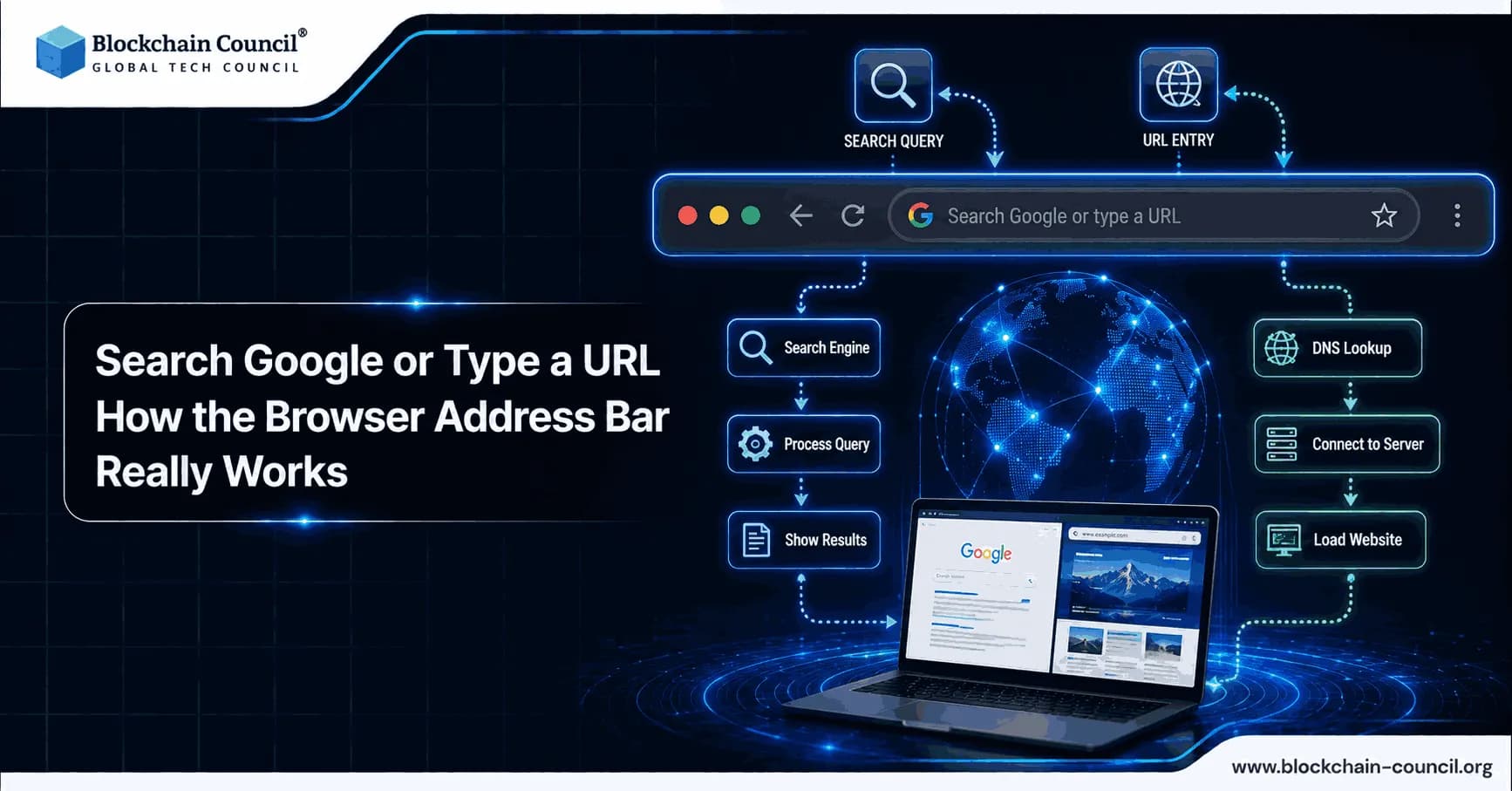
The prompt search google or type a url is more than placeholder text. It describes how modern browsers use a single address bar (often called an omnibox) to handle two core actions: running a search and navigating directly to a website. This unified design is now standard across Chrome, Firefox, Edge, and Safari, helping users move faster between research and direct access to trusted tools.
Below is a practical guide to what search google or type a url means, when each method is better, and how professionals can apply advanced techniques for speed, accuracy, and security.

What Does "Search Google or Type a URL" Mean?
In most browsers, the address bar serves two distinct purposes:
A search box: Type keywords like blockchain certification to search using your default search engine.
A navigation field: Type a web address like https://www.blockchain-council.org to go directly to a site.
This combined interface reduces friction by eliminating the need to open a search engine homepage first. It also enables quick suggestions, history-based completion, and AI-assisted intent prediction based on partial input. Understand how browser address bars process searches, URLs, DNS lookups, and autocomplete systems to improve web navigation and search efficiency by building expertise through an AI certification, analyzing browser workflows and automation systems using a Python certification, and optimizing digital experiences with a Digital marketing course.
Search Google vs. Type a URL: What the Data Shows
Browser interaction data and UX benchmarks consistently reveal a split between discovery (search) and precision (direct navigation):
Usage split: Roughly 65% of address bar interactions are searches, while about 35% are direct URL entries, based on reported Chrome telemetry trends.
Speed: Typing a URL can be roughly 2 to 3 times faster (often under 2 seconds) than scanning search results (commonly 5 to 7 seconds), according to Nielsen Norman Group UX benchmarks.
Error rates: Direct URL typing carries a notable typo failure rate, often cited between 15% and 20%, while search engines correct most misspellings automatically.
Mobile behavior: On mobile devices, searches dominate due to smaller keyboards, with estimates suggesting around 70% of omnibox interactions are search-driven.
Quick Comparison
Search Google: better for exploration, comparisons, and unfamiliar topics.
Type a URL: better for known destinations, secure portals, and repeat workflows.
When to Search Google (and When Not To)
Searching Google works best when you want options and context. A professional evaluating training options, for example, might search best blockchain certification to compare curricula, prerequisites, and industry recognition across providers.
Best Use Cases for Search
Research and discovery: comparing tools, reading documentation, or learning a new concept.
Tracking trends: searching for updates like Web3 security trends or AI governance regulations.
Problem solving: looking up error messages, configuration steps, or code snippets.
Limitations to Keep in Mind
Extra decision time: results require scanning, which slows down frequent tasks.
Phishing exposure: search results can include malicious ads or lookalike domains, particularly around high-value targets like wallets, exchanges, and banking logins.
Privacy tradeoffs: search queries can be logged and used for personalization depending on browser and search settings. Direct navigation is often recommended for sensitive destinations.
When to Type a URL (and How to Do It Safely)
Typing a URL is the most direct method when you already know the destination. It is especially practical for repeat visits where brand recall is strong. Many users, for instance, type gmail.com rather than searching for Gmail.
Best Use Cases for Typing a URL
Secure logins: banking portals, admin dashboards, and enterprise applications.
Certification and learning dashboards: navigating directly to an official source, such as https://www.blockchain-council.org, avoids result clutter and reduces misdirection risk.
Time-critical workflows: repeated daily tools where speed matters.
Safety Checklist for Direct Navigation
Use HTTPS: confirm the lock icon is present and the domain is spelled correctly.
Bookmark critical sites: applies to exchanges, wallets, banking portals, and learning platforms.
Watch for lookalike domains: attackers frequently register domains that differ by a single character from legitimate sites.
Avoid copying URLs from unknown sources: messaging apps and social platforms can conceal malicious links.
Power Tips: Getting More from the Omnibox
The omnibox is not just a search field. Used well, it functions as a command interface for faster navigation and more targeted research.
1) Use Site-Specific Search Operators
To search within a single domain, use the site: operator. This is particularly helpful for technical research and documentation.
Example: site:blockchain-council.org certifications locates certification pages quickly.
Example: site:nytimes.com blockchain regulation surfaces relevant articles without browsing the homepage.
2) Let Autocomplete Work for You
Typing a few characters often triggers history-based completion. This reduces the typo rate associated with manual URL entry and improves speed for frequently visited sites.
3) Use Voice Search on Mobile
Recent browser updates have improved voice-to-text in the address bar on mobile, reducing input time for spoken queries. Voice and AI-driven search are expected to continue expanding as a share of mobile browsing.
4) Combine Search and Direct Access for Professional Workflows
Many users naturally alternate between search and direct navigation within a single task:
Search to gather options and assess credibility.
Type a URL (or use a bookmark) to return to the best sources repeatedly.
A practical example: search for blockchain certification prerequisites, then navigate directly to the official provider site to enroll or review the syllabus. Learn how browsers interpret typed queries, differentiate URLs from searches, and connect users to websites through DNS and search engine infrastructure by mastering web technologies through an AI certification, developing browser-related tools using a Node JS Course, and improving SEO and web visibility using an AI powered marketing course.
How AI and Privacy Changes Are Shaping Address Bar Behavior
The omnibox remains a stable, universal browser pattern, but two forces are reshaping how it behaves:
AI-Assisted Suggestions
Modern browsers increasingly predict intent before a full query is entered, offering richer dropdown suggestions and context previews. Chrome has tied its address bar experience more closely to AI-driven search, including contextual follow-up prompts that surface before a user finishes typing.
Privacy-First Defaults and Anonymized Suggestions
Regulatory pressure and user demand have pushed browsers toward more privacy-aware suggestion handling, including limits on tracking cookies and anonymized search suggestions in certain environments. This is relevant for professionals managing sensitive research, security tasks, or compliance-related workflows.
Future Outlook: Will We Still Search or Type URLs?
Many analysts expect embedded AI agents to automate a growing share of navigation within the next several years, pre-loading likely destinations based on context such as calendar events or established usage patterns. Security considerations will keep URL validation and anti-phishing measures central to browser design regardless of how navigation methods evolve.
More specialized URL schemes may also emerge alongside new ecosystems. In Web3 contexts, wallet connections and decentralized application routing may rely on new link formats, while enterprise browsers are likely to add stricter policy checks for high-risk domains.
Conclusion
The phrase search google or type a url reflects a straightforward but important reality: the browser address bar is both a discovery tool and a precision navigation tool. Use search Google when you need breadth, comparison, and context. Type a URL when you need speed, certainty, and safer access to known destinations - particularly for logins and repeat workflows.
For professionals building skills across blockchain, AI, cybersecurity, and Web3, sound navigation habits save time daily and reduce exposure to common web risks. Pair targeted searches with direct navigation to authoritative sources, and bookmark key training hubs and certification dashboards you visit regularly.
FAQs
1. What does “Search Google or Type a URL” mean?
This phrase explains how the browser address bar works as both a search tool and a navigation field. Users can either search keywords or directly enter a website address. Browsers basically turned one box into a multitasking overachiever.
2. What is an omnibox in a browser?
An omnibox is the combined address and search bar found in modern browsers like Chrome and Edge. It allows users to search the web or visit websites directly from one place. Humanity merged two tools into one because apparently clicking twice was unbearable.
3. When should you search Google instead of typing a URL?
Searching Google is useful when researching topics, comparing services, or exploring unfamiliar information. It provides multiple results and broader context for decision-making. Humans enjoy opening fifteen tabs before reading exactly none of them.
4. When is typing a URL the better option?
Typing a URL is best when visiting trusted websites you already know, especially login portals and dashboards. It saves time and reduces the chance of clicking misleading search results. Direct navigation is surprisingly rare for a species obsessed with efficiency.
5. Is typing a URL faster than searching Google?
Yes, direct URL entry is often much faster than searching and scanning results pages. It helps users reach known destinations quickly without extra clicks. Browsers reward certainty, which is refreshing considering how little certainty exists online.
6. What are the risks of searching for websites?
Search results can sometimes include phishing links, fake ads, or misleading domains. This is especially dangerous for banking, crypto, and enterprise login pages. Criminals discovered humans trust the top result like it was handed down from the heavens.
7. Why do mobile users rely more on searches?
Mobile users tend to search more because typing long URLs on small keyboards is inconvenient. Search engines also provide faster suggestions and corrections on mobile devices. Tiny keyboards turned humanity into keyword-dependent creatures.
8. What is direct navigation in web browsing?
Direct navigation means typing a complete web address into the browser to visit a website immediately. It avoids search engines and connects users straight to the destination. It is the digital equivalent of walking directly into a store instead of wandering the parking lot.
9. How does autocomplete improve browsing?
Autocomplete predicts websites and searches based on browsing history and popular suggestions. This reduces typing time and helps users avoid spelling mistakes. Browsers now finish people’s thoughts before they can finish their coffee.
10. Why is HTTPS important when typing a URL?
HTTPS encrypts the connection between the browser and the website, improving security and privacy. Users should always check for the lock icon before entering sensitive information. The internet remains a place where one missing letter can ruin your afternoon.
11. What are lookalike domains?
Lookalike domains are fake websites designed to resemble legitimate ones by changing small characters in the URL. Cybercriminals use them to steal passwords and personal information. Apparently deception became a full-time business model online.
12. How can bookmarks improve online safety?
Bookmarks help users access trusted websites directly without relying on search results every time. They reduce exposure to phishing links and typing errors. Even browsers quietly admit humans should not trust themselves to type accurately every day.
13. What is the site: search operator?
The site: operator allows users to search for content within a specific website only. It helps locate articles, documents, or pages more efficiently. Search engines hide useful features while people keep searching “how to search better.”
14. How does voice search help mobile browsing?
Voice search lets users speak queries instead of typing them into the address bar. This improves convenience and speeds up browsing on mobile devices. Humans built advanced speech recognition mainly to avoid typing with thumbs. Remarkable priorities.
15. Why do professionals combine search and direct navigation?
Professionals often search for information first and later revisit trusted sites directly through bookmarks or typed URLs. This improves both productivity and security during daily workflows. Even experts alternate between exploration and routine like everyone else pretending to be organized.
16. How is AI changing browser address bars?
AI-powered browsers now predict searches, suggest websites, and provide contextual recommendations before users finish typing. These tools aim to improve speed and personalization. Browsers are becoming disturbingly good at anticipating human behavior.
17. What privacy concerns exist with search queries?
Search queries may be logged and analyzed for personalization, advertising, or analytics purposes. This can expose browsing habits and sensitive interests over time. The internet remembers far more than most people realize.
18. Why should users avoid unknown links?
Unknown links from emails, messages, or social media can lead to phishing pages or malware downloads. Directly typing trusted URLs is usually safer. The web contains endless shortcuts leading directly into traps. Efficient, in a sinister way.
19. Will AI eventually replace manual web navigation?
Future AI systems may automate browsing by predicting destinations and preloading websites based on user habits. However, secure URL verification will still remain important. Even advanced AI cannot fully protect humans from clicking suspicious nonsense.
20. What is the main advantage of the modern browser address bar?
The modern address bar combines searching and navigation into one simple interface for convenience and speed. It supports research, productivity, and safer access to trusted websites. One tiny box now carries the burden of humanity’s entire online existence.
Related Articles
View All
Info
Is SEO Dead Without Google Search? What Digital Marketers Should Do Next
SEO is not dead without Google Search. It is evolving into multi-platform and AI-driven discovery across YouTube, social search, marketplaces, and LLM assistants.

Info
Blockchain: What It Is, How It Works, and Why It Matters
A clear guide to blockchain, how it works, its use cases, benefits, limits, and the best learning paths for business and technical professionals.

Info
Ask Google About This Page
Learn how Google’s “About This Page” feature helps users verify website credibility, search transparency, and online information reliability.
Trending Articles
AWS Career Roadmap
A step-by-step guide to building a successful career in Amazon Web Services cloud computing.
Blockchain in Supply Chain Provenance Tracking
Supply chains are under pressure to prove not just efficiency, but also authenticity, sustainability, and fairness. Customers want to know if their coffee really is fair trade, if the diamonds are con
How to Create Claude Skills?
Claude Skills are one of the most important features Anthropic has introduced for users who want automation that is structured, consistent and reusable. Instead of giving Claude long instructions ever