

Google Ads for Doctors SEO Outline: A Practical Framework for Patient Growth
 Suyash Raizada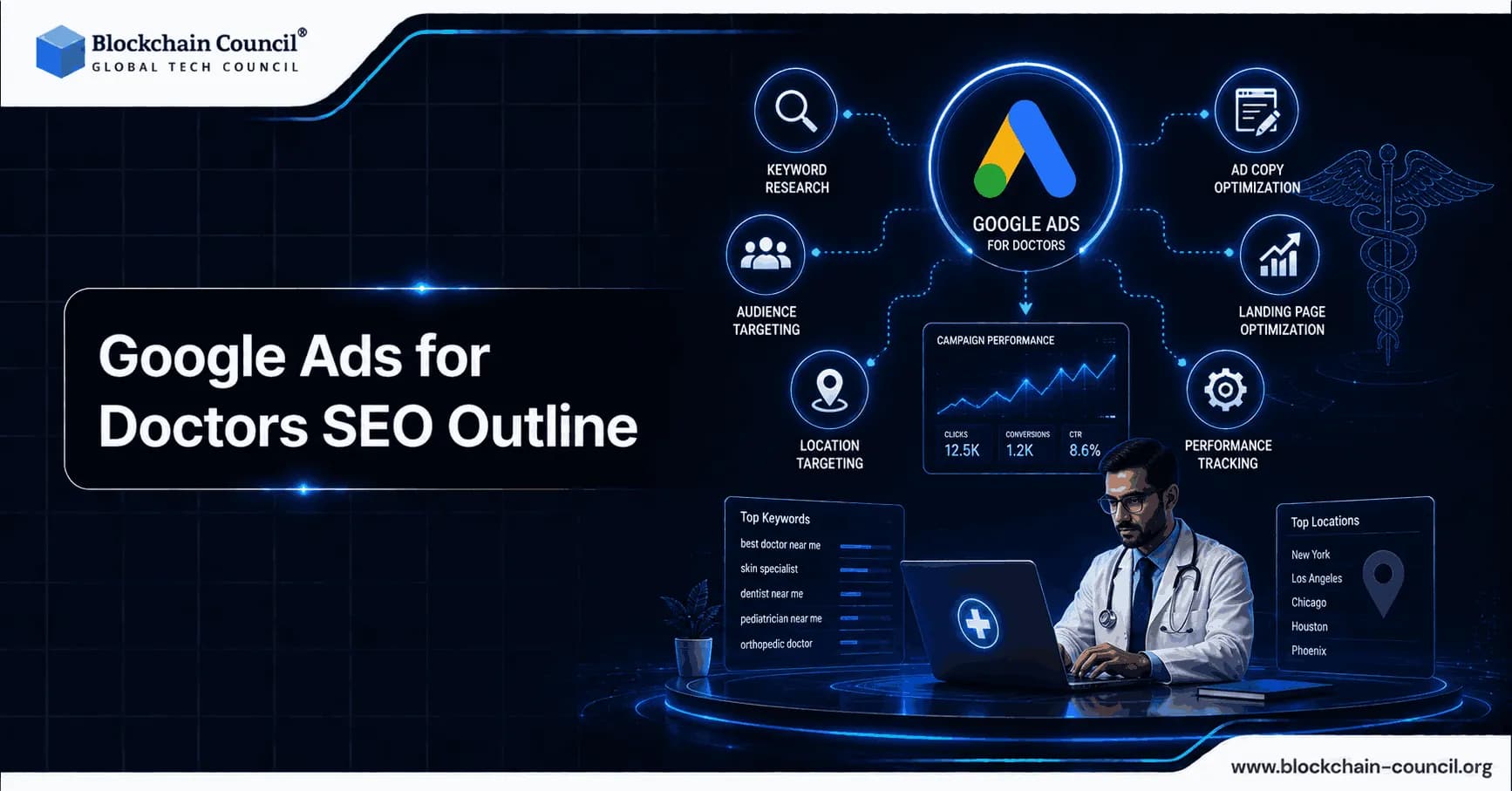
Google Ads for doctors SEO outline refers to a structured plan that connects paid search (Google Ads) with organic SEO so medical practices can capture immediate appointment demand while building durable local visibility. In 2026, this approach is shaped by stricter healthcare ad policies, mobile-first search behavior, AI-assisted bidding, and higher expectations for trust and privacy. When executed well, combining PPC and SEO can reduce cost per lead by 30-40% over 12 months compared with relying on paid ads alone. Learn how doctors and clinics can use SEO, Google Ads, and local search optimization to increase patient acquisition and online visibility by building expertise through an AI certification, analyzing campaign performance and keyword trends using a Python certification, and mastering healthcare promotion strategies with a Digital marketing course.
This article provides a practical, step-by-step outline you can adapt for a solo practice, specialty clinic, or multi-location group, with an emphasis on compliance, measurement, and local intent.

Why an Integrated Google Ads and SEO Outline Matters for Doctors
Doctors compete in one of the most expensive and trust-sensitive search categories. Industry benchmarks for healthcare commonly cite an average cost per click around $5.64, an average conversion rate near 8.09%, and an average cost per lead around $53.53, though specialty and geography can push numbers significantly higher or lower.
An integrated outline helps you:
Capture high-intent demand now with paid search for queries like "specialist near me" or "accepting new patients."
Build long-term authority with SEO content that ranks for mid-intent questions and condition research.
Lower costs over time by shifting budget away from keywords where you earn stable organic rankings, improving overall efficiency.
Improve patient experience through faster pages, clearer messaging, and better appointment pathways.
Google Ads for Doctors SEO Outline: The Complete Framework
1) Define Goals, Constraints, and Compliance Requirements
Start with business outcomes, not platforms. Common goals include booked appointments, call volume, new patient acquisition, and growth of specific service lines.
Key healthcare-specific guardrails:
Privacy and data handling: Ensure forms, call tracking, and analytics workflows follow your organization's HIPAA policies and vendor agreements where applicable.
Healthcare ad policies: Some medical claims and categories require additional verification or carry platform-level restrictions. Review the latest Google Ads healthcare policies before launching campaigns.
Claims and substantiation: Avoid ad copy that implies guaranteed results or unverified outcomes. Emphasize services, availability, and patient experience instead.
2) Build a Keyword Map That Connects PPC and SEO
A useful keyword map splits queries into intent layers and assigns each layer a primary channel.
High-intent (PPC first): "dermatologist near me," "cardiologist accepting new patients [city]," "same-day appointment."
Mid-intent (SEO and selective PPC): "best treatment for [condition]," "ACL tear treatment options," "how to know if I need a specialist."
Low-intent informational (SEO first): broad symptom research that is unlikely to convert quickly.
For Google Ads, consistent guidance from practitioners recommends caution with broad match in medical campaigns. Start with exact match and phrase match on high-intent queries, then expand only if your search term reports show consistent relevance.
3) Structure Google Ads Campaigns by Specialty and Location
Campaign structure is where many practices either gain control or waste budget. A scalable structure looks like this:
Campaign level: Specialty or service line (orthopedics, dermatology, urgent care), separated by location when needed.
Ad group level: Condition-based and treatment-based clusters (for example: "knee pain specialist," "ACL tear treatment").
Keyword level: Mostly exact and phrase match; add negative keywords on a weekly basis.
This structure supports clean budget allocation, clearer compliance review, and higher relevance, all of which can improve Quality Score. Poor relevance and low Quality Scores can materially raise CPC, with industry guidance often citing increases of up to 50% in worst-case scenarios.
4) Write Ads That Match Patient Intent and Build Trust
In healthcare, trust signals matter as much as any offer. Aim for clarity and consistency between query, ad, and landing page.
Message match: If the keyword is "same-day dermatologist appointment," the ad and landing page should explicitly reference same-day availability if that is accurate.
Trust builders: Board-certified credentials (where relevant), years in practice, accepted insurance (if you choose to state it), verified ratings and reviews, and hospital affiliations.
Extensions: Call extensions, location extensions, and structured snippets for services can lift CTR. Benchmark CTR in competitive healthcare segments often falls in the 6-8% range.
5) Design HIPAA-Aware Landing Pages That Convert
Landing pages frequently determine whether you hit a sustainable cost-per-lead target - keeping CPL below $70 is a common benchmark for many practices.
Landing page checklist:
Speed: Aim for a 2-second load time on mobile where possible. Healthcare searches skew heavily mobile, with estimates commonly cited in the 60-80% range.
Simple conversion path: Short forms (typically around 3 fields) and click-to-call buttons for mobile users.
Clear next step: "Book an appointment," "Request a call," "Call now." Avoid multiple competing calls to action.
Trust content: Reviews, clinician profiles, credentials, and a description of what patients can expect during their visit.
Privacy cues: Plain-language notices about how information is used, aligned with your compliance policy.
6) Implement Tracking, Attribution, and a Fast Response Workflow
Without attribution, optimizing spend across Google Ads and SEO is guesswork. A minimum measurement stack typically includes:
Conversion tracking: Form submissions, calls, and online scheduling completions.
Call tracking: Particularly important for medical practices where phone calls remain a primary booking method.
CRM or scheduling attribution: Connecting lead source to booked appointments, not just raw lead counts.
Operationally, speed-to-lead is critical. Healthcare marketing benchmarks consistently indicate that contacting leads within 5 minutes can drive substantially higher conversions - sometimes reported as up to 10x compared with delayed follow-up. Build a routing and response process before scaling budget.
7) Build the SEO Layer: E-E-A-T, Local SEO, and Schema
Your SEO plan should mirror the same service lines as your paid campaigns, with a strong focus on trust signals and local presence.
Google Business Profile (GBP): Keep categories, services, hours, photos, and appointment links current. Actively acquire reviews and respond to them professionally.
Local landing pages: One page per location with unique content, clinician information, parking details, and service availability.
Condition and treatment pages: Build mid-intent content that answers common patient questions and routes to appointment actions.
E-E-A-T signals: Author bylines, clinician reviewers, citations to reputable medical sources, and clear editorial policies can strengthen credibility with both users and search engines.
Schema markup: Use MedicalBusiness and Physician structured data where appropriate to help search engines interpret entities and services accurately.
As AI-powered search experiences expand, clarity, demonstrated expertise, and well-structured content increase the likelihood of appearing in richer results and AI-generated summaries. Understand how healthcare businesses optimize PPC campaigns, landing pages, and patient conversion funnels using automation and analytics by mastering intelligent marketing systems through an Agentic AI Course, building SEO and analytics integrations using a Node JS Course, and scaling healthcare outreach using an AI powered marketing course.
8) Use PPC Insights to Drive SEO Priorities and Cut Ad Waste
This feedback loop is straightforward:
Launch Google Ads on high-intent keywords to generate leads quickly.
Analyze search terms, converting keywords, device performance, and geography.
Create SEO content around high-performing mid-intent themes (conditions, treatments, FAQs).
As organic rankings stabilize, reduce bids on keywords where SEO delivers consistent conversions.
This integration can reduce cost per lead by 30-40% over a 12-month period because the practice gradually relies less on paid clicks for every appointment booked.
Example Timeline: What Results Typically Look Like
While outcomes vary by market and specialty, a common pattern is:
Weeks 2-4: Paid campaigns start producing measurable leads; early optimizations focus on negative keywords, ad relevance, and landing page improvements.
Months 3-6: SEO pages begin indexing and climbing in rankings; Google Business Profile activity strengthens local visibility; CPL improves as Quality Score and targeting tighten.
Months 6-12: Stronger organic coverage reduces reliance on high-cost clicks; budget can shift toward new services, remarketing, or additional locations.
Common Mistakes to Avoid
Overusing broad match and failing to review search terms regularly, which causes spend on irrelevant queries.
Sending all traffic to a homepage instead of dedicated service or condition landing pages.
Ignoring mobile performance despite most healthcare searches occurring on phones.
Measuring leads but not bookings, which obscures true ROI by specialty and channel.
Slow follow-up, which can severely reduce appointment rates even when ad performance is strong.
Conclusion: A Repeatable Outline for Sustainable Patient Acquisition
A well-constructed Google Ads for doctors SEO outline aligns campaign structure, landing pages, and local SEO into one measurable system. Google Ads deliver immediate visibility for high-intent searches, while SEO builds authority for mid-intent questions and long-term local discovery. With sound compliance practices, rigorous tracking, and a PPC-to-SEO feedback loop, medical practices can improve conversion rates, stabilize cost per lead, and reduce dependency on paid clicks over time.
FAQs
1. What is a Google Ads for doctors SEO outline?
A Google Ads for doctors SEO outline is a structured marketing strategy that combines paid ads with organic search optimization. It helps medical practices attract patients through both immediate and long-term visibility. Healthcare marketing now requires the precision of surgery and the budget of a small kingdom.
2. Why should doctors combine Google Ads with SEO?
Combining Google Ads with SEO allows doctors to generate fast patient leads while building lasting online authority. Paid ads deliver quick traffic, while SEO supports long-term rankings. One strategy handles urgency while the other plays the painfully slow long game.
3. How does Google Ads help medical practices?
Google Ads helps doctors appear in search results when patients look for nearby medical services. It targets high-intent searches like “dentist near me” or “urgent care clinic.” Humans trust search engines with healthcare decisions more than they probably should.
4. Why is SEO important for doctors?
SEO helps medical websites rank organically for health-related searches and local queries. It builds trust, visibility, and steady patient traffic over time. Google has effectively become the modern waiting room receptionist.
5. What are high-intent keywords in healthcare marketing?
High-intent keywords are searches that suggest a patient is ready to book an appointment soon. Examples include “same-day dermatologist appointment” or “cardiologist near me.” Search behavior reveals human panic with startling accuracy sometimes.
6. Why should doctors avoid broad match keywords?
Broad match keywords can trigger irrelevant searches and waste advertising budget quickly. Exact and phrase match keywords usually provide more targeted healthcare traffic. Advertising platforms happily spend your money on unrelated clicks if allowed.
7. How should doctors structure Google Ads campaigns?
Campaigns should be organized by specialty, service type, and location for better targeting and budget control. This improves ad relevance and performance tracking. Organized campaign structures prevent marketing chaos disguised as strategy.
8. What makes healthcare ad copy effective?
Effective healthcare ads focus on trust, clarity, and patient intent rather than exaggerated claims. Mentioning credentials, availability, and experience can improve engagement. Patients generally prefer competence over dramatic marketing promises. Sensible instinct.
9. Why are landing pages important for medical ads?
Landing pages guide patients toward booking appointments after clicking on ads. Fast-loading pages with clear forms and trust signals improve conversion rates. One confusing webpage can quietly destroy an expensive advertising campaign.
10. What should healthcare landing pages include?
Medical landing pages should include clinician profiles, reviews, appointment options, and simple contact forms. They should also explain services clearly and professionally. Patients want reassurance before surrendering personal health information online.
11. Why is mobile optimization critical for doctors’ websites?
Most healthcare searches happen on mobile devices, especially local appointment searches. Mobile-friendly websites improve usability and increase patient conversions. Humanity now searches for medical advice while standing in grocery store lines.
12. What is HIPAA-aware marketing?
HIPAA-aware marketing ensures patient data and online interactions follow healthcare privacy regulations. This includes secure forms, analytics practices, and communication systems. Healthcare marketing apparently requires equal parts advertising and legal caution.
13. How does local SEO help doctors attract patients?
Local SEO improves visibility for nearby searches and map-based results in Google. It helps patients find clinics, office hours, and contact information quickly. Modern healthcare discovery often begins with a map pin and a review score.
14. What role does Google Business Profile play in healthcare SEO?
Google Business Profile helps doctors appear in local search results and Google Maps listings. Updated photos, reviews, and office information improve trust and visibility. One neglected business profile can quietly send patients elsewhere.
15. What is E-E-A-T in medical SEO?
E-E-A-T stands for Experience, Expertise, Authoritativeness, and Trustworthiness in online content. Google values these signals strongly for healthcare-related websites. Search engines now evaluate medical credibility like strict digital examiners.
16. Why is call tracking important for medical practices?
Call tracking helps practices understand which ads and keywords generate appointment inquiries. This improves marketing decisions and budget allocation over time. Data analysis has become the heartbeat of modern advertising campaigns.
17. How quickly should healthcare leads be contacted?
Medical practices should respond to leads as quickly as possible, ideally within a few minutes. Fast follow-up greatly improves appointment conversion rates. Patients lose patience faster than websites finish loading nowadays.
18. How can PPC insights improve SEO strategy?
Paid advertising data reveals which keywords and topics generate the most patient interest. Practices can then create SEO content around those successful search themes. Advertising effectively becomes expensive market research with extra steps.
19. What are common mistakes in healthcare digital marketing?
Common mistakes include poor mobile design, weak landing pages, slow lead response, and broad keyword targeting. Many practices also fail to track actual appointment bookings. Spending money without measurement remains a strangely popular business strategy.
20. What long-term benefits come from combining SEO and Google Ads?
Combining SEO with Google Ads can lower marketing costs and improve patient acquisition over time. Organic rankings reduce dependence on paid advertising for every lead. Sustainable growth usually requires patience, consistency, and fewer random marketing experiments.
Related Articles
View All
Info
Is SEO Dead Without Google Search? What Digital Marketers Should Do Next
SEO is not dead without Google Search. It is evolving into multi-platform and AI-driven discovery across YouTube, social search, marketplaces, and LLM assistants.

Info
Ask Google About This Page
Learn how Google’s “About This Page” feature helps users verify website credibility, search transparency, and online information reliability.

Info
Student Resources and Academic Support: A Practical Guide to Free Help in College
Learn what Student Resources and Academic Support includes, why it improves outcomes, and how to find free resources for college students on campus and online.
Trending Articles
AWS Career Roadmap
A step-by-step guide to building a successful career in Amazon Web Services cloud computing.
How Blockchain Secures AI Data
Understand how blockchain technology is being applied to protect the integrity and security of AI training data.

Can DeFi 2.0 Bridge the Gap Between Traditional and Decentralized Finance?
The next generation of DeFi protocols aims to connect traditional banking with decentralized finance ecosystems.