

PM Modi's Work From Home Appeal Explained: What It Means for Working Professionals
 Suyash Raizada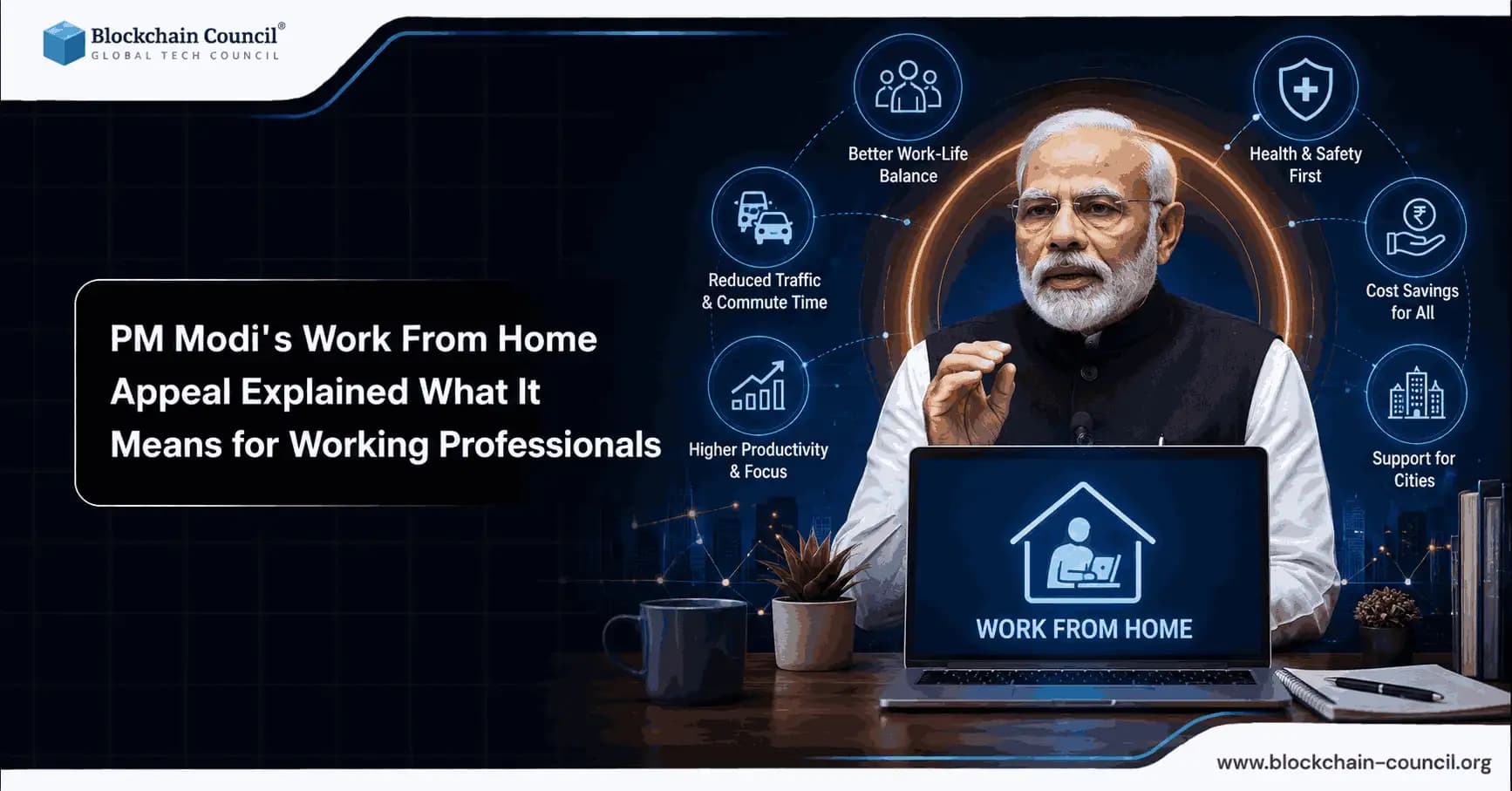
Work From Home is back in the national conversation, but for a different reason this time. On May 11, 2026, Prime Minister Narendra Modi urged Indians to revive work-from-home practices from the COVID-19 era to conserve fuel and strengthen India's energy security amid rising geopolitical tensions in West Asia. The appeal connects everyday commuting choices to the country's exposure to global oil price shocks and supply disruptions. Understand how PM Modi’s work-from-home appeal impacts productivity, digital transformation, remote collaboration, and professional workflows by building expertise through an AI certification, automating remote work processes using a Python certification, and adapting to modern work trends with a Digital marketing course.
What Modi Said About Work From Home
Speaking at an event in Secunderabad, Telangana, after inaugurating projects worth Rs 9,400 crore, Prime Minister Modi called for prioritizing:

Work From Home wherever feasible
Online conferences and virtual meetings
Reduced discretionary travel and lifestyle changes that cut fuel use
The framing matters. This was not a public health directive. It was positioned as an economic and energy-security measure to reduce petrol and diesel consumption and limit dependence on imported petroleum products during periods of global instability.
Why This Appeal Now: Fuel Prices, Geopolitics, and the Strait of Hormuz
The timing is tied to escalating tensions in West Asia, including developments linked to the US-Iran conflict and risks around the Strait of Hormuz, a critical global oil transit route. When such chokepoints face disruption, crude supply tightens and prices rise.
As of May 2026, Brent crude was reported above $105 per barrel, increasing pressure on fuel-importing economies like India. When oil prices surge:
Import bills rise, putting pressure on foreign exchange reserves
Inflation risks increase through higher transport and logistics costs
Household and business fuel expenses climb
Reducing daily urban commuting becomes a fast, scalable lever in this context. Even partial Work From Home adoption across large cities can decrease fuel demand at the margins, which is precisely what policymakers often pursue during externally driven price spikes.
How Work From Home Reduces Fuel Consumption
Prime Minister Modi's appeal targets a routine reality: millions of daily commutes in major urban centers. While not every role can go remote, a large share of knowledge work can shift from roads to broadband, particularly in IT, ITES, consulting, finance operations, and digital services.
WFH reduces fuel use through:
Fewer individual car and two-wheeler trips during peak hours
Lower congestion, which also improves fuel efficiency for those who must travel
Reduced business travel when meetings move online
This approach is consistent with what India already demonstrated during 2020-2022: remote operations at scale are achievable when organizations commit to process redesign, security controls, and collaboration tooling.
The COVID-19 Precedent: Remote Work at Scale
During the COVID-19 period (2020-2022), India's IT and ITES sectors shifted to near-total remote work at various points. Industry groups and employees have consistently noted that productivity and operational continuity were maintained without widespread disruption. That experience is now being referenced as a national capability India can reactivate quickly.
For working professionals, the key takeaway is that this is not a theoretical experiment. Many teams already have:
Established video meeting norms
Remote access workflows
Cloud-based collaboration and documentation
Distributed delivery practices
Organizations that preserved these habits through hybrid policies are better positioned to adapt if Work From Home becomes more widely encouraged again.
Industry Response: Support for WFH, With Practical Questions
Corporate reactions have been broadly positive, especially among knowledge-driven sectors. Many leaders and employees view remote and hybrid work as beneficial for flexibility and wellbeing, while acknowledging that a full shift depends on role type and available infrastructure.
Common considerations across workplaces include:
Operational readiness: Can teams handle remote onboarding, mentoring, and cross-functional collaboration?
Security and compliance: Are endpoints, networks, and identity controls adequate?
Equity across roles: What about functions that require physical presence?
NITES Pushes for Formal Guidance in IT and ITES
On May 11, 2026, the IT employees' union NITES submitted a representation to the Ministry of Labor and Employment requesting a formal advisory for mandatory Work From Home in IT and ITES where feasible. The argument rests on the sector's proven ability to operate remotely during COVID-19 and the potential national benefit from reduced commuting and travel.
This signals that Work From Home could move beyond a company-by-company policy choice toward a more standardized, sector-specific recommendation if fuel volatility persists.
Modi's Broader Lifestyle Suggestions and What They Indicate
Alongside Work From Home, Prime Minister Modi mentioned additional lifestyle changes intended to reduce fuel imports and conserve foreign exchange. These included using public transport such as metros, carpooling, and avoiding non-essential high-consumption choices for at least a year, including foreign travel and destination weddings. Other suggestions included curbing non-essential gold purchases, reducing edible oil consumption, and encouraging farmers to cut chemical fertilizer use by 50% while expanding natural farming and solar-powered irrigation.
For working professionals, this broader list clarifies the government's position: energy security is being treated as a whole-of-society challenge, not solely an industrial one.
A Practical Work From Home Playbook for Professionals
If your organization considers expanding Work From Home or hybrid work, a structured approach helps avoid disruption and productivity loss. Here are practical steps professionals and managers can implement quickly.
1. Make WFH Measurable, Not Informal
Define outcomes and weekly deliverables clearly
Agree on response-time norms and meeting protocols
Use documented workflows instead of ad-hoc messaging
2. Strengthen Security Practices
Use multi-factor authentication for all key systems
Keep devices updated and encrypted where possible
Avoid personal email and unmanaged applications for sensitive work
For teams handling sensitive data, formal training in cybersecurity fundamentals is advisable. Blockchain Council's Certified Cybersecurity Expert program is one option for professionals supporting remote operations who want structured, recognized credentials in this area.
3. Improve Collaboration and Documentation
Move decisions into written notes and shared documents
Record key meetings when appropriate for asynchronous review
Standardize project dashboards and status reporting formats
Professionals building modern remote workflows can also benefit from structured learning in AI tooling and automation. Blockchain Council's Certified AI Professional certification covers AI copilots and workflow automation for those looking to improve productivity in distributed environments.
4. Plan for Hybrid Reality, Not a Single Mandate
Even if Work From Home expands, many organizations will remain hybrid due to client requirements, security needs, or physical operations. High-performing teams typically define:
Which roles are remote-first, hybrid, or onsite
Which days are meeting-heavy versus focus-heavy
Clear expectations for office presence and travel
Which Sectors Are Most Likely to Adopt WFH Quickly?
Based on India's COVID-19 experience and current digital maturity, the fastest adoption tends to occur in:
IT and ITES
Digital services, support, and operations
Marketing, design, content, and consulting
Back-office finance and HR operations (role dependent)
Industries with factory floors, frontline customer service, healthcare, logistics, and field operations will have lower WFH feasibility, but can still reduce fuel use through staggered shifts, carpooling, and increased public transport adoption. Learn how professionals and businesses can optimize remote work using AI tools, digital communication systems, and workflow automation by mastering AI-driven productivity through an AI certification, building remote collaboration systems using a Node JS Course, and scaling digital-first work strategies using an AI powered marketing course.
Future Outlook: Could Work From Home Become Policy Again?
If high oil prices and regional instability persist, Work From Home could become a semi-permanent tool in the policy toolkit, potentially through formal advisories in high-impact sectors. The pandemic demonstrated that India can operate remotely at scale, and today's collaboration infrastructure is considerably more mature than it was in early 2020.
India is also investing in longer-term energy resilience measures such as solar power, ethanol blending, CNG systems, and piped gas infrastructure. If these measures reduce import dependence over time, the urgency around WFH as a fuel-saving strategy may ease. In the near term, however, reduced commuting remains one of the fastest demand-side actions available.
Conclusion: Why the WFH Appeal Matters to Professionals
Prime Minister Modi's Work From Home appeal is best understood as a national resilience measure in response to global fuel volatility, not as a return to pandemic restrictions. For working professionals, it is a reminder that remote work is not only about personal convenience. It can form part of a broader economic response that reduces fuel consumption, supports stability during supply disruptions, and advances how organizations operate.
If your role allows it, adopting Work From Home or a structured hybrid routine - paired with strong security practices and disciplined collaboration - can deliver meaningful benefits for employees, employers, and the broader economy.
FAQs
1. What did PM Modi say about Work From Home?
PM Modi urged Indians to adopt Work From Home wherever possible to reduce fuel consumption. He also encouraged online meetings, virtual conferences, and less discretionary travel. The appeal was linked to India’s energy security, not public health restrictions.
2. Why did PM Modi make the Work From Home appeal?
The appeal was made because rising geopolitical tensions could affect global oil prices and fuel supply. India imports a large share of its petroleum, so higher crude prices can increase economic pressure. Reducing daily commuting can help lower fuel demand.
3. Is this Work From Home appeal related to COVID-19?
No, this appeal is not a COVID-19 directive. PM Modi referred to the remote work practices used during the pandemic as an example of what India can do again. This time, the purpose is fuel conservation and energy security.
4. How can Work From Home reduce fuel consumption?
Work From Home reduces the number of daily office commutes by cars and two-wheelers. Fewer vehicles on roads can also reduce traffic congestion and improve fuel efficiency for people who must travel. Online meetings can further reduce business travel.
5. Which professionals can benefit most from Work From Home?
Professionals in IT, ITES, finance operations, consulting, marketing, design, content, and digital services can benefit most. These roles usually require laptops, internet access, and collaboration tools rather than physical presence. Naturally, not every job can be done from a sofa with Wi-Fi.
6. Which sectors may find Work From Home difficult?
Sectors such as healthcare, manufacturing, logistics, frontline retail, and field operations may find full remote work difficult. These jobs often require physical presence, equipment access, or direct customer interaction. However, they can still reduce fuel use through staggered shifts, carpooling, or public transport.
7. Why are oil prices important in this discussion?
Oil prices matter because higher crude prices increase India’s import bill and can raise inflation. Transport, logistics, and household fuel expenses may also rise when global oil prices surge. Work From Home is one way to reduce demand during such pressure.
8. What role does the Strait of Hormuz play?
The Strait of Hormuz is a major global oil transit route, so disruptions there can affect crude oil supply. Tensions in West Asia can increase fears of supply shortages and price spikes. This makes fuel-saving measures more important for countries like India.
9. How did India manage remote work during COVID-19?
During the COVID-19 period, many Indian IT and ITES companies operated remotely at scale. Teams used video meetings, cloud tools, remote access systems, and digital documentation. That experience showed that large-scale Work From Home is possible when systems are properly managed.
10. What has been the industry response to the appeal?
Many knowledge-sector companies and employees have responded positively to the idea of remote or hybrid work. They see benefits in flexibility, productivity, and employee wellbeing. Still, companies must address security, collaboration, onboarding, and role-based feasibility.
11. What is NITES asking for?
NITES has requested formal guidance for mandatory Work From Home in IT and ITES roles where remote work is feasible. The union argues that the sector already proved its remote work capability during COVID-19. This could push WFH from a company choice toward a broader sector recommendation.
12. What other lifestyle changes did PM Modi suggest?
PM Modi also encouraged public transport, carpooling, reduced foreign travel, and fewer high-consumption lifestyle choices. He mentioned cutting unnecessary fuel-related expenses and supporting broader conservation habits. The message was that energy security needs public participation, because apparently national resilience now includes skipping destination weddings.
13. How should companies make Work From Home effective?
Companies should define clear deliverables, response-time expectations, and meeting rules. They should use documented workflows instead of relying only on informal chats. Clear structure prevents remote work from turning into calendar chaos with better furniture.
14. What security practices are important for Work From Home?
Employees should use multi-factor authentication, updated devices, secure networks, and approved workplace tools. Sensitive data should not be shared through personal emails or unmanaged apps. Strong cybersecurity practices are essential when employees work outside office networks.
15. Why is documentation important in remote work?
Documentation helps teams track decisions, responsibilities, updates, and project progress clearly. It reduces confusion when people are not working in the same physical space. Shared notes, dashboards, and recorded meetings can improve accountability.
16. Will all companies shift fully to Work From Home?
No, many companies are more likely to adopt hybrid models instead of full remote work. Client needs, security requirements, team culture, and role type will influence the final policy. A practical model may divide roles into remote-first, hybrid, and onsite categories.
17. How can employees prepare for more Work From Home?
Employees can prepare by improving home internet access, learning collaboration tools, and following security rules. They should also create a reliable routine for communication and task updates. Remote work rewards discipline, which is inconvenient but effective.
18. Could Work From Home become policy again?
Work From Home could become a policy tool if oil prices and geopolitical risks remain high. The government may issue formal advisories for sectors where remote work is practical. However, its scope would likely depend on fuel conditions and economic needs.
19. How does Work From Home support India’s economy?
Work From Home can help reduce petrol and diesel demand by cutting daily commuting. Lower fuel demand can ease pressure on imports, foreign exchange reserves, and inflation. Even partial adoption across major cities can make a measurable difference.
20. Why does PM Modi’s Work From Home appeal matter to professionals?
The appeal matters because it connects individual work habits with national energy security. For professionals, remote or hybrid work can save time, reduce travel costs, and support broader fuel conservation goals. It also reminds companies that flexible work is not just comfort, but part of economic resilience.
Related Articles
View All
Info
LS Studio Explained: Meanings, Use Cases, and the Most Relevant Tech Context
LS studio is an ambiguous term. This guide explains its main meanings, from L-Acoustics L-ISA Studio for immersive audio to salon booking apps and other uses.

Info
BlackRock CEO Larry Fink Has Changed His Stance on Bitcoin: What It Means for Institutions
BlackRock CEO Larry Fink's shift from Bitcoin skeptic to advocate signals institutional normalization, driven by spot Bitcoin ETFs, macro concerns, and maturing market structure.

Info
The Blocking in Blockchain: Censorship, Blacklists, and Transaction Filtering Explained
Blocking in blockchain refers to censorship, blacklisting, or filtering at the network, consensus, application, or exchange layer. Learn why it happens and where it is headed.
Trending Articles
AWS Career Roadmap
A step-by-step guide to building a successful career in Amazon Web Services cloud computing.
How to Install Claude Code
Learn how to install Claude Code on macOS, Linux, and Windows using the native installer, plus verification, authentication, and troubleshooting tips.

Claude Code Vs Cursor
Claude Code vs Cursor compares two AI coding tools based on features, automation, and developer workflows.