

Blockchain Keywords
 Suyash Raizada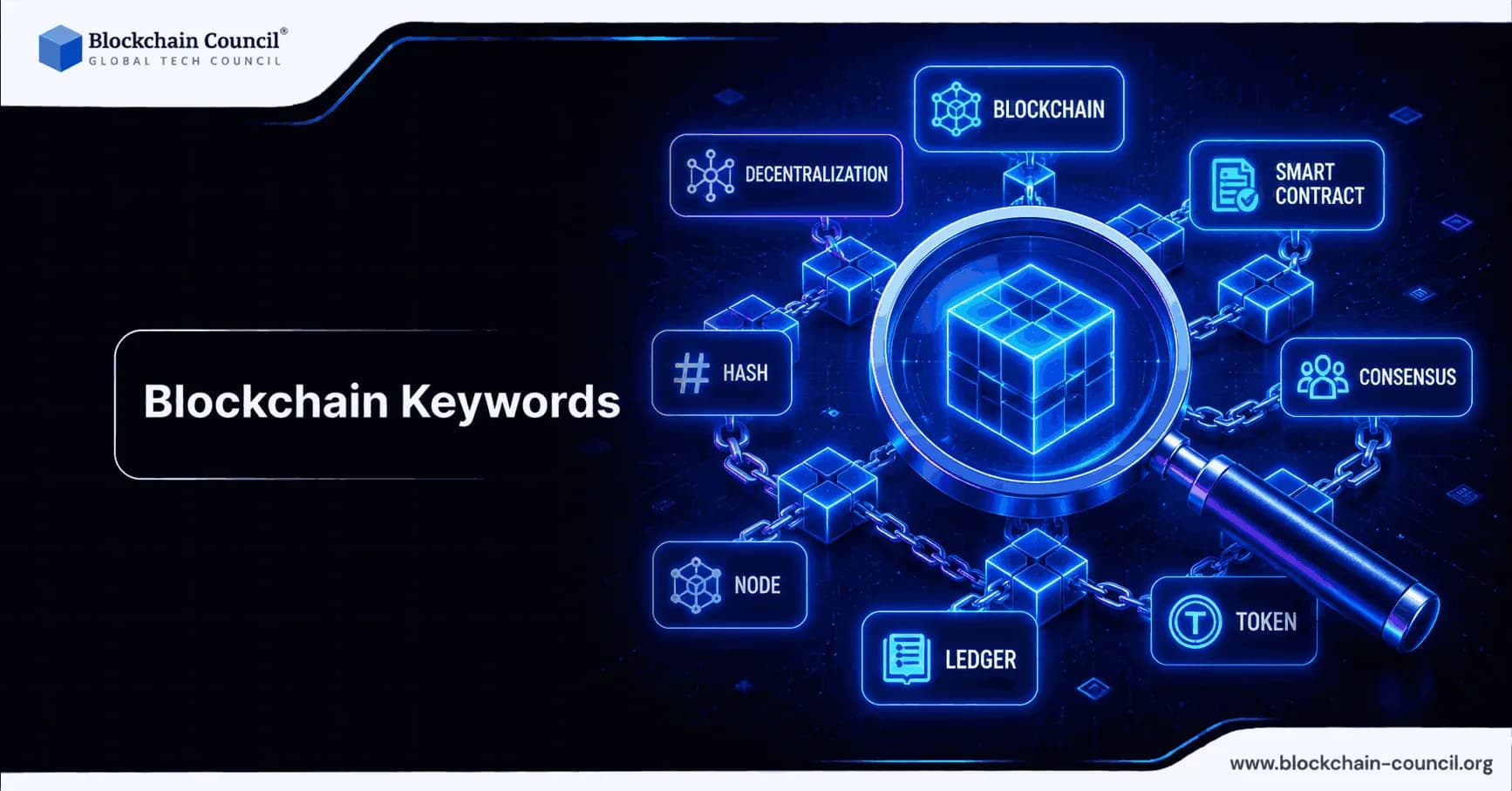
Blockchain has moved far beyond being a technology linked only with Bitcoin. Today, it is used in finance, supply chains, healthcare, cybersecurity, digital identity, real estate, gaming, artificial intelligence, and enterprise automation. As adoption grows, understanding blockchain keywords has become essential for students, developers, investors, marketers, and business leaders.
Blockchain has its own vocabulary, and ignoring it is a reliable way to sit through meetings pretending “staking,” “hashing,” and “zero-knowledge proofs” are perfectly casual lunch-table terms. Charming, really.

This guide explains the most important blockchain keywords in simple language, explores recent industry developments, and shows how these terms connect to real-world applications.
Blockchain Keywords
Blockchain keywords are the core terms and phrases used to describe blockchain technology, cryptocurrency systems, decentralized applications, and Web3 ecosystems. These keywords help people understand how blockchain works and how it is applied across industries.
For example, terms like “smart contracts,” “decentralization,” “wallet,” “consensus mechanism,” and “tokenization” are essential for understanding blockchain systems. Businesses also use blockchain keywords for SEO, content marketing, technical documentation, training programs, and professional certifications.
Professionals who want deeper expertise often pursue programs such as the Blockchain expert certification, Online degree in blockchain certification, or Blockchain security certification.
Why Blockchain Keywords Matter
Blockchain keywords are important because they help explain complex technologies in a structured way. Whether someone is building a decentralized app, investing in crypto assets, writing blockchain content, or managing enterprise adoption, these terms create a common language.
For businesses, blockchain keywords help improve search visibility and educate customers. For professionals, they support career growth by making technical concepts easier to understand. For developers, they provide clarity when working with smart contracts, security systems, and decentralized networks.
Search engines also rely on relevant keywords to understand blockchain content. That is why SEO-friendly blockchain articles should include clear explanations of high-value terms without stuffing them awkwardly into every paragraph like someone trying to impress an algorithm with a thesaurus.
Core Blockchain Keywords Everyone Should Know
Blockchain
Blockchain is a decentralized digital ledger that records transactions across multiple computers. Each group of transactions is stored in a block, and blocks are connected in chronological order.
This structure makes blockchain secure, transparent, and difficult to alter. It is used for cryptocurrencies, digital identity, supply chains, healthcare records, and financial settlements.
Decentralization
Decentralization means no single authority controls the entire system. Instead, control is distributed across a network of participants.
In blockchain, decentralization improves transparency, reduces dependence on intermediaries, and lowers the risk of single-point failures.
Distributed Ledger Technology
Distributed Ledger Technology, or DLT, refers to systems where records are shared across multiple locations or participants. Blockchain is one type of DLT.
Banks, governments, and enterprises use DLT to improve record management, reduce fraud, and increase efficiency.
Cryptography
Cryptography protects blockchain data through mathematical techniques. It secures transactions, verifies identities, and ensures privacy.
Public keys, private keys, hashing, and digital signatures are all cryptographic concepts used in blockchain.
Hash
A hash is a unique digital fingerprint created from data. Even a small change in the original data creates a completely different hash.
Blockchains use hashes to secure blocks and detect tampering.
Node
A node is a computer connected to a blockchain network. Nodes store, verify, and share blockchain data.
Some nodes validate transactions, while others maintain copies of the blockchain.
Consensus Mechanism
A consensus mechanism is the process blockchain networks use to agree on valid transactions.
Popular consensus mechanisms include Proof of Work, Proof of Stake, and Delegated Proof of Stake.
Proof of Work
Proof of Work is a consensus mechanism used by Bitcoin. Miners solve complex mathematical problems to validate transactions and secure the network.
It is secure but energy-intensive, which is why many newer networks prefer alternative systems.
Proof of Stake
Proof of Stake allows users to validate transactions by locking, or staking, their tokens. Validators are selected based on the amount they stake and other network rules.
Ethereum’s move to Proof of Stake significantly reduced its energy consumption, making this keyword especially important in modern blockchain discussions.
Smart Contract
A smart contract is a self-executing digital agreement stored on a blockchain. It automatically performs actions when predefined conditions are met.
Smart contracts are used in DeFi, insurance, gaming, real estate, and supply chain automation.
Token
A token is a digital asset created on a blockchain. Tokens can represent money, ownership, voting rights, loyalty points, or access to services.
Examples include utility tokens, governance tokens, security tokens, and non-fungible tokens.
Cryptocurrency
Cryptocurrency is a digital currency secured by blockchain technology. Bitcoin, Ethereum, and stablecoins are well-known examples.
Cryptocurrencies support peer-to-peer payments, decentralized finance, and digital asset ecosystems.
Wallet
A blockchain wallet stores private keys that allow users to access and manage digital assets.
Wallets may be custodial, non-custodial, hardware-based, mobile-based, or browser-based.
Private Key
A private key is a secret code that gives access to blockchain assets. Anyone with the private key can control the associated funds.
Losing a private key usually means losing access permanently. Very efficient, in the most unforgiving way possible.
Public Key
A public key is used to receive blockchain transactions. It works like an account address that can be shared safely.
Public keys are mathematically connected to private keys but do not reveal them.
DeFi
Decentralized Finance, or DeFi, refers to blockchain-based financial services that operate without traditional banks.
DeFi platforms support lending, borrowing, trading, staking, and yield generation.
NFT
A non-fungible token, or NFT, is a unique digital asset recorded on a blockchain. NFTs can represent artwork, gaming items, music, certificates, tickets, and memberships.
Although hype cycles have cooled, NFTs remain useful for digital ownership and authentication.
Web3
Web3 refers to a decentralized version of the internet built on blockchain technology. It gives users more control over digital identity, assets, and data.
Web3 applications include decentralized finance, DAOs, NFT platforms, and blockchain games.
DAO
A Decentralized Autonomous Organization is a blockchain-based organization governed by community voting and smart contracts.
DAOs are used for investment groups, gaming communities, protocol governance, and decentralized projects.
Tokenization
Tokenization converts real-world or digital assets into blockchain-based tokens.
Real estate, artwork, carbon credits, stocks, bonds, and loyalty points can all be tokenized.
Blockchain Security Keywords
Security is one of the most important areas of blockchain. Since blockchain systems often manage valuable assets, even small vulnerabilities can cause major losses.
Smart Contract Audit
A smart contract audit is a security review of blockchain code. Auditors check for vulnerabilities before contracts are deployed.
This is critical because deployed smart contracts are often difficult or impossible to change.
Reentrancy Attack
A reentrancy attack occurs when a malicious contract repeatedly calls another contract before the first execution is complete.
This vulnerability has caused major DeFi losses in the past.
Rug Pull
A rug pull happens when project creators abandon a crypto project after taking investor funds.
This is why due diligence is not optional, despite humanity’s heroic ability to ignore red flags when charts go upward.
Phishing
Phishing is a cyberattack where criminals trick users into revealing private keys, passwords, or wallet access.
Blockchain users must be especially careful because transactions are usually irreversible.
Multi-Signature Wallet
A multi-signature wallet requires multiple approvals before a transaction is completed.
Businesses and DAOs use multi-signature wallets to improve fund security.
Professionals interested in this field can develop specialized skills through the Blockchain security certification.
Blockchain Keywords in Business
Blockchain is increasingly used by enterprises to solve practical business problems.
Supply Chain Tracking
Blockchain helps businesses track products from origin to delivery. Companies can verify sourcing, shipping, authenticity, and compliance.
For example, food retailers use blockchain to trace contaminated products faster and improve consumer safety.
Digital Identity
Blockchain-based identity systems allow individuals to manage credentials securely.
These systems can reduce identity theft and simplify verification for banks, universities, employers, and governments.
Cross-Border Payments
Blockchain enables faster and cheaper international payments by reducing reliance on intermediaries.
Stablecoins and blockchain settlement networks are increasingly used for global transfers.
Real-World Asset Tokenization
Real-world asset tokenization is one of the strongest recent blockchain trends. Financial institutions are exploring tokenized bonds, funds, real estate, and commodities.
Tokenization improves liquidity, transparency, and fractional ownership.
Blockchain and AI Keywords
The combination of blockchain and artificial intelligence is becoming increasingly important.
AI needs trustworthy data, while blockchain provides secure and verifiable records. Together, they support automation, analytics, cybersecurity, and intelligent smart contracts.
AI Smart Contracts
AI smart contracts use artificial intelligence to make automated decisions based on verified data.
They can be applied in insurance, finance, logistics, and compliance.
Decentralized AI
Decentralized AI uses blockchain networks to support distributed model training, data sharing, and AI marketplaces.
This reduces dependence on centralized platforms.
Data Provenance
Data provenance means tracking where data comes from and how it changes over time.
Blockchain helps verify data history, making AI systems more trustworthy.
Professionals working at the intersection of coding, AI, and blockchain can explore the AI Powered coding expert Course.
Blockchain Keywords for Digital Marketing
Blockchain is also influencing digital marketing through privacy, ad transparency, loyalty programs, and customer data control.
Ad Fraud Prevention
Blockchain can verify ad impressions, clicks, and campaign delivery.
This helps advertisers reduce bot traffic and fake engagement.
Tokenized Loyalty Programs
Brands can use blockchain tokens as loyalty rewards. Customers may redeem, transfer, or exchange these rewards across platforms.
Consumer Data Ownership
Blockchain gives users greater control over how their personal data is shared.
This supports privacy-focused marketing and stronger customer trust.
Marketing professionals who want to combine AI and digital strategy can benefit from the AI powered digital marketing course.
Most Important Blockchain SEO Keywords
For content creators and businesses, blockchain SEO keywords help attract readers searching for reliable information.
Common blockchain SEO keywords include:
Blockchain technology, blockchain development, blockchain security, smart contracts, cryptocurrency, Web3, DeFi, NFTs, tokenization, blockchain certification, blockchain course, blockchain developer, blockchain use cases, enterprise blockchain, blockchain wallet, blockchain mining, blockchain trends, blockchain and AI, blockchain for business, and blockchain career.
The best SEO strategy is not to dump every keyword into one paragraph like a desperate robot wrote it. Search engines prefer useful content, clear structure, natural keyword placement, and strong topical coverage.
Recent Developments in Blockchain
Recent blockchain developments show that the industry is maturing.
Ethereum’s transition to Proof of Stake changed how people discuss blockchain energy efficiency. Layer-2 networks such as Arbitrum, Optimism, and Polygon have improved scalability. Tokenized real-world assets are attracting interest from financial institutions. Stablecoins are being used for faster settlement and global payments. Blockchain analytics tools are improving compliance and fraud detection.
Enterprise blockchain is also becoming more practical. Businesses are focusing less on hype and more on specific use cases such as trade finance, supply chain transparency, identity verification, and secure data sharing.
The rise of AI has also changed blockchain discussions. More companies are exploring blockchain for AI data verification, model accountability, and decentralized compute networks.
How to Learn Blockchain Keywords Effectively
The best way to learn blockchain keywords is to connect each term to a real use case.
Start with basic concepts such as blockchain, wallet, hash, node, and smart contract. Then move to advanced terms such as zero-knowledge proofs, tokenomics, interoperability, and decentralized governance.
Learners can also build small projects, follow blockchain news, read whitepapers, and complete structured programs such as an Online degree in blockchain certification.
Career Opportunities Linked to Blockchain Keywords
Understanding blockchain terminology supports many career paths.
Popular roles include blockchain developer, smart contract auditor, blockchain analyst, Web3 product manager, crypto compliance specialist, blockchain security professional, DeFi researcher, tokenomics analyst, and blockchain consultant.
Companies value professionals who understand both technical concepts and business use cases.
The Blockchain expert certification can help learners build foundational and professional blockchain knowledge.
Conclusion
Blockchain keywords are more than technical terms. They are the foundation for understanding one of the most important technologies shaping finance, business, cybersecurity, artificial intelligence, and digital ownership.
From decentralization and smart contracts to tokenization, Web3, DeFi, and blockchain security, these terms help professionals communicate clearly and make better decisions.
As blockchain adoption continues expanding, people who understand its vocabulary will be better prepared for career growth, business innovation, and emerging technology opportunities. The technology may be complex, but the language becomes manageable once the core concepts are explained properly. A rare mercy from the tech industry.
FAQs
1. What are blockchain keywords?
Blockchain keywords are important terms used to explain blockchain technology, cryptocurrency, Web3, and decentralized systems. They include words such as smart contracts, decentralization, wallets, tokens, and consensus mechanisms. Understanding these keywords helps learners, professionals, and businesses communicate clearly about blockchain.
2. Why are blockchain keywords important?
Blockchain keywords are important because they simplify complex technical concepts. They help readers understand blockchain use cases, security models, and business applications. They are also useful for SEO, professional learning, and technical documentation.
3. What is the most important blockchain keyword?
The most important keyword is blockchain because it represents the core technology behind decentralized ledgers. All other terms, such as smart contracts, tokens, wallets, and nodes, connect back to blockchain. Understanding blockchain first makes advanced concepts easier to learn.
4. What does decentralization mean in blockchain?
Decentralization means that control is distributed across multiple participants instead of one central authority. In blockchain, this improves transparency, security, and resilience. It reduces dependence on intermediaries and helps create trustless digital systems.
5. What is a smart contract?
A smart contract is a self-executing agreement stored on a blockchain. It automatically performs actions when specific conditions are met. Smart contracts are used in finance, insurance, gaming, supply chains, and digital identity systems.
6. What is a blockchain wallet?
A blockchain wallet is a digital tool used to manage private keys and access blockchain assets. It allows users to send, receive, and store cryptocurrencies or tokens. Wallets can be hardware-based, software-based, custodial, or non-custodial.
7. What is a private key?
A private key is a secret code that allows users to control blockchain assets. Anyone with access to the private key can move the associated funds. Losing a private key usually means losing access to the assets permanently.
8. What is Proof of Stake?
Proof of Stake is a consensus mechanism where validators secure the blockchain by staking tokens. It is more energy-efficient than Proof of Work. Ethereum and many modern blockchain networks use Proof of Stake or similar systems.
9. What is DeFi?
DeFi stands for Decentralized Finance and refers to blockchain-based financial services without traditional intermediaries. It includes lending, borrowing, trading, staking, and yield generation. DeFi platforms operate through smart contracts.
10. What is tokenization?
Tokenization is the process of converting real-world or digital assets into blockchain-based tokens. These tokens can represent property, bonds, art, carbon credits, or loyalty rewards. Tokenization improves liquidity, ownership transfer, and market accessibility.
11. What is blockchain security?
Blockchain security refers to the methods used to protect blockchain networks, wallets, smart contracts, and transactions. It includes cryptography, audits, multi-signature wallets, and threat monitoring. Strong security is essential because blockchain transactions are often irreversible.
12. What is Web3?
Web3 is a decentralized internet model built on blockchain technology. It gives users more control over their data, assets, and digital identities. Web3 includes decentralized applications, NFTs, DAOs, and blockchain-based communities.
13. What is an NFT?
An NFT is a non-fungible token that represents unique ownership of a digital or physical asset. NFTs are used in art, gaming, music, tickets, certifications, and memberships. Their value comes from uniqueness, ownership proof, and utility.
14. How are blockchain and AI connected?
Blockchain can verify and secure the data used by AI systems. AI can improve blockchain analytics, fraud detection, automation, and smart contract performance. Together, they support more transparent and intelligent digital systems.
15. Why do marketers need blockchain keywords?
Marketers need blockchain keywords to create clear, SEO-friendly content about decentralized technologies. These keywords help explain products, services, trends, and use cases to target audiences. They also improve visibility in search engines.
16. What are enterprise blockchain keywords?
Enterprise blockchain keywords include supply chain tracking, digital identity, trade finance, tokenization, compliance, and data sharing. These terms relate to business-focused blockchain applications. Enterprises use them to describe blockchain solutions for operational efficiency.
17. What is a DAO?
A DAO is a Decentralized Autonomous Organization governed by smart contracts and community voting. Members use tokens to participate in decision-making. DAOs are used for investment groups, Web3 projects, gaming communities, and protocol governance.
18. How can beginners learn blockchain terminology?
Beginners can learn blockchain terminology by starting with basic concepts such as blocks, wallets, nodes, and smart contracts. They should connect each keyword to a real-world example. Courses, certifications, whitepapers, and hands-on projects also help.
19. Are blockchain keywords useful for careers?
Yes, blockchain keywords are useful for careers because they help professionals understand technical discussions and industry trends. Employers value candidates who understand blockchain terminology and practical applications. Strong vocabulary supports roles in development, security, consulting, and analysis.
20. What is the future of blockchain keywords?
Blockchain keywords will continue evolving as the industry grows. Terms related to AI integration, tokenized assets, decentralized identity, and zero-knowledge proofs will become more common. Professionals who stay updated will be better prepared for future blockchain opportunities.
Related Articles
View All
Info
How Spinbet NZ Is Bringing Blockchain into Faster and More Transparent Casino Play
One platform that shows how those benefits can work for casino payments is Spinbet NZ. Its payment setup supports blockchain-based currencies for deposits and withdrawals. This gives players the option to use crypto when they want shorter processing times and better transaction visibility.

Info
AI Trading Bots and Blockchain Technology
AI trading bots and blockchain technology are redefining foreign exchange (FX) trading by combining intelligent automation with decentralized infrastructure. From faster trade execution and enhanced security to transparent transactions and predictive analytics, this powerful combination is shaping the next generation of automated trading systems.

Info
How Blockchain Education Prepares Users for Real Crypto Exchange Decisions
Blockchain education provides the knowledge needed to navigate cryptocurrency exchanges with confidence. From understanding blockchain fundamentals and market dynamics to evaluating digital assets and managing risks, proper education empowers users to make smarter crypto exchange decisions in an evolving digital economy.
Trending Articles
The Role of Blockchain in Ethical AI Development
How blockchain technology is being used to promote transparency and accountability in artificial intelligence systems.
AWS Career Roadmap
A step-by-step guide to building a successful career in Amazon Web Services cloud computing.
How to Install Claude Code
Learn how to install Claude Code on macOS, Linux, and Windows using the native installer, plus verification, authentication, and troubleshooting tips.