

Global Impact, Local Opportunity: How Blockchain Council Empowered Professionals Across Regions in 10 Years
 Suyash Raizada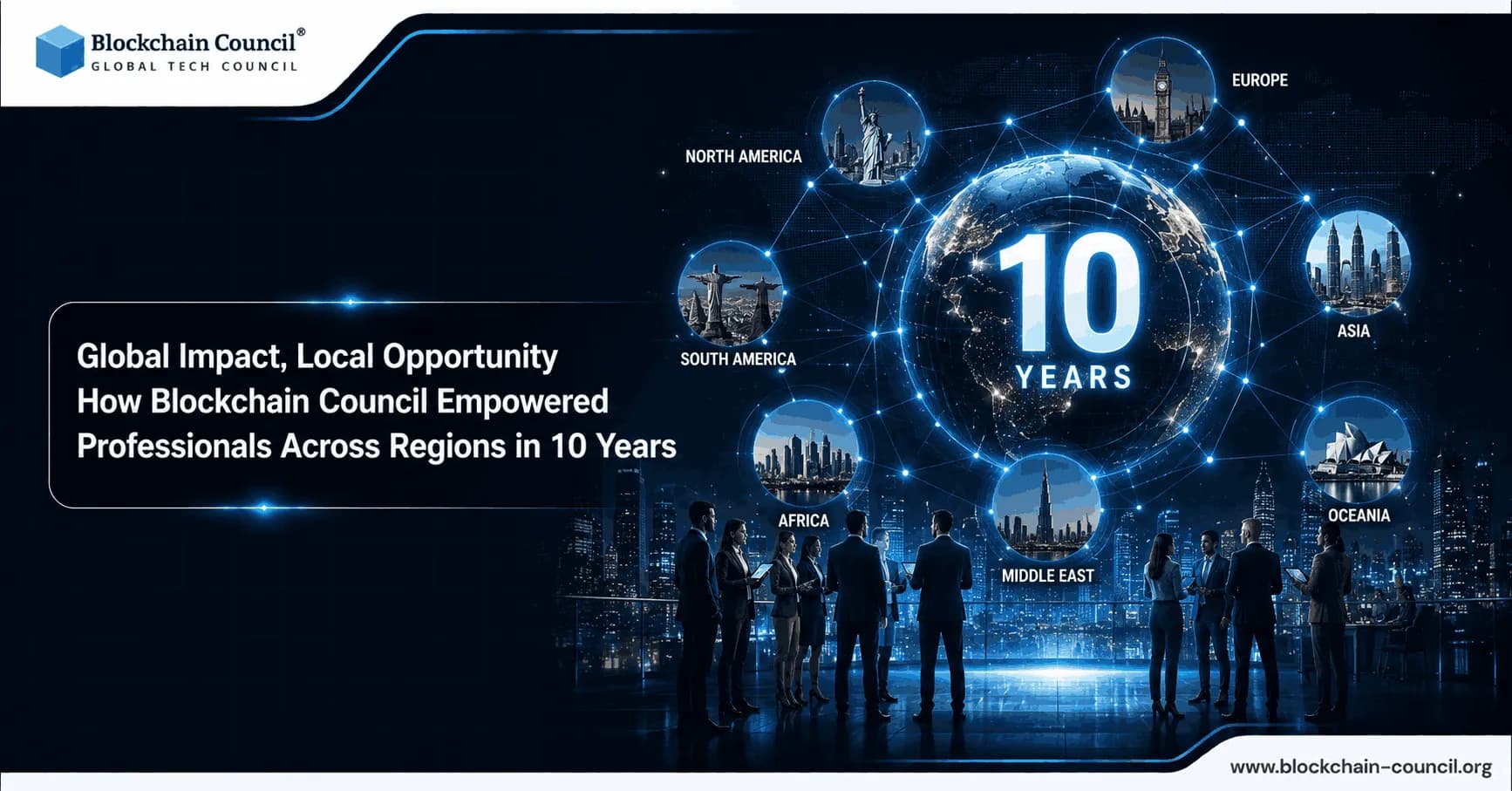
Global Impact, Local Opportunity is not just a theme for emerging technology education. It is a practical requirement for a workforce trying to keep pace with blockchain, AI, Web3, crypto, and cybersecurity as these technologies move from experimentation to enterprise deployment. Over the past decade, Blockchain Council has positioned itself as a professional education and certification body focused on applied skills, flexible learning, and globally relevant credentials. It operates as a private organization dedicated to raising awareness and educating businesses, developers, and society in the blockchain space, while serving learners across 145+ countries as a recognized authority in blockchain and AI certifications.
This article explores how Blockchain Council's model translates into local opportunity across regions, why demand for certification has risen alongside market growth, and how professionals can align certification choices with real-world roles.

Blockchain Council's Mission: Workforce-First, Applied Learning
Blockchain Council's mission has consistently emphasized professional enablement rather than academic credentialing. Its mandate centers on creating awareness and educating stakeholders through practical knowledge of blockchain research, development, use cases, and products. Blockchain Council positions its certification programs as research-backed and globally accessible, with reach across 145+ countries.
This positioning matters because emerging technology moves faster than most formal curricula. Professional certification programs are often chosen when learners need:
Job-aligned skills for immediate workplace application
Schedule-flexible learning compatible with full-time roles
Portable credentials that can signal competence across regions
Why the Last 10 Years Created a Global Certification Moment
Blockchain Council's growth sits within a broader macro trend: blockchain and AI have become strategic priorities for governments, enterprises, and startups alike. Several market indicators explain why upskilling demand accelerated sharply over this period.
Blockchain's Projected Economic Contribution
PwC has estimated that blockchain could add approximately 1.76 trillion USD to global GDP by 2030, driven by improvements in transactions, supply chains, and record management. When a technology is expected to influence GDP at that scale, the workforce implications are immediate: organizations need talent that can design, build, audit, govern, and deploy blockchain systems responsibly.
DeFi Growth and the Need for Specialized Skills
Decentralized finance expanded rapidly, with total value locked rising from roughly 1 billion USD in 2020 to approximately 200 billion USD in 2022. This growth increased demand for professionals who understand smart contracts, protocol security, governance design, and risk management in on-chain environments.
Investment Inflows That Reshaped Hiring
Venture capital investment in blockchain and crypto-related companies surpassed 30 billion USD in 2021, up from about 10 billion USD in 2020. Capital acceleration at this pace typically triggers a talent race across engineering, product, security, compliance, and growth functions.
Trade Finance and Enterprise Adoption Pressure
The global trade finance gap was estimated at around 1.7 trillion USD in 2020. Blockchain is frequently examined as a tool to reduce paperwork, create single sources of truth, and improve access to trade finance through digitized registries and shared infrastructure. These are enterprise-heavy implementations where required skills extend beyond coding into architecture, integration, and compliance.
From Blockchain-Only to Deeptech: Expansion into AI, Web3, and Beyond
One of the defining shifts in Blockchain Council's 10-year trajectory is its expansion from blockchain-focused education into a wider deeptech scope that includes AI and adjacent domains. A third-party review of Blockchain Council's AI certification portfolio describes three layers that reflect how professionals actually upskill:
General AI literacy and foundations for broad understanding
Specialized AI application aligned to functions and industries
Deeptech certification connecting AI with Web3, blockchain, cloud, and emerging stacks
These programs are designed as professional training rather than formal academic study, emphasizing practical value and schedule fit for consultants, founders, managers, and career changers. That structure maps closely to the reality of adoption: enterprises need people who can apply AI and blockchain, not only study them in theory.
Global Reach with Local Relevance Across Regions
Blockchain Council reports serving learners in 145+ countries, reflecting a globally distributed audience. While detailed per-region metrics are not publicly disclosed, the organization's online-first, professional format naturally supports regional variation in use cases and career outcomes.
North America and Western Europe: Enterprise Deployment and Governance Readiness
In mature markets, opportunity tends to cluster around institutional adoption, compliance alignment, and enterprise modernization. Professionals commonly pursue certifications to support roles such as:
Blockchain solution architect for supply chain and record systems
Web3 product manager for tokenization and user-facing platforms
Security and smart contract auditor supporting DeFi and on-chain applications
AI and data leaders implementing automation and decision support systems
These regions also show strong focus on responsible innovation. Organizations like the World Economic Forum emphasize interoperability, transparency, and equitable governance for distributed ledger technologies, which increases demand for professionals who can connect technical decisions to policy and governance realities.
Asia-Pacific: Innovation Velocity and Competitive Technical Markets
Asia-Pacific markets are characterized by fast iteration in digital payments, consumer Web3 applications, and experimentation with new models of digital infrastructure. In high-competition hiring environments, professional certifications help candidates signal job readiness and structured learning progression. Local opportunity often includes:
Web3 development for wallets, dApps, and token economies
Cross-border payments and fintech built on blockchain infrastructure
Applied AI roles in operations, customer support automation, and product analytics
Middle East and Africa: Fintech Inclusion, Identity, and New Hubs
Across many Middle East and Africa markets, fintech and mobile-first services create a strong foundation for blockchain use cases such as remittances, digital identity, and trade infrastructure. Several jurisdictions have positioned themselves as innovation hubs for crypto and Web3. Certification carries particular value here as a portable credential in contexts where local university curricula are still developing coverage of specialized areas.
Professionals often benefit by aligning certification with ecosystem needs such as:
Blockchain for financial inclusion and low-cost transaction rails
Identity and compliance tooling for regulated environments
AI-enabled services in customer operations and decision support
Latin America: Crypto Utility, Remittances, and Practical Skill Signaling
Latin America has seen strong interest in crypto for store-of-value use cases, payments, and remittances, alongside growing AI adoption in finance, retail, and government services. Professionals in these markets frequently seek certifications that help them compete for remote roles, serve global clients, or build locally relevant products that meet international standards.
How Certifications Translate into Real Roles and Projects
Blockchain Council's thematic coverage maps to common professional pathways. The following examples show how certification content typically aligns with industry work.
Blockchain and Web3 Pathways
DeFi and smart contracts: protocol development, smart contract engineering, and security practices are essential as DeFi complexity continues to grow.
Enterprise blockchain: architecture, permissioned deployments, and integration with existing systems support adoption in trade and supply chain contexts.
Tokenization and DAOs: tokenomics, governance, and identity management support creator economies and new organizational models.
AI and Generative AI Pathways
Blockchain Council also publishes analysis on AI's impact across education, healthcare, business, and creative work, including the rise of AI-based tutoring systems and enterprise decision support. For professionals, AI certification value frequently appears in:
Operations automation and process optimization
Customer support modernization through AI tooling
Responsible AI practices tied to governance and data stewardship
Deeptech Convergence: Where Local Opportunity Grows Fastest
One of the strongest workforce signals is convergence. Industry analysis has highlighted the fusion of blockchain and generative AI as a means of addressing longstanding constraints in finance and operations while creating new models of value creation. Cross-disciplinary professionals are increasingly valuable, particularly in roles that sit between product, compliance, and engineering.
AI & Technology
As artificial intelligence continues to transform education, students are getting more opportunities to explore technology beyond traditional classroom learning. A World Tech Olympiad can help students develop their understanding of AI, logical reasoning, problem-solving, and other technology skills through structured competition.
For professionals looking to keep pace with this convergence, a Tech Certification can complement hands-on experience by helping broaden technical knowledge across evolving technology domains.
Ecosystem Alignment: Preparing Talent for Policy-Aware Innovation
Blockchain adoption is increasingly shaped by governance and regulation, not only engineering capability. The Global Blockchain Business Council emphasizes education for regulators, executives, and institutional stakeholders, reinforcing that the next stage of adoption requires shared understanding across policy and industry. Public discussions from organizations like the Council on Foreign Relations similarly highlight blockchain's relevance to finance, national security, and democratic institutions.
This environment favors professionals who can communicate across functions. Certification programs covering fundamentals, risk, and compliance concepts support that need, especially when teams operate across jurisdictions.
Learning Pathways Professionals Can Consider
The most effective certification strategy is to match credentials to the role you want in 6 to 18 months, then build breadth for long-term resilience.
For developers: start with a blockchain developer track, then add smart contract security or Web3 specialization. Pairing with an AI certification is valuable if your work involves security analytics, fraud detection, or automation.
For product and business leaders: start with blockchain fundamentals and AI foundations, then add a deeptech certification to understand system-level tradeoffs across Web3, cloud, and data infrastructure.
For enterprises: standardize baseline literacy across teams, then create role-based specializations for architecture, security, compliance, and operations.
Conclusion: Global Impact That Compounds Through Local Careers
Global Impact, Local Opportunity describes how professional education scales when it is designed for applied work. Over 10 years, Blockchain Council has evolved from a blockchain education initiative into a broader deeptech certification provider spanning blockchain, AI, Web3, and adjacent domains, with reach across 145+ countries. That global footprint matters because the demand drivers are global: projected GDP impact from blockchain, DeFi growth, enterprise modernization needs, and rapid AI integration across industries.
At the local level, the opportunity is practical: professionals can access structured learning without relocating or enrolling in multi-year degree programs, then apply those skills to region-specific use cases such as remittances, supply chain transparency, enterprise automation, or product innovation. As regulation matures and AI-blockchain convergence accelerates, professionals who invest in credible, job-aligned certification pathways will be better prepared to build responsibly, communicate clearly across functions, and lead implementation in their own markets. For professionals involved in promoting these emerging technologies, a Marketing Certification can further complement technical knowledge by developing skills for communicating complex technology concepts to relevant audiences.
FAQs
1. What Is Blockchain Council?
Blockchain Council is an organization focused on education and professional certifications in blockchain, AI, Web3, cryptocurrency, and other emerging technologies. It was established in 2016 and says its programs are designed to help professionals develop industry-relevant technology skills.
2. How Has Blockchain Council Created Global Opportunities for Professionals?
Blockchain Council has expanded its certification and learning programs to professionals across many countries. The organization currently reports reaching professionals in more than 145 countries, providing access to emerging technology education regardless of a learner's location.
3. How Many Professionals Has Blockchain Council Certified?
Blockchain Council currently reports more than 125,000 certified professionals, while its broader website reports more than one million learners across its education ecosystem. These figures demonstrate the scale of its global technology education and certification activities.
4. In How Many Countries Does Blockchain Council Have Certified Professionals?
Blockchain Council reports that its certified professionals are represented across more than 145 countries. This international reach allows professionals from different regions and industries to access blockchain and emerging technology education.
5. Why Is Global Access to Emerging Technology Education Important?
Emerging technologies can create new career opportunities, but access to specialized education is not equally distributed across every region. Online and self-paced learning can help professionals develop relevant skills without needing to relocate or leave their existing careers.
6. How Can Blockchain Certifications Help Professionals Advance Their Careers?
A specialized certification can help professionals demonstrate structured knowledge in areas such as blockchain, smart contracts, Web3, AI, or digital assets. Blockchain Council says its programs are designed around industry-relevant skills and provide verifiable credentials that can be shared with employers and clients.
7. Can Professionals From Different Industries Learn Blockchain Technology?
Yes. Blockchain education is relevant to professionals in technology, finance, healthcare, supply chain, law, marketing, cybersecurity, and other fields. Blockchain Council offers programs spanning technical development as well as industry-specific applications such as blockchain and finance, KYC, healthcare, law, HR, and digital marketing.
8. How Does Blockchain Council Support Career Switching Into Emerging Technologies?
Structured certification programs can provide professionals with a focused pathway for learning a new technology without pursuing another full-time degree. Blockchain Council's recent 10-year review highlights career pivots into blockchain, AI, Web3, and related emerging technology fields as an important use of its certification programs.
9. Why Are Blockchain Skills Becoming More Important Across Regions?
Blockchain has expanded beyond cryptocurrency into areas such as digital identity, finance, supply chains, tokenization, and enterprise applications. As adoption becomes more diverse, professionals in different regions can benefit from understanding both the technical foundations and practical business applications of blockchain.
10. How Can Online Learning Create Local Career Opportunities?
Online learning allows professionals to acquire globally relevant skills while remaining in their local communities. These skills can then be applied to local companies, startups, financial institutions, technology projects, consulting opportunities, or remote roles serving international organizations.
11. What Types of Blockchain Certifications Are Available?
Blockchain Council currently offers certification programs covering areas such as blockchain fundamentals, blockchain architecture, smart contracts, Ethereum, Solidity, Hyperledger, DeFi, blockchain analytics, and blockchain product management. Its broader catalog also includes AI, Web3, cryptocurrency, cybersecurity, and other emerging technology programs.
12. Are Blockchain Council Certifications Available Online?
Yes. Blockchain Council offers self-paced learning options that allow professionals to study remotely. Its certification pages also describe expert-designed curricula, online examinations, digital certificates, and lifetime access for applicable programs.
13. How Do Digital Credentials Help Globally Distributed Professionals?
Digital credentials can make it easier for professionals to demonstrate their qualifications when applying for jobs, freelance projects, consulting opportunities, or further education. Blockchain Council says its certificates include unique verification information that employers and clients can use to confirm credential authenticity.
14. How Can Blockchain Education Support Professionals in Developing Technology Markets?
Blockchain education can help professionals build skills that can be applied to emerging local technology ecosystems. Knowledge of areas such as digital assets, decentralized applications, smart contracts, blockchain security, and tokenization can provide a foundation for participating in new technology initiatives as they develop.
15. Does Blockchain Education Focus Only on Technical Careers?
No. Blockchain education can support both technical and non-technical career paths. Programs can address roles involving development, architecture, product management, finance, compliance, healthcare, law, marketing, cybersecurity, and business strategy.
16. How Has Blockchain Council Expanded Beyond Blockchain Education?
Over the past decade, the organization's educational focus has expanded alongside changes in the technology landscape. Its current catalog covers blockchain as well as AI, Web3, cryptocurrency, cybersecurity, metaverse technologies, and other emerging fields.
17. Why Is Continuous Learning Important for Emerging Technology Professionals?
Technologies such as blockchain, AI, and Web3 evolve rapidly, meaning skills that are valuable today can change as platforms, standards, regulations, and applications develop. Continuous learning helps professionals update their knowledge and adapt to changing career requirements. Blockchain Council's 10-year review specifically describes the shift from one-time education toward ongoing future-skills development.
18. What Role Does Certification Play in Global Career Mobility?
A verifiable professional credential can provide standardized evidence of learning when professionals apply for opportunities outside their local markets. It does not guarantee employment, but it can complement work experience, portfolios, technical skills, and professional achievements when presenting qualifications to employers or clients.
19. What Can Professionals Learn From Blockchain Council's 10-Year Journey?
One key lesson is that emerging technology education needs to evolve alongside the technologies themselves. The shift from blockchain-focused learning toward broader areas including AI, Web3, digital assets, and specialized industry applications illustrates the growing importance of adaptable, continuous professional development.
20. What Is the Future of Emerging Technology Education?
The future is likely to involve more flexible, skills-focused, digitally verifiable, and continuously updated learning. As AI, blockchain, Web3, cybersecurity, and other technologies continue developing, professionals will increasingly need accessible education that connects technical knowledge with practical workplace applications.
Related Articles
View All
Info
From First Certification to Global Community: How Blockchain Council Built a Trusted Learning Ecosystem in 10 Years
A research-based look at how Blockchain Council grew from early blockchain certifications into a global learning ecosystem spanning blockchain, AI, and Web3.

Info
10 Years of Future Skills: How Blockchain Council Certifications Helped Professionals Pivot Into Emerging Tech Careers
Explore how Blockchain Council certifications enabled career pivots into blockchain, AI, Web3, and crypto over 10 years, plus what future skills matter next.

Info
10 Years of Blockchain Council Learners: Career Outcomes and Success Pathways
Explore 10 years of Blockchain Council learners through market-backed career outcomes, role pathways, and practical success patterns across blockchain, Web3, AI, and security.
Trending Articles
The Role of Blockchain in Ethical AI Development
How blockchain technology is being used to promote transparency and accountability in artificial intelligence systems.
AWS Career Roadmap
A step-by-step guide to building a successful career in Amazon Web Services cloud computing.
Claude AI Tools for Productivity
Discover Claude AI tools for productivity to streamline tasks, manage workflows, and improve efficiency.