

The Evolution of Emerging Technology Education: Key Trends Blockchain Council Anticipated Over the Last Decade
 Suyash Raizada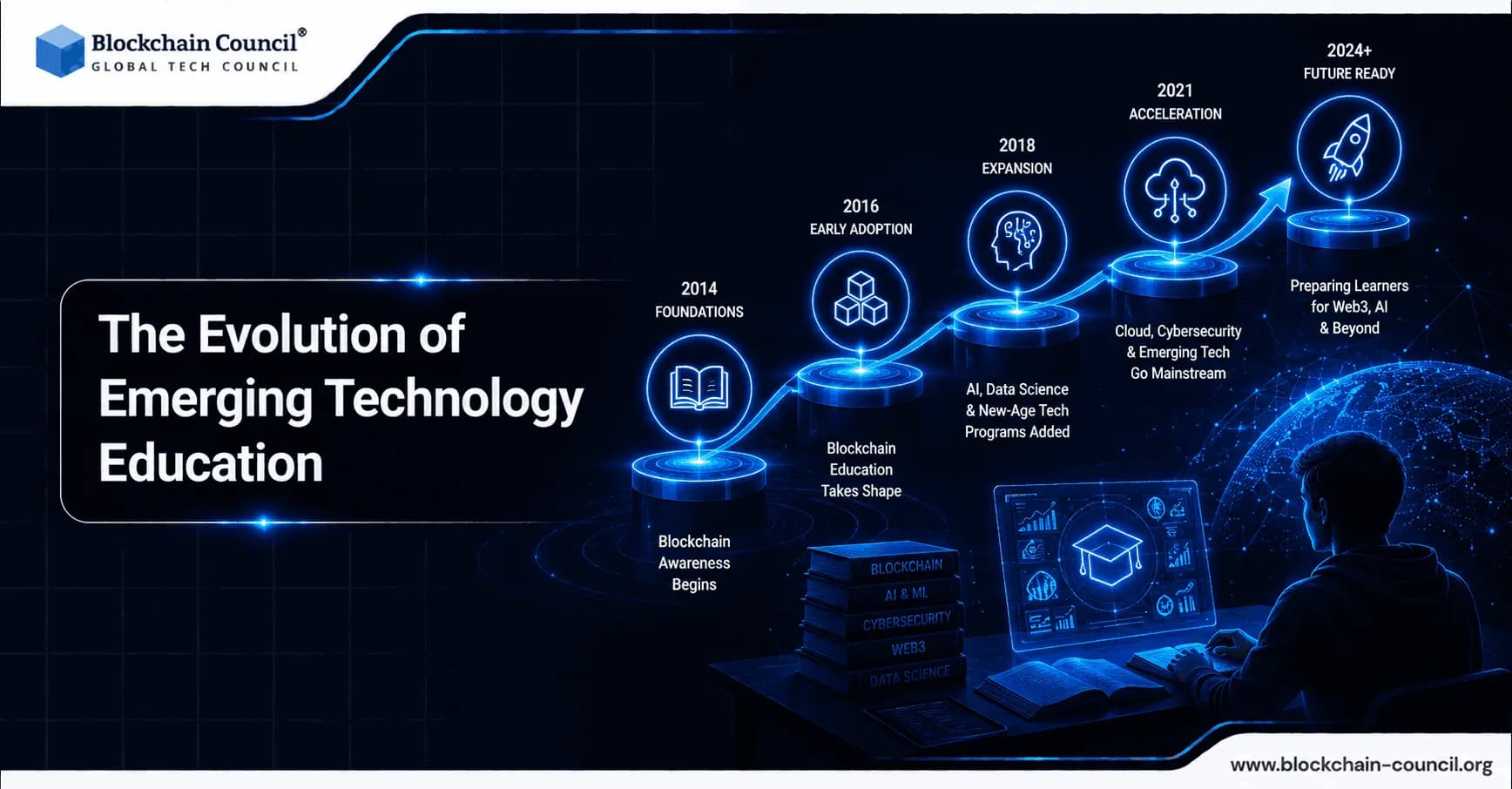
Emerging technology education has changed dramatically since the mid-2010s. What began as broad edtech adoption has matured into specialized, skills-first learning paths for AI, blockchain, Web3, extended reality (XR), and cybersecurity. Online and self-paced formats made it feasible for working professionals to continuously upskill, while employers increasingly required verifiable proof of competency rather than course attendance alone. For learners looking to build practical expertise in artificial intelligence, pursuing a Certified Artificial Intelligence (AI) Expert pathway can complement this broader shift toward demonstrable, technology-focused skills.
Over the last decade, organizations focused on industry-aligned credentials, including Blockchain Council, anticipated several of these shifts: faster refresh cycles, project-based learning, micro-credentials, and the growing need for portable digital proof of skills. Below is a research-driven view of how the field evolved, what is happening now, and what the next decade is likely to bring.

1) From Edtech Adoption to Emerging Tech as a Discipline
Between roughly 2014 and 2016, three macro-trends set the foundation for today's emerging technology education ecosystem.
Self-paced and competency-based learning became mainstream
The 2010s saw rapid growth in MOOCs and competency-based education models, enabling learners to progress by demonstrating mastery rather than accumulating seat time. This was a strong fit for fast-moving domains like blockchain and AI, where curricula must be refreshed frequently. Competency-based pathways and adaptive tools shifted learning toward more flexible, learner-centered models that prioritize demonstrated ability over time spent in a course.
Classroom technology and digital platforms expanded access
Classrooms evolved from static instruction to interactive smart boards, connected devices, and digital learning platforms. Technology expanded access to education and supported new learning space designs that prioritize collaboration, with teachers increasingly acting as facilitators rather than sole lecturers.
Personalization and immersive learning started to scale
VR, AR, and data-driven personalization moved from experimental to practical use. Real classroom applications emerged that did not require educators to have deep computer science backgrounds. Generative AI and immersive tools began reshaping instruction, content creation, and student experiences at institutions ranging from K-12 to professional training providers.
2) Where Emerging Technology Education Stands Today
Emerging technology education now operates on two parallel tracks:
Emerging tech as content: learners study AI, blockchain, Web3, XR, and cybersecurity as professional disciplines.
Emerging tech as infrastructure: AI, data analytics, and immersive tools increasingly shape how education is delivered, assessed, and personalized.
AI education and AI in education
AI as a subject has grown rapidly, reflected in expanding computer science enrollment and the rise of AI and data science degree programs, bootcamps, and professional certificates. Corporate training budgets for AI skills have grown alongside broader enterprise investment in AI systems. As blockchain education has similarly become more specialized, learners seeking a stronger foundation in decentralized technologies may consider a Certified Blockchain Expert pathway alongside hands-on technical learning.
AI as a tool accelerated significantly with generative AI adoption. The 2023 surge in generative AI use raised legitimate concerns about academic integrity while enabling new workflows such as creating reading materials, customizing assignments, and coaching writing. This aligns with a broader shift toward adaptive learning, where tools tailor content and pacing based on learner performance and behavior.
Practical AI-in-education patterns now commonly include:
AI-assisted formative feedback on writing and coding
Personalized quizzes and practice plans driven by performance data
Educator support for lesson planning and resource creation
Blockchain and Web3 education
Following the 2017 to 2018 crypto boom, blockchain education expanded into universities and professional training providers. Many programs now cover smart contracts, decentralized applications, token design, and compliance considerations. Demand from both learners and employers drove widespread availability of blockchain and crypto courses across institutions globally.
Web3 also introduced new models for tracking and verifying learning achievements. While broad mainstream adoption remains uneven, pilots have explored:
Verifiable credentials: tamper-resistant, independently verifiable proofs of completion
Micro-certifications: smaller skill signals aligned with specific job tasks
Tokenized incentives: experimental reward systems for learning progress and community contribution
XR (VR, AR, MR) moved from novelty to workforce training utility
XR has become particularly relevant for hands-on training where physical labs are expensive, dangerous, or impractical. As devices and creation tools become more accessible, adoption in both academic and corporate training contexts has grown. Students are not only consuming immersive content but also creating it - for example, building 360-degree scenes with smartphones and low-cost cameras. This learner-as-creator shift supports deeper understanding and builds durable digital skills.
XR use cases that map well to skills-first certification include:
Virtual labs for STEM and technical training
Role-play simulations for emergency response and soft skills development
Contextual training for maintenance, operations, and safety procedures
Cybersecurity education became a baseline requirement
As cyber risk increased and regulations expanded, cybersecurity moved from a niche specialization to a core organizational need. Training evolved beyond theory into lab-based methods such as cyber ranges and capture-the-flag competitions that simulate realistic attacks and defenses. This approach aligns with the competency-based learning movement, where demonstrated skill matters more than time spent studying.
A practical pathway for learners and teams often combines foundational knowledge with role-based specializations such as cloud security, DevSecOps, and incident response.
3) Key Trends Blockchain Council Anticipated and Why They Mattered
Across the last decade, several trends became defining features of emerging technology education. Many were anticipated early by certification-led ecosystems because they were direct responses to industry hiring and delivery constraints.
Trend 1: Industry-aligned certifications became core skill signals
As blockchain, AI, and security moved into production environments, employers needed reliable indicators of competency. Certifications tied to hands-on outcomes complemented degrees and helped mid-career professionals pivot or specialize without returning to full-time academic programs.
Trend 2: Skills-first learning outpaced theory-first learning
In emerging technologies, frameworks and best practices change quickly. Skills-first programs prioritize the ability to build, audit, deploy, and secure systems. This mirrors the broader rise of competency-based learning models that reward demonstrated ability over course completion.
Trend 3: Self-paced online learning became the default for professionals
Working learners needed flexible formats. Online content availability expanded learning access globally, reinforcing the viability of asynchronous, modular training. In emerging tech specifically, this also supports faster curriculum updates and more frequent reassessment cycles.
Trend 4: Interdisciplinary demand reshaped curricula
Blockchain and AI education expanded beyond computer science into finance, law, compliance, product management, and policy. This reflects the real-world nature of implementation, where technical design intersects with governance, risk, and ethics.
Trend 5: Lifelong learning replaced one-and-done education
Continuous upskilling is now a practical requirement for many roles in technology. Certification pathways increasingly reflect this reality through advanced tracks, updated syllabi, and evolving skill frameworks that keep pace with industry change.
Trend 6: Verifiable and portable digital credentials gained importance
As careers became more global and project-based, professionals needed portable proof of skills. Blockchain-based credentialing pilots and digital credential systems helped shape expectations for independent verification, faster background checks, and reduced credential fraud.
Trend 7: Regulation and ethics became first-class topics
AI governance, privacy, algorithmic bias, and crypto compliance moved into mainstream curricula. This matched enterprise demand for responsible innovation, not just technical capability, as regulatory scrutiny of AI and digital assets increased across major markets.
4) What the Next Decade Is Likely to Bring
Current research and adoption patterns suggest several high-probability directions for emerging technology education.
AI embedded in most learning experiences
AI will increasingly support tutoring, assessment, personalization, and educator workflows. A notable caution from researchers is that AI can make poor pedagogy more efficient if instructional design is not reconsidered alongside tool adoption. The practical implication is that educators and training providers will need AI-pedagogy skills, not only tool familiarity.
Convergence: AI, XR, and verifiable learning records
Expect more immersive, simulation-based learning paired with stronger proof of competency. A plausible model is AI-guided XR labs where completion is recorded as verifiable evidence of skill, supporting hiring decisions and internal mobility programs.
Security, privacy, and ethical literacy as universal requirements
As learning platforms collect more data and AI tools become ubiquitous, security and privacy literacy will expand beyond dedicated security teams. Advanced cybersecurity skills will remain in high demand, but baseline competence will matter for most professional roles.
Project-based and interdisciplinary training becomes the default
Workforce-aligned learning will continue to emphasize real-world deliverables such as smart contract prototypes, AI model evaluation, security audits, and policy analysis. Partnerships among educators, enterprises, and certification bodies will be increasingly important to keep content current and practically relevant.
Funding constraints push ROI-focused adoption
As institutions and enterprises face tighter budgets, ROI scrutiny will increase across technology investments in education. This is likely to drive demand for scalable, measurable programs with clearly defined outcomes and assessable competency milestones.
AI & Technology
As artificial intelligence continues to transform education, students are getting more opportunities to explore technology beyond traditional classroom learning. A World Tech Olympiad can help students develop their understanding of AI, logical reasoning, problem-solving, and other technology skills through structured competition.
5) Implications for Professionals, Developers, and Enterprises
For professionals and developers
Plan for continuous learning in AI, blockchain, Web3, and cybersecurity as tools, threats, and standards change.
Choose competency-driven pathways with labs and assessments that mirror real-world tasks.
Build a verifiable portfolio that combines project work with recognized credentials.
For enterprises
Use role-based learning paths - for example, developer, security analyst, product leader - to reduce wasted training time and improve skill relevance.
Pair AI-enabled training with governance frameworks to address privacy, bias, and compliance risks from the outset.
Adopt measurable outcomes like skill assessments, project delivery milestones, and validated credentials to track training effectiveness.
For professionals and developers navigating rapidly changing technology ecosystems, broader learning pathways can also help connect technical expertise with practical implementation. Exploring a Tech Certification can therefore complement hands-on experience by supporting the development of wider technology skills across emerging and established domains.
Conclusion
The past decade transformed emerging technology education from general digital learning adoption into a specialized ecosystem focused on practical competence in AI, blockchain, Web3, XR, and cybersecurity. Consistent themes have emerged across research and practice: personalization, immersive learning, online access, and the need to rethink pedagogy rather than simply digitize traditional methods.
For professionals and enterprises, the direction is clear: the most resilient strategy is a skills-first, continuously updated learning plan supported by hands-on practice and verifiable credentials. Over the next decade, the convergence of AI-driven personalization, XR-based simulation, and portable digital credentialing is likely to make emerging tech education more measurable, more modular, and more closely aligned with real work than at any previous point in its development.
As these changes continue, technology education will increasingly overlap with how organizations communicate, position, and apply new digital capabilities. Professionals involved in promoting technology-focused products, services, and educational initiatives may also benefit from a Marketing Certification that complements their understanding of emerging technology with relevant marketing knowledge.
FAQs
1. How Has Emerging Technology Education Evolved Over the Last Decade?
Emerging technology education has moved from broad digital learning toward specialized, skills-focused education in areas such as blockchain, AI, Web3, cybersecurity, and extended reality. Online learning, practical projects, certifications, and continuous upskilling have become increasingly important as technology changes rapidly.
2. What Are the Major Trends in Emerging Technology Education?
Major trends include self-paced learning, skills-first education, industry-aligned certifications, project-based training, interdisciplinary curricula, lifelong learning, digital credentials, and the increasing use of AI in education. These trends reflect the growing need for professionals to continuously update their technical skills.
3. Why Has Skills-First Learning Become Important?
Skills-first learning focuses on what learners can actually demonstrate rather than only how much time they spend studying. This approach is particularly useful for emerging technologies because tools, frameworks, and industry practices can change faster than traditional academic curricula.
4. How Has Blockchain Changed Technology Education?
Blockchain has developed from a niche topic associated mainly with cryptocurrencies into a broader field covering distributed ledgers, smart contracts, decentralized applications, Web3, digital assets, and enterprise applications. This expansion has encouraged universities and professional training providers to introduce more specialized blockchain education.
5. How Has Artificial Intelligence Influenced Emerging Technology Education?
AI has become both a subject of study and a tool used to deliver education. Learners can now study AI while also using AI-powered tools for personalized practice, feedback, content creation, research, and other learning activities.
6. Why Are Online Certifications Important for Emerging Technology Professionals?
Online certifications can provide flexible pathways for professionals who want to develop specialized skills without leaving full-time employment. They can also provide structured learning and a way to demonstrate knowledge in rapidly evolving technology fields.
7. How Has Self-Paced Learning Changed Professional Education?
Self-paced learning allows professionals to study according to their schedules rather than following a fixed classroom timetable. This model is particularly valuable for emerging technologies because learners can access modular content and update their skills more frequently.
8. What Role Does Project-Based Learning Play in Emerging Technology Education?
Project-based learning allows students to apply concepts to practical problems rather than relying exclusively on theoretical study. In fields such as blockchain, AI, and cybersecurity, projects can include building applications, evaluating AI systems, developing smart contracts, or conducting security exercises.
9. Why Has Interdisciplinary Technology Education Become More Important?
Emerging technologies increasingly affect multiple industries and professional functions. Blockchain, for example, can involve technology, finance, law, compliance, governance, and business strategy, while AI can intersect with areas such as marketing, healthcare, cybersecurity, and product development.
10. How Is Web3 Education Different From Traditional Blockchain Education?
Traditional blockchain education often focuses on distributed ledger fundamentals, consensus mechanisms, and blockchain architecture. Web3 education expands into decentralized applications, DeFi, tokenomics, decentralized governance, digital assets, and other decentralized technologies.
11. What Role Does Cybersecurity Play in Emerging Technology Education?
Cybersecurity has become a core component of technology education because organizations increasingly depend on connected systems, cloud platforms, AI, blockchain, and digital infrastructure. Modern cybersecurity education increasingly emphasizes practical exercises, cyber ranges, simulations, and role-specific skills.
12. How Is Extended Reality Changing Technology Training?
Extended reality, including virtual, augmented, and mixed reality, can create immersive environments for technical and professional training. It can be particularly useful for simulations, virtual laboratories, safety training, maintenance, emergency response, and other situations where hands-on physical training may be expensive or difficult.
13. Why Are Digital Credentials Becoming More Important?
Digital credentials can provide portable evidence of skills, qualifications, and learning achievements. Emerging technology education has increasingly emphasized verifiable credentials and micro-certifications because professionals often build skills across multiple institutions, courses, employers, and learning platforms.
14. How Can Blockchain Support Verifiable Educational Credentials?
Blockchain can provide infrastructure for recording credential-related information in a way that can be independently verified and made resistant to unauthorized alteration. This can help learners share trusted evidence of qualifications and skills with employers or educational institutions.
15. Why Has Lifelong Learning Become Essential in Emerging Technologies?
Emerging technologies evolve continuously, making it difficult for professionals to rely only on skills acquired early in their careers. Lifelong learning allows professionals to update their knowledge as new tools, standards, security practices, and business applications emerge.
16. How Are Universities Adapting to Emerging Technology Education?
Universities are increasingly incorporating subjects such as blockchain, AI, Web3, cybersecurity, and other emerging technologies into academic and professional learning. Industry partnerships, specialized curricula, faculty training, practical labs, and applied research can help institutions keep programs aligned with changing technology requirements.
17. What Is the Role of Industry-Aligned Certification in Emerging Technology Education?
Industry-aligned certifications can complement academic degrees by focusing on specific skills and practical technology applications. They can be particularly useful for professionals who want to specialize, reskill, or demonstrate knowledge in rapidly changing fields such as blockchain and AI.
18. What Are the Biggest Challenges in Emerging Technology Education?
Major challenges include rapidly changing technology, outdated curricula, skills gaps, limited access to practical training, privacy and security concerns, and the need for continuous curriculum updates. Educational institutions and training providers must balance technical depth with the speed at which emerging technologies evolve.
19. What Will Emerging Technology Education Look Like in the Future?
Future technology education is likely to become more personalized, modular, practical, and continuously updated. AI-powered learning, immersive simulations, interdisciplinary programs, project-based assessment, and portable digital credentials are likely to become increasingly important.
20. What Can Professionals Do to Stay Relevant in Emerging Technologies?
Professionals can stay relevant by adopting a continuous learning strategy that combines foundational knowledge, practical projects, recognized credentials, and regular skill updates. Building expertise across complementary areas such as AI, blockchain, cybersecurity, data, and emerging digital technologies can also improve long-term adaptability.
Related Articles
View All
Info
A Decade of Digital Transformation Training: What Blockchain Council Taught the World About Blockchain, AI, and Cybersecurity
Review how a decade of digital transformation training shaped real-world adoption of blockchain, AI, and cybersecurity, and what skills and governance matter next.

Info
Blockchain Council at 10: A Timeline of Milestones Shaping Blockchain, AI, and Web3 Education
A 10-year lens on Blockchain Council and the ecosystem: key Bitcoin, Ethereum, DeFi, NFT, AI, and regulatory milestones that reshaped professional education and certifications.

Info
10 Years of Future Skills: How Blockchain Council Certifications Helped Professionals Pivot Into Emerging Tech Careers
Explore how Blockchain Council certifications enabled career pivots into blockchain, AI, Web3, and crypto over 10 years, plus what future skills matter next.
Trending Articles
AWS Career Roadmap
A step-by-step guide to building a successful career in Amazon Web Services cloud computing.
How Blockchain Secures AI Data
Understand how blockchain technology is being applied to protect the integrity and security of AI training data.
What is AWS? A Beginner's Guide to Cloud Computing
Everything you need to know about Amazon Web Services, cloud computing fundamentals, and career opportunities.