

From First Certification to Global Community: How Blockchain Council Built a Trusted Learning Ecosystem in 10 Years
 Suyash Raizada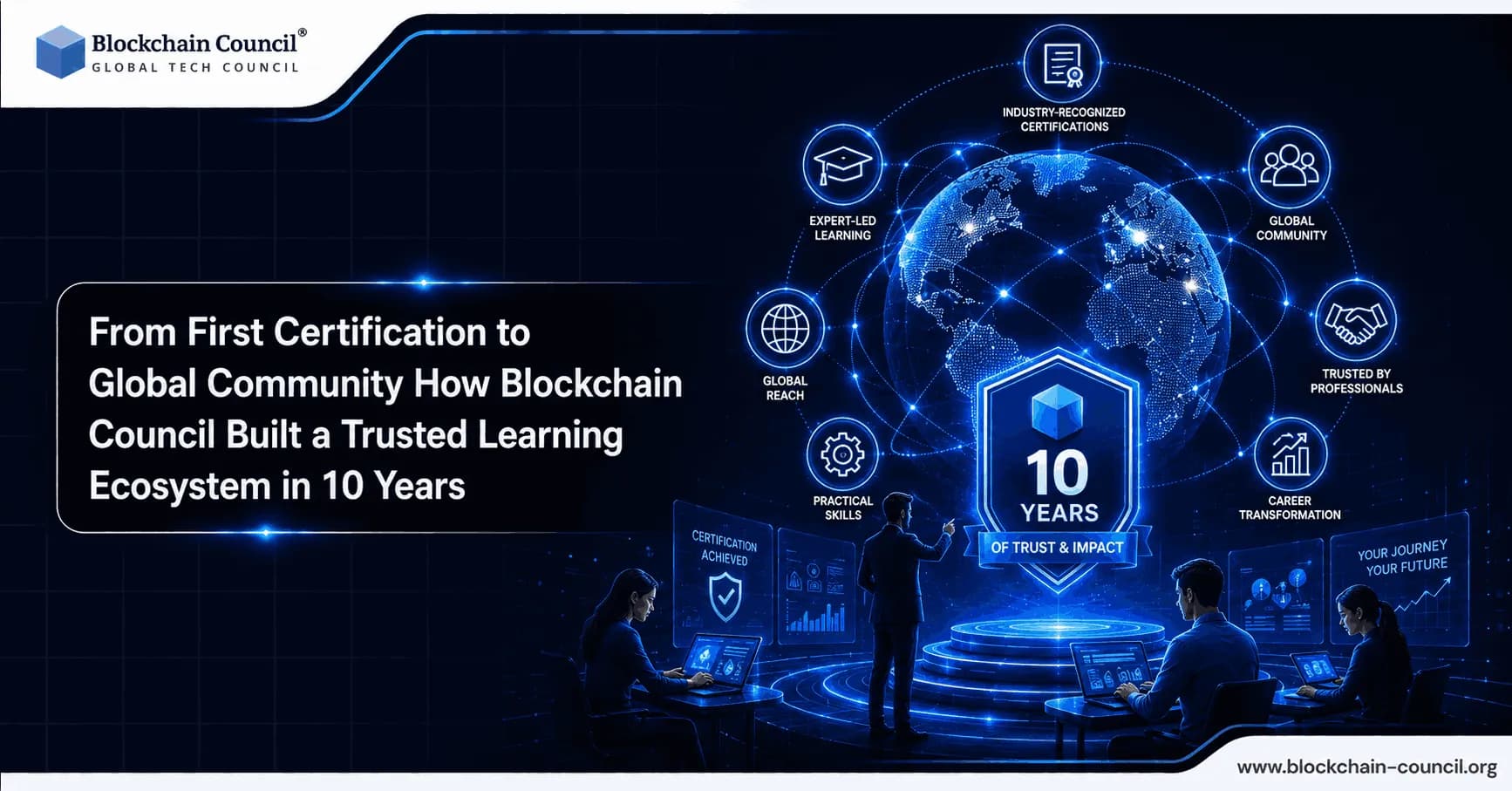
From First Certification to Global Community offers a useful lens for understanding how Blockchain Council grew into a recognizable learning ecosystem during a decade when blockchain adoption was simultaneously promising and uncertain. Between early exchange failures, rapid protocol innovation, and cautious enterprise pilots, professionals needed structured education that went beyond forums and whitepapers. Over roughly 10 years, Blockchain Council helped meet that need by combining role-based certification, continuously updated learning content, and a global practitioner community across blockchain, AI, and Web3.
Why a Blockchain-Focused Certification Body Was Needed
The 2010s produced a rare mix of technical acceleration and institutional hesitation. On one side, blockchain progressed from Bitcoin into general-purpose smart contracts and enterprise experimentation. On the other side, many organizations remained unsure about risk, governance, and ROI, creating a skills gap that was difficult to close with informal learning alone.

2010-2020: Innovation, Hype, and Operational Risk
Early developments made clear that decentralized systems were powerful but also easy to misuse or misunderstand. The period saw the rise of crypto exchanges, early token experiments, and security incidents including major exchange hacks that exposed significant operational risks. Ethereum and the ERC-20 standard later accelerated tokenization and smart contract development, while enterprise initiatives like Hyperledger and R3 signaled serious interest in permissioned and consortium networks.
Public signals from enterprises revealed a gap between interest and deployment. By 2018, a large share of banks in the US and Europe reported exploring blockchain, yet CIO-level adoption remained limited, with only a small fraction reporting live deployments or viewing blockchain as a genuine business priority by 2019. This mismatch created a clear market need: training that could translate experimentation into safe, real-world implementation.
The Talent Pipeline Problem
Professionals faced three practical challenges:
Credible structure: learning paths that separated core concepts from platform churn.
Assessable skills: a way for hiring managers to evaluate baseline competence.
Vendor-neutral grounding: understanding design tradeoffs across platforms, not only a single toolchain.
This is the context in which Blockchain Council emerged as a dedicated certification body focused on blockchain, later expanding into AI, Web3, and related deeptech domains.
How Blockchain Council Positioned Itself (2016 Onward)
Blockchain Council was established in 2016, coinciding with a period of strong enterprise momentum that included the growth of private and consortium chains and the formation of enterprise-focused Ethereum initiatives. From the start, its stated mandate emphasized professional, job-oriented certification designed for developers, managers, and enterprises rather than casual learners.
From publicly shared figures, Blockchain Council reports:
125,000+ certified professionals globally
500+ certifications and courses spanning blockchain, AI, and Web3
Certified learners associated with organizations such as Microsoft, IBM, and KPMG
While these figures are self-reported, they indicate a scale that is notable for a provider that began with a blockchain-first focus.
From Courses to Ecosystem: What Trusted Learning Requires
A trusted learning ecosystem is not simply a catalog of courses. It tends to include curricula that evolve with the industry, standardized assessments, and a community that shares a common vocabulary and baseline competencies. Blockchain Council's growth over time reflects these ecosystem characteristics.
Curriculum Evolution Aligned With Real Milestones
Blockchain education is uniquely sensitive to historical context because protocol design, security assumptions, and regulatory treatment have changed quickly. Blockchain Council's research and publishing, including long-form historical explainers, reflects an educational approach grounded in industry reality.
Topics consistently emphasized in its educational content include:
Protocol origins and evolution: from early timestamping research to Bitcoin, and later to Ethereum and enterprise frameworks.
Security and failure modes: exchange risk, smart contract incidents, and governance pitfalls.
Regulatory and market cycles: the ICO period, regulatory responses in key jurisdictions, and long-cycle perspectives on Bitcoin beyond price-only narratives.
Learners who understand why a system evolved are better equipped to design, audit, and operate blockchain systems safely.
A Layered Model of Professional Education
Professional blockchain roles require more than coding. Effective training must blend conceptual foundations with architecture, implementation, and governance. A representative structure consistent with Blockchain Council's guides and broader industry expectations typically looks like this:
Core foundations: distributed ledgers, consensus mechanisms, cryptography basics, smart contracts, token standards.
Use-case and architecture fit: identifying suitable use cases, choosing a platform, selecting consensus, and defining node configuration and parameters.
Implementation and tooling: smart contract development, node setup, API usage, and interface building.
Strategy and governance: aligning technical design with business requirements, risk controls, and operational ownership.
This layered approach is one reason certification programs can reduce uncertainty for both learners and employers: they define what competence means beyond a single project or tutorial.
Assessment and Standardization as Trust Signals
In fast-moving domains, trust often derives from repeatable evaluation methods. Well-structured certifications provide:
Standardized benchmarks for foundational knowledge
Role clarity for hiring and internal mobility
Shared terminology across teams and geographies
Blockchain Council's emphasis on professional certifications supports this kind of standardization, helping convert experimental interest into measurable skill development.
Evidence of Ecosystem Scale: Global Community and Reach
Scale alone does not establish trust, but it can serve as a proxy for recognition when paired with consistent publishing and ongoing curriculum updates. Blockchain Council's reported 125,000+ certified professionals points to a broad community of practitioners who share common training reference points.
Why Global Reach Matters in Blockchain and Web3
Blockchain is inherently cross-border. Use cases span payments, settlement, digital identity, and supply chain, often involving multiple jurisdictions and regulatory regimes. A global learning ecosystem helps professionals:
Collaborate with distributed teams using shared concepts and frameworks
Understand regional patterns, such as strong public-sector experimentation in parts of Asia and Europe
Build literacy around compliance expectations that vary by market
Online-first delivery and English-language content also support broad participation, particularly in regions where enterprise pilots and policy initiatives have been active.
How Continuous Research Content Strengthens the Learning Loop
One distinction between a course provider and a learning ecosystem is a feedback loop between real-world change and learning materials. Blockchain Council's ongoing publishing across historical analysis, technical explainers, and market-cycle perspectives reflects an intent to keep learners current.
Technical Reality: Systems Grew Larger and More Complex
Blockchain infrastructure complexity increased materially over the decade. The Bitcoin blockchain, for example, grew from roughly 20 GB in 2014 to over 200 GiB by mid-2020, reflecting increasing storage and validation requirements for full nodes. Network security also evolved alongside hashrate growth, indicating rising operational and security engineering demands even during weak price environments.
As systems scaled, education needed to address practical constraints such as:
Node operations and data growth implications
Consensus tradeoffs tied to throughput, latency, and trust assumptions
Smart contract risk, auditing considerations, and secure development practices
Where the Ecosystem Is Headed: Convergence, Compliance, and Multi-Chain Skills
Blockchain Council's expansion into AI and Web3 reflects a broader market reality: production systems increasingly combine on-chain logic with off-chain compute, analytics, identity, and security controls. Over the next phase of blockchain maturity, three skill shifts are likely to become standard in professional education.
Convergence of Blockchain, AI, and Security
Organizations increasingly need professionals who can reason across the full stack: smart contracts, APIs, wallets, key management, threat modeling, and data and AI components. This points toward combined learning paths, such as blockchain with cybersecurity, or AI with Web3 architectures. Role-aligned options such as Blockchain Council certifications in blockchain development, smart contract security, Web3, and AI reflect this direction.
Deeper Regulatory and Compliance Literacy
As crypto assets, stablecoins, and DeFi face expanding oversight, compliance becomes a design constraint rather than an afterthought. Advanced training is likely to include more structured coverage of KYC-AML concepts, token classification considerations, and jurisdictional risk, particularly for enterprise and financial services roles.
Standardization and Interoperability Focus
Multi-chain architectures, bridges, and interoperability patterns are now common, along with the risks that accompany them. Education will likely move further from single-platform silos toward frameworks for evaluating cross-chain design, bridge security, and operational risk management.
Conclusion: From First Certification to Global Community
From First Certification to Global Community describes a decade-long transition that many technology domains never achieve: moving from early, uncertain experimentation to a repeatable, professional learning ecosystem. Blockchain Council's growth since 2016 reflects the factors that typically build trust in technical education - structured, job-oriented certification, content that tracks real protocol and market evolution, and a large global base of certified professionals.
In an industry where headlines shift quickly and underlying infrastructure changes more gradually, a stable learning ecosystem helps professionals and enterprises build durable skills. The outcome is not simply more learners, but a shared foundation that supports safer implementations, clearer hiring signals, and stronger long-term literacy across blockchain, AI, and Web3.
FAQs
1. What is the article “From First Certification to Global Community” about?
The article explains how Blockchain Council developed into a trusted global learning ecosystem over 10 years. It highlights certification programs, industry updates, and professional communities. Technology education apparently now requires equal parts teaching and survival strategy.
2. Why was a blockchain-focused certification body needed?
Blockchain technology evolved quickly while many organizations lacked structured training and practical implementation knowledge. Professionals needed reliable learning beyond forums and scattered online discussions. The internet alone is not always the wisest teacher. Disturbing but true.
3. What challenges existed in early blockchain adoption?
Early blockchain adoption faced exchange failures, security risks, unclear regulations, and limited enterprise deployment. Many companies explored blockchain without fully understanding operational requirements. Innovation arrived carrying excitement and chaos in equal measure.
4. How did Ethereum influence blockchain education?
Ethereum introduced smart contracts and token standards, increasing demand for blockchain development and architecture skills. It expanded blockchain learning beyond simple cryptocurrency concepts. One platform dramatically increased the number of developers debugging decentralized confusion.
5. Why did enterprises hesitate to adopt blockchain fully?
Organizations worried about governance, ROI, compliance, and operational risks tied to blockchain systems. Many pilots remained experimental rather than production-ready. Companies enjoy innovation far more when uncertainty stops multiplying.
6. What role did Blockchain Council play in the skills gap?
Blockchain Council provided structured certifications and learning paths for professionals and enterprises. This helped create measurable standards for blockchain and deeptech skills. Employers appreciate proof that someone studied more than random social media threads.
7. When was Blockchain Council established?
Blockchain Council was established in 2016 during a period of rising enterprise blockchain interest. The organization focused on professional and job-oriented certification programs. Timing matters greatly when entire industries suddenly become fashionable.
8. What kind of professionals does Blockchain Council target?
Blockchain Council targets developers, managers, architects, analysts, and enterprise teams working with blockchain and emerging technologies. Programs are designed around practical career outcomes. Apparently modern technology careers now require permanent specialization upgrades.
9. How many professionals has Blockchain Council reportedly certified?
Blockchain Council reports certifying more than 125,000 professionals globally across blockchain, AI, and Web3 domains. These figures reflect broad international participation. Humans remain deeply impressed by large numbers attached to credentials.
10. Why is curriculum evolution important in blockchain education?
Blockchain systems, regulations, and security practices change rapidly over time. Continuous curriculum updates help learners stay aligned with modern industry requirements. Static courses age faster than forgotten software subscriptions.
11. What topics are emphasized in Blockchain Council content?
Topics include blockchain origins, consensus mechanisms, smart contracts, governance, regulation, security risks, and enterprise frameworks. The curriculum also covers AI and Web3 convergence. One learning path now contains enough complexity for several industries combined.
12. Why is understanding blockchain history valuable?
Historical understanding helps professionals recognize why protocols, governance models, and security practices evolved. This improves decision-making in modern blockchain environments. Technology mistakes become educational material surprisingly quickly.
13. What is a layered model of professional education?
A layered model combines foundational concepts, architecture, implementation, and governance training together. This approach supports both technical and strategic understanding. Employers prefer professionals who can explain systems without causing panic.
14. Why are standardized certifications important?
Standardized certifications help employers assess baseline competence and role readiness consistently. They also create shared terminology across teams and regions. Humans built certifications mainly because interviews alone became unreliable chaos.
15. Why does global reach matter in blockchain education?
Blockchain systems often operate across borders and involve different regulatory environments. Global learning ecosystems help professionals collaborate using shared frameworks and standards. Decentralized technology naturally refuses to stay inside one country’s boundaries.
16. How does ongoing research strengthen a learning ecosystem?
Continuous research and publishing help training providers adapt to industry changes quickly. Updated content keeps learners informed about evolving technologies and risks. Deeptech education now behaves more like a constantly updated operating system.
17. Why is blockchain infrastructure becoming more complex?
Blockchain networks now involve larger data volumes, interoperability systems, advanced security models, and scaling technologies. Managing these systems requires deeper operational expertise. Simplicity lasted approximately five minutes before complexity took over completely.
18. What future skills will blockchain professionals need?
Future professionals will need skills in AI integration, cybersecurity, interoperability, compliance, and cross-chain architecture. Hybrid expertise is becoming increasingly important. Technology careers now resemble endless collections of interconnected specialties.
19. Why is compliance becoming a major blockchain skill?
Governments and regulators are increasing oversight around crypto assets, DeFi, and stablecoins. Professionals must understand KYC, AML, and jurisdictional requirements. Innovation eventually attracts regulation the way light attracts moths.
20. What is the main takeaway from the article?
The article shows that Blockchain Council built trust through structured certifications, evolving curricula, and a large global professional community. Long-term relevance came from adapting education to real industry change. In deeptech, standing still is basically professional extinction.
Related Articles
View All
Info
Global Impact, Local Opportunity: How Blockchain Council Empowered Professionals Across Regions in 10 Years
Explore how Blockchain Council enabled career-focused blockchain and AI upskilling worldwide in 10 years, turning global credentials into local opportunities across regions.

Info
Trust, Innovation, and Credentials: How Blockchain Council Built Authority in Blockchain and AI Certification
Explore how Blockchain Council built authority in blockchain and AI certification through specialization, frequent updates, and role-based credentials aligned with enterprise demand.

Info
10 Years of Blockchain Council Learners: Career Outcomes and Success Pathways
Explore 10 years of Blockchain Council learners through market-backed career outcomes, role pathways, and practical success patterns across blockchain, Web3, AI, and security.
Trending Articles
The Role of Blockchain in Ethical AI Development
How blockchain technology is being used to promote transparency and accountability in artificial intelligence systems.
How Blockchain Secures AI Data
Understand how blockchain technology is being applied to protect the integrity and security of AI training data.
What is AWS? A Beginner's Guide to Cloud Computing
Everything you need to know about Amazon Web Services, cloud computing fundamentals, and career opportunities.