

Blockchain Council at 10: A Timeline of Milestones Shaping Blockchain, AI, and Web3 Education
 Suyash Raizada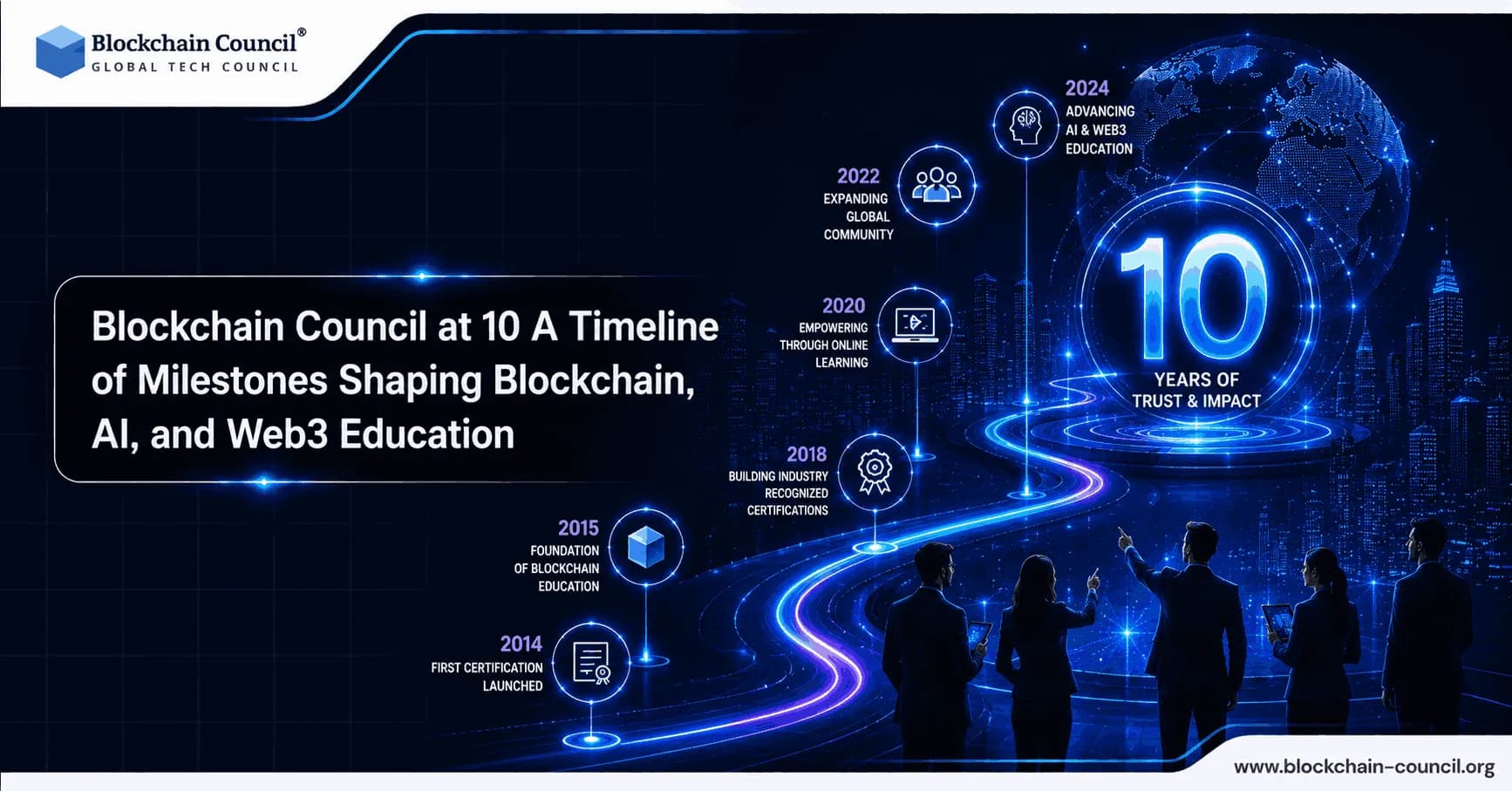
Blockchain Council at 10 offers a practical lens for understanding how professional education has evolved alongside real shifts in blockchain, AI, and Web3 adoption. In fast-moving domains, a decade is long enough for technologies to move from experimentation to enterprise deployment, and for training to mature from introductory explainers to role-based, compliance-aware, hands-on curricula.
This timeline-style overview connects three threads: major ecosystem milestones, the corresponding skills employers began to demand, and how structured learning (including certifications) became a practical way to validate competence across technical, business, and regulatory roles.

Why a 10-Year Lens Matters for Blockchain and AI Education
In crypto, anniversaries often mark visible inflection points because maturity shows up in protocol realities and market infrastructure, not just sentiment. Bitcoin discussions, for example, shifted over time from questions of survival to what is structurally established: a fixed issuance schedule, halving events, industrial-scale security, and institutional access through regulated products.
Applying this perspective to Blockchain Council at 10 highlights how education matured in three specific ways:
From basics to systems thinking: curricula expanded from "what is blockchain?" to architecture, security, economics, and operational risk.
From general learning to role-based validation: certifications increasingly map to job outcomes - developer, architect, auditor, compliance specialist, AI engineer.
From optional knowledge to regulated competence: evolving rules around custody, trading, stablecoins, and tokenization pushed compliance and governance into the core curriculum.
A Decade of Ecosystem Milestones That Reshaped Learning
Phase 1: Foundations and Early Legitimacy (2009-2016)
Even before enterprise adoption, a set of early Bitcoin milestones created baseline demand for technical and policy literacy:
2009: Bitcoin's Genesis Block was mined on January 3, embedding a headline about bank bailouts - an early signal of its monetary and political context.
2010: The first widely cited real-world Bitcoin purchase, 10,000 BTC for two pizzas, made the concept of programmable money tangible.
2013: Bitcoin's market cap surpassed 1 billion USD and early regulatory hearings began examining the benefits and risks of digital assets.
Education impact: This era seeded three tracks that still exist today:
Protocol and cryptography basics for developers and engineers.
Risk and policy orientation for legal, compliance, and public sector professionals.
Foundational market literacy for business leaders trying to separate technical facts from speculation.
Professional training providers, including Blockchain Council, emerged to organize fragmented knowledge into structured courses and certifications suitable for workplace learning.
Phase 2: ICO Boom, Enterprise Blockchain, and Compliance (2017-2020)
The 2017 ICO wave created urgent demand for practical skills. Thousands of token launches exposed gaps in smart contract safety, token economics design, and regulatory interpretation - particularly around whether tokens resembled securities.
In parallel, enterprise blockchain initiatives (often permissioned) gained visibility through consortia and vendors building supply chain, trade finance, and identity prototypes. This created a distinct learning demand: mapping business requirements to distributed ledger architectures, governance models, and integration constraints.
Education impact: Learning shifted from theory to application:
Smart contract development and secure design patterns.
Blockchain architecture for enterprise use cases, including permissioned network design.
Compliance fundamentals including AML, KYC, and jurisdictional differences.
This is where role-based learning becomes meaningful for career pathways. Blockchain Council training aligns to roles such as blockchain developer, blockchain architect, and blockchain security or auditing tracks, depending on job requirements.
Phase 3: DeFi, NFTs, and Institutional Entry (2020-2022)
Between 2020 and 2022, the scope of blockchain skills expanded significantly.
DeFi introduced automated market makers, on-chain lending, derivatives, and governance, with total value locked rising from under 1 billion USD in early 2020 to tens of billions at its peak, as tracked by analytics platforms such as DeFiLlama.
NFTs pushed token standards and digital ownership into mainstream awareness through art, gaming assets, and collectibles.
Institutional adoption accelerated as public companies added Bitcoin to treasuries and regulated custody and derivatives infrastructure matured.
Education impact: Curriculum needed to become more specialized and risk-aware:
DeFi mechanics: liquidity provision, oracle design, governance, and economic attack surfaces.
NFT engineering and product: ERC-721, ERC-1155, marketplace flows, royalties, and IP considerations.
Institutional operations: custody standards, on-chain analytics for compliance, and operational risk.
This period also reinforced the need for parallel tracks for developers and non-developers. Product managers, analysts, compliance officers, and risk teams needed enough depth to make decisions without necessarily writing Solidity.
Phase 4: Regulation Consolidates, Scaling Goes Modular, AI Accelerates (2023-2026)
The most recent phase is central to the "at 10" perspective because it reflects maturity: regulated access, clearer policy pathways, and deeper technical roadmaps.
Bitcoin milestones that changed how professionals learn
April 20, 2024: The Bitcoin halving at block height 840,000 reduced the block subsidy from 6.25 BTC to 3.125 BTC.
January 10, 2024: US spot Bitcoin exchange-traded product approvals materially changed institutional access and product design considerations.
January 3, 2026: Bitcoin turns 17, reinforcing the concept of durability through protocol schedule and market infrastructure.
Education impact: Professionals increasingly need to understand Bitcoin as infrastructure - supply schedule mechanics, mining economics, custody, risk controls, and how regulated venues affect portfolio, tax, and compliance workflows.
Ethereum at 10 and the move to modular scaling
By Ethereum's tenth anniversary on July 30, 2025, scaling conversations centered on rollups and modular architecture. A widely discussed "lean Ethereum" vision emphasized a robust base layer with high throughput via Layer 2 networks, targeting around 10,000 transactions per second on mainnet and significantly higher aggregate throughput on L2s while preserving decentralization and data availability.
Education impact: Modern smart contract education must include:
L2 deployment patterns and bridging considerations.
Cross-layer security including fraud proofs and validity proofs concepts.
Modular stack literacy: data availability, sequencers, and interoperability tradeoffs.
Regulatory developments that reshaped compliance curricula
From 2024 onward, policy discussions focused increasingly on practical market structure: trading rules, custody, token classification, and compliance pathways for DeFi and tokenization.
US market structure proposals addressed clearer authority boundaries and spot market oversight for non-security digital assets, alongside clarified rules for custody and registration.
SEC "Project Crypto" (announced July 31, 2025) outlined a comprehensive reform initiative spanning token classification and issuance, tokenization support, custody and trading rule revisions, and approaches to DeFi compliance pathways.
Hong Kong stablecoin licensing opened issuer licensing applications in August to September 2025, emphasizing stricter KYC and identity verification requirements for compliant stablecoin ecosystems.
Education impact: Compliance and governance learning is no longer optional. Programs now need to cover multi-jurisdiction realities - for example, US frameworks, the EU's MiCA, and Asia-Pacific financial hubs - and how product design decisions intersect with licensing, disclosures, custody, and AML controls.
AI acceleration and convergence with Web3
Since 2022, generative AI adoption has expanded rapidly across software engineering and operations. Enterprises increasingly explore AI and blockchain combinations such as verifiable data provenance for training sets, on-chain governance for agents, and token-incentivized data or model marketplaces.
Education impact: Learners need cross-domain competence:
AI and blockchain solution design for provenance, auditability, and secure data sharing.
Security for agentic systems that interact with smart contracts and financial primitives.
Human-in-the-loop controls to manage AI limitations, bias, and adversarial risk.
Professionals exploring this convergence often pursue structured paths such as a Certified AI Expert certification combined with blockchain or Web3 certifications to build a combined AI and Web3 skill portfolio.
What "Blockchain Council at 10" Signals About Education Today
At the decade mark, professional education in blockchain, AI, and Web3 resembles other mature technology domains: it is modular, role-based, and aligned with enterprise risk and regulatory requirements.
Across hiring and training programs, the most requested capability clusters typically include:
Smart contract development across major ecosystems and languages.
Infrastructure engineering including nodes, validators, rollups, and bridges.
Security and auditing with a focus on real attack patterns and verification methods.
Compliance and policy including custody, AML, market structure, and token classification.
Product and governance spanning tokenomics, protocol incentives, and stakeholder decision-making.
Market indicators support this direction. Analysts at IDC have projected multi-billion-dollar annual blockchain spending across financial services, manufacturing, and public sector use cases through the mid-2020s, while workforce research consistently reports shortages in AI, cybersecurity, and blockchain skills. Education providers that keep curricula current and validate competency through structured assessments are better positioned to serve both individuals and enterprises under these conditions.
Looking Ahead: The Next Decade of Blockchain, AI, and Web3 Learning
The next stage will likely be defined less by single-topic mastery and more by composable competence across disciplines:
Converged skill stacks: blockchain, AI, and cybersecurity combined with enough governance knowledge to build and ship safely in regulated environments.
Regulation-aware engineering: compliance by design as a product requirement, particularly for stablecoins, tokenization, and DeFi interfaces.
Rapid iteration and renewal: curricula that update with major protocol upgrades, new L2 patterns, and policy changes, with periodic recertification becoming more common.
Conclusion
Blockchain Council at 10 reflects a broader maturation story: Bitcoin moved from questions of survival to established institutional infrastructure, Ethereum shifted toward modular scaling as a default architecture, regulators focused on workable pathways rather than existential debate, and AI became a force multiplier across software and data workflows.
The education implication is straightforward. Professionals and enterprises need structured, current learning that reflects protocol facts, security realities, and regulatory constraints. Over the last decade, the direction of travel has been from curiosity-driven learning to competence-driven validation. Over the next decade, the differentiator will be interdisciplinary fluency and the ability to build systems that are scalable, secure, and compliant in real-world conditions.
FAQs
1. What is “Blockchain Council at 10” about?
The article explains how blockchain, AI, and Web3 education evolved over the last decade alongside industry adoption. It connects technology milestones with changing workforce skills. Apparently even education now needs version upgrades every few months.
2. Why is a 10-year perspective important in blockchain education?
A decade shows how blockchain moved from experimentation to enterprise infrastructure and regulated adoption. It also highlights how training evolved from basic explanations to advanced role-based learning. Technology maturity takes longer than internet hype cycles suggest.
3. How did blockchain education change over time?
Early blockchain education focused on Bitcoin basics and cryptography, while modern learning includes security, governance, scaling, and compliance. Curricula became more practical and role-oriented. “What is blockchain?” eventually became painfully insufficient as a skill.
4. What was the significance of Bitcoin’s Genesis Block?
Bitcoin’s Genesis Block introduced the first decentralized cryptocurrency network and referenced bank bailout concerns. It symbolized an alternative approach to financial systems. Financial revolutions apparently begin with code and embedded newspaper headlines.
5. Why is BTC Pizza Day important in blockchain history?
The famous 10,000 BTC pizza purchase proved Bitcoin could function as real-world programmable money. It demonstrated practical use beyond theory and mining experiments. Humanity unintentionally created the world’s most expensive pizza order.
6. How did the ICO boom affect blockchain learning?
The ICO era increased demand for smart contract development, token economics, and compliance knowledge. It exposed security weaknesses and regulatory uncertainty. Innovation and questionable decision-making arrived together in spectacular fashion.
7. Why did enterprise blockchain projects increase after 2017?
Businesses explored blockchain for supply chain, identity, and trade finance applications. Permissioned systems and consortium models gained attention in enterprise environments. Companies enjoy decentralization slightly more when they still keep governance controls.
8. What skills became important during the ICO and enterprise phase?
Smart contract security, blockchain architecture, AML, KYC, and governance skills became increasingly important. Organizations needed professionals who understood both technology and compliance. Apparently coding alone no longer qualified as complete expertise.
9. How did DeFi change blockchain education?
DeFi introduced new concepts like automated market makers, on-chain lending, staking, and governance systems. Training programs expanded to include financial and economic risk models. Finance became programmable and dramatically more complicated simultaneously.
10. Why did NFTs affect blockchain training?
NFTs increased demand for knowledge about token standards, marketplaces, royalties, and digital ownership systems. Businesses and creators explored blockchain-based asset models more actively. The internet collectively decided digital collectibles required engineering careers.
11. Why is institutional blockchain adoption important?
Institutional adoption brought regulated custody, compliance frameworks, and operational risk management into blockchain ecosystems. This pushed education toward enterprise-ready skills. Corporations eventually entered crypto once enough paperwork appeared. Predictable outcome.
12. What was significant about the 2024 Bitcoin halving?
The 2024 halving reduced Bitcoin mining rewards from 6.25 BTC to 3.125 BTC per block. It reinforced Bitcoin’s fixed supply and long-term economic structure. Scarcity mechanics continue being one of Bitcoin’s favorite personality traits.
13. Why did spot Bitcoin ETF approvals matter?
Spot Bitcoin ETF approvals expanded institutional access to Bitcoin through regulated investment products. This changed how financial firms approached digital asset infrastructure. Traditional finance finally opened the door slightly wider to crypto exposure.
14. What is modular scaling in Ethereum?
Modular scaling separates blockchain functions across layers to improve throughput and scalability. Ethereum increasingly relies on Layer 2 systems and rollup technologies. Even blockchains now outsource workloads because life became too complicated.
15. Why are Layer 2 solutions important?
Layer 2 solutions reduce costs and improve transaction speed while relying on Ethereum’s security. They support broader adoption without overwhelming the base network. One blockchain layer apparently could not handle humanity’s endless transactions alone.
16. How has regulation reshaped blockchain education?
Regulations around custody, stablecoins, AML, and token classification made compliance education essential. Professionals now need multi-jurisdiction awareness and governance knowledge. Governments eventually noticed crypto was not disappearing after all.
17. What is the connection between AI and blockchain?
AI and blockchain are increasingly combined for provenance, auditability, governance, and decentralized data systems. Enterprises are exploring secure AI workflows tied to blockchain infrastructure. One disruptive technology apparently needed another disruptive technology as a company.
18. Why is cybersecurity important in blockchain and AI training?
Cybersecurity protects smart contracts, wallets, AI systems, and digital infrastructure from attacks and misuse. Secure design is now critical for production systems. Technology innovation tends to attract attackers almost immediately.
19. What skills will matter most in the next decade?
Future professionals will need blockchain, AI, cybersecurity, governance, and compliance skills together. Interdisciplinary expertise is becoming more valuable than isolated specialization. Career paths increasingly resemble giant overlapping technology diagrams.
20. What is the main takeaway from “Blockchain Council at 10”?
The article shows that blockchain and AI education evolved from curiosity-driven learning into structured professional validation. Modern training now focuses on scalability, governance, security, and real-world deployment. Deeptech education officially became serious business infrastructure.
Related Articles
View All
Info
The Evolution of Emerging Technology Education: Key Trends Blockchain Council Anticipated Over the Last Decade
Explore how emerging technology education evolved over the last decade, from self-paced learning to AI, Web3, XR, and cybersecurity, plus what comes next.

Info
Behind the Curriculum: How Blockchain Council Kept Its Blockchain, AI, and Web3 Programs Industry-Relevant for 10 Years
Explore the curriculum mechanisms that helped Blockchain Council keep blockchain, AI, and Web3 certifications industry-relevant across 10 years of rapid technology change.

Info
Blockchain Council Is 10 Years Old: How Its Courses and Certifications Evolved With Web3 and AI
Blockchain Council turns 10, highlighting how its courses and certifications evolved with blockchain, Web3, DeFi, security, and AI-driven industry demands.
Trending Articles
AWS Career Roadmap
A step-by-step guide to building a successful career in Amazon Web Services cloud computing.
How Blockchain Secures AI Data
Understand how blockchain technology is being applied to protect the integrity and security of AI training data.
Claude AI Tools for Productivity
Discover Claude AI tools for productivity to streamline tasks, manage workflows, and improve efficiency.