

AI-Powered Media and Sentiment Analysis Leading Firms

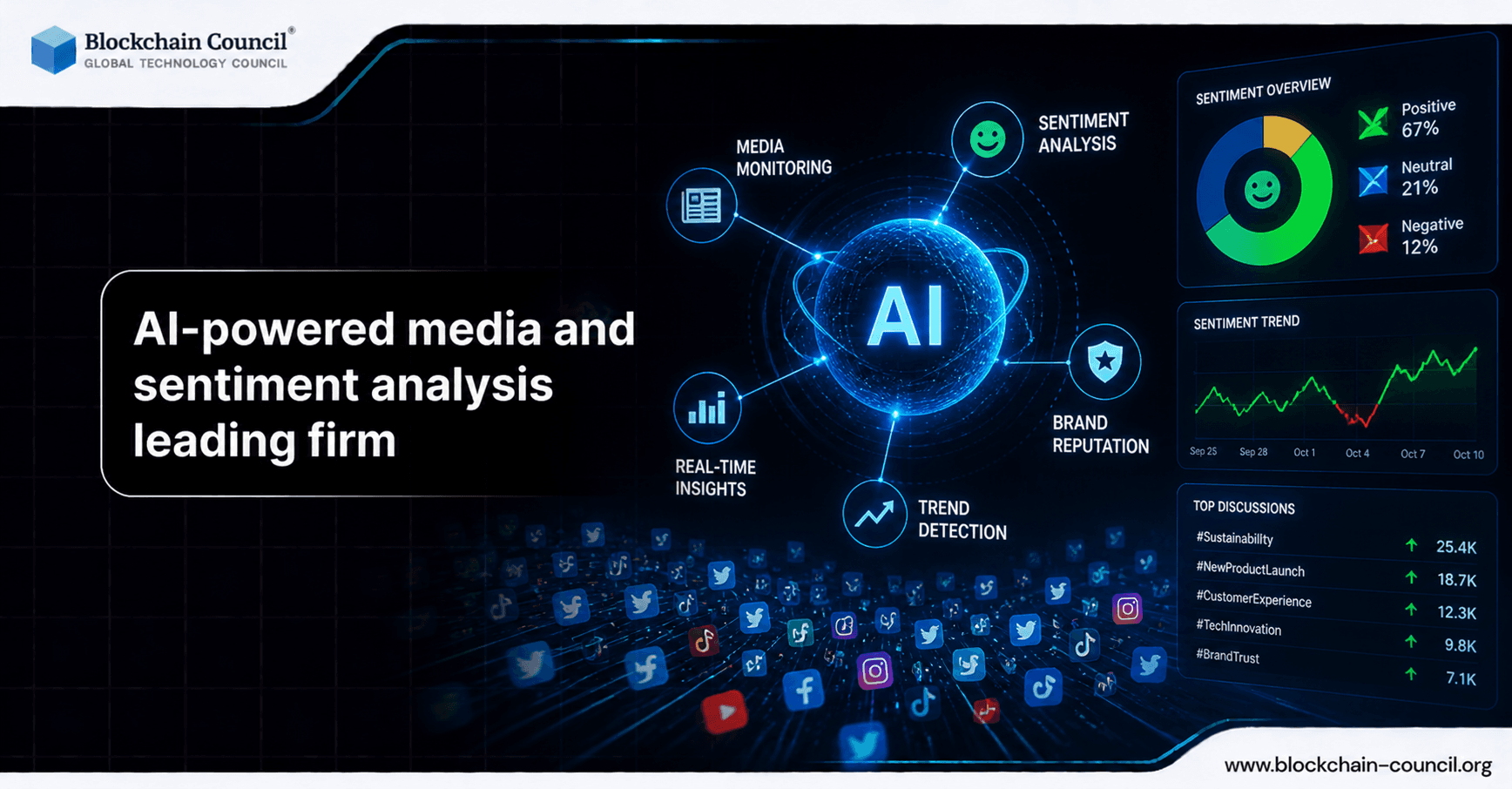
In today’s digital world, vast amounts of content are generated every second across social media, news platforms, blogs, and online forums. Understanding this data is critical for businesses, governments, and organizations aiming to stay competitive and responsive. This is where AI-powered media and sentiment analysis comes into play.
Sentiment analysis uses artificial intelligence to evaluate opinions, emotions, and attitudes expressed in text, audio, or video content. Leading firms in this space are leveraging advanced technologies to provide real-time insights, enabling better decision-making and strategic planning.

This article explores AI-powered media and sentiment analysis, the technologies behind it, leading firms, real-world applications, recent developments, and future trends. It also highlights the importance of AI expertise through certifications such as AI expert certification, Claude AI Certification, and ChatGPT Expert certification.
What is AI-Powered Media and Sentiment Analysis?
AI-powered media and sentiment analysis refers to the use of artificial intelligence to analyze large volumes of media content and determine public sentiment. It involves extracting insights from:
Social media posts
News articles
Customer reviews
Video and audio content
The goal is to understand how people feel about a brand, product, or topic.
How Sentiment Analysis Works
Data Collection
AI systems gather data from various sources, including social media platforms and news websites.
Text Processing
Natural language processing (NLP) analyzes the text to identify keywords, phrases, and context.
Sentiment Classification
The system categorizes content as positive, negative, or neutral.
Insight Generation
AI generates reports and visualizations to help users understand trends and patterns.
Key Technologies Behind Sentiment Analysis
Natural Language Processing (NLP)
NLP enables machines to understand human language and context.
Machine Learning
Machine learning models improve accuracy by learning from data.
Deep Learning
Deep learning enhances the ability to analyze complex patterns and emotions.
Computer Vision
Used for analyzing visual media such as images and videos.
Leading Firms in AI-Powered Media and Sentiment Analysis
Brandwatch
Brandwatch provides advanced social media analytics and sentiment tracking tools for businesses.
Sprinklr
Sprinklr offers a unified customer experience platform with AI-driven sentiment analysis capabilities.
Meltwater
Meltwater specializes in media monitoring and analytics, helping organizations track public perception.
Talkwalker
Talkwalker uses AI to analyze social media and online content, providing actionable insights.
IBM Watson
IBM Watson offers AI-powered analytics tools for sentiment analysis and data insights.
Recent Developments in Sentiment Analysis
Integration with Generative AI
Sentiment analysis tools are now integrating generative AI to provide deeper insights and contextual understanding.
Real-Time Analytics
Modern systems offer real-time sentiment tracking, enabling immediate responses.
Multilingual Capabilities
AI systems can analyze sentiment across multiple languages, supporting global businesses.
Video and Audio Analysis
Advancements allow sentiment analysis in video and audio content, expanding capabilities.
Real-World Applications
Marketing and Brand Management
Companies use sentiment analysis to understand customer opinions and improve marketing strategies. Professionals can enhance their skills through the AI powered digital marketing course.
Customer Service
AI helps identify customer issues and improve support services.
Political Analysis
Governments and organizations analyze public sentiment to understand opinions and trends.
Financial Markets
Investors use sentiment analysis to predict market movements.
Software Development
Developers build sentiment analysis tools and applications. Programs like the AI Powered coding expert Course support these skills.
Benefits of AI-Powered Sentiment Analysis
Better Decision-Making
Data-driven insights enable informed decisions.
Improved Customer Experience
Understanding customer sentiment helps improve services.
Competitive Advantage
Businesses can stay ahead by analyzing trends.
Efficiency
AI automates data analysis, saving time and resources.
Challenges and Limitations
Accuracy Issues
Understanding sarcasm and context can be difficult for AI.
Data Privacy Concerns
Handling large datasets raises privacy issues.
Bias in AI Models
Bias in training data can affect results.
Complexity
Implementing AI systems requires expertise.
Importance of AI Skills
As sentiment analysis grows, the demand for AI professionals increases. Certifications such as:
help individuals stay competitive in the industry.
Future of AI-Powered Media Analysis
The future includes:
More accurate sentiment detection
Advanced contextual understanding
Integration with other AI technologies
Expansion into new industries
AI will continue to enhance how organizations understand and respond to public sentiment.
Best Practices for Using Sentiment Analysis
Use high-quality data
Regularly update AI models
Ensure ethical data usage
Combine AI insights with human analysis
Ethical Considerations
Organizations must ensure:
Transparency in AI processes
Fair and unbiased analysis
Protection of user data
Conclusion
AI-powered media and sentiment analysis is transforming how organizations understand public opinion and make decisions. Leading firms in this space are driving innovation, providing powerful tools for analyzing vast amounts of data.
As technology continues to evolve, sentiment analysis will become even more accurate and impactful. However, its success depends on responsible implementation, ethical practices, and skilled professionals.
FAQs
1. What is AI-powered sentiment analysis?
AI-powered sentiment analysis is the use of artificial intelligence to evaluate opinions and emotions in text or media. It analyzes data from sources like social media and reviews. The system classifies sentiment as positive, negative, or neutral. It helps businesses understand public perception. Insights are generated for decision-making. It is widely used across industries.
2. How does sentiment analysis work?
Sentiment analysis works by collecting data and processing it using NLP. The system identifies patterns and context. Machine learning models classify sentiment. Results are presented as insights. Continuous learning improves accuracy. It is an automated process.
3. What are the benefits of sentiment analysis?
Benefits include better decision-making and improved customer experience. Businesses can understand trends and opinions. It helps in marketing strategies. Efficiency increases through automation. Competitive advantage is gained. Insights are valuable.
4. What are the challenges of sentiment analysis?
Challenges include accuracy issues and understanding context. Sarcasm can be difficult to detect. Data privacy is a concern. Bias in models can affect results. Implementation can be complex. Continuous improvement is needed.
5. Which industries use sentiment analysis?
Industries such as marketing, finance, and politics use sentiment analysis. It helps understand public opinion. Applications are diverse. Growth is significant. Adoption is increasing. Impact is widespread.
6. What technologies are used in sentiment analysis?
Technologies include NLP, machine learning, and deep learning. These systems analyze and classify data. Computer vision may also be used. Integration improves functionality. Technology evolves rapidly. Capabilities expand.
7. How accurate is sentiment analysis?
Accuracy has improved but is not perfect. Context and language complexity affect results. Continuous updates improve performance. Data quality is important. Human review may be needed. Accuracy is increasing.
8. Can sentiment analysis handle multiple languages?
Yes, many systems support multiple languages. This enables global analysis. Accuracy varies by language. Improvements are ongoing. Multilingual support is expanding. It enhances usability.
9. What is real-time sentiment analysis?
Real-time sentiment analysis provides instant insights from data. It allows quick responses to trends. Businesses can act immediately. It improves decision-making. Technology enables speed. It is highly valuable.
10. How does sentiment analysis help marketing?
It helps marketers understand customer opinions and preferences. Campaigns can be optimized. Engagement improves. Insights guide strategies. Results are more effective. Marketing performance increases.
11. Is sentiment analysis secure?
Security depends on data handling practices. Organizations must protect user data. Privacy policies should be followed. Responsible use is important. Security measures are improving. Awareness is necessary.
12. What skills are needed for sentiment analysis?
Skills include data analysis, programming, and AI knowledge. Understanding NLP is important. Continuous learning is required. Certifications can help. Skills improve effectiveness. Demand is growing.
13. How can I learn sentiment analysis?
You can learn through courses, tutorials, and practice. Hands-on projects are useful. Online resources provide guidance. Learning from experts helps. Staying updated is important. Practice improves skills.
14. What is the future of sentiment analysis?
The future includes better accuracy and deeper insights. Integration with other AI technologies will increase. Applications will expand. Innovation will continue. Adoption will grow. Impact will increase.
15. Can sentiment analysis replace human judgment?
It cannot fully replace human judgment. AI provides insights but lacks full understanding. Human interpretation is still needed. Collaboration is important. Balance is necessary. AI supports decision-making.
16. How does sentiment analysis impact businesses?
It helps businesses understand customers and improve strategies. Decision-making becomes data-driven. Customer satisfaction increases. Efficiency improves. Competitive advantage is gained. Impact is significant.
17. What are ethical concerns in sentiment analysis?
Concerns include data privacy and bias. AI systems must be fair. Transparency is important. Responsible use is required. Regulations may apply. Awareness is necessary.
18. Why is sentiment analysis important?
It helps understand public opinion and trends. Businesses can respond effectively. Decision-making improves. Insights drive strategies. It supports innovation. It is essential.
19. How do leading firms use sentiment analysis?
Leading firms use it to analyze large datasets and provide insights. They develop advanced tools. Businesses rely on these platforms. Innovation drives growth. Applications are diverse. Impact is global.
20. How can businesses implement sentiment analysis?
Businesses can start with data collection and choose AI tools. Training models is important. Monitoring performance helps. Integration with systems is needed. Continuous improvement is essential. Implementation becomes successful.
Related Articles
View All
Info
AI Art-Amber com Domain Safety Analysis
Learn how to evaluate the safety of AI.art-amber.com through domain reputation checks, HTTPS verification, malware scans, and cybersecurity analysis.

Info
AI-Powered Personalization for Shopify Stores: Use Cases, Tech Stack, and ROI Benchmarks
Learn AI-powered personalization for Shopify stores: top use cases, a practical tech stack, and ROI benchmarks to improve conversion, AOV, retention, and support.

Info
Google Maps Media Controls Removed: What Changed, Why It Matters, and What to Do Next
Learn why Google Maps removed media playback controls, how the update affects users, and alternative ways to manage music while navigating.
Trending Articles
AWS Career Roadmap
A step-by-step guide to building a successful career in Amazon Web Services cloud computing.
How Blockchain Secures AI Data
Understand how blockchain technology is being applied to protect the integrity and security of AI training data.
What is AWS? A Beginner's Guide to Cloud Computing
Everything you need to know about Amazon Web Services, cloud computing fundamentals, and career opportunities.