

Tokenomics Explained: Supply, Incentives, Utility, and Value Design
 Suyash Raizada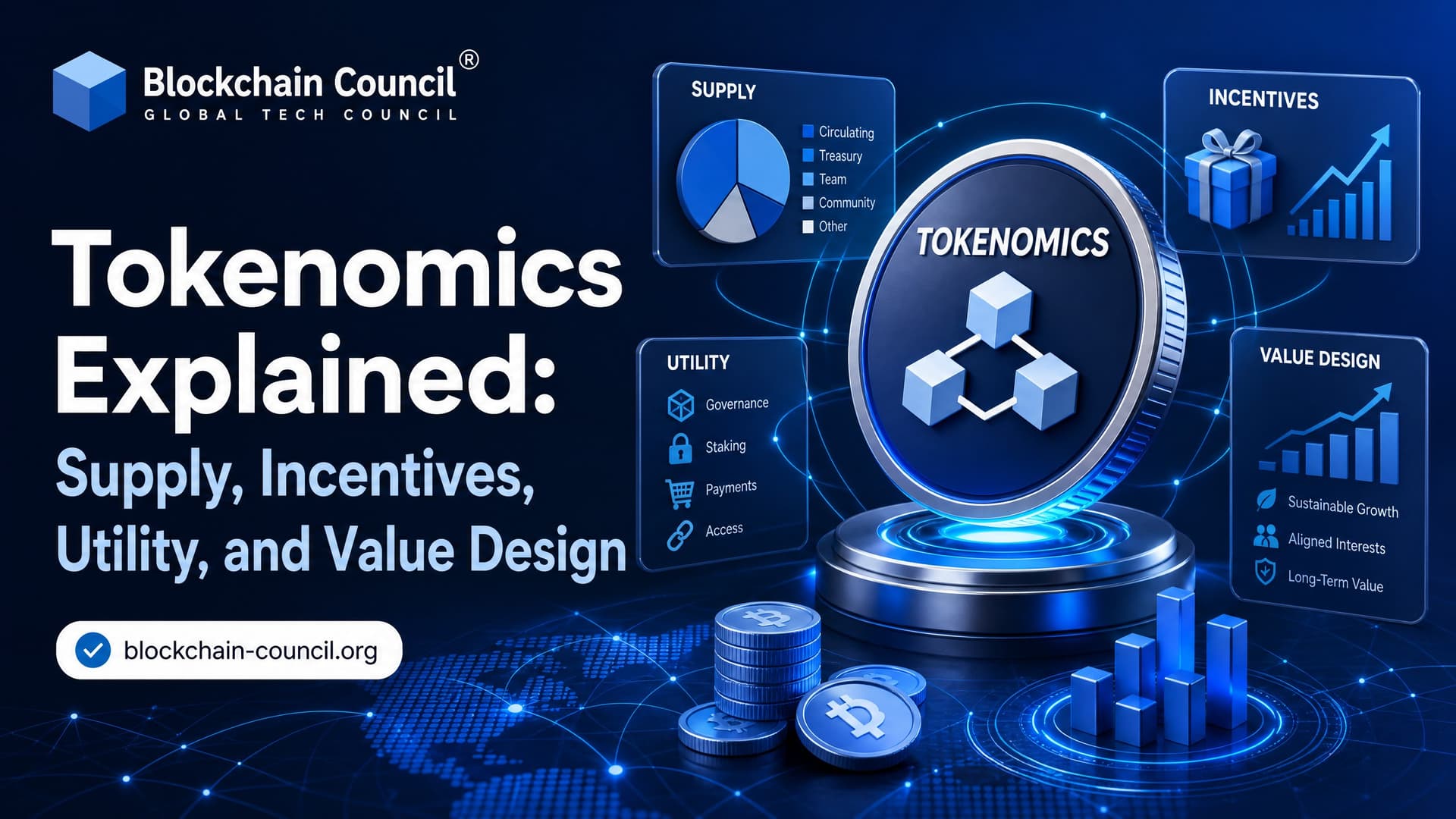
Tokenomics explained simply means understanding the economic design behind a crypto token: how many tokens exist, who receives them, what people can do with them, and why demand should persist after the launch campaign ends. A good token model is not just a spreadsheet. It is monetary policy, product design, governance, and behavioral economics written into code and community rules.
If you are evaluating a project, building a protocol, or preparing for a digital assets role, tokenomics tells you whether a token has a credible reason to exist. Scarcity helps. But scarcity without utility is thin ice.

Understanding tokenomics also requires knowledge of digital asset governance, tokenization models, blockchain ecosystems, custody, and regulatory considerations. A Certified Digital Assets Expert credential helps professionals develop these practical skills, making it easier to evaluate token economies and design sustainable digital asset projects for long-term growth.
What Is Tokenomics?
Tokenomics is the framework that defines a token's supply, distribution, utility, incentives, governance rights, and value capture. In practical terms, it answers five questions:
Supply: How many tokens exist now, and how many can exist later?
Distribution: Who owns the tokens, and when can they sell or use them?
Utility: What does the token actually do inside the network?
Incentives: Which behaviors are rewarded or discouraged?
Value capture: How does protocol usage create demand or economic value for the token?
This is why tokenomics is often described as on-chain monetary policy. Bitcoin uses a fixed supply model with a hard cap of 21 million BTC. Ethereum, after EIP-1559 and the move to Proof of Stake, uses a more dynamic model where ETH is issued to validators while a portion of transaction fees is burned. Different goals. Different economics.
For professionals studying digital assets, Blockchain Council's Certified Cryptocurrency Expert™ and Certified Blockchain Expert™ are useful learning paths to connect token design with broader blockchain architecture, market structure, and security fundamentals.
Supply Design: Caps, Emissions, Burns, and Dilution
Supply is the first number most people check, but it is also the number many people misread. Total supply, maximum supply, circulating supply, and fully diluted valuation are not the same thing.
Fixed, Inflationary, and Hybrid Supply Models
Most token supply models fall into three broad categories:
Fixed supply: A maximum cap limits issuance. Bitcoin is the classic example.
Inflationary supply: New tokens are minted over time, often to pay validators, miners, liquidity providers, or contributors.
Hybrid supply: Tokens are issued through rewards, but burns or fee sinks remove some supply from circulation.
A fixed cap can be powerful, but it does not guarantee value. If nobody needs the token, a cap only means there is a limited amount of something with weak demand. Inflation is not always bad either. Proof of Stake networks often need issuance to pay validators for securing the chain. The question is whether demand, fee activity, or token sinks can offset that dilution.
Circulating Supply and FDV
Fully diluted valuation, or FDV, estimates the market value if all tokens were circulating. A token can look cheap based on market cap while carrying a huge FDV because most supply is locked. That gap matters.
Say only 10 percent of supply is circulating at launch. Early price discovery may be distorted. When team, investor, and treasury allocations begin to unlock, the market can face heavy sell pressure. Many current design guides treat a launch circulating supply above 40 percent as healthier than extremely low-float launches, especially when insider allocations vest over 24 to 48 months.
Here is the blunt version: a beautiful whitepaper cannot fix a bad unlock calendar. If you are analyzing a token, read the vesting table before you read the roadmap.
Practitioner Detail: Vesting Contracts Can Hide Real Risk
When teams test token vesting, one small mistake shows up again and again: the vesting wallet is deployed, but the treasury never funds it. In older OpenZeppelin ERC-20 contracts, the test fails with ERC20: transfer amount exceeds balance. In OpenZeppelin Contracts 5.x, many ERC-20 failures use custom errors such as ERC20InsufficientBalance instead of the old string message. That version change catches beginners during audits and unit tests.
The lesson is not just technical. Tokenomics needs executable discipline. If vesting, cliffs, emissions, and claims are not modeled in code and tested under realistic dates, your economics are still theoretical.
Designing effective token supply models also depends on a solid understanding of blockchain architecture, smart contracts, consensus mechanisms, and on-chain governance. A Certified Blockchain Expert credential equips professionals with the technical foundation needed to build and evaluate blockchain networks where tokenomics supports long-term ecosystem sustainability.
Distribution: Who Gets the Tokens?
Distribution determines ownership power. It also shapes trust. A token with 60 percent of supply controlled by insiders can still work, but the burden of proof is high. Investors, users, and validators will ask hard questions about governance capture and future sell pressure.
A balanced allocation usually includes:
Team and contributors: Rewards long-term builders, usually with multi-year vesting.
Investors: Funds development, but should not dominate governance.
Community: Airdrops, user rewards, grants, and ecosystem incentives.
Treasury or foundation: Funds development, audits, liquidity, and partnerships.
Public sale or launch pool: Supports broader ownership and price discovery.
Fair distribution does not mean everyone receives the same amount. It means the rules are visible, defensible, and aligned with long-term participation. Airdrops can help, but lazy airdrops often attract mercenary wallets. Contribution-based rewards usually work better because they tie ownership to real activity.
Utility: Why Should the Token Exist?
Utility is where many token models break. A token should not be added to a product just because fundraising would be easier with one. If the same system works better with ETH, USDC, or a normal subscription, forcing a new token may damage user experience and regulatory posture.
Common token utility models include:
Fees: Users pay gas, transaction fees, or service fees with the token.
Access: The token grants access to premium features, data, compute, storage, or bandwidth.
Governance: Holders vote on parameters, upgrades, treasury spending, or risk settings.
Staking: Tokens are locked to secure a network, receive rewards, or back service-level commitments.
Collateral: Tokens are used in lending markets, derivatives, or DeFi strategies.
Rewards: Users earn tokens for validation, liquidity provision, infrastructure, content, or development work.
The strongest designs connect utility to recurring demand. Ethereum's ETH is not valuable only because supply is limited. It is needed for gas, used as collateral across DeFi, staked by validators, and affected by fee burns under EIP-1559. That combination is much harder to copy than a simple token cap.
If you want to build or assess these models in depth, Blockchain Council's Certified DeFi Expert™ and Certified Blockchain Developer™ are relevant paths for readers who need a stronger base in smart contracts, DeFi protocols, and token standards such as ERC-20 and ERC-721.
Incentives: Align Behavior Without Ponzinomics
Incentives are the behavioral engine of tokenomics. They tell users what the network wants them to do. Stake. Validate. Provide liquidity. Store files. Run hardware. Vote. Build applications. Report bugs.
But incentives can also create fake traction. High annual rewards may attract capital for a few weeks, then vanish when emissions drop. That is not product-market fit. That is rented liquidity.
Healthy Incentive Patterns
Decaying emissions: Rewards taper as the network matures.
Usage-based rewards: Tokens go to users who create measurable value, not just passive holders.
Slashing and penalties: Validators or service providers lose stake for downtime or malicious behavior.
Grants and bounties: Developers and auditors earn tokens for concrete contributions.
Fee-linked rewards: Stakers or participants receive value connected to actual protocol revenue.
Avoid designs where old users are paid mainly from new buyers. That is the pattern critics call ponzinomics. A sustainable incentive system has an external source of value: fees, services, security, compute, storage, liquidity depth, or genuine network effects.
Value Design: How Protocol Success Reaches the Token
Value design asks a hard question. If the protocol grows, why should the token benefit?
Some projects generate usage but fail to connect that usage to token demand. Others rely on governance rights alone, which may not be enough unless governance controls meaningful treasury assets, fee switches, risk parameters, or protocol upgrades.
Common value capture mechanisms include:
Fee burns: A portion of fees is used to burn tokens, reducing supply.
Buybacks: Protocol revenue buys tokens from the market, sometimes for treasury or burns.
Staking rewards from fees: Participants earn rewards tied to actual usage, not only inflation.
Discounts and access: Holding or spending the token reduces fees or opens network features.
Treasury governance: Token holders direct capital toward growth, grants, audits, or liquidity.
Do not treat burns as magic. A burn funded by real fees is meaningful. A burn funded by reserves or marketing optics is weaker. The source matters.
Building and managing successful token ecosystems also requires broader technical expertise in cybersecurity, cloud computing, APIs, enterprise systems, automation, analytics, and blockchain infrastructure. A Tech Certification helps professionals strengthen these complementary skills, enabling them to support secure, scalable, and efficient digital asset platforms.
Tokenomics Checklist for Investors and Builders
Use this checklist before you invest in, design, or advise on a token launch:
Read the supply schedule. Check maximum supply, emissions, burns, and whether minting can be changed.
Compare circulating market cap with FDV. A large gap means future dilution risk.
Study unlocks. Look for cliffs, monthly vesting, insider allocations, and treasury release rules.
Validate utility. Ask whether users need the token repeatedly, or only during speculation.
Inspect incentives. Rewards should drive useful behavior, not wash activity.
Check governance power. Identify who can change fees, mint supply, pause contracts, or move treasury funds.
Look for value capture. Protocol growth should create credible token demand or economic return.
Demand simulations. Serious teams model emissions, sell pressure, staking ratios, and user growth scenarios before launch.
Current Trends in Tokenomics
From 2024 onward, token design has moved away from extreme emissions and vague utility claims. The market has become less forgiving. Builders now publish clearer dashboards, emissions charts, unlock calendars, and governance documentation. Traders monitor FDV and unlocks with the same seriousness they apply to liquidity and volume.
Several models are gaining attention:
DePIN tokens: Networks reward real-world infrastructure such as compute, wireless coverage, storage, or sensors.
RWA tokens: Token models connect on-chain ownership or claims with off-chain legal structures.
Dual-token systems: One token handles governance or value capture, while another supports payments or usage.
Adaptive governance: Communities adjust rewards, fees, and treasury policy as conditions change.
Regulatory-aware design is becoming central, especially for revenue-sharing, stablecoin, and real-world asset models. If a token looks like a claim on revenue, legal analysis should happen before launch, not after exchange listings.
Final Takeaway: Design Demand Before Supply
The best tokenomics explained in one sentence: design durable demand first, then build supply mechanics around it. Caps, burns, and vesting matter, but they cannot rescue a token that has no recurring purpose.
If you are a builder, start with utility and incentives. Then model supply, dilution, and value capture under conservative assumptions. If you are an analyst, check FDV, unlocks, and governance control before believing the story. And if you want structured training, continue with Blockchain Council's Certified Cryptocurrency Expert™, Certified DeFi Expert™, or Certified Blockchain Developer™ depending on whether your goal is market analysis, protocol evaluation, or hands-on token implementation.
Even the strongest token model needs clear communication to earn user trust and encourage adoption. A Marketing Certification helps professionals strengthen strategic communication and stakeholder engagement skills, making it easier to explain token utility, governance, and long-term value propositions to investors, partners, communities, and customers.
FAQs
1. What is tokenomics?
Tokenomics refers to the economic design of a blockchain token, including its supply, distribution, utility, incentives, governance, and mechanisms that influence demand and circulation. Well-designed tokenomics aim to align the interests of users, developers, investors, and the broader ecosystem while supporting long-term sustainability.
2. Why is tokenomics important?
Tokenomics plays a significant role in determining how a blockchain ecosystem functions and grows over time. A thoughtful token model can encourage participation, strengthen network security, support adoption, and create incentives for responsible ecosystem development, although it does not guarantee a token's future value.
3. What is token supply?
Token supply refers to the number of tokens that exist or can exist within a blockchain ecosystem. Common supply metrics include maximum supply, total supply, and circulating supply, each providing different insights into a token's availability and potential economic dynamics.
4. What is the difference between maximum, total, and circulating supply?
Maximum supply is the highest number of tokens that can ever be created if a limit exists. Total supply includes all existing tokens except those permanently removed from circulation, while circulating supply represents the tokens currently available for trading or public use.
5. How does token distribution affect a project?
Token distribution determines how tokens are allocated among founders, developers, investors, community members, treasury funds, ecosystem incentives, and strategic partners. Transparent and balanced distribution may help reduce concentration risk and encourage broader ecosystem participation.
6. What is token utility?
Token utility describes the practical functions a token performs within its ecosystem. Utilities may include paying transaction fees, accessing services, staking, governance voting, rewarding participants, purchasing digital goods, or enabling decentralized applications.
7. What are governance tokens?
Governance tokens allow eligible holders to participate in protocol decisions, such as voting on upgrades, treasury allocations, or ecosystem proposals. Governance rights vary between projects and are typically defined by the protocol's governance framework.
8. How do staking incentives work?
Staking incentives reward eligible participants for locking or delegating tokens to help support proof-of-stake blockchain networks or decentralized protocols. Reward structures differ by network and may be influenced by participation levels, protocol rules, and market conditions.
9. What is token inflation?
Token inflation occurs when new tokens are introduced into circulation over time. Some blockchain networks use inflation to reward validators or support ecosystem growth, while others implement fixed supply models or alternative issuance schedules.
10. What are token burns?
Token burns permanently remove tokens from circulation by sending them to an inaccessible blockchain address. Projects may use burns as part of their economic design, although reducing supply alone does not guarantee increased demand or higher market value.
11. How do incentives support blockchain ecosystems?
Blockchain ecosystems often use incentives to encourage network participation, validation, liquidity provision, application development, governance engagement, and community contributions. Effective incentive structures seek to balance growth with long-term sustainability.
12. What role do vesting schedules play in tokenomics?
Vesting schedules gradually release tokens to founders, employees, investors, or advisors over a predetermined period. Vesting can help align long-term interests, reduce immediate selling pressure, and improve transparency regarding future token availability.
13. How does AI contribute to tokenomics analysis?
Artificial intelligence can analyze blockchain activity, monitor token distribution, detect unusual market behavior, evaluate governance participation, and model potential economic scenarios. AI-generated insights should be interpreted alongside sound financial analysis and project-specific research.
14. What risks should investors consider when evaluating tokenomics?
Potential risks include excessive token concentration, unclear utility, unsustainable reward models, high inflation, weak governance, regulatory uncertainty, low liquidity, security vulnerabilities, and market volatility. Digital assets can experience substantial price fluctuations, and investment outcomes are uncertain.
15. How do tokenomics affect decentralized finance (DeFi)?
Tokenomics influences liquidity incentives, lending, staking, governance participation, yield mechanisms, and protocol sustainability within DeFi platforms. Balanced economic models can help maintain healthy ecosystem participation, while poorly designed incentives may create instability.
16. What regulations may apply to blockchain tokens?
Depending on the jurisdiction and token characteristics, blockchain tokens may be subject to securities laws, consumer protection rules, anti-money laundering (AML) requirements, taxation, financial services regulations, and disclosure obligations. Regulatory treatment varies significantly across countries.
17. What trends are shaping tokenomics in 2025-2026?
Key trends include tokenized real-world assets (RWAs), AI-assisted economic modeling, adaptive reward systems, institutional blockchain adoption, cross-chain interoperability, decentralized identity integration, sustainable incentive structures, and increasing regulatory clarity for digital assets.
18. How can businesses design effective tokenomics?
Organizations should define clear token utility, establish transparent supply mechanisms, implement appropriate governance, design sustainable incentive models, conduct security reviews, communicate allocation policies openly, and evaluate legal and regulatory considerations before launching a token ecosystem.
19. What are tokenomics best practices?
Best practices include publishing transparent token allocation details, documenting issuance schedules, implementing appropriate vesting periods, aligning incentives among stakeholders, conducting independent smart contract audits, maintaining governance transparency, and regularly reviewing the economic model as the ecosystem evolves.
20. What is the future of tokenomics?
Tokenomics is expected to become increasingly sophisticated as blockchain ecosystems mature, integrating AI-driven analytics, institutional participation, tokenized real-world assets, and more standardized governance frameworks. Successful token designs will likely emphasize sustainable incentives, practical utility, transparency, regulatory awareness, and long-term ecosystem health rather than short-term speculation. A token can have flawless mathematics, but convincing humans not to panic during market swings remains one of blockchain's more ambitious engineering challenges.
Related Articles
View All
Digital Assets
Real Estate Tokenization Explained: Benefits, Process, and Compliance
Real estate tokenization turns property rights into blockchain tokens. Learn the benefits, process, compliance risks, and skills needed in 2026.

Digital Assets
RWA Tokenization Process Explained for Businesses and Investors
Learn the RWA tokenization process for issuers and investors, from legal structuring and custody to smart contracts, compliance, servicing, and liquidity.

Digital Assets
What Assets Can Be Tokenized? Real-World Asset Categories Explained
Learn what assets can be tokenized, from Treasuries and stablecoins to real estate, commodities, IP, carbon credits, and private credit.
Trending Articles
AWS Career Roadmap
A step-by-step guide to building a successful career in Amazon Web Services cloud computing.

Top 5 DeFi Platforms
Explore the leading decentralized finance platforms and what makes each one unique in the evolving DeFi landscape.
How Blockchain Secures AI Data
Understand how blockchain technology is being applied to protect the integrity and security of AI training data.