

Soulbound Tokens Explained: Non-Transferable Credentials for Web3 Identity
 Suyash Raizada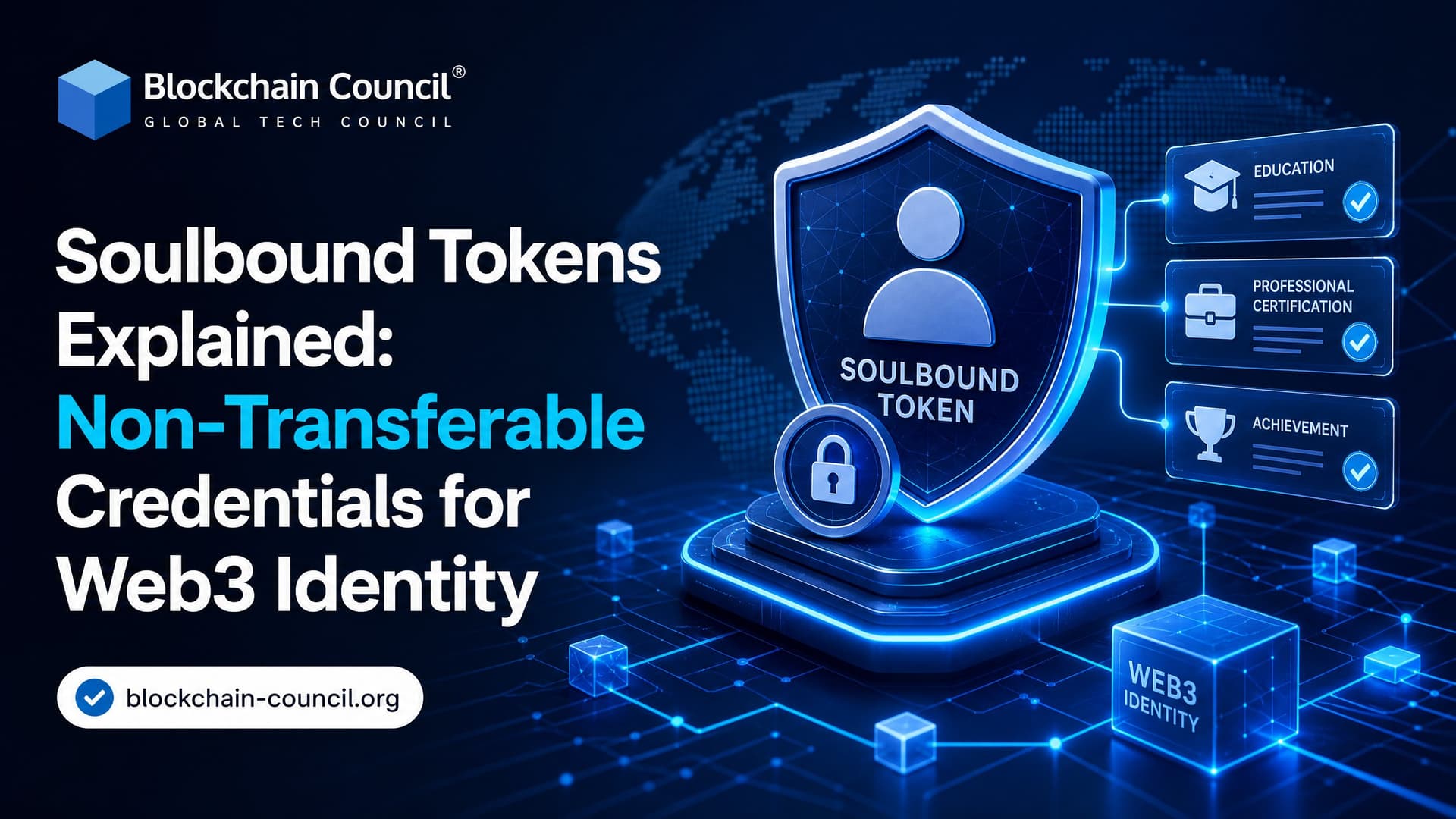
Soulbound tokens are non-transferable blockchain tokens used to represent credentials, roles, affiliations, and reputation inside Web3 identity systems. Think of them as onchain attestations that should not be sold: a university degree, a professional certification, a DAO contributor badge, a KYC status, or a hospital identity credential.
The idea matters because much of Web3 still treats wallets as disposable trading accounts. That works for DeFi swaps. It does not work well for trust. If a credential can be bought, it stops proving that you earned it.

As decentralized identity becomes an important part of Web3 ecosystems, professionals benefit from understanding digital asset governance, tokenization, identity frameworks, compliance, and blockchain-based trust models. A Certified Digital Assets Expert credential helps build these practical skills, enabling individuals to evaluate and implement digital asset solutions that support secure and verifiable digital identities.
What Are Soulbound Tokens?
Soulbound tokens, often shortened to SBTs, are unique blockchain tokens tied to a specific wallet or account. In the language introduced by Vitalik Buterin, Glen Weyl, and Puja Ohlhaver in the 2022 paper Decentralized Society: Finding Web3's Soul, that wallet or identity container is called a Soul.
A Soul can represent a person, company, university, DAO, hospital, or other entity. SBTs attached to that Soul can record facts such as:
Completion of a certification or degree
Membership in a DAO or professional body
Event attendance
KYC or compliance status
Healthcare or institutional authentication credentials
Reputation earned through verified contributions
The defining feature is simple: SBTs are non-transferable credentials. Unlike standard NFTs, they are not designed for resale on marketplaces. They are meant to stay with the identity that received them.
Soulbound Tokens vs NFTs: The Key Difference
Traditional NFTs under standards such as ERC-721 are transferable by design. You can sell an artwork NFT, move a collectible to a hardware wallet, or send a gaming asset to another player.
Soulbound tokens remove that transferability because transferability would destroy the signal. A medical license, for example, should not be listed on OpenSea. A proof of course completion should not be sold to someone who never took the course.
Why non-transferability matters
Non-transferability gives SBTs their identity value. A platform can check whether your wallet holds a specific credential and make a decision from that fact. For example:
A DAO can grant access to a committee channel only to wallets holding a contributor SBT.
A lending protocol can consider repayment-history SBTs before offering undercollateralized credit.
An employer can verify a training credential without calling a central database.
A conference app can issue proof-of-attendance tokens that cannot be resold.
To be blunt, SBTs are not a better NFT for collectibles. They are a different primitive for identity.
Implementing non-transferable credentials also requires a solid understanding of blockchain architecture, smart contracts, token standards, consensus mechanisms, and enterprise blockchain design. A Certified Blockchain Expert credential equips professionals with the technical knowledge needed to build secure identity solutions that align with evolving Web3 ecosystems.
How Soulbound Tokens Work Technically
At the smart contract level, an SBT usually starts from a token model similar to an NFT, then disables or restricts transfers. Developers often build around ERC-721-style tokens, but override transfer behavior so tokens cannot move after minting.
There are also standards designed specifically for this pattern. ERC-5192, known as Minimal Soulbound NFTs, defines a simple locked status for NFTs through a locked(uint256 tokenId) function. If a token is locked, wallets and applications can understand that it should not be transferred. ERC-5484 explores consensual soulbound tokens with burn authorization rules, which is useful when the recipient or issuer needs limited removal rights.
A practical warning if you are building this: many older tutorials override OpenZeppelin's _beforeTokenTransfer hook. In OpenZeppelin Contracts v5, that hook pattern changed, and developers commonly hit TypeError: Function has override specified but does not override anything. In v5, you typically need to work with the newer _update flow instead. Small version changes matter in identity contracts because one mistaken transfer path can break the whole credential model.
Issuance and attestation
An issuer Soul can mint an SBT to a recipient Soul. A university might issue a degree credential. A certification body might issue a professional credential. A DAO might issue a governance-role badge.
Other Souls can also attest to the credential, creating a web of trust. This is one reason SBTs are linked to the idea of a Decentralized Society, or DeSoc, where relationships and reputation are represented through onchain credentials rather than only through transferable tokens.
Top Use Cases for Soulbound Tokens
1. Education and professional credentials
Education is one of the clearest use cases. Degrees, licenses, and course completions are identity-linked achievements. They should be easy to verify and hard to fake.
For professionals studying blockchain systems, SBTs could represent verifiable completion of programs such as Certified Blockchain Expert, Certified Blockchain Developer, or Certified Smart Contract Developer as learning-path credentials. The important design choice is not just minting a badge. It is deciding what data stays onchain, what stays off-chain, and who can revoke or correct the credential.
2. DAO governance and reputation
Token-weighted voting has a known flaw: people with more capital can buy more influence. SBTs offer another model. A DAO can assign voting rights or committee access based on non-transferable contribution records, verified roles, or long-term participation.
This does not magically solve governance. Wallet farming and private key sales still exist. But reputation-weighted governance is often better than pretending that token balance equals trust.
3. KYC, memberships, and gated access
An SBT can prove that a wallet passed a KYC check or belongs to an approved membership group. A DeFi app might query for that token before permitting certain regulated actions. A private community might use it to control entry.
The better pattern is to avoid publishing personal information. Store a hash, reference, or proof. Let the SBT prove status, not expose a passport number or home address.
4. Healthcare authentication
Healthcare is sensitive, so it is also a good stress test. Academic work has proposed combining Self-Sovereign Identity with soulbound tokens to connect hospitals and patients in a decentralized trust network. The goal is faster authentication, better interoperability, and less reliance on a single central server.
No serious architect should put medical records directly on a public chain. The safer approach is off-chain storage, strict access control, and onchain credentials that prove authorization.
5. Events and proof of attendance
Proof-of-attendance SBTs can confirm that a person actually attended a conference, workshop, or training session. Because the token cannot be transferred, it is a stronger attendance signal than a collectible ticket NFT.
The Privacy Problem You Cannot Ignore
Soulbound tokens create a privacy paradox. Blockchains are public and hard to change. Identity credentials are often sensitive and sometimes legally protected.
If you issue a permanent public token that reveals someone's medical condition, political group, debt history, or employment dispute, you have not built trust. You have built a surveillance risk.
Better SBT designs use:
Off-chain data storage for personal records
Hashes or references instead of raw sensitive data
Encryption and access controls for document access
Zero-knowledge proofs to prove eligibility without exposing the credential itself
Revocation registries for expired, wrong, or withdrawn credentials
Building privacy-preserving identity systems extends beyond blockchain development alone. It also requires expertise in cybersecurity, cloud infrastructure, APIs, enterprise systems, encryption, automation, and secure data management. A Tech Certification helps professionals strengthen these complementary technical skills, supporting the development of scalable and secure decentralized identity platforms.
This is where Web3 identity starts to overlap with W3C Verifiable Credentials and decentralized identifiers. SBTs can be useful, but they should not be treated as a replacement for every identity standard.
Limitations and Risks of Soulbound Tokens
They bind to accounts, not humans
A smart contract can stop token transfers. It cannot stop someone from selling a private key, renting account access, or delegating control through another contract. This is the hard truth: an SBT proves that a wallet holds a credential. It does not always prove who is holding the wallet right now.
Revocation is difficult
Credentials change. People leave jobs. Licenses expire. Universities correct records. If an SBT is permanent and non-revocable, errors become painful.
Good systems need clear revocation rules. Who can revoke? Can the holder reject a credential? Can a court order removal? These are governance questions, not just Solidity questions.
Social scoring is a real danger
SBTs can help build trust, but they can also be misused for blacklists, exclusion, and opaque reputation scoring. Permanent negative marks are especially risky. Designers should prefer consent-based, purpose-limited credentials over public life-long labels.
Are Soulbound Tokens Ready for Enterprise Use?
SBTs are promising, but most deployments are still pilot-level. You will see them in credential experiments, DAO tooling, healthcare identity research, and event access. You will not yet see a mature global SBT infrastructure comparable to payment networks or mainstream identity providers.
For enterprises, the best use cases today are narrow and controlled:
Internal training credentials
Partner ecosystem badges
Compliance status tokens with privacy controls
DAO or consortium governance roles
Event and membership verification
The wrong use case matters just as much. Do not use SBTs to store sensitive personal data directly on a public blockchain. Do not issue irreversible negative credentials. Do not assume non-transferable means fraud-proof.
How to Start Learning and Building with SBTs
If you want to work with soulbound tokens, learn the basics first: ERC-721 mechanics, Solidity 0.8.x, access control, revocation design, and wallet security. Then study identity concepts such as decentralized identifiers, verifiable credentials, and zero-knowledge proofs.
A practical learning path would be:
Build a simple ERC-721 token using Hardhat or Foundry.
Modify it so transfers revert after minting.
Add issuer-only minting with OpenZeppelin access control.
Add a revocation function and test edge cases.
Store only a hash or metadata pointer, not private data.
Query the credential from a simple gated application.
For structured study, look at Blockchain Council learning paths such as Certified Blockchain Expert, Certified Blockchain Developer, and Certified Smart Contract Developer. If your goal is governance or decentralized identity architecture, pair smart contract practice with Web3 security and privacy design.
Start small: issue one non-transferable credential on a testnet, write the revocation policy before the contract, and test what happens when the issuer makes a mistake. That exercise teaches more than a dozen whitepapers.
As decentralized identity solutions move toward wider enterprise adoption, organizations must also communicate their benefits, governance models, and privacy safeguards clearly to users, partners, regulators, and other stakeholders. A Marketing Certification helps professionals develop strategic communication and stakeholder engagement skills that support greater understanding and adoption of blockchain-based identity technologies.
FAQs
1. What are Soulbound Tokens (SBTs)?
Soulbound Tokens (SBTs) are non-transferable digital tokens designed to represent identity, credentials, achievements, memberships, or other verifiable attributes on a blockchain. Unlike traditional NFTs, SBTs are generally intended to remain permanently associated with a specific wallet or digital identity rather than being bought or sold.
2. Why are Soulbound Tokens important in Web3?
SBTs aim to establish trusted digital identities by allowing individuals and organizations to hold verifiable credentials on-chain. They can support reputation systems, reduce fraud, and enable decentralized applications to verify qualifications or affiliations without relying entirely on centralized databases.
3. How do Soulbound Tokens differ from NFTs?
Traditional NFTs are typically transferable and often represent collectibles, digital art, or ownership of unique assets. Soulbound Tokens are designed to be non-transferable, emphasizing identity, reputation, certifications, or achievements instead of market trading.
4. How do Soulbound Tokens work?
An authorized issuer creates and assigns an SBT to a blockchain wallet representing an individual or organization. Once issued, the token generally remains associated with that wallet, allowing others to verify the credential while preserving the integrity of the issuer's attestation.
5. What types of credentials can Soulbound Tokens represent?
SBTs may represent educational degrees, professional certifications, employment history, licenses, memberships, conference attendance, volunteer activities, healthcare credentials, governance participation, or other verifiable achievements. The specific use cases depend on the issuing organization and blockchain ecosystem.
6. What are the benefits of Soulbound Tokens?
Potential benefits include improved credential verification, reduced document fraud, stronger digital identity systems, simplified onboarding, transparent reputation tracking, and greater interoperability across decentralized applications. They may also reduce administrative costs associated with verifying credentials.
7. Can Soulbound Tokens be transferred or sold?
In most proposed implementations, Soulbound Tokens are intentionally non-transferable. This design helps ensure that credentials remain linked to the original recipient rather than becoming tradable assets in secondary markets.
8. How do Soulbound Tokens support decentralized identity (DID)?
SBTs can complement decentralized identity (DID) frameworks by serving as verifiable credentials issued by trusted organizations. Together, these technologies allow users to prove qualifications or affiliations while maintaining greater control over their digital identities.
9. How are Soulbound Tokens used in education?
Educational institutions may issue SBTs to verify diplomas, certifications, course completions, academic achievements, or professional development credentials. Employers and other organizations can verify these credentials without relying solely on paper documents.
10. How can businesses use Soulbound Tokens?
Organizations may use SBTs for employee credentials, partner certifications, customer loyalty recognition, compliance records, access permissions, governance participation, and workforce training verification. Adoption depends on business requirements and applicable regulatory considerations.
11. How do Soulbound Tokens improve security?
Because SBTs are generally non-transferable, they reduce the risk of credential resale or unauthorized transfers. Blockchain technology also provides transparent and tamper-evident records that support verification of issued credentials.
12. What privacy considerations apply to Soulbound Tokens?
Organizations should carefully balance transparency with user privacy by minimizing on-chain personal data and considering privacy-enhancing technologies where appropriate. Many implementations store only proofs or references on-chain while sensitive information remains off-chain.
13. How does AI complement Soulbound Tokens?
Artificial intelligence can assist with credential verification, fraud detection, identity analytics, compliance monitoring, anomaly detection, and automated risk assessments. AI should operate within governance frameworks that include transparency, security, and appropriate human oversight.
14. What industries may benefit from Soulbound Tokens?
Potential industries include education, healthcare, financial services, government, insurance, human resources, supply chain, professional certification, gaming, and decentralized autonomous organizations (DAOs). Each sector can use verifiable credentials to streamline trust-based interactions.
15. What challenges affect Soulbound Token adoption?
Key challenges include interoperability, privacy protection, wallet recovery, identity management, regulatory uncertainty, standardization, user adoption, governance, and ensuring that credentials remain accurate over time. Technical and legal frameworks continue to evolve.
16. What regulations may apply to Soulbound Tokens?
Depending on the jurisdiction and use case, SBT implementations may need to comply with privacy laws, data protection regulations, electronic identity frameworks, anti-money laundering (AML) requirements, consumer protection rules, and sector-specific compliance obligations.
17. What trends are shaping Soulbound Tokens in 2025-2026?
Emerging trends include decentralized identity adoption, verifiable credentials, zero-knowledge proofs, AI-assisted identity verification, enterprise blockchain integration, digital identity wallets, tokenized real-world assets (RWAs), and increased collaboration on interoperability standards.
18. How can organizations implement Soulbound Tokens successfully?
Organizations should define clear identity objectives, adopt recognized technical standards, establish governance policies, protect user privacy, secure credential issuance processes, integrate with existing identity systems, and regularly review compliance with applicable laws and industry guidance.
19. What are best practices for using Soulbound Tokens?
Best practices include issuing credentials only through trusted authorities, minimizing sensitive on-chain data, implementing strong cybersecurity controls, providing credential revocation or update mechanisms where appropriate, educating users, maintaining transparent governance, and monitoring evolving regulatory requirements.
20. What is the future of Soulbound Tokens and Web3 identity?
Soulbound Tokens are expected to play an increasingly important role in decentralized identity by enabling trusted, verifiable, and non-transferable digital credentials across education, employment, finance, healthcare, and online communities. As standards, privacy technologies, and regulatory frameworks mature, SBTs could become a key building block for secure and interoperable Web3 identity ecosystems. The credential may live forever on the blockchain, but remembering where you stored your wallet recovery phrase is still a surprisingly human responsibility.
Related Articles
View All
Digital Assets
RWA Tokenization and KYC/AML: Identity, Compliance, and Investor Protection
RWA tokenization is moving into regulated markets. Learn how KYC/AML, wallet whitelists, travel rule workflows, and disclosures protect investors.

Digital Assets
Real Estate Tokenization Explained: Benefits, Process, and Compliance
Real estate tokenization turns property rights into blockchain tokens. Learn the benefits, process, compliance risks, and skills needed in 2026.

Digital Assets
RWA Tokenization Process Explained for Businesses and Investors
Learn the RWA tokenization process for issuers and investors, from legal structuring and custody to smart contracts, compliance, servicing, and liquidity.
Trending Articles
The Role of Blockchain in Ethical AI Development
How blockchain technology is being used to promote transparency and accountability in artificial intelligence systems.

Top 5 DeFi Platforms
Explore the leading decentralized finance platforms and what makes each one unique in the evolving DeFi landscape.
What is AWS? A Beginner's Guide to Cloud Computing
Everything you need to know about Amazon Web Services, cloud computing fundamentals, and career opportunities.