

Security Tokens Explained: Compliance, Ownership Rights, and Market Potential
 Suyash Raizada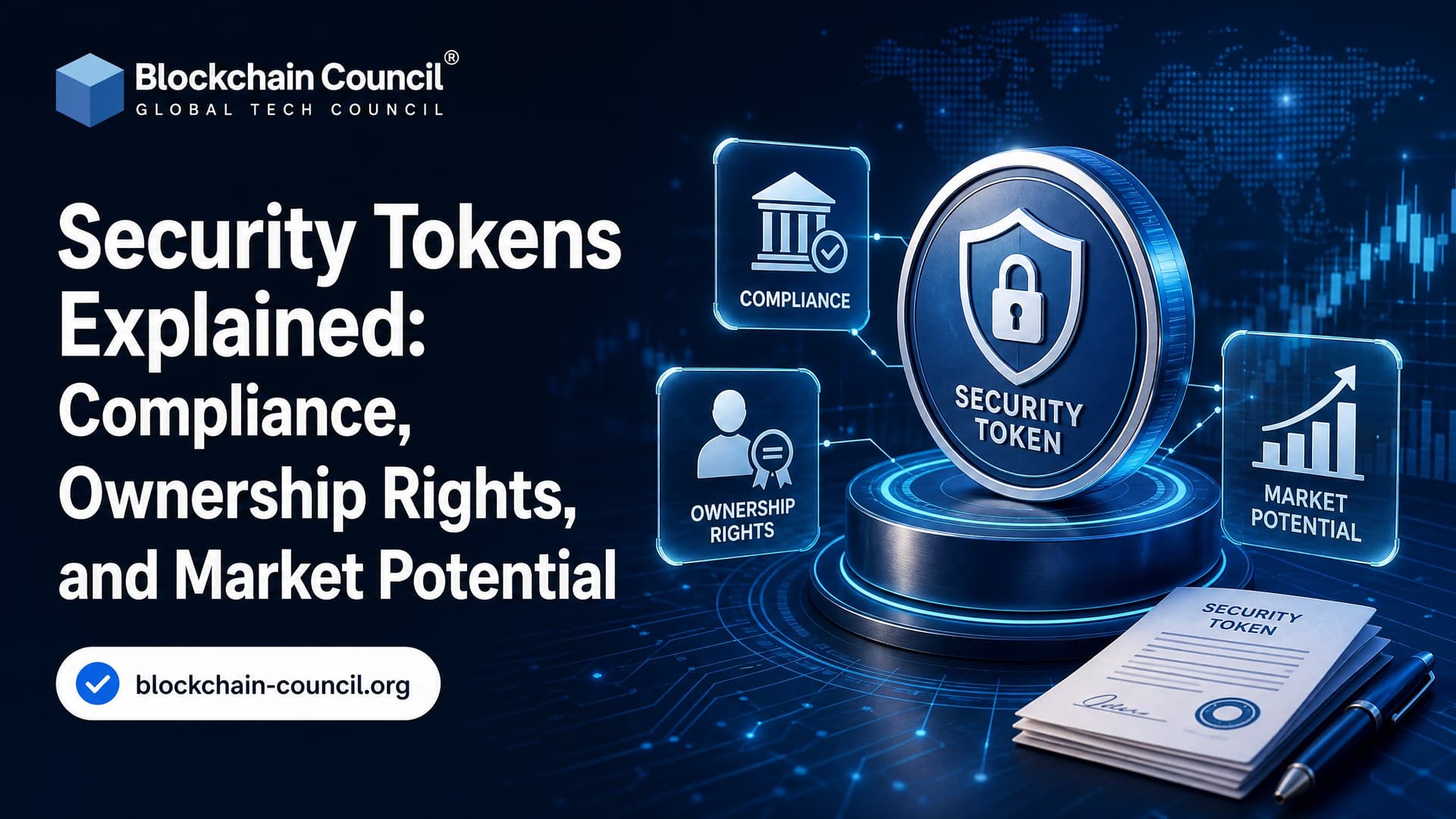
Security tokens are regulated digital representations of financial rights, issued and transferred using blockchain or distributed ledger technology. Think of them as a digital wrapper around something familiar: shares, bonds, fund units, revenue claims, or fractional real estate interests. The blockchain records ownership and transfers. The legal documents define what you actually own.
That distinction matters. A token alone does not magically create investor rights. The enforceable right comes from securities law, contracts, offering documents, and the issuer's obligations. The better security token projects treat code and compliance as one system, not as separate teams meeting at the end of a launch.

As tokenized securities become an increasingly important part of modern finance, professionals benefit from understanding digital asset governance, tokenization frameworks, compliance, custody, and institutional blockchain adoption. A Certified Digital Assets Expert credential helps develop these practical skills, enabling individuals to evaluate and implement digital asset strategies that align with both business objectives and regulatory requirements.
What Are Security Tokens?
A security token is a blockchain-based digital security that represents a regulated investment interest. Common examples include:
Equity tokens: Digital shares with voting rights, dividend rights, or liquidation claims.
Debt tokens: Tokenized bonds or loans with rights to interest and principal repayment.
Fund tokens: Interests in private funds, venture vehicles, or real estate funds.
Revenue-share tokens: Claims on defined revenue streams or profit pools.
Real estate tokens: Fractional ownership or income rights linked to property assets.
Security tokens differ from utility tokens. A utility token is usually designed to access a network, service, or product. A security token represents an investment right and is generally regulated as a security. In the United States, the Howey Test remains central to this analysis: if buyers invest money in a common enterprise with an expectation of profit based mainly on the efforts of others, the instrument may be a security.
To be blunt, calling a token a utility token does not make it one. Regulators look at economic reality, not branding.
Why Compliance Is the Core Feature
The biggest misconception about security tokens is that blockchain removes regulation. It does not. Across major jurisdictions, regulators have made the same point: tokenization changes the recordkeeping and settlement layer, not the legal nature of the asset.
The U.S. Securities and Exchange Commission has repeatedly stated that securities represented on blockchains remain subject to federal securities laws. Offers and sales of tokenized securities generally must be registered under the Securities Act of 1933 unless an exemption applies. Issuers may also face ongoing reporting obligations under the Securities Exchange Act of 1934.
SEC Commissioner Hester Peirce has summarized the position clearly: tokenized securities are still securities. That is the right framing for professionals. The token may improve transfer and settlement, but it does not remove disclosure, anti-fraud, insider trading, custody, or market surveillance obligations.
Compliance Controls Built Into Tokens
Security token platforms often encode compliance controls into smart contracts and workflows. These may include:
KYC and AML checks before wallet approval.
Accredited investor or professional investor restrictions.
Transfer limits by jurisdiction.
Lock-up periods after private placements.
Whitelist-based transfers between approved wallets.
Automatic blocking of transfers to sanctioned addresses or ineligible investors.
This is useful, but it is not magic. Smart contracts can enforce only the rules they are given. If the investor onboarding process is weak, the token logic inherits bad data.
A practical detail developers learn quickly: standard ERC-20 behavior is not enough for many security tokens. If you implement transfer restrictions by overriding _beforeTokenTransfer in OpenZeppelin Contracts 4.x, that hook is gone in OpenZeppelin Contracts 5.x. You need to use _update instead. This small version change has broken more compliance-token prototypes than teams like to admit.
Successfully building regulated tokenized assets also requires a strong understanding of blockchain architecture, smart contracts, consensus mechanisms, token standards, and enterprise blockchain infrastructure. A Certified Blockchain Expert credential equips professionals with the technical knowledge needed to design secure, compliant, and scalable blockchain solutions for institutional financial markets.
Standards Used in Security Token Design
Several token standards and patterns appear in security token projects. ERC-20 is common for fungible instruments, but it does not define compliance behavior. ERC-1404 introduced a simple restricted-transfer model. ERC-3643, associated with permissioned tokens and on-chain identity, is often discussed for regulated assets. Some platforms also use ERC-721 or ERC-1155 patterns for unique or semi-fungible asset representations.
Your choice should follow the asset and compliance model. Do not choose ERC-721 for a bond just because non-fungible tokens are familiar. For most debt or fund interests, a fungible or partitioned model is easier to reconcile with investor records.
Ownership Rights: What Investors Actually Get
Security tokens are valuable only when the ownership rights are clear. Those rights should be documented in shareholder agreements, subscription agreements, bond indentures, offering memoranda, fund documents, or token terms.
Depending on the structure, a holder may receive:
Voting rights on company or fund matters.
Dividend rights or profit distributions.
Interest payments and principal repayment for debt instruments.
Information rights, such as financial reports or asset updates.
Rental income rights from tokenized real estate.
Residual claims if an issuer liquidates.
The phrase to remember is enforceable financial right. A security token should give the holder a legal claim, not just a digital badge in a wallet. If the issuer fails to pay interest, withholds distributions, or misrepresents the asset, investors should have legal remedies under contract and securities law.
Security Token Offerings and Capital Raising
Security tokens are often issued through Security Token Offerings, or STOs. An STO resembles a traditional securities offering, but the security is represented digitally and transferred through blockchain infrastructure.
In practice, STOs usually depend on one of three routes:
Registered offering: Full registration with the relevant securities regulator.
Private placement exemption: Offers limited to qualified or accredited investors.
Regulated crowdfunding or regional exemption: Smaller offerings under defined caps and investor rules.
The hard work is not minting tokens. It is legal structuring, investor verification, custody, disclosures, tax treatment, secondary trading rules, and ongoing reporting. A two-week token build can become a six-month compliance project.
Real-World Use Cases
Tokenized Real Estate
Real estate is one of the clearest use cases for security tokens. A commercial building can be divided into fractional interests, with token holders receiving rental income or sale proceeds according to the legal structure. This can reduce minimum investment sizes and make private property deals easier to administer.
Still, tokenized real estate is not automatically liquid. If transfers are restricted to approved investors, and there is no active secondary market, holders may still face long exits. The token improves administration. It does not guarantee a buyer.
Tokenized Bonds and Debt
Tokenized debt can automate coupon payments, principal repayment, and ownership updates. Institutions are especially interested because post-trade operations in debt markets are still expensive and fragmented. A well-designed tokenized bond can reduce reconciliation work between issuers, custodians, paying agents, and investors.
Private Equity and Fund Interests
Private markets are another strong fit. Fund interests are often illiquid, paperwork-heavy, and hard to transfer. Tokenization can make investor onboarding, cap table management, and controlled secondary transfers more efficient. For compliance teams, the challenge is tracking beneficial ownership across wallets and platforms.
Market Potential: Why Institutions Are Paying Attention
Forecasts for asset tokenization are large, but treat them as potential, not certainty. The World Economic Forum has estimated that asset tokenization could create trillions of dollars in new investment opportunities over the coming years. Analyst projections from firms such as Boston Consulting Group have put tokenized illiquid assets in the multi-trillion-dollar range by 2030.
Those numbers reflect a serious trend: institutions are no longer treating tokenized securities as a crypto side experiment. Market infrastructure is moving in the same direction, with major exchanges and clearing organizations running pilots for securities in tokenized form.
The more interesting shift is operational. Financial firms now need systems that can monitor a traditional security and its tokenized representations across multiple venues. A ticker-based restricted list is not enough if the same issuer appears as a stock, a tokenized share, and a platform-specific instrument.
Key Risks and Challenges
Security tokens have promise, but they are not a shortcut around market discipline. The main risks include:
Regulatory fragmentation: Rules differ across the United States, Europe, Asia, and offshore jurisdictions.
Custody risk: Private key loss, wallet compromise, and unclear custodian liability can harm investors.
Smart contract risk: A transfer restriction bug can freeze assets or allow prohibited transfers.
Liquidity risk: Fractional ownership does not guarantee active trading.
Data quality risk: Compliance automation fails when KYC, sanctions, or investor-status data is outdated.
Cyber security risk: Tokenized assets create new attack surfaces for issuers, exchanges, custodians, and investors.
Europe's MiCA regulation has improved legal clarity for many crypto-asset activities, but tokenized financial instruments may also fall under existing securities, market infrastructure, and national property laws. In other words, you still need jurisdiction-specific legal analysis.
As financial institutions expand their use of blockchain infrastructure, organizations also need expertise in cybersecurity, cloud computing, APIs, enterprise systems, automation, analytics, and secure software development. A Tech Certification helps professionals strengthen these complementary technical capabilities, supporting the deployment of reliable and resilient digital asset platforms.
Skills Professionals Need for Security Tokens
If you work in finance, compliance, blockchain development, or digital asset strategy, security tokens sit at the intersection of several skill sets:
Securities law basics and exemption analysis.
Smart contract architecture using Solidity 0.8.x and audited libraries.
KYC, AML, sanctions screening, and investor eligibility workflows.
Custody models, including self-custody, qualified custody, and omnibus structures.
Token standards such as ERC-20, ERC-1404, ERC-3643, ERC-721, and ERC-1155.
Market surveillance, restricted lists, and insider trading controls.
For structured learning, Blockchain Council's Certified Blockchain Expert is a useful starting point for professionals who need the business and architecture view. Developers building token logic should consider the Certified Smart Contract Developer program. If your role touches custody, wallet security, or institutional controls, pair blockchain training with cyber security education as well.
What Happens Next?
Security tokens are likely to coexist with traditional securities for years. That is not a weakness. It is how regulated markets adopt new infrastructure. The near-term winners will be assets where current transfer, reconciliation, and investor administration are painful: private funds, real estate, private credit, structured products, and cross-border institutional collateral.
Your next step is practical: pick one asset class, map the investor rights, then map the compliance rules before thinking about token standards. If you can explain who may buy, who may transfer, what rights attach, and what happens when a transfer fails, you are already ahead of most tokenization pitches.
Even well-designed security token projects depend on clear communication with investors, regulators, partners, and internal stakeholders. A Marketing Certification helps professionals strengthen strategic communication and stakeholder engagement skills, making it easier to explain tokenization models, compliance frameworks, and the long-term value of digital asset initiatives.
FAQs
1. What are security tokens?
Security tokens are blockchain-based digital assets that represent ownership or rights in an underlying financial asset, such as equity, debt, investment funds, real estate, or revenue-sharing arrangements. Unlike many utility tokens, security tokens are generally subject to securities laws and financial regulations in the jurisdictions where they are offered or traded.
2. How do security tokens work?
Security tokens are issued on a blockchain using smart contracts that record ownership, facilitate transfers, and automate certain compliance functions. Depending on the applicable legal framework, they may also provide investors with rights such as dividends, profit sharing, voting rights, or interest payments.
3. How are security tokens different from utility tokens?
Utility tokens primarily provide access to products or services within a blockchain ecosystem, whereas security tokens represent investment-related rights or interests. The classification depends on a token's characteristics and the applicable legal framework rather than its name alone.
4. What assets can be tokenized as security tokens?
Security tokens can represent shares of private companies, publicly traded securities where permitted, real estate interests, investment funds, bonds, private credit, commodities, infrastructure projects, and other regulated financial assets. The legal structure varies depending on jurisdiction and the nature of the underlying asset.
5. What ownership rights can security tokens provide?
Depending on the issuer and offering structure, security tokens may provide rights such as equity ownership, dividend distributions, interest payments, voting rights, profit participation, or claims on specific assets. Investors should review the official offering documents to understand the rights associated with a particular security token.
6. Why are security tokens important?
Security tokens combine blockchain technology with traditional financial assets, offering opportunities to improve settlement efficiency, transparency, ownership tracking, and operational automation. They are also contributing to the broader adoption of tokenized real-world assets (RWAs).
7. How do smart contracts support security tokens?
Smart contracts can automate functions such as investor eligibility checks, transfer restrictions, dividend or coupon distributions, corporate actions, ownership updates, and compliance monitoring. Automation can reduce manual administrative processes while improving operational accuracy.
8. What regulations apply to security tokens?
Security tokens are typically subject to securities regulations, anti-money laundering (AML) requirements, know-your-customer (KYC) obligations, disclosure rules, investor protection laws, tax reporting requirements, and other financial regulations. Compliance obligations differ across jurisdictions and should be verified with official regulatory guidance.
9. Why is compliance essential for security tokens?
Compliance helps protect investors, maintain market integrity, reduce legal risks, and support confidence in tokenized financial markets. Issuers generally need to establish governance, reporting, disclosure, and operational controls consistent with applicable securities regulations.
10. How do KYC and AML requirements affect security token offerings?
Many security token offerings require investor identity verification, customer due diligence, sanctions screening, and ongoing compliance monitoring. These procedures help organizations satisfy financial crime prevention requirements before allowing eligible investors to participate.
11. Can security tokens improve market liquidity?
Tokenization may improve market accessibility and operational efficiency by enabling faster settlement, programmable ownership records, and, in some cases, fractional ownership. However, liquidity depends on factors such as market demand, trading venue availability, regulatory restrictions, and investor participation.
12. What is fractional ownership in security tokens?
Fractional ownership allows high-value assets to be divided into smaller digital ownership interests represented by security tokens. This structure may broaden access to certain investment opportunities, subject to applicable regulations and eligibility requirements.
13. What industries are adopting security tokens?
Industries exploring security tokens include real estate, private equity, venture capital, infrastructure, commercial lending, asset management, investment funds, banking, commodities, and institutional financial services. Adoption varies based on market readiness and regulatory developments.
14. How does AI complement security token markets?
Artificial intelligence can support compliance monitoring, investor onboarding, fraud detection, transaction analysis, portfolio management, document review, regulatory reporting, and risk assessment. AI systems should operate within appropriate governance frameworks and include human oversight where necessary.
15. What risks should investors consider?
Potential risks include market volatility, regulatory changes, cybersecurity threats, smart contract vulnerabilities, liquidity constraints, issuer risk, operational failures, and legal uncertainties. Investing in security tokens carries financial risk, and prospective investors should carefully review offering documentation before making investment decisions.
16. How are security tokens traded?
Security tokens may be traded on authorized digital asset platforms or alternative trading systems that comply with applicable regulatory requirements. Trading availability depends on jurisdiction, investor eligibility, platform licensing, and the specific terms governing each security token.
17. What trends are shaping security tokens in 2025-2026?
Key trends include institutional adoption of tokenized real-world assets (RWAs), programmable securities, AI-assisted compliance, blockchain-based settlement infrastructure, cross-border tokenization initiatives, improved custody solutions, and greater regulatory clarity in several jurisdictions.
18. What are best practices for issuing security tokens?
Issuers should establish a clear legal structure, comply with securities regulations, implement robust governance, conduct smart contract audits, maintain transparent disclosures, perform investor due diligence, secure digital infrastructure, and monitor regulatory developments throughout the token's lifecycle.
19. What should businesses evaluate before adopting security tokens?
Organizations should assess legal and regulatory obligations, asset suitability, investor eligibility requirements, blockchain infrastructure, custody arrangements, cybersecurity, operational processes, tax implications, and long-term business objectives before launching a security token initiative.
20. What is the future of security tokens?
Security tokens are expected to play an increasingly important role in modern capital markets as tokenization, blockchain infrastructure, and digital asset regulations continue to evolve. Broader adoption will likely depend on regulatory clarity, institutional participation, interoperable market infrastructure, strong investor protections, and secure custody solutions. The future of finance may be increasingly digital, but regulators will still expect the paperwork to be in excellent order.
Related Articles
View All
Digital Assets
Real Estate Tokenization Explained: Benefits, Process, and Compliance
Real estate tokenization turns property rights into blockchain tokens. Learn the benefits, process, compliance risks, and skills needed in 2026.

Digital Assets
How RWA Tokens Work: Ownership, Transfers, Income, and Redemption
Learn how RWA tokens represent real world assets, manage legal ownership, restrict transfers, distribute income, and support redemption into cash or assets.
Digital Assets
RWA Tokenization: Market Outlook and Emerging Opportunities
RWA tokenization is moving from pilots to institutional deployment, led by Treasuries, funds, and credit, with trillion-dollar forecasts ahead.
Trending Articles
AWS Career Roadmap
A step-by-step guide to building a successful career in Amazon Web Services cloud computing.

Top 5 DeFi Platforms
Explore the leading decentralized finance platforms and what makes each one unique in the evolving DeFi landscape.
Claude AI Tools for Productivity
Discover Claude AI tools for productivity to streamline tasks, manage workflows, and improve efficiency.