

Retail CBDC vs Wholesale CBDC: Use Cases, Design, and Adoption
 Suyash Raizada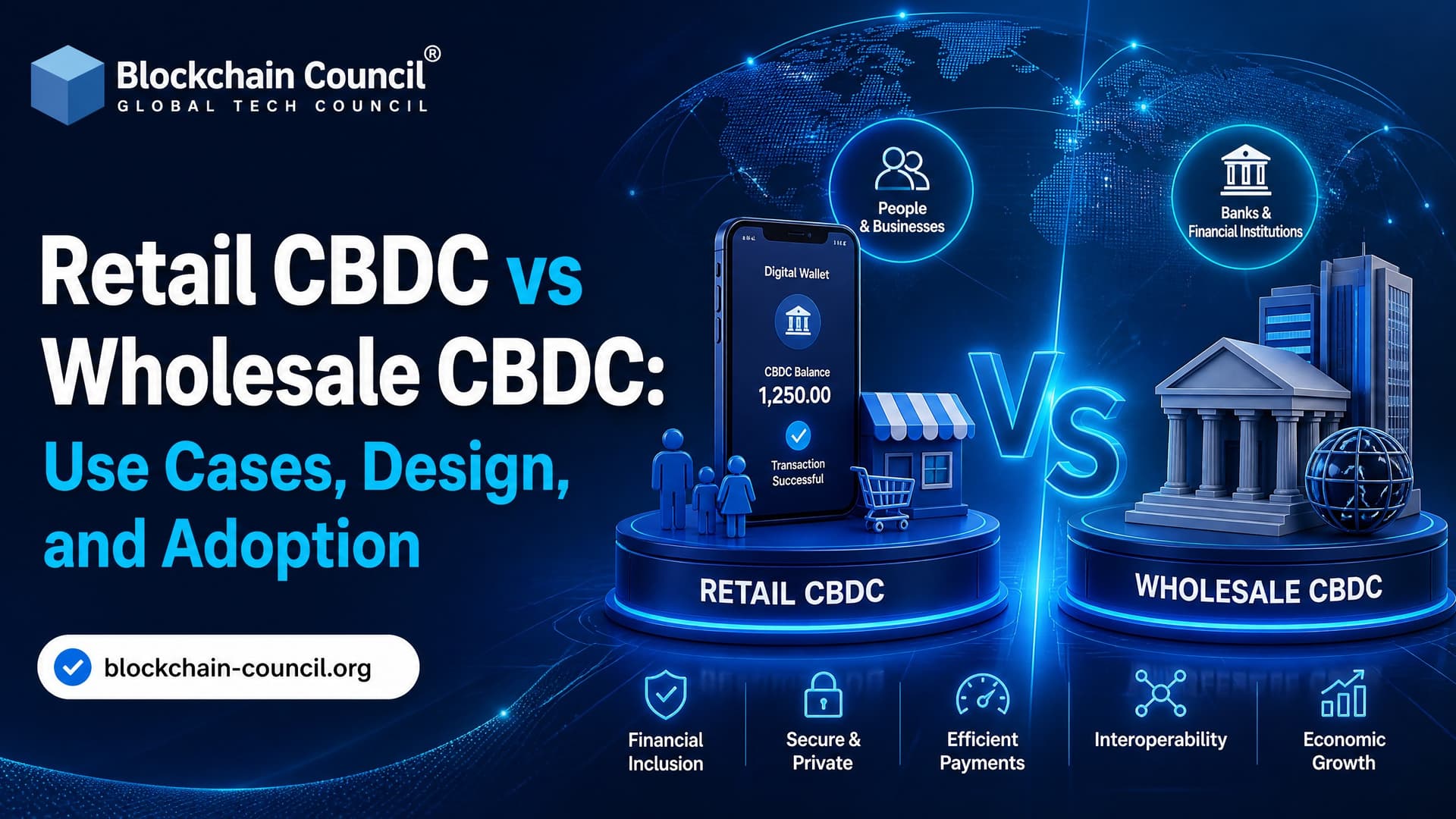
Retail CBDC vs Wholesale CBDC is not a debate about which version wins. It is a question of layers. Retail CBDCs are public-facing digital cash for households and businesses. Wholesale CBDCs are institutional settlement assets for banks, securities markets, and cross-border payment systems. The design choices are very different, and so is the adoption outlook. Professionals building a working grasp of both layers often start with a grounding like the Certified Central Bank Digital Currency (CBDC) Expert credential before working through the comparison below.
The short version: retail CBDC is politically sensitive and hard to scale. Wholesale CBDC has a clearer near-term business case, especially where tokenised assets, securities settlement, and foreign exchange are involved.

What Is a Retail CBDC?
A retail central bank digital currency is a digital form of central bank money available to the general public. You could use it for person-to-person transfers, merchant payments, government benefits, or basic digital wallet payments.
Think of it as sovereign digital cash, although most proposed systems do not behave exactly like banknotes. They usually include wallets, identity checks, transaction monitoring rules, and limits on how much a person can hold.
Common retail CBDC use cases
Everyday payments: P2P transfers and person-to-merchant payments.
Financial inclusion: Digital payment access for people without full bank accounts.
Government transfers: Direct benefit payments, subsidies, or emergency relief.
Offline payments: Payments during network outages or in low-connectivity areas.
Programmable payments: Conditional transfers, time-bound vouchers, or automated disbursements.
The Bahamas Sand Dollar, Jamaica JAM-DEX, and Nigeria eNaira are the three widely cited live retail CBDC launches as of 2025. India's retail e₹ pilot is one of the largest, with more than 6 million users by early 2025 and 17 banks involved, according to Reserve Bank of India updates.
What Is a Wholesale CBDC?
A wholesale CBDC is a digital form of central bank money restricted to eligible financial institutions. It is used for large-value settlement rather than daily shopping. Understanding how these institutional liabilities sit alongside other tokenised instruments is its own discipline, and the Certified Digital Assets Expert program is a useful companion for anyone mapping this ground alongside CBDC-specific study.
In practice, wholesale CBDC is closer to tokenised central bank reserves. Banks, clearing houses, payment system operators, and securities market participants use it to settle interbank payments, tokenised securities, collateral transfers, and foreign exchange transactions.
Common wholesale CBDC use cases
Interbank settlement: Faster final settlement between regulated institutions.
Securities settlement: Delivery-versus-payment, often called DvP, for tokenised bonds or equities.
Foreign exchange: Payment-versus-payment, or PvP, to reduce settlement risk.
Collateral movement: Intraday liquidity and collateral transfers.
Cross-border payments: Multi-CBDC platforms and shared settlement networks.
This is where adoption is moving faster. A BIS survey covering 93 central banks found that roughly 9 in 10 were exploring CBDC in some form. BIS analysis also shows wholesale CBDC work is now more likely than retail CBDC to reach issuance within a six-year horizon.
Retail CBDC vs Wholesale CBDC: Key Differences
The cleanest distinction is the user base. Retail CBDC is for millions of consumers and merchants. Wholesale CBDC is for a smaller group of regulated financial institutions.
Factor | Retail CBDC | Wholesale CBDC |
Users | Individuals, merchants, businesses | Banks, FMIs, payment operators |
Transaction profile | High volume, low value | Low volume, high value |
Typical use | Payments, benefits, inclusion | Interbank, securities, FX |
Main risk | Privacy, bank funding, public trust | Interoperability, legal finality, platform risk |
Adoption outlook | Mixed and slower | Stronger near-term momentum |
To be blunt, a retail CBDC must beat or at least match mobile wallets, cards, instant payment rails, and cash for normal users. That is a high bar. A wholesale CBDC only needs to improve settlement where current infrastructure is slow, fragmented, or expensive.
Design Choices for Retail CBDC
Account-based or token-based
Retail CBDCs are usually discussed as either account-based or token-based systems. In an account-based model, identity and account records are central. In a token-based model, the instrument behaves more like a digital bearer asset, though real-world systems still need AML and consumer protection controls.
Most central banks favor a two-tier model. The central bank issues and redeems the CBDC. Banks or payment providers handle wallets, onboarding, customer support, and compliance. This reduces the risk that the central bank becomes a retail bank for the entire country.
Limits, interest, and bank funding
Retail CBDC can pull deposits away from commercial banks if people see it as safer than bank money. That matters during stress. For this reason, central banks often discuss:
Holding caps per wallet
Non-interest-bearing CBDC balances
Tiered remuneration above a threshold
Transaction limits for lower-KYC wallets
These controls are not decorative. They are core monetary design tools.
Privacy and compliance
Privacy is the hardest retail CBDC issue. A system that exposes every coffee purchase to the state will struggle to win trust. A system with no monitoring will fail AML and counter-terrorist financing expectations.
The practical answer is usually tiered privacy: small offline payments can have lighter identity checks, while larger transfers require stronger KYC. IMF work on CBDC financial integrity has repeatedly pointed to privacy-by-design, pseudonymization, and clear data governance as baseline requirements.
Offline payments and programmability
Offline capability sounds simple until you build it. The hard problem is double spending. If two devices transact without contacting the ledger, the system needs secure hardware, risk limits, or delayed reconciliation rules. This is where many whitepapers get vague.
Programmability also needs care. Conditional benefit payments may help governments target support, but overly restrictive money can feel intrusive. The better design is programmable payment logic, not programmable control over every unit of money.
Design Choices for Wholesale CBDC
Permissioned access
Wholesale CBDCs usually run on permissioned infrastructure or upgraded real-time gross settlement systems. Access is limited to institutions already eligible for central bank settlement accounts or closely regulated market participants.
This makes implementation less politically charged. There are fewer users, known identities, established compliance processes, and existing legal relationships.
DvP, PvP, and atomic settlement
The most valuable wholesale CBDC feature is synchronized settlement. In securities, DvP means the asset moves only if the payment also settles. In FX, PvP means one currency leg settles only if the other does too.
In permissioned DLT pilots, the tricky part is not minting a token. That part is easy. The real issue is finality across systems. If a DvP smart contract releases cash before the securities leg reaches final settlement, you have simply rebuilt settlement risk in a newer stack. Getting this atomic settlement logic right is exactly the kind of hands-on engineering ground covered in Tech Certification programs, which pair well with the settlement design work described here.
Interoperability
Wholesale CBDC projects often involve multiple ledgers, domestic platforms, and legal regimes. ISO 20022 messaging, common technical standards, and well-governed bridges matter as much as the token itself.
BIS Project Mariana tested bridges between domestic wholesale CBDC platforms and an automated market maker model for FX. Project Jura explored euro and Swiss franc wholesale CBDCs for cross-border transfer and settlement. Project mBridge focuses on multi-CBDC infrastructure for faster cross-border payments.
Current Adoption Trends in 2024-2025
Retail CBDC adoption is uneven. The live systems in the Bahamas, Jamaica, and Nigeria have provided valuable lessons, but usage has often been modest compared with the size of the population or the scale of existing payment options. No new retail CBDC went live in 2024, based on widely reported industry tracking.
Wholesale CBDC is on a different path. The Swiss National Bank's Project Helvetia has tested settlement of tokenised assets on SIX Digital Exchange and was extended into the mid-2020s. Australia's Project Acacia is examining wholesale CBDC, tokenised deposits, stablecoins, fixed income, private markets, trade receivables, and carbon credits. Singapore continues trials around interbank transfers and tokenised bills.
Australia's policy stance is telling: no retail CBDC is justified at present, but wholesale settlement experiments continue. That is a practical signal, not a theoretical one.
Which CBDC Type Matters More for Enterprises?
If you work in capital markets, banking, treasury, or cross-border payments, wholesale CBDC deserves your attention first. It can change settlement workflows, liquidity management, collateral mobility, and post-trade infrastructure.
If you work in consumer fintech, wallet design, public-sector payments, or inclusion-focused products, retail CBDC remains relevant. But you should compare it honestly against instant payments, mobile money, open banking, and regulated stablecoins. Retail CBDC is not automatically the best tool.
Skills Professionals Should Build
CBDC work sits at the intersection of monetary policy, digital assets, cybersecurity, payments, and regulation. For Blockchain Council readers, useful learning paths include the Certified Blockchain Expert™, Certified Blockchain Developer™, and Certified Cryptocurrency Expert™, depending on your role.
Policy teams: Study CBDC design, privacy models, AML/CFT rules, and financial stability trade-offs.
Developers: Learn permissioned DLT, smart contract settlement logic, wallet architecture, and key management.
Banking professionals: Focus on tokenised deposits, central bank reserves, ISO 20022, RTGS integration, DvP, and PvP.
Enterprise leaders: Track wholesale CBDC pilots tied to securities, trade finance, and FX settlement.
Since both retail and wholesale CBDC projects eventually need to be explained clearly to institutional partners, regulators, or the public, teams handling that side of a rollout may also want a Marketing Certification in their toolkit.
Future Outlook: Complementary Layers, Not Rivals
The likely future is not retail CBDC replacing wholesale CBDC, or the other way around. The more credible model is layered digital money. Wholesale CBDC sits at the settlement core. Tokenised deposits and regulated stablecoins operate as private liabilities. Retail CBDC or instant payment systems serve the public payment layer.
Wholesale CBDC will probably reach broader production first because its business case is narrower and stronger. Retail CBDC will keep moving, but in many advanced economies it will depend on legislation, public trust, privacy protections, and whether existing payment systems already meet public needs.
If you want a practical next step, map one CBDC use case to your role. Developers can prototype DvP settlement logic on a permissioned ledger. Compliance teams can model tiered wallet KYC. Banking teams can study Project Helvetia, Mariana, Jura, mBridge, and Acacia. Then build the skills around that path rather than treating CBDC as one generic technology.
FAQs
1. What is the difference between retail and wholesale CBDCs?
A retail central bank digital currency (CBDC) is designed primarily for use by individuals and businesses for everyday payments.
A wholesale CBDC is designed primarily for banks and other eligible financial institutions for interbank and financial-market settlement.
The simplest distinction is:
Retail CBDC → public-facing digital central bank money
Wholesale CBDC → institutional digital central bank settlement money
Both can be liabilities of the central bank, but their users, infrastructure requirements, transaction patterns, and policy objectives differ substantially.
2. Who uses a retail CBDC?
Potential retail CBDC users include:
Consumers
Merchants
Small businesses
Corporations
Government agencies
Other eligible members of the public
A person might use retail CBDC to buy groceries, pay a utility bill, receive government benefits, or send money to another person.
The emphasis is therefore on mass-market payments.
3. Who uses a wholesale CBDC?
Wholesale CBDC access would normally be restricted to eligible institutions, potentially including:
Commercial banks
Central counterparties
Securities settlement systems
Payment institutions
Broker-dealers
Other regulated financial institutions
A wholesale CBDC might be used to settle a $100 million securities transaction rather than someone's increasingly offensive grocery bill.
4. What are the main retail CBDC use cases?
Retail CBDC could support:
Person-to-person payments
Alice → Bob
Person-to-business payments
Customer → Merchant
Business-to-person payments
Employer → Employee
Government payments
Government → Citizen
Bill payments
Consumer → Utility
Potential additional use cases include e-commerce, remittances, machine payments, and offline transactions.
5. What are the main wholesale CBDC use cases?
Wholesale CBDC focuses more heavily on financial-market infrastructure.
Potential applications include:
Interbank settlement
Securities settlement
Delivery versus payment
Foreign-exchange settlement
Payment versus payment
Repo transactions
Collateral management
Tokenized assets
Cross-border settlement
These are fewer transactions than retail payments, but individual values can be enormous.
6. How does retail CBDC compare with cash?
Retail CBDC can be understood as a potential digital form of publicly accessible central bank money.
Both cash and retail CBDC can represent central bank liabilities, but their characteristics differ.
Cash
Physical → naturally offline → bearer-like
Retail CBDC
Digital → electronically transferable → architecture-dependent identity and privacy
Replicating useful cash characteristics digitally, especially privacy and offline usability, is considerably harder than replacing paper with pixels.
7. How does wholesale CBDC compare with central bank reserves?
This comparison is more subtle because commercial banks already use digital central bank reserves for settlement.
Both reserves and wholesale CBDC can represent central bank liabilities.
The potential difference lies largely in functionality:
Traditional reserves → account-based central bank settlement infrastructure
Wholesale CBDC → potentially tokenized, programmable, interoperable settlement infrastructure
This is why the business case for wholesale CBDC often depends on what it can do that existing RTGS and reserve systems cannot do efficiently.
8. How does the architecture differ?
A retail CBDC might use:
Central Bank
↓
Banks / PSPs
↓
Wallet Infrastructure
↓
Millions of Consumers and Businesses
A wholesale CBDC might use:
Central Bank
↓
Wholesale CBDC Platform
↓
Banks / Securities Systems / Clearing Institutions
The retail architecture emphasizes enormous scale and user accessibility. The wholesale architecture emphasizes institutional integration and settlement efficiency.
9. Do retail and wholesale CBDCs require blockchain?
No.
Either could use:
Centralized databases
Distributed databases
DLT
Permissioned blockchain
Hybrid infrastructure
However, DLT may have particularly interesting wholesale applications because multiple regulated institutions may need synchronized access to tokenized assets and settlement money.
10. Why might DLT be more attractive for wholesale CBDC?
Wholesale markets involve multiple institutions maintaining interconnected records.
DLT could potentially provide:
Shared state → synchronized records → coordinated settlement → reduced reconciliation
It may also support atomic transactions involving tokenized financial assets.
For retail CBDC, where transaction throughput and simplicity can dominate, conventional centralized infrastructure may sometimes be more attractive.
11. What is delivery versus payment?
Delivery versus payment (DvP) links securities delivery with payment.
Suppose Bank A purchases tokenized bonds from Bank B.
The transaction can be structured as:
Bank A → Wholesale CBDC → Bank B
simultaneously with:
Bank B → Tokenized Bonds → Bank A
The transaction executes only if both sides can complete.
This reduces principal risk.
12. What is payment versus payment?
Payment versus payment (PvP) coordinates the two currency legs of a foreign-exchange transaction.
For example:
Digital Dollar ↔ Digital Euro
Both transfers can be structured to settle together.
Wholesale CBDCs could potentially facilitate PvP across compatible central-bank infrastructures, reducing foreign-exchange settlement risk.
13. What does settlement mean for retail CBDC?
Retail settlement involves transferring CBDC between users or businesses and making that transfer final according to the system's rules.
For example:
Consumer: −50 CBDC
Merchant: +50 CBDC
Because CBDC represents central bank money, the transfer can potentially settle directly in a central-bank liability.
14. What does settlement mean for wholesale CBDC?
Wholesale settlement concerns large financial obligations between eligible institutions.
For example:
Bank A: −50 million wholesale CBDC
Bank B: +50 million wholesale CBDC
The transaction may also be linked atomically to securities, foreign currency, or collateral transfers.
Settlement finality and liquidity management are therefore particularly important.
15. How important are digital wallets for retail CBDC?
Extremely important.
Retail users need accessible interfaces such as:
Mobile applications
Bank apps
Payment cards
Smart cards
Hardware devices
Feature-phone services
Wallet usability can materially influence adoption.
A technically immaculate CBDC with an unpleasant wallet can lose to an ordinary payment app remarkably quickly.
16. Do wholesale CBDCs need wallets?
They may use institutional wallets or equivalent interfaces, but these are very different from consumer wallets.
Institutional systems may involve:
Hardware security modules
Treasury-management systems
API integrations
DLT nodes
Institutional key-management systems
Automated settlement engines
The priority is security and system integration rather than whether the “Pay” button has tasteful rounded corners.
17. How do identity requirements differ?
Retail CBDC may need to support millions of individual identities and potentially different verification tiers.
Wholesale participants are already regulated financial institutions.
Therefore:
Retail → consumer identity, KYC, accessibility, privacy
Wholesale → institutional identity, authorization, permissions, compliance
Wholesale identity is narrower in scale but involves very high-value permissions.
18. Which CBDC needs stronger privacy protections?
Both require strong protections, but the problems differ.
Retail CBDC raises significant concerns about personal financial privacy, including who can see an individual's transactions.
Wholesale CBDC raises concerns involving:
Trading information
Institutional positions
Market-sensitive transactions
Liquidity information
Counterparty relationships
A wholesale ledger that casually reveals every bank's trading activity would be an impressively efficient mechanism for creating new market problems.
19. Which CBDC needs offline payments?
Offline functionality is generally more important for retail CBDC.
Consumers may need to make payments during:
Network outages
Natural disasters
Telecommunications failures
Limited-connectivity situations
Wholesale institutions generally operate through dedicated financial networks with sophisticated redundancy, making device-to-device offline payment less central.
20. How do transaction requirements differ?
Requirement | Retail CBDC | Wholesale CBDC |
|---|---|---|
Users | Potentially millions | Limited institutions |
Transaction count | Very high | Lower |
Individual value | Usually low/medium | Often very high |
User interface | Critical | Institutional |
Offline capability | Potentially important | Usually less important |
Tokenized assets | Secondary | Major potential use case |
DvP/PvP | Less central | Important |
Privacy focus | Consumer data | Market/institutional data |
Financial inclusion | Major potential goal | Not primary goal |
Integration | Retail payment ecosystem | Financial-market infrastructure |
21. What are the potential benefits of retail CBDC?
Potential benefits include:
Public access to digital central bank money
Faster payments
Greater payment competition
Lower transaction costs
Financial inclusion
Payment resilience
Offline capability
Efficient government transfers
Whether these benefits materialize depends heavily on design and adoption.
22. What are the potential benefits of wholesale CBDC?
Potential benefits include:
Faster institutional settlement
Atomic transactions
Reduced counterparty risk
Improved securities settlement
Better collateral mobility
Reduced reconciliation
Tokenized-asset integration
Cross-border efficiency
Extended operating hours
Wholesale CBDC may therefore be particularly relevant to the modernization of capital-market infrastructure.
23. What are the major retail CBDC risks?
Retail CBDC can create risks involving:
Commercial bank deposit outflows
Digital bank runs
Consumer privacy
Cybersecurity
Financial exclusion
Operational outages
Fraud
Excessive government or intermediary data access
These issues can influence whether consumers and banks support the system.
24. What are the major wholesale CBDC risks?
Wholesale CBDC can create different risks:
Technology failures
Smart-contract vulnerabilities
Institutional key compromise
Liquidity fragmentation
Interoperability failures
Legal uncertainty
Governance complexity
New systemic dependencies
Because transaction values are large, even a low-frequency failure can have serious consequences.
25. How could retail CBDC affect commercial banks?
Consumers could shift funds from commercial bank deposits into CBDC.
For example:
Bank Deposit → Retail CBDC
Large shifts could affect:
Deposit funding
Bank liquidity
Funding costs
Lending
Potential safeguards include holding limits, tiered remuneration, and liquidity facilities.
26. How could wholesale CBDC affect commercial banks?
Wholesale CBDC may change how banks manage:
Settlement liquidity
Securities transactions
Collateral
Foreign exchange
Intraday funding
Tokenized assets
Rather than competing directly for consumer deposits, wholesale CBDC primarily changes financial-market infrastructure.
Related Articles
View All
Digital Assets
CBDC Use Cases for Cross-Border Trade: Reducing Friction in Global Commerce
Explore CBDC use cases for cross-border trade, including mBridge, wholesale CBDCs, PvP, DvP, compliance, and faster global settlement.

Digital Assets
CBDC Use Cases for Consumers: Payments, Remittances, and Savings
Explore CBDC use cases for consumers, including everyday payments, remittances, offline wallets, government transfers, and simple savings.

Digital Assets
CBDC Use Cases for Businesses: Faster Settlement, Lower Costs, and Automation
Explore practical CBDC use cases for businesses, including faster settlement, lower B2B payment costs, programmable tax flows, and treasury automation.
Trending Articles
AWS Career Roadmap
A step-by-step guide to building a successful career in Amazon Web Services cloud computing.
How Blockchain Secures AI Data
Understand how blockchain technology is being applied to protect the integrity and security of AI training data.

Can DeFi 2.0 Bridge the Gap Between Traditional and Decentralized Finance?
The next generation of DeFi protocols aims to connect traditional banking with decentralized finance ecosystems.