

How Is CBDC Different From Ethereum? Smart Contracts, Governance, and Use Cases
 Suyash Raizada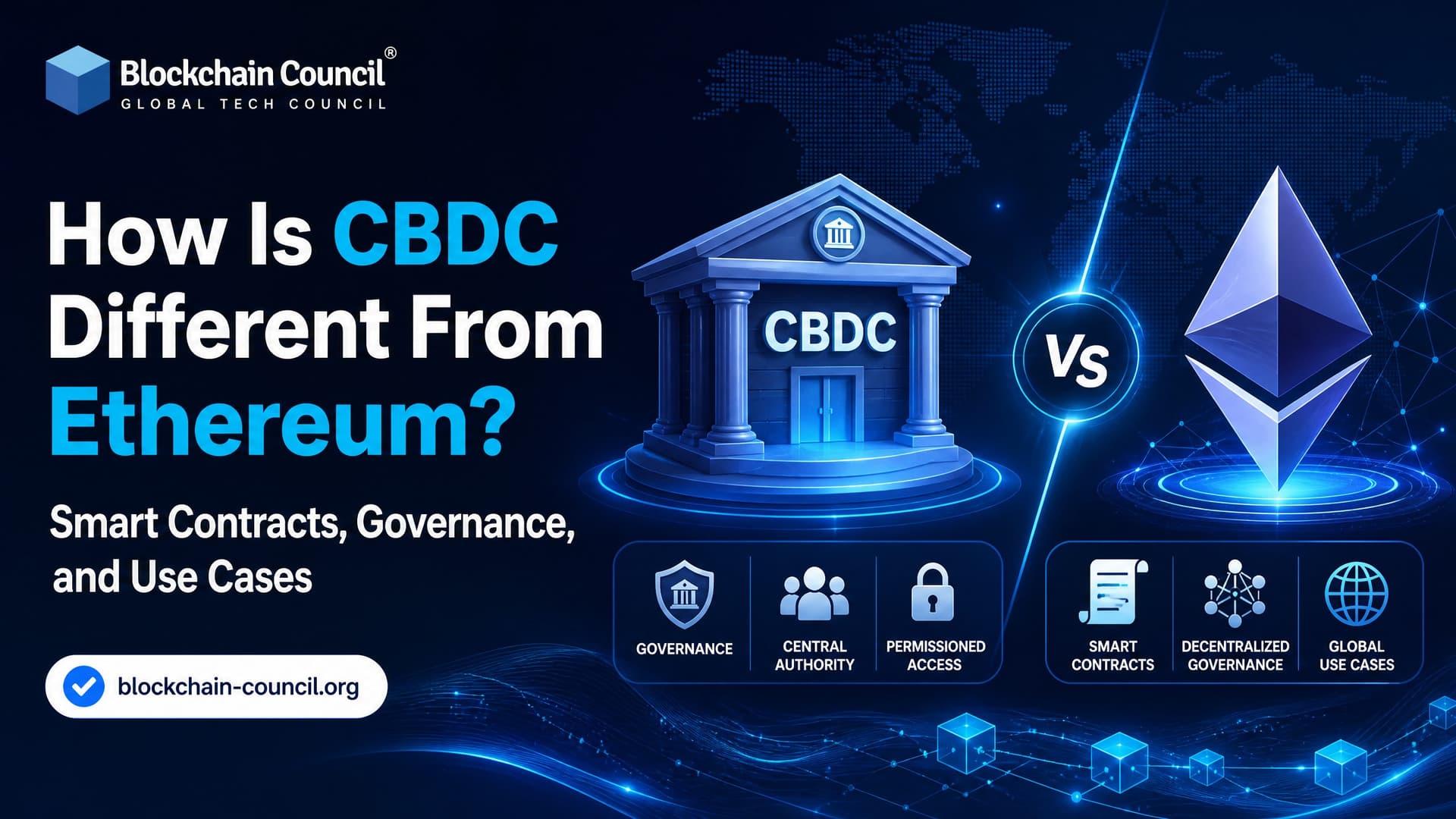
How is CBDC different from Ethereum? A CBDC is state-issued digital fiat money, usually controlled by a central bank. Ethereum is a public smart contract blockchain where developers deploy applications without asking a central authority for permission. That one distinction changes almost everything: who can issue money, who validates transactions, what smart contracts are allowed to do, and which use cases actually make sense. Professionals building structured expertise in the CBDC side of this comparison are increasingly formalizing it through a program such as the Certified Central Bank Digital Currency (CBDC) Expert designation.
If you work in digital assets, payments, compliance, or Web3 development, do not treat CBDCs and Ethereum as two versions of the same thing. They solve different problems. Sometimes they connect. They are not substitutes.

CBDC vs Ethereum: The Core Difference
A central bank digital currency, or CBDC, is a digital form of sovereign fiat currency. It is a direct liability of the central bank, similar in monetary status to physical cash, though the technical design varies from one country to the next. A retail CBDC would be used by the public. A wholesale CBDC would be used by banks and financial institutions for high-value settlement.
Ethereum is different at the foundation. It is a public, permissionless blockchain with its own native asset, Ether. Anyone can run a node, send a transaction, or deploy a smart contract, provided they pay gas and follow protocol rules. Ethereum mainnet uses chain ID 1, and since The Merge in 2022 it has run on Proof of Stake rather than Proof of Work.
So the comparison starts here:
Issuer: A CBDC is issued by a central bank. Ether is issued according to Ethereum protocol rules.
Legal status: A CBDC is designed as legal tender or central bank money. Ether is not legal tender in most jurisdictions.
Infrastructure: CBDCs usually run on centralized or permissioned systems. Ethereum runs as a public global state machine.
Control: CBDC rules can be changed by policy decisions. Ethereum protocol changes require broad coordination through Ethereum Improvement Proposals and client upgrades.
Architecture: Central Bank Ledger vs Public Blockchain
Most CBDC designs use either a centralized ledger or a permissioned distributed ledger. In both cases, validation is restricted. The central bank, or approved intermediaries, decide who participates in the network and how transactions are processed.
Ethereum takes the opposite approach. Its ledger is public. Validators propose and attest to blocks under consensus rules, and users can verify the chain independently. No single entity should be able to rewrite balances or block valid transactions at the protocol level, though application-level controls can still exist.
For enterprises, this matters. A CBDC platform is closer to regulated payment infrastructure. Ethereum is closer to a programmable settlement and application layer. You choose CBDC architecture when legal certainty and central bank settlement are the priority. You choose Ethereum when open composability and global developer access matter more. Since tokenized assets on Ethereum and CBDC balances behave so differently in custody terms, professionals working across both often add a Certified Digital Assets Expert credential to get a clearer working model of custody, classification, and settlement finality across permissioned and public systems.
Smart Contracts: Open Execution vs Policy-Limited Programmability
How Ethereum Smart Contracts Work
Ethereum smart contracts are compiled programs deployed to blockchain addresses. They run on the Ethereum Virtual Machine, hold assets, call other contracts, and update state when users or other contracts trigger them. Solidity 0.8.x is still the dominant language for production contracts, though Vyper and other tools see real use too.
Developers build decentralized exchanges, lending protocols, NFT contracts, tokenized asset systems, DAO voting tools, escrow contracts, and automated market makers on Ethereum. The strength here is composability. A lending protocol can use an ERC-20 token, pull prices from an oracle, route swaps through a decentralized exchange, and settle everything on-chain.
That freedom cuts both ways. Bad code is expensive. Ask anyone who has deployed contracts with Hardhat and hit ProviderError: insufficient funds for intrinsic transaction cost because the deployer wallet held tokens on the wrong network, or had no ETH for gas. Even experienced developers get caught by chain configuration, proxy upgrade permissions, or a missing initializer in an upgradeable contract.
How CBDC Smart Contracts Are Different
CBDC smart contracts are not meant to be open-ended in the same way. Central banks are unlikely to let any developer deploy arbitrary code directly onto a national money ledger. That would introduce security, dependency, and operational risks into critical monetary infrastructure.
Instead, CBDC programmability is usually constrained. The smart contract logic may support policy-approved functions such as:
Automatic tax collection at the point of payment
Targeted subsidies for specific sectors or households
Spending limits for benefit programs
Time-bound fiscal transfers
Wholesale securities settlement against central bank money
Interest or holding limits tied to monetary policy
To be blunt, CBDC smart contracts are not built for DeFi experimentation. They are built for compliance, settlement efficiency, and policy execution. That is not a weakness. It is the design goal.
Governance: Centralized Authority vs Distributed Coordination
CBDC governance is centralized by design. The central bank sets issuance rules, access rules, compliance obligations, privacy controls, upgrade paths, and monetary parameters. If the system needs an emergency rule change, the authority can act quickly.
This is useful for financial stability. It also raises serious privacy and civil liberties questions. Depending on the legal framework, a CBDC system could support transaction monitoring, wallet restrictions, negative interest rates, or merchant category controls. The Bank for International Settlements and several central bank papers have repeatedly framed CBDC design around the balance between privacy, security, and public policy objectives.
Ethereum governance is messier. Core developers write proposals. Client teams implement changes. Validators and node operators choose which software to run. Application developers and users react. EIP-1559, which changed Ethereum fee mechanics in 2021, is a good example: it took years of discussion, code changes across clients, and community coordination.
Ethereum governance is slower, but it is harder for one actor to capture completely. CBDC governance is faster, but users must trust the institution and the legal regime behind it. Following either governance process closely, let alone both, takes real systems literacy, which is why some analysts pair their finance background with a general Tech Certification so client upgrades, EIPs, and policy change logs stop reading like a foreign language.
Trust and Settlement Finality
A CBDC gives you a claim on central bank money. That is powerful. For banks, payment providers, and public agencies, settlement in central bank money can reduce counterparty risk.
Ethereum gives you cryptographic settlement under public blockchain rules. If you hold ETH in a self-custody wallet, your risk is not a commercial bank default. Your risks are different: private key loss, smart contract bugs, market volatility, bridge failures, and regulatory uncertainty.
Tokenized assets on Ethereum add another layer. A stablecoin may settle technically on Ethereum, but its value depends on the issuer, reserve management, redemption rights, and applicable law. A tokenized treasury product depends on the legal structure behind the token. Ethereum can record ownership and automate transfer rules, but it does not magically remove off-chain obligations.
Use Cases: Where CBDCs Fit Best
CBDCs are strongest where public money, regulatory certainty, and payment infrastructure intersect. Common CBDC use cases include:
Retail digital payments: A public alternative to cash in increasingly digital economies.
Financial inclusion: Basic digital money access for people without traditional bank accounts.
Government payments: Faster welfare payments, subsidies, refunds, and emergency transfers.
Wholesale settlement: Interbank transfers, securities settlement, and collateral movements using tokenized central bank money.
Policy tools: Controlled programmability for fiscal transfers, tax handling, or monetary policy experiments.
The Reserve Bank of Australia's CBDC pilot, for example, explored smarter payments, asset market innovation, private digital money, and resilience themes. Wholesale CBDC experiments in several jurisdictions have tested settlement of securities and derivatives on permissioned platforms.
Use Cases: Where Ethereum Fits Best
Ethereum is strongest when applications need open smart contracts, interoperability, and a large developer ecosystem. Typical Ethereum use cases include:
DeFi: Lending, borrowing, decentralized exchanges, derivatives, liquid staking, and structured products.
Tokenization: ERC-20 tokens, ERC-721 NFTs, real-world asset tokens, and on-chain fund units.
Stablecoins: Dollar-backed and other fiat-referenced tokens used for transfers, treasury operations, and trading.
DAOs: On-chain voting, treasury management, grants, and community-controlled protocols.
Enterprise workflows: Supply chain proofs, energy markets, identity systems, and audit trails.
Ethereum is not the right tool for every payment problem. Gas costs, compliance requirements, and public data exposure can be deal breakers. But if your product depends on composable smart contracts, Ethereum and EVM-compatible networks remain the default starting point for many teams.
Can CBDCs Connect to Ethereum?
Yes, but the connection will likely be controlled. Researchers and international policy groups have discussed bridges that let CBDC ledgers interact with public blockchains. In one wholesale CBDC experiment, a permissioned CBDC platform connected with Ethereum smart contracts so central bank money could settle derivative-related transactions while the authority retained control over the CBDC side.
This pattern is realistic. CBDCs may stay on permissioned ledgers, while Ethereum hosts market logic, tokenized assets, and application workflows. A bridge or interoperability layer can connect the two. That design gives institutions regulated settlement assets without placing unrestricted smart contract execution inside the core central bank ledger.
Which Skills Should You Build?
If you are a developer, learn Ethereum smart contract security before trying to build CBDC-adjacent systems. Reentrancy, access control, oracle risk, upgradeable proxy patterns, and gas griefing are not theory. They break real systems.
If you work in payments, banking, or policy, study CBDC architecture, permissioned ledgers, identity, AML controls, privacy models, and settlement design. The technical work is inseparable from regulation.
Useful learning paths on Blockchain Council include the Certified Blockchain Expert™ for architecture foundations, the Certified Smart Contract Developer™ for contract implementation, and the Certified Ethereum Expert™ for Ethereum-specific protocol and ecosystem knowledge.
CBDC and Ethereum Are Complementary, Not Identical
The cleanest answer is this: CBDCs provide regulated digital fiat, while Ethereum provides a public programmable execution layer. CBDCs are about state-backed money and policy control. Ethereum is about decentralized applications, open smart contracts, and tokenized value networks.
Neither model earns adoption purely on architecture. Central banks need to explain CBDC design choices to a skeptical public, and Ethereum-based projects need to explain risk and utility to users who have heard mostly hype or scandal, which is a real communication gap. That is one reason professionals on both sides sometimes round out their technical training with a general Marketing Certification focused on explaining complex financial and technical products honestly.
Your next step depends on your role. If you build products, deploy a basic ERC-20 contract on a testnet and inspect every transaction in a block explorer. If you work in financial infrastructure, map how a wholesale CBDC could settle tokenized securities without exposing the central bank ledger to arbitrary code. That exercise will teach you more than another abstract comparison.
FAQs
1. What is the main difference between a CBDC and Ethereum?
A central bank digital currency (CBDC) is digital sovereign money issued by a central bank. Ethereum is a programmable blockchain network that supports digital assets, applications, and smart contracts. Its native asset is ether (ETH).
The simplest distinction is:
CBDC → a form of money issued by a central bank
Ethereum → programmable blockchain infrastructure with a native crypto asset
Comparing them directly is therefore slightly awkward. One is primarily a monetary instrument; the other is a computing and settlement platform.
2. Who issues a CBDC?
A CBDC is issued by a country's central bank or monetary authority.
The central bank determines, subject to its legal framework:
Issuance
Redemption
Monetary characteristics
Distribution model
Participation rules
Settlement framework
CBDC is therefore part of the official monetary system.
3. Who issues Ethereum?
Ethereum itself is not issued by a company or central bank.
The network operates through a decentralized protocol and a global set of validators. Its native asset, ETH, is issued according to Ethereum's protocol rules.
Those rules can evolve through Ethereum's governance and software-development processes rather than through central-bank monetary-policy decisions.
4. Is ETH the same thing as Ethereum?
No.
Ethereum is the blockchain network and programmable platform.
Ether (ETH) is its native digital asset.
ETH is used for purposes including:
Paying transaction fees
Staking
Transferring value
Interacting with applications
Providing economic security to the network
This is similar to distinguishing a transportation network from the fuel needed to use it, although analogies start misbehaving if pushed too far.
5. Is a CBDC a cryptocurrency?
Not in the conventional sense.
A CBDC may use cryptography and could potentially use distributed ledger technology, but it remains central bank money.
Cryptocurrencies such as ETH operate on decentralized blockchain networks without a central bank issuing the asset.
So:
Cryptography ≠ cryptocurrency
and:
Digital currency ≠ decentralized currency
6. Does a CBDC require blockchain?
No.
A CBDC could use:
Centralized databases
Distributed databases
Permissioned DLT
Blockchain
Hybrid infrastructure
Ethereum, by contrast, is inherently a blockchain-based system.
A central bank therefore does not need to “build an Ethereum” merely to digitize central bank money. Computers had databases before blockchains arrived to make architecture meetings longer.
7. How does governance differ?
CBDC governance is institutional.
Depending on the jurisdiction, authority can involve:
Central bank → legislature → regulators → courts → regulated financial institutions
Ethereum governance is decentralized and community-driven.
Protocol changes involve participants such as:
Developers
Validators
Node operators
Researchers
Application developers
Users
Changes generally become effective when software implementing them is adopted across the network.
8. Who validates CBDC transactions?
That depends on the architecture.
CBDC transactions might be validated by:
Central-bank infrastructure
Authorized commercial banks
PSPs
Permissioned nodes
A combination of these
Participation would generally be governed by institutional rules.
9. Who validates Ethereum transactions?
Ethereum uses proof of stake.
Validators stake ETH and participate in proposing and attesting to blocks.
The protocol provides economic incentives for correct behavior and can impose penalties for certain forms of misconduct.
This allows Ethereum to operate without a central transaction-processing authority.
10. What are Ethereum smart contracts?
A smart contract is program code deployed on Ethereum that executes according to predefined rules.
Smart contracts can support:
Token transfers
Decentralized exchanges
Lending
Escrow
Stablecoins
NFTs
Games
Governance systems
Financial derivatives
They make Ethereum a programmable platform rather than merely a payment ledger.
11. Can CBDCs use smart contracts?
Potentially.
CBDC infrastructure could support programmable transaction logic for applications such as:
Delivery versus payment
Payment versus payment
Escrow
Automated settlement
Conditional disbursements
Collateral management
However, CBDC programmability does not require Ethereum or blockchain.
Conventional systems can also execute programmable payment rules.
12. What is programmable money versus programmable payments?
This distinction is particularly important for CBDCs.
Programmable payment means software determines when or how a transaction executes.
For example:
Release payment when goods are delivered.
Programmable money means restrictions are attached to the monetary unit itself.
For example:
This unit can only be spent on specified goods.
The latter raises much larger questions involving privacy, autonomy, fungibility, and government authority.
13. Is ETH stable like a CBDC?
No.
A domestic CBDC would be denominated directly in the national currency:
1 digital dollar = $1
ETH has a market-determined price that can fluctuate substantially relative to dollars, euros, and other currencies.
CBDC therefore serves as sovereign money, while ETH is a market-priced crypto asset.
14. How is supply managed?
CBDC supply would be managed within the central bank's monetary framework.
ETH supply follows Ethereum's protocol rules, including mechanisms involving:
Validator issuance
Staking
Transaction-fee burning
Unlike Bitcoin, ETH does not have a fixed 21-million-unit maximum supply.
Its monetary mechanics are protocol-based rather than determined by a central bank.
15. How does transaction privacy differ?
Ethereum's base-layer transactions are generally visible on a public blockchain.
Observers can examine:
Addresses
Transfers
Smart-contract interactions
Token balances
Transaction histories
Addresses are pseudonymous rather than inherently tied to legal names.
CBDC transaction visibility would depend on the architecture, intermediaries, privacy technologies, and legal framework.
16. Is Ethereum anonymous?
No.
Ethereum addresses are pseudonymous.
If an address becomes associated with a person's identity through an exchange, payment, public disclosure, or blockchain analysis, substantial transaction history may become attributable.
Public blockchains can therefore provide less transactional secrecy than casual observers sometimes assume.
17. Could a CBDC be more private than Ethereum?
In some respects, yes.
A CBDC could keep transaction records away from public view and restrict access through institutional and technical controls.
For example:
Public → no transaction visibility
PSP → customer-specific information
Central bank → limited settlement information
However, institutional visibility could be greater than on Ethereum depending on CBDC design.
Privacy therefore has multiple dimensions rather than one convenient slider.
18. Can anyone access Ethereum?
Ethereum is generally permissionless at the protocol level.
A user can create a wallet and interact with the blockchain without obtaining permission from a central bank.
However, particular services, applications, interfaces, exchanges, or regulated intermediaries may impose their own restrictions.
A CBDC would operate within a regulated monetary framework and may require authorized wallets or identity checks.
19. Can CBDC transactions be censored or frozen?
Potentially, under applicable laws and system rules.
A CBDC could allow authorized institutions to implement:
Court orders
Sanctions
Fraud restrictions
Account freezes
AML controls
The exact powers would depend on legislation and architecture.
Ethereum does not have a single central administrator capable of simply editing every user's balance, although applications, stablecoin issuers, interfaces, and centralized service providers can have their own control mechanisms.
20. What happens if a transaction is sent to the wrong address?
CBDC systems could potentially provide recovery or dispute mechanisms depending on their design.
Ethereum transactions are generally difficult to reverse once finalized unless the recipient voluntarily returns the assets or the application itself contains an applicable recovery mechanism.
This is one of those areas where decentralization provides strong finality and simultaneously reminds users that typing accurately is apparently a financial skill.
21. How does settlement differ?
CBDC settlement can represent final transfer in central bank money.
Ethereum settlement involves changes to blockchain state under Ethereum's consensus rules.
ETH itself is not a claim on a central bank.
Tokens representing other assets may also settle on Ethereum, but their legal and financial characteristics depend on the issuer and underlying arrangement.
22. What are Ethereum's main use cases?
Ethereum supports a broad ecosystem including:
Decentralized finance
Stablecoins
Tokenized assets
NFTs
Decentralized exchanges
DAOs
Gaming
Digital identity applications
Settlement applications
Its purpose extends far beyond payments.
23. What are the main CBDC use cases?
CBDC use cases could include:
Retail payments
Person-to-person transfers
Government payments
Merchant payments
Financial inclusion
Offline payments
Wholesale settlement
Cross-border payments
Tokenized-asset settlement
The priorities depend heavily on whether the CBDC is retail or wholesale.
24. Could CBDCs operate on Ethereum?
Technically, central-bank money could potentially be represented or connected to Ethereum-compatible technology, but public Ethereum raises major considerations involving:
Governance
Privacy
Scalability
Transaction fees
Regulatory control
Operational resilience
Legal finality
Cybersecurity
A central bank could instead use an Ethereum-compatible permissioned network or connect CBDC infrastructure to public blockchains through controlled interfaces.
Technical possibility and central-bank suitability are not the same test.
25. Could Ethereum interact with CBDCs?
Potentially.
Future infrastructure could connect:
CBDC ↔ Tokenized Deposits ↔ Stablecoins ↔ Ethereum Assets
Possible mechanisms include regulated gateways, APIs, interoperability protocols, tokenized representations, or settlement bridges.
Such connections would require strong controls because bridges between financial systems have an unfortunate habit of becoming interesting to attackers.
26. How do CBDC and Ethereum compare?
Feature | CBDC | Ethereum |
|---|---|---|
Primary purpose | Sovereign digital money | Programmable blockchain |
Native asset | National currency | ETH |
Issuer | Central bank | Protocol-based ETH issuance |
Governance | Institutional | Decentralized ecosystem |
Price | National currency unit | Market determined |
Blockchain required | No | Yes |
Network model | Typically permissioned | Permissionless |
Consensus | Architecture-dependent | Proof of stake |
Smart contracts | Optional | Core capability |
Public ledger | Not required | Yes |
Identity | Policy/design-dependent | Pseudonymous protocol addresses |
Monetary policy | Central bank | Protocol rules |
Offline payments | Potentially designed in | Not native to base-layer settlement |
27. Which is more programmable?
Ethereum is designed from the ground up as a general-purpose programmable blockchain, so it supports far broader open-ended application development.
A CBDC could support programmable payments, but central banks may deliberately limit programmability for reasons involving:
Security
Privacy
Monetary neutrality
Operational risk
Legal certainty
Fungibility
A currency system does not necessarily benefit from allowing arbitrary code to execute inside its monetary core. Software developers have already provided sufficient evidence for caution.
28. Which is more decentralized?
Ethereum is substantially more decentralized in transaction validation and network governance.
CBDCs intentionally preserve central monetary authority.
Even if a CBDC uses DLT:
Distributed ledger ≠ decentralized monetary policy
The central bank remains responsible for the sovereign currency.
29. Are CBDC and Ethereum competitors?
Only partially.
They may overlap in areas such as:
Digital payments
Settlement
Tokenized assets
Programmability
Cross-border transactions
But their fundamental purposes differ.
CBDC provides official digital central bank money.
Ethereum provides open programmable blockchain infrastructure.
They could therefore compete in some applications while also becoming interoperable.
30. What is the easiest way to understand CBDC versus Ethereum?
Think of them as different layers of a digital financial system:
CBDC
Central Bank → Sovereign Digital Money → Payments and Settlement
Ethereum
Blockchain Protocol → ETH + Smart Contracts → Programmable Applications and Digital Assets
The most important distinction is that CBDC is primarily a type of money, while Ethereum is primarily a programmable network.
CBDCs emphasize monetary sovereignty, stable denomination, regulated access, payment reliability, and central-bank settlement.
Ethereum emphasizes permissionless participation, smart contracts, composability, decentralized applications, and programmable digital assets.
So asking whether CBDC is “better than Ethereum” misses the architectural point. The more useful question is which system is appropriate for a particular function, and whether future financial infrastructure can safely connect the two without turning interoperability into an expensive cybersecurity case study.
Related Articles
View All
Digital Assets
CBDC Blockchain Developer Skills: DLT, Smart Contracts, APIs, and Security
CBDC blockchain developer skills now span permissioned DLT, smart contracts, financial APIs, security engineering, privacy, and compliance.

Digital Assets
CBDC Use Cases for Cross-Border Trade: Reducing Friction in Global Commerce
Explore CBDC use cases for cross-border trade, including mBridge, wholesale CBDCs, PvP, DvP, compliance, and faster global settlement.

Digital Assets
CBDC Use Cases for Consumers: Payments, Remittances, and Savings
Explore CBDC use cases for consumers, including everyday payments, remittances, offline wallets, government transfers, and simple savings.
Trending Articles

Can DeFi 2.0 Bridge the Gap Between Traditional and Decentralized Finance?
The next generation of DeFi protocols aims to connect traditional banking with decentralized finance ecosystems.
Claude AI Tools for Productivity
Discover Claude AI tools for productivity to streamline tasks, manage workflows, and improve efficiency.
How to Install Claude Code
Learn how to install Claude Code on macOS, Linux, and Windows using the native installer, plus verification, authentication, and troubleshooting tips.