

How Do CBDCs Work? Technology, Wallets, and Payment Flows Explained
 Suyash Raizada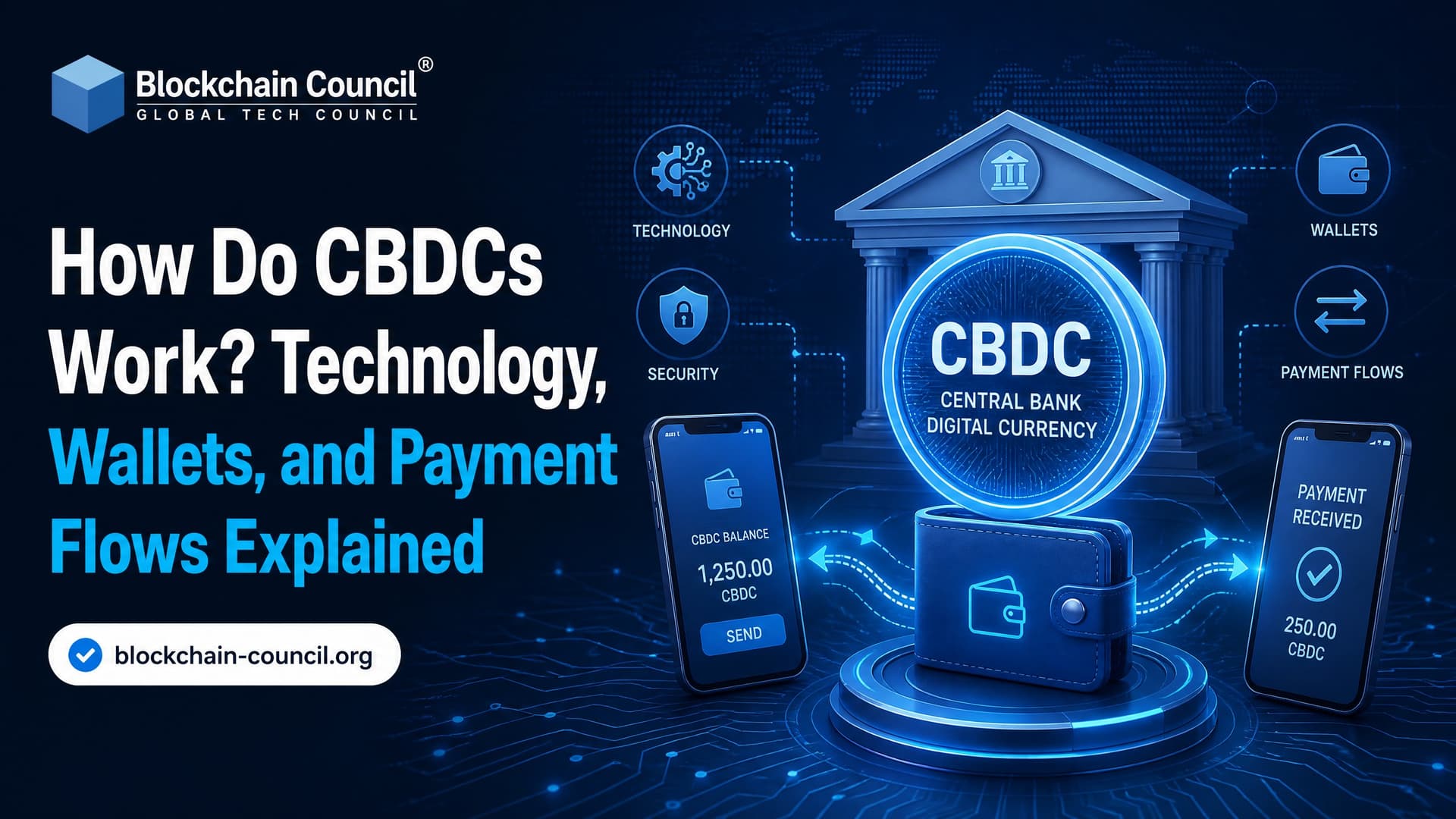
How do CBDCs work? A central bank digital currency is sovereign money in digital form. You access it through a regulated wallet, spend it through a payment network, and settle the transaction in central bank money rather than through a card scheme or a commercial bank ledger. That sounds simple. The engineering is not. For professionals who want to build focused expertise in this evolving financial infrastructure, a Certified Central Bank Digital Currency (CBDC) Expert pathway can provide structured knowledge of CBDC concepts, architecture, and applications.
CBDCs sit between monetary policy, payment infrastructure, identity, cybersecurity, and digital asset design. Some systems look like modern account-based payment rails. Others borrow ideas from blockchain and distributed ledger technology, especially in wholesale settlement. Most real projects are hybrids.

What Is a CBDC?
A CBDC is a digital form of a country's fiat currency issued by the central bank. It is a direct liability of that central bank, much like physical cash, but represented as electronic balances or digital tokens. It is not a private stablecoin. It is not a bank deposit. It is base money.
For professionals exploring the wider digital financial ecosystem, a Certified Digital Assets Expert pathway can complement CBDC knowledge by providing broader exposure to digital assets and their applications across modern financial infrastructure.
Most CBDC designs share five core traits:
They represent an existing national currency.
They are issued or controlled by the central bank.
They are used for electronic payments.
They settle in central bank money.
They are intended to function as legal tender within the relevant jurisdiction.
Retail CBDC vs Wholesale CBDC
There are two main categories.
Retail CBDC: Used by households, merchants, and businesses for daily payments. Wallets may be provided by banks, payment firms, or sometimes the central bank itself.
Wholesale CBDC: Used by regulated financial institutions for interbank settlement, securities settlement, and large-value transfers.
Retail CBDCs get more public attention because they affect consumers. Wholesale CBDCs may move faster in practice because the user base is smaller, identified, and already regulated. If you work in financial infrastructure, do not ignore wholesale CBDC. It is where delivery versus payment, tokenized deposits, and cross-border settlement experiments are getting serious attention.
How CBDC Technology Works
Centralized Ledger or Distributed Ledger?
Most CBDCs do not need a public blockchain. That is the blunt answer. A central bank already controls issuance, monetary rules, and final settlement. Bitcoin-style permissionless mining would add cost and governance problems without solving the main trust issue.
Instead, many CBDC architectures use a central ledger operated by the central bank or a trusted technology provider. Banks and payment service providers connect through APIs, messaging layers, and compliance systems. Some pilots use permissioned distributed ledger technology, especially for wholesale CBDCs, where multiple regulated institutions need shared state and programmable settlement.
A typical CBDC stack includes:
Core ledger: Records balances, tokens, transaction status, and final settlement.
Access layer: APIs for banks, fintechs, merchant acquirers, and wallet providers.
Identity layer: KYC, AML screening, sanctions controls, and risk scoring.
Wallet layer: Mobile apps, hardware cards, secure elements, and merchant terminals.
Operations layer: Monitoring, fraud controls, dispute processes, key management, and reconciliation.
One practical detail that catches teams off guard: offline CBDC is not just online payments with a bad network. You need local balance controls, counters, replay protection, terminal risk limits, and a reconciliation process for when devices reconnect. The hard part is not the tap. It is proving later that the same offline value was not spent twice.
Account-Based vs Token-Based CBDCs
CBDCs can follow an account model, a token model, or a mix of both.
Account-based CBDC: The ledger links balances to identified users. This is easier for compliance and resembles existing banking systems.
Token-based CBDC: Digital tokens represent value, and ownership changes when tokens are transferred. This can support cash-like features and offline payments.
Hybrid CBDC: Common in practice. Low-value use may feel token-like, while higher-value activity requires stronger identity checks.
Token-based does not automatically mean anonymous. Account-based does not automatically mean surveillance. The privacy outcome depends on policy, data access rules, wallet design, and the role of intermediaries.
CBDC Wallets: How Users Access Digital Cash
CBDC wallets are the front door. If the wallet fails, the policy design does not matter much. Users need a way to store value, authenticate themselves, send money, receive money, and recover access after losing a phone or card.
Types of CBDC Wallets
Software wallets: Mobile apps, bank apps, web wallets, or payment apps that hold CBDC balances and show transaction history.
Hardware wallets: Smart cards, wearables, secure-element phones, or dedicated devices that can store keys and sometimes offline value.
Custodial wallets: A bank or payment provider manages keys, onboarding, compliance, recovery, and support.
User-controlled wallets: Users control keys directly, usually with limits because regulators worry about loss, fraud, and AML gaps.
China's e-CNY pilot shows this mix clearly. Mobile wallets are offered through commercial banks and payment platforms, while hardware wallets such as cards and wearables have been tested at large events and offline payment settings. The People's Bank of China has reported broad use across retail purchases, public-sector salary payments, and selected financial product transactions, with cumulative transaction volume rising into the trillions of yuan.
Onboarding and Funding a CBDC Wallet
A common user journey looks like this:
You download a CBDC wallet from a bank, payment provider, or approved public channel.
You complete identity verification. Low-tier wallets may require less information, while higher limits need full KYC.
You link a bank account, card, cash-in point, or government payment source.
You convert bank deposits or cash into CBDC at par value.
Your wallet balance updates, and the issuing or intermediary systems adjust their settlement records.
Tiered wallets matter. They let central banks support financial inclusion without giving unlimited anonymous digital cash to everyone. A small offline wallet for transport fares is one risk profile. A high-balance business wallet is another.
CBDC Payment Flows Explained
Retail Point-of-Sale Payments
At a shop, a CBDC payment usually starts like a card or mobile wallet transaction. Under the surface, the flow is different because settlement can be final in central bank money.
A basic online point-of-sale flow works like this:
The merchant terminal creates a payment request.
You approve the payment using a phone, card, QR code, biometric check, or PIN.
The wallet provider sends the request to the CBDC platform or an authorized intermediary.
The system checks wallet status, limits, fraud signals, and available balance.
The ledger updates the payer and merchant balances.
The merchant receives confirmation, often in seconds.
In an offline flow, the customer wallet and merchant terminal can exchange value locally. Later, the merchant terminal syncs with the CBDC platform or its provider. This design is useful for public transport, rural commerce, disaster recovery, and areas with unstable connectivity.
Person-to-Person Transfers
P2P CBDC payments may use QR codes, phone numbers, aliases, wallet IDs, or near-field communication. The central attraction is immediate settlement with low fees, especially for small domestic transfers. If cross-border links are available, CBDCs could also reduce the number of correspondent banks involved in remittances.
That said, cross-border CBDC is politically difficult. Foreign exchange controls, sanctions compliance, capital flow rules, and monetary sovereignty do not disappear because the ledger is newer.
Government and Business Payments
Government-to-person payments are one of the strongest CBDC use cases. Social benefits, relief funds, tax refunds, and public wages can move directly to citizen wallets with real-time status and lower leakage risk. Person-to-government payments, such as taxes or license fees, can also settle instantly.
Business use cases are more specialized. Australia's CBDC pilot tested scenarios such as construction supply chain payments, livestock auction settlement, GST-linked payment flows, and offline campus payments. These are not science-fiction examples. They show where programmable settlement can reduce reconciliation work between accounting systems, payment systems, and counterparties.
Identity, Privacy, and Compliance
CBDCs carry a privacy trade-off that cannot be hand-waved away. Cash is private by default. Digital payments create data. A CBDC could give authorities a powerful view of transaction behavior unless legal and technical controls limit access.
European data protection authorities have stressed data minimization, purpose limitation, and proportionality in digital euro discussions. In the United States, Congressional Research Service analysis has highlighted concerns around surveillance, bank disintermediation, and the need for clear legislative safeguards before any launch.
Most credible CBDC proposals use some version of tiered identity:
Small-value wallets with simplified onboarding and lower limits.
Higher-value wallets with full KYC and stronger monitoring.
Merchant wallets with business verification and tax reporting rules.
Special offline limits to reduce fraud and double-spend exposure.
This is the right direction. Full anonymity at scale is unrealistic for regulated money. Full traceability for every coffee purchase is excessive. A good CBDC design sits between those extremes.
Global CBDC Status
Independent trackers such as the Atlantic Council CBDC Tracker report that more than 130 countries and territories, representing over 98 percent of global GDP, are researching, developing, piloting, or operating CBDCs. The activity is uneven. Some projects are technical pilots. Others are policy studies. A smaller group has moved into production or extended live testing.
China: The e-CNY remains the largest retail CBDC pilot, active since 2020 across cities, public services, merchants, and selected cross-border settings.
Euro area: The digital euro project has focused on privacy, offline capability, and a two-tier model involving the European Central Bank and private intermediaries.
Australia: Pilot work has centered on digital finance use cases, programmable payments, and industry experimentation.
Norway: Norges Bank has researched technology options and policy effects while delaying a final issuance decision.
United States: No CBDC has launched. Policy debate continues around privacy, financial stability, and the role of commercial banks.
Why CBDCs Matter for Blockchain and Digital Asset Professionals
CBDCs are not public crypto assets, but they borrow from the same technical conversations: wallets, cryptography, tokenization, distributed systems, programmable settlement, and secure key management. If you work with digital assets, CBDCs are worth studying because they may become part of the regulated settlement layer for tokenized securities, deposits, and institutional payment flows.
For professionals who want to strengthen their technical understanding of these systems, a Tech Certification pathway can complement CBDC and digital asset knowledge with broader technology-focused learning.
If you are building skills in this area, consider learning paths such as Blockchain Council's Certified Blockchain Expert™, Certified Blockchain Developer™, Certified Cryptocurrency Expert™, or Certified Smart Contract Developer™. For compliance and architecture roles, pair technical blockchain training with payments, cybersecurity, and digital identity knowledge.
Building Technology Skills Through Competitions
Technology learning can also begin at an early stage through structured academic competitions. The World Tech Olympiad (WTO) is a global technology competition for students from Class 2 to Class 12, offering age-appropriate tracks in areas such as Robotics, Artificial Intelligence, Coding, Computational Thinking, and Cybersecurity.
The Robotics track gives students an opportunity to explore how machines work, how programmed instructions control robotic systems, and how technology can be used to solve real-world problems. Through structured learning and competition, students can develop practical technology awareness along with problem-solving, logical-thinking, and computational skills.
The World Tech Olympiad provides both individual and institutional participation pathways. Parents can directly enroll their children, while schools can register their institution and bring eligible students into the competition. This makes the Robotics Olympiad a practical way for schools and families to introduce students to emerging technologies and encourage early interest in technology-driven learning.
What to Watch Next
CBDCs will likely arrive gradually, not all at once. Expect caps, limited pilots, offline wallets, government payment use cases, and wholesale settlement projects before broad consumer replacement of existing payment apps. The near-term winner is probably not a universal retail wallet. It is targeted infrastructure where central bank money reduces settlement risk or reconciliation cost.
Your next step: map one payment flow you know well, such as payroll, merchant settlement, or securities delivery versus payment, and redraw it with CBDC settlement. Identify who holds identity data, who controls keys, when settlement becomes final, and what happens offline. That exercise will teach you more than most policy headlines.
For professionals also working on the business side of emerging financial technologies, a Marketing Certification pathway can complement technical expertise with marketing knowledge relevant to communicating and positioning new digital financial products and services.
FAQs
1. How do Central Bank Digital Currencies (CBDCs) work?
A Central Bank Digital Currency (CBDC) works by representing sovereign central bank money in digital form and allowing eligible users or financial institutions to hold and transfer it electronically.
A simplified retail CBDC payment looks like:
Central Bank → CBDC Infrastructure → Bank/PSP → User Wallet → Merchant
The exact process depends on whether the CBDC uses centralized databases, distributed ledger technology (DLT), token-based designs, account-based systems, or some hybrid arrangement.
2. Who issues and controls a CBDC?
A CBDC is issued by a country's central bank or monetary authority. The central bank controls issuance and establishes the monetary and operational framework.
Commercial banks and payment service providers (PSPs) may handle:
Customer onboarding
Wallets
Identity verification
Payment services
Fraud monitoring
Customer support
This allows central banks to issue the money without becoming everyone's retail bank, help desk, and forgotten-password department.
3. How is CBDC money created?
CBDC is created through authorized changes to the central bank's monetary records.
For example, a commercial bank could potentially convert central bank reserves into CBDC:
Bank Reserves: −1 million
CBDC Outstanding: +1 million
This can simply change the composition of central bank liabilities rather than automatically increasing the total money supply.
CBDC issuance and monetary expansion are therefore not the same thing.
4. What technology is used to run a CBDC?
There is no single CBDC technology.
A CBDC platform could use:
Centralized databases
Distributed databases
DLT
Permissioned blockchain
Cloud and data-center infrastructure
APIs
Cryptographic security systems
Hybrid architectures
The appropriate technology depends on requirements such as transaction volume, privacy, resilience, offline functionality, cybersecurity, interoperability, and settlement finality.
5. Does a CBDC need blockchain technology?
No. Blockchain is optional.
A central bank could operate CBDC using a conventional high-performance database. Alternatively, a permissioned blockchain or DLT system could allow multiple authorized institutions to maintain synchronized transaction information.
Blockchain may be useful when multiple institutions genuinely need shared state or atomic settlement. Otherwise, a conventional database remains annoyingly good at being a database.
6. What is a CBDC digital wallet?
A CBDC wallet is an interface that allows a user to access, receive, hold, and transfer CBDC.
Wallets could potentially be provided by:
Commercial banks
Fintech companies
PSPs
Central banks
Other authorized institutions
A wallet might be accessible through a smartphone application, bank app, card, feature phone, or dedicated hardware device.
The wallet does not necessarily mean that monetary records are physically stored on the phone.
7. How would someone get CBDC into a wallet?
A consumer could potentially convert a commercial bank deposit or cash into CBDC.
For example:
Bank Account: −$500
↓
CBDC Conversion
↓
CBDC Wallet: +$500
The corresponding settlement occurs between the commercial bank and CBDC infrastructure.
The user has changed the form of money held, not received an additional $500. Humanity has unfortunately not solved personal finance quite that efficiently.
8. How does a CBDC payment work step by step?
Suppose Alice pays a merchant 100 CBDC units.
A simplified payment flow could be:
Step 1: Alice initiates payment through her wallet.
Step 2: The wallet authenticates Alice.
Step 3: The payment instruction reaches her bank or PSP.
Step 4: The CBDC infrastructure verifies transaction requirements.
Step 5: Alice's available CBDC is reduced by 100.
Step 6: The merchant receives 100 CBDC.
Step 7: Settlement becomes final according to the system's rules.
The entire process could potentially occur within seconds.
9. What happens behind the scenes during a CBDC payment?
A CBDC transaction may involve several technical functions:
Authentication → Authorization → Validation → Transfer → Ledger Update → Settlement → Confirmation
The infrastructure may verify:
User credentials
Available balance
Transaction limits
Digital signatures
Duplicate transactions
Compliance requirements
Recipient information
Ideally, consumers see almost none of this machinery. Good payment infrastructure is usually most impressive when nobody has to think about it.
10. What is an account-based CBDC?
An account-based CBDC records monetary balances against accounts or identifiable relationships.
A payment might involve:
Alice CBDC Account: −100
Bob CBDC Account: +100
The system verifies that the person requesting the payment is authorized to control the relevant account.
Identity and authentication are therefore important elements of an account-oriented design.
11. What is a token-based CBDC?
A token-oriented CBDC focuses more heavily on validating the authenticity and control of digital monetary units or credentials.
Conceptually, the system asks:
Is this digital value valid, and does the payer have authority to transfer it?
Cryptographic mechanisms can help establish authenticity and prevent unauthorized duplication or double spending.
In practice, the distinction between account-based and token-based CBDCs can become less tidy because real systems may combine characteristics of both.
12. How do CBDC wallets verify users?
Possible authentication methods include:
PINs
Passwords
Biometrics
Device authentication
Cryptographic keys
Multi-factor authentication
Secure hardware
Higher-value transactions could require stronger authentication than small payments.
Wallet design must balance security with usability. A payment system that requires seventeen authentication steps is technically secure right up until everyone stops using it.
13. How does CBDC settlement work?
Settlement is the final transfer of monetary value between parties.
With CBDC, settlement can occur in central bank money because CBDC itself represents a central-bank liability.
A basic transfer is:
Payer CBDC: −100
Recipient CBDC: +100
Depending on the architecture, the CBDC core ledger or authorized distributed infrastructure records the final change in ownership or balances.
14. Can CBDCs work without an internet connection?
Potentially. Some CBDC architectures explore offline payments.
A simplified flow could be:
Alice's Device → Offline Transfer → Bob's Device
followed later by:
Bob's Device → CBDC Infrastructure → Synchronization
Offline capability could be valuable during network outages, natural disasters, or in areas with poor connectivity.
The difficult part is preventing double spending while devices cannot contact the central system.
15. How can offline CBDC payments be secured?
Offline systems could use mechanisms such as:
Secure elements
Trusted hardware
Cryptographic credentials
Offline spending limits
Transaction counters
Device authentication
Risk-based transaction limits
Later reconciliation
A central bank might permit only relatively small offline balances to limit losses if a device is compromised.
Offline CBDC is therefore more complicated than merely putting a wallet into “airplane mode.”
16. How is privacy protected in a CBDC system?
CBDC privacy can be designed through technical and institutional controls such as:
Data minimization
Encryption
Pseudonymous identifiers
Separation of identity and transaction information
Tiered identification
Access controls
Privacy-enhancing cryptography
Legal restrictions on data access
For example, a PSP could know the customer's identity while the central settlement layer receives only the information necessary to process the transaction.
The actual privacy level depends on policy and architecture.
17. Can CBDCs support programmable payments?
Yes, technically.
CBDC infrastructure could potentially support programmable payment functions such as:
Automated bills
Escrow
Conditional payments
Delivery versus payment
Payment versus payment
Government disbursements
However, programmable payments should be distinguished from programmable money that restricts how currency itself can be spent.
The second raises much broader concerns involving privacy, fungibility, autonomy, and governance.
18. How could CBDCs work for cross-border payments?
Interoperable CBDC systems could potentially connect currencies and payment infrastructures across jurisdictions.
For example:
Sender CBDC A
↓
Foreign-Exchange Conversion
↓
Cross-Border Settlement Infrastructure
↓
Recipient CBDC B
Potential benefits include faster settlement, fewer intermediaries, lower reconciliation costs, and improved payment-versus-payment mechanisms.
The technology is manageable. Getting several jurisdictions, regulators, currencies, and legal systems to cooperate is where the plot becomes more ambitious.
19. What happens if a CBDC wallet or system fails?
A resilient CBDC would require several layers of recovery.
For a lost or compromised wallet, mechanisms could include:
Identity verification → Old credentials disabled → New wallet activated → CBDC access restored
At the infrastructure level, resilience could involve:
Multiple data centers
Redundant networks
Backup systems
Failover mechanisms
Cybersecurity monitoring
Disaster recovery
Multiple payment providers
Because CBDC could become critical national infrastructure, availability and recovery would be central design requirements rather than optional technical niceties.
20. What does a complete CBDC payment ecosystem look like?
A simplified retail CBDC architecture can be represented as:
Central Bank
↓ issues and governs CBDC
CBDC Core Infrastructure
↓ provides settlement and monetary records
Banks / PSPs
↓ provide wallets, identity and payment services
CBDC Wallets
↓
Consumers ↔ Merchants ↔ Businesses ↔ Government
Around this core sit additional components such as:
Identity Systems + APIs + Cybersecurity + Fraud Controls + Offline Infrastructure + Compliance Systems + Existing Payment Networks
The easiest way to understand CBDC is therefore as a complete digital monetary and payment ecosystem, not merely an app or blockchain token.
The central bank creates the monetary liability. Banks and PSPs may distribute it. Wallets give users access. Payment infrastructure moves it. Settlement systems make transfers final. Security and privacy controls determine who can authorize transactions and access information.
For users, all of that complexity should ideally collapse into something wonderfully boring:
Open wallet → choose recipient → enter amount → authenticate → payment complete.
If consumers need to understand consensus protocols, cryptographic key architecture, and settlement ledgers merely to buy coffee, somebody has designed the wrong CBDC.
Related Articles
View All
Digital Assets
Tokenized Asset Custody: How Wallets, Trustees, and Institutional Custodians Work
Learn how tokenized asset custody combines wallets, trustees, qualified custodians, key management, and compliance for institutional and retail RWA holders.

Digital Assets
RWA Tokenization and CBDCs: What to Expect Next
RWA tokenization and CBDCs are converging around settlement, with tokenized fixed income growing fast and wholesale CBDCs likely to support institutional markets.

Digital Assets
Real Estate Tokenization Explained: Benefits, Process, and Compliance
Real estate tokenization turns property rights into blockchain tokens. Learn the benefits, process, compliance risks, and skills needed in 2026.
Trending Articles

Top 5 DeFi Platforms
Explore the leading decentralized finance platforms and what makes each one unique in the evolving DeFi landscape.
How Blockchain Secures AI Data
Understand how blockchain technology is being applied to protect the integrity and security of AI training data.
Claude AI Tools for Productivity
Discover Claude AI tools for productivity to streamline tasks, manage workflows, and improve efficiency.