

CBDC and Cross-Border Transactions: Challenges for Global Adoption
 Suyash Raizada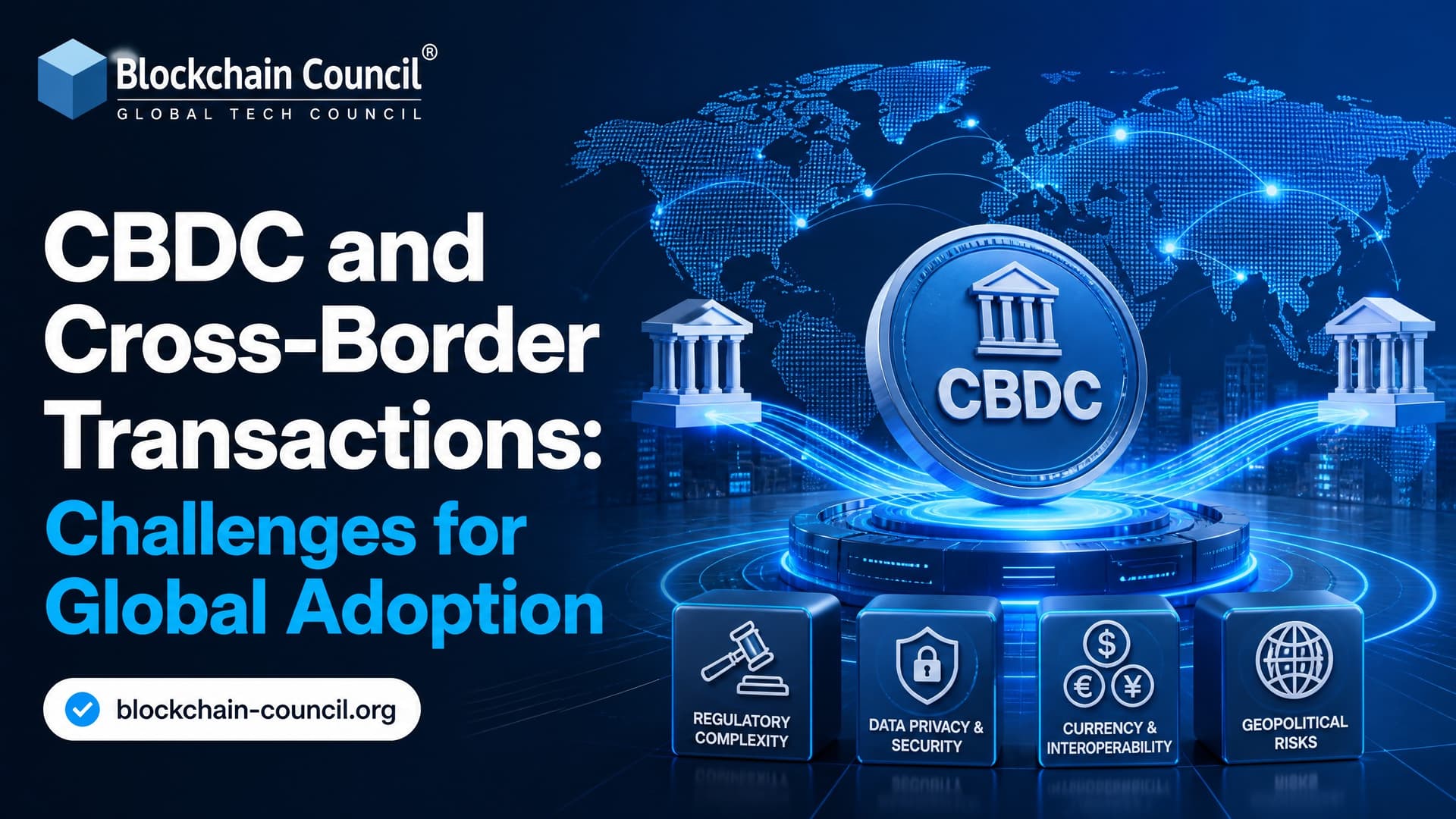
CBDC and cross-border transactions sit at the center of one of the hardest payment policy debates right now. The promise is clear: cheaper remittances, faster settlement, better tracking, and less dependence on long correspondent banking chains. The catch is just as clear. A cross-border CBDC is not only a payment rail. It is a legal arrangement, a monetary policy choice, a data governance system, and a cyber target.
That is why global adoption is moving slowly. The Atlantic Council reported that 134 countries or currency unions, representing about 98 percent of global GDP, were exploring CBDCs in 2025. Yet live retail CBDCs remain limited, and cross-border use is still mostly experimental. The IMF has warned that central banks should not assume a CBDC will scale simply because it launches. Users, merchants, banks, wallet providers, and regulators all need a reason to participate. Anyone trying to make sense of this landscape usually benefits from a structured Certified Central Bank Digital Currency (CBDC) Expert foundation before specializing in cross-border settlement design.

Why Cross-Border CBDC Matters
International payments still work poorly in many corridors. A domestic transfer may settle in seconds, while a cross-border payment can take days, with uncertain fees and limited tracking. This is not because banks are unaware of the problem. It is because the current system was built around correspondent banking relationships, local compliance checks, fragmented data standards, and prefunded accounts.
CBDCs could reduce some of those frictions if central banks coordinate well. Research from the BIS, IMF, and World Bank points to several possible gains:
Shorter settlement times, potentially near real time in some models
Lower funding costs by reducing reliance on prefunded correspondent accounts
Better payment transparency and end-to-end status tracking
Clearer foreign exchange pricing if FX providers and rates are disclosed upfront
Improved access in corridors where correspondent banking relationships have declined
Still, this is not a simple technology upgrade. If two countries disagree on sanctions screening, privacy rules, settlement finality, or capital controls, a shared ledger will not magically fix it. Because cross-border settlement so often touches tokenized assets and multi-currency platforms alongside CBDC rails, pairing that foundation with a Certified Digital Assets Expert background gives a fuller picture of the settlement stack involved.
The Baseline Problem: Current Cross-Border Payment Frictions
To judge CBDCs fairly, you need to understand what they are trying to replace or improve. Current international payments are often slowed by:
Long transaction chains: Multiple correspondent banks may sit between the sender and receiver.
Prefunding requirements: Banks often need trapped liquidity in nostro and vostro accounts.
Fragmented messaging: Data can be incomplete, truncated, or converted poorly between formats.
Compliance duplication: Different institutions repeat KYC, AML, sanctions, and fraud checks.
Time zone and operating hour gaps: A payment can wait because one market is closed.
Opaque FX spreads: Customers may not know the full cost until the payment is processed.
Here is a detail that rarely appears in policy summaries. Anyone who has mapped ISO 20022 pacs.008 customer credit transfer messages into older correspondent formats knows the ugly part. Fields that look optional in a domestic flow can become compliance blockers across a border. A missing purpose code or beneficiary address line may trigger manual repair, and manual repair is where speed dies.
Core Challenges for Global Cross-Border CBDC Adoption
Legal and Regulatory Fragmentation
Cross-border CBDC payments must satisfy multiple legal systems at once. That includes anti-money laundering rules, counter-terrorist financing controls, sanctions, consumer protection, data protection, and capital flow regulations.
The World Bank groups the major cross-border CBDC barriers into legal and regulatory divergence, technological incongruities, and monetary risks. Of those, legal divergence may be the hardest. Code can be rewritten. Laws need political agreement.
Key unresolved questions include:
Which jurisdiction's law governs settlement finality?
Who can reverse or freeze a cross-border CBDC payment?
Which institutions are allowed direct access to a foreign CBDC system?
How are sanctions lists and reporting duties reconciled when rules conflict?
Without answers, banks and payment firms will treat cross-border CBDC systems as high-risk infrastructure, not low-cost innovation.
Interoperability and Technical Standards
Most CBDCs are being designed first for domestic needs. That makes sense politically, but it creates a technical problem later. If each country builds a separate architecture, cross-border transactions depend on bridges, gateways, APIs, and shared standards.
Two models dominate current research:
Bridged ledgers: Each country keeps its own CBDC ledger, while gateways connect systems for international transfers.
Common platforms: Multiple central banks issue digital currencies on a shared multi-currency platform.
Neither model is perfect. Bridged ledgers preserve domestic control but can become complex as more countries join. Common platforms may improve settlement efficiency, but they require deeper governance agreement and shared operational responsibility.
Standards matter here. Messaging formats, identity models, wallet rules, API specifications, and transaction monitoring interfaces all need alignment. If not, CBDC systems could repeat the same fragmentation that makes today's cross-border payments expensive.
Compliance, Data Governance, and Privacy
CBDCs can improve traceability, but traceability cuts both ways. Regulators want better tools for AML and CFT checks and dispute resolution. Citizens and businesses want protection from excessive surveillance.
This tension is especially visible in democracies. Reuters has reported strong privacy and civil liberties concerns around CBDCs in the United States and other advanced economies. Those concerns are not fringe. Payment data can reveal religion, medical treatment, political donations, travel, and business strategy.
Cross-border systems make the issue harder. A single transfer may involve the sender's central bank, the receiver's central bank, wallet providers, FX providers, commercial banks, and compliance vendors. Each party may request data. Each country may impose different rules on retention, access, and disclosure.
A workable CBDC design needs clear answers to three questions:
What data is collected?
Who can see it?
How long is it stored?
If the answer is vague, adoption will suffer.
Monetary Policy and Financial Stability Risks
Foreign CBDC access can create monetary risks. If residents of a smaller economy can easily hold a major foreign CBDC, they may shift out of the domestic currency during stress. That could accelerate capital flight and weaken monetary sovereignty.
This is not theoretical. Many countries already worry about dollarization. A widely accessible foreign CBDC could make currency substitution faster and easier, particularly through mobile wallets.
Central banks may respond with holding limits, transaction caps, tiered fees, or restrictions on non-resident access. Those controls reduce risk, but they also reduce convenience. That is the trade-off. The more open the CBDC, the more useful it becomes for payments, but the more it may affect capital flows.
Governance, Access, and Participation
Cross-border CBDC systems need rules about who can participate. The IMF frames the problem around five elements: access, communication, currency conversion, compliance, and settlement. Each element involves governance choices.
Should a foreign bank be allowed to hold wholesale CBDC directly? Can tourists use a retail CBDC wallet? Can a foreign fintech onboard users? Who provides FX conversion, and who is responsible when the rate shown to the user differs from the final settlement amount?
These decisions affect incentives. One reason some CBDC launches have seen weak adoption is that intermediaries were not given a strong business model. If banks and payment firms carry compliance costs without revenue opportunities, they will not push adoption with much energy.
Operational, Cyber, and Resilience Risks
A cross-border CBDC platform is critical financial infrastructure. It must handle identity, messaging, settlement, liquidity, compliance, dispute handling, and cyber defense across jurisdictions.
Research from the University of Twente has argued that near real time peer-to-peer settlement could reduce interest rate, FX, counterparty, and settlement risk. Fair enough. But operational risk moves to the front. A gateway outage, key management failure, compromised identity provider, or denial-of-service attack could disrupt payments across countries.
Round-the-clock availability sounds attractive until you have to staff incident response across public holidays in three jurisdictions. That is where CBDC design becomes less glamorous and more like serious infrastructure engineering.
What Real-World Experiments Show
Production-scale global CBDC networks are not here yet, but pilots offer useful lessons. BIS-linked projects have tested multi-CBDC platforms, bridged arrangements, and cross-border retail concepts. Project Dunbar explored a shared platform for international settlements using multiple CBDCs. Project Icebreaker examined how retail CBDC systems could connect through a hub-and-spoke model with competitive FX providers.
Asia has been especially active in wholesale CBDC experimentation for interbank settlement. That path may mature before global retail CBDCs because wholesale systems have fewer participants, clearer compliance boundaries, and closer links to existing financial market infrastructure.
Some projections suggest well-designed cross-border CBDC systems could cut remittance costs sharply, with estimates as high as 75 percent in certain models. Treat that as a scenario, not a guarantee. The savings depend on broad participation, shared standards, viable FX markets, and legal coordination.
What Enterprises and Professionals Should Watch
If you work in banking, fintech, compliance, treasury, or digital assets, do not plan for one global CBDC standard arriving overnight. The near-term path will likely be corridor-based and regional.
Watch these areas:
ISO 20022 adoption: Better data quality is a foundation for both CBDCs and upgraded payment rails.
Wholesale CBDC pilots: These may shape institutional settlement before retail wallets go global.
Privacy frameworks: Adoption will depend heavily on trust and legal safeguards.
FX and liquidity design: Poor FX transparency can erase payment cost benefits.
Access rules: Non-resident access, wallet limits, and intermediary licensing will define real usability.
For structured learning, Blockchain Council's Certified Blockchain Expert™ can help you build the foundation for distributed ledger design and tokenized payment systems. If your role is closer to trading, custody, or digital asset operations, the Certified Cryptocurrency Expert™ is a relevant path. Developers working on payment prototypes should pair CBDC policy knowledge with smart contract and security training, not just wallet UX. Those coming from a general engineering background may also want to browse the wider Tech Certification catalog, since a good share of the gateway, messaging, and resilience work above is standard infrastructure engineering applied to a cross-border setting.
Future Outlook: Gradual, Not Instant
The most likely future is not a single global CBDC network. It is a patchwork of domestic systems, bilateral links, regional pilots, and wholesale settlement platforms. Some will use distributed ledger technology. Some may not. The winning design will be the one that satisfies regulators, works for intermediaries, protects users, and stays reliable under stress.
To be blunt, CBDCs are overhyped when presented as a cure for every cross-border payment problem. They are underappreciated when dismissed as just another digital wallet. The real value sits in coordinated settlement, better data, clearer FX, and reduced dependence on inefficient correspondent chains.
Your next step is practical. Track the CBDC pilots in the corridors that matter to your business, study ISO 20022 and AML/CFT data requirements, and build a working view of bridged ledger versus common platform models. If you need a formal foundation, start with Blockchain Council's Certified Blockchain Expert™, then add digital asset risk and compliance training before making CBDC strategy decisions. And if you will be the one presenting corridor strategy or CBDC readiness to leadership or partners, a Marketing Certification can help you turn that technical groundwork into a case that actually persuades a non-specialist audience.
FAQs
1. How can CBDCs improve cross-border transactions?
Central Bank Digital Currencies (CBDCs) could improve cross-border transactions by enabling faster settlement, reducing reliance on multiple intermediaries, lowering processing costs, and increasing payment transparency. Interoperable CBDC networks could allow financial institutions and users in different countries to transfer value more efficiently. However, achieving global adoption requires agreement on regulations, technical standards, identity systems, and data-sharing rules. Moving money digitally is easier than getting countries to agree on how that movement should be governed.
2. What are the biggest challenges for cross-border CBDC adoption?
Major challenges include regulatory differences, interoperability issues, cybersecurity risks, privacy concerns, foreign-exchange management, sanctions compliance, and varying levels of digital infrastructure. Countries also have different monetary policies, legal systems, and approaches to financial data. A successful cross-border CBDC ecosystem requires cooperation between central banks, governments, financial institutions, and technology providers.
3. Why is CBDC interoperability important for global payments?
Interoperability allows different CBDC systems to communicate and process transactions across borders. Without interoperability, each country may create an isolated digital currency system that cannot efficiently connect with others. Common technical standards, messaging protocols, identity frameworks, and settlement rules are necessary to make international CBDC payments practical. Creating many digital currencies without connection would simply recreate the fragmented payment landscape that CBDCs aim to improve.
4. How can CBDCs reduce the cost of international payments?
CBDCs could reduce international payment costs by shortening transaction chains, reducing manual processing, and improving settlement efficiency. Traditional cross-border payments often involve multiple banks, payment networks, compliance checks, and currency conversions. A well-designed CBDC system could simplify some of these processes. However, foreign exchange fees, regulatory requirements, infrastructure costs, and compliance obligations would still influence the final cost.
5. Can CBDCs make cross-border payments faster?
Potentially, yes. CBDCs could support faster settlement by allowing transactions to occur through digital infrastructure connected directly between participating institutions or countries. Multi-CBDC platforms could enable near-real-time settlement in some cases. However, speed depends on regulatory approvals, liquidity arrangements, identity verification, sanctions screening, and operational readiness. A payment system can technically move at light speed while waiting for legal approvals to move at the pace of paperwork.
6. What role do multi-CBDC platforms play in global transactions?
Multi-CBDC platforms allow different central banks and financial institutions to connect their digital currencies through shared infrastructure. These platforms can support direct settlement between currencies, reduce intermediaries, and improve transparency. Projects exploring multi-CBDC arrangements aim to address challenges in cross-border payments. Their success depends on governance models, technical compatibility, regulatory alignment, and participation from major financial markets.
7. How do regulatory differences affect cross-border CBDC adoption?
Countries have different rules for financial services, data privacy, anti-money laundering, sanctions, taxation, and capital controls. These differences can make cross-border CBDC transactions difficult to standardize. A payment that is acceptable in one country may require additional checks or restrictions in another. International cooperation and common regulatory frameworks will be essential for CBDCs to operate smoothly across borders.
8. How could CBDCs affect foreign exchange markets?
CBDCs could change foreign exchange markets by enabling faster currency conversion and settlement between countries. They may reduce some operational risks associated with traditional foreign exchange transactions. However, increased accessibility to foreign CBDCs could also influence currency demand, capital flows, and monetary stability. Smaller economies may face risks if residents prefer holding foreign digital currencies over domestic money.
9. Could foreign CBDCs threaten monetary sovereignty?
Yes, particularly in countries with weaker currencies or unstable financial systems. If residents gain easy access to foreign CBDCs, they may use them for savings and payments instead of domestic currency. This could weaken a country's ability to conduct monetary policy and manage exchange rates. Central banks may need access restrictions, holding limits, or international coordination to manage these risks.
10. How do CBDCs handle cross-border AML and compliance requirements?
Cross-border CBDCs must support anti-money laundering (AML), counter-terrorist financing (CFT), sanctions screening, and suspicious transaction monitoring. Different countries may have different compliance rules and reporting requirements. Systems need secure methods for sharing necessary information while protecting user privacy. The challenge is finding the balance between preventing financial crime and avoiding a global payment system that treats every transaction as a potential investigation file.
11. What privacy challenges exist for cross-border CBDC transactions?
International CBDC payments create questions about who can access transaction data, where information is stored, and which country's laws apply. Users may require privacy protections while regulators require sufficient visibility for compliance purposes. Privacy-enhancing technologies, data minimization, and controlled access models may help balance these competing goals. Cross-border privacy is difficult because data does not respect borders nearly as much as legal systems insist it should.
12. How can CBDCs improve international trade?
CBDCs could support international trade by enabling faster settlement between importers, exporters, banks, and financial institutions. Businesses may benefit from reduced payment delays, improved cash-flow management, and greater transaction visibility. Integration with digital trade platforms and tokenized assets could further automate trade processes. The benefits depend on widespread adoption and cooperation among trading partners.
13. How can CBDCs affect global remittances?
CBDCs could potentially reduce remittance costs and improve transfer speed for migrant workers sending money internationally. By reducing intermediaries and improving settlement efficiency, CBDCs may allow recipients to receive more of the transferred value. However, challenges remain around currency conversion, wallet access, regulations, and local cash-out infrastructure. A digital transfer is only useful if recipients can actually use the money where they live.
14. What cybersecurity risks affect cross-border CBDC systems?
Cross-border CBDC networks may face cyber threats including wallet attacks, infrastructure compromise, API vulnerabilities, ransomware, identity theft, and nation-state attacks. Because these systems could become globally important payment infrastructure, security requirements must be extremely high. Strong encryption, authentication, monitoring, incident response, and international cybersecurity cooperation will be essential.
15. How do CBDCs affect correspondent banking?
CBDCs could reduce reliance on traditional correspondent banking networks by enabling more direct settlement between participating institutions. This may lower costs and improve speed for some international payments. However, correspondent banks also provide valuable services such as compliance checks, liquidity management, and local market access. CBDCs are more likely to transform correspondent banking than completely eliminate it.
16. What technology challenges limit global CBDC adoption?
Technical challenges include different blockchain or ledger designs, scalability requirements, cybersecurity standards, identity systems, messaging protocols, and settlement mechanisms. Countries may develop CBDCs using different architectures, making interoperability more complex. Global adoption requires shared technical standards and reliable infrastructure. The digital currency world risks recreating the same fragmentation problem it is trying to solve if every country builds a separate technological island.
17. How could CBDCs affect developing economies in cross-border payments?
Developing economies could benefit from cheaper remittances, improved trade payments, and greater access to global financial networks. However, they may also face challenges involving infrastructure costs, cybersecurity capabilities, digital literacy, and currency competition. International support, technical assistance, and appropriate regulatory frameworks will be important to ensure CBDCs improve access rather than widen existing financial gaps.
18. What role will central banks play in global CBDC cooperation?
Central banks will need to coordinate on technical standards, regulatory approaches, settlement arrangements, and risk management. They may establish agreements for interoperability, information sharing, and cross-border payment rules. International organizations can also support cooperation by developing frameworks and best practices. Since money crossing borders involves national interests, diplomacy becomes almost as important as technology.
19. Will CBDCs replace traditional international payment systems?
CBDCs are unlikely to completely replace existing systems in the near term. Instead, they may coexist with banks, payment networks, correspondent banking arrangements, and other digital payment solutions. Adoption will depend on whether CBDCs provide clear advantages in speed, cost, reliability, and accessibility. Financial systems tend to accumulate new layers rather than politely removing old ones, because apparently complexity is a feature humans continue to request.
20. What is the future of CBDCs in global cross-border payments?
The future of cross-border CBDCs will depend on international cooperation, interoperability, privacy protection, cybersecurity, and regulatory alignment. If these challenges are addressed, CBDCs could make global payments faster, cheaper, and more transparent. If countries develop isolated systems without coordination, benefits may remain limited. The long-term success of CBDCs will depend less on the technology itself and more on whether nations can agree on the rules governing its use.
Related Articles
View All
Digital Assets
CBDC Use Cases for Cross-Border Trade: Reducing Friction in Global Commerce
Explore CBDC use cases for cross-border trade, including mBridge, wholesale CBDCs, PvP, DvP, compliance, and faster global settlement.

Digital Assets
CBDC for Remittances: How Digital Currency Could Lower Cross-Border Costs
CBDC for remittances could cut cross-border costs by reducing intermediaries, FX spreads, settlement delays, and cash handling, if systems interoperate.
Digital Assets
CBDC Implementation: Lessons From Global Experiments
CBDC implementation is advancing worldwide, but pilots show that adoption, privacy, regulation, and interoperability matter more than technology alone.
Trending Articles

Top 5 DeFi Platforms
Explore the leading decentralized finance platforms and what makes each one unique in the evolving DeFi landscape.

Can DeFi 2.0 Bridge the Gap Between Traditional and Decentralized Finance?
The next generation of DeFi protocols aims to connect traditional banking with decentralized finance ecosystems.
Claude AI Tools for Productivity
Discover Claude AI tools for productivity to streamline tasks, manage workflows, and improve efficiency.