

CBDC Adoption Challenges: Technology, Trust, Education, and Policy
 Suyash Raizada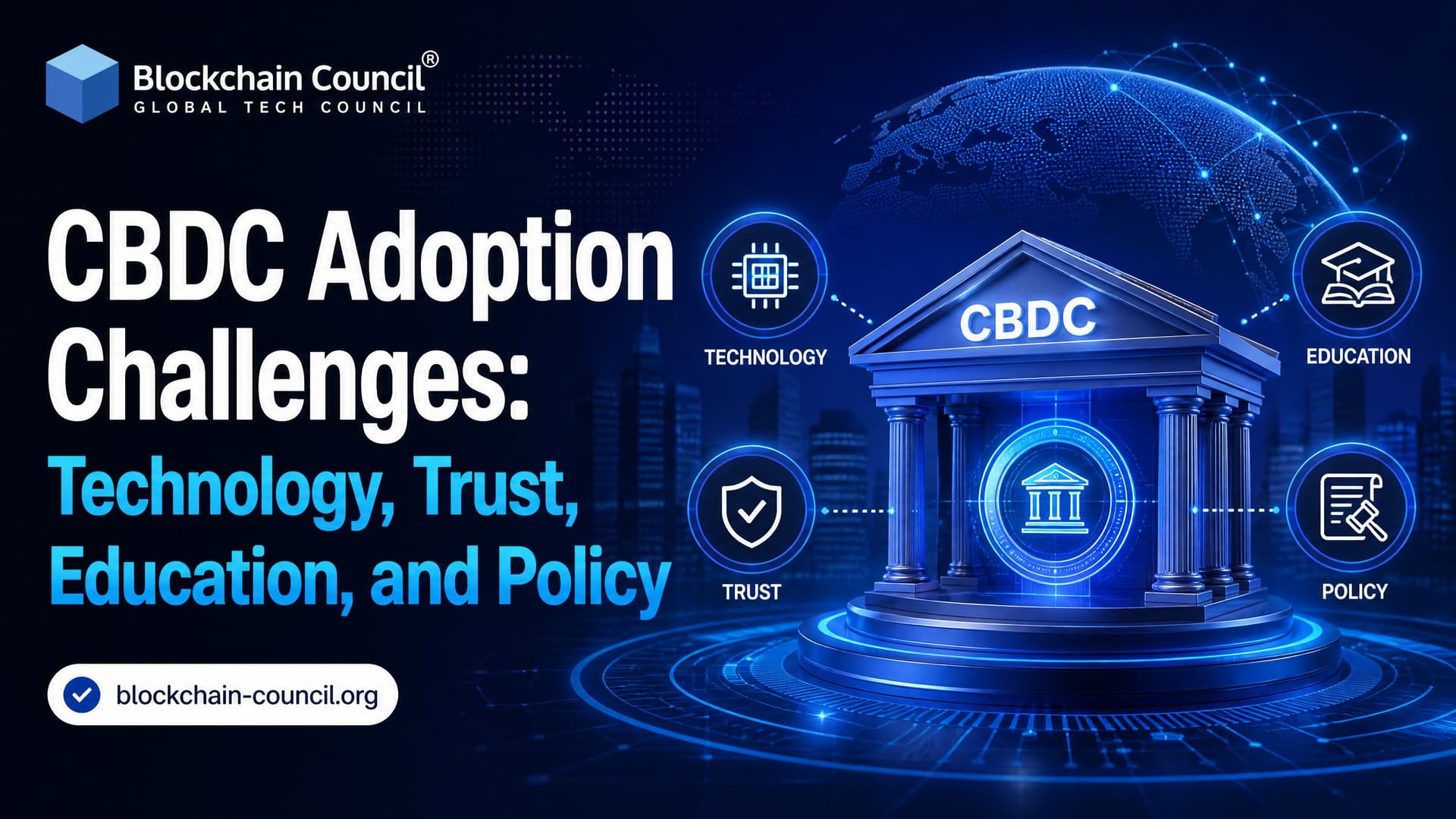
CBDC adoption challenges are no longer about whether a central bank can build a digital currency prototype. Most can. The harder question is whether people, banks, merchants, and regulators will trust it enough to use it at scale. That is where the real work begins. Professionals trying to make sense of that trust gap often start with a Certified Central Bank Digital Currency (CBDC) Expert credential, which frames the policy, design, and adoption issues covered here in a structured way.
Central bank digital currencies have moved into mainstream monetary policy debate. A Bank for International Settlements survey of 86 central banks found that most were exploring retail CBDCs, wholesale CBDCs, or both. The Atlantic Council tracker has reported CBDC activity across roughly 130 countries or currency unions, covering nearly all global GDP. Yet live retail CBDCs remain rare. The Bahamas Sand Dollar, Jamaica JAM-DEX, and Nigeria eNaira are the most cited launches, and adoption has been modest.

Where CBDC Development Stands Now
The CBDC map looks busy, but production use is still limited. Many projects sit in research, proof of concept, or pilot stages. China's e-CNY is the largest retail pilot, with hundreds of millions of individual wallets and cumulative transactions reported in the trillions of yuan. India has also scaled e-rupee pilots across retail and wholesale settings, with several million users and participation from major banks. Analysts comparing CBDCs against stablecoins, tokenized deposits, and other digital money formats often supplement this with a Certified Digital Assets Expert credential, since adoption decisions rarely happen in a vacuum where CBDCs are the only digital asset on the table.
That sounds large. It is, technically. But it does not prove everyday adoption. In early retail CBDC launches, CBDC balances have represented well under 1 percent of currency in circulation in their jurisdictions. The lesson is blunt: launch is not adoption.
For professionals studying digital assets, this distinction matters. A CBDC is not only a token, ledger, or wallet. It is a national payment system, a public policy instrument, a cybersecurity target, and a trust product all at once.
Technology Challenges: Scale, Offline Payments, and Integration
CBDC infrastructure has to meet a standard far higher than most blockchain pilots. If a DeFi testnet pauses, developers complain. If a national retail payment system fails on payday, the problem becomes political within minutes.
Scalability and performance
Retail CBDCs may need to process huge transaction volumes with low latency and high availability. A permissioned distributed ledger can help with auditability and controlled participation, but it is not a magic answer. Throughput numbers from a lab test often ignore wallet authentication, sanctions screening, fraud checks, HSM signing, reconciliation, and settlement reporting. Those layers add latency.
This is a common mistake in prototype design. A team benchmarks ledger writes and claims 20,000 transactions per second, then discovers the real bottleneck is the identity or compliance service sitting in front of the ledger. In CBDC systems, the boring middleware often decides whether the product works.
Offline functionality is hard
Offline CBDC payments are attractive for financial inclusion, disaster recovery, and rural access. They are also one of the hardest design problems. If two devices transact without contacting the central ledger, the system must prevent double spending, support limits, handle lost devices, and sync safely later.
Secure elements, tamper-resistant hardware, transaction caps, and delayed settlement rules can reduce risk. They do not remove it. Power cuts, weak mobile coverage, and damaged local infrastructure can still break the user experience. For countries targeting unbanked users, offline design is not an optional feature. It is central.
Interoperability with existing rails
A CBDC must connect to banks, payment service providers, merchant systems, card networks, and fast payment infrastructure. Cross border CBDCs add another layer: foreign exchange rules, settlement models, jurisdiction, sanctions compliance, and messaging standards such as ISO 20022.
This is why many central banks favor intermediated models. The central bank issues the digital money, while commercial banks or regulated payment firms manage wallets, onboarding, and customer support. It keeps the private sector in the payment chain and reduces the operational burden on the central bank.
Cybersecurity and Privacy Risks
Cybersecurity is one of the biggest CBDC adoption challenges because the stakes are national. A CBDC platform could concentrate sensitive payment data, identity data, and transaction history in one high-value environment. Attackers would notice.
Risk is not limited to the core ledger. The CBDC ecosystem includes mobile wallets, APIs, cloud services, telecom networks, merchant devices, identity providers, recovery systems, and insider access. A weak wallet recovery process can be just as damaging as a flaw in the ledger.
Core infrastructure attacks: compromise of issuance servers, settlement engines, or validation nodes.
Credential theft: stolen private keys, SIM swap attacks, phishing, and lost devices.
Data breaches: exposure of transaction patterns, merchant relationships, and personal financial behavior.
Operational disruption: outages caused by software bugs, cloud failures, power disruption, or denial-of-service attacks.
Future cryptographic risk: long-term concerns around quantum attacks on existing cryptographic schemes.
BIS Project Polaris has pushed central banks to think about security and resilience across the whole CBDC ecosystem, not only the central platform. That is the right approach. A retail CBDC with strong cryptography but poor user recovery will fail in practice.
Privacy versus AML compliance
Privacy is the trust issue that will not go away. Cash allows small transactions without routine tracking. A CBDC may not. Governments need anti-money laundering and counter-terrorist financing controls, but users fear surveillance and control over personal spending.
The workable middle ground is likely tiered privacy: low-value wallets with simplified checks and stronger privacy, higher-value accounts with full identity verification, monitoring, and reporting. This is not perfect. Still, it is more realistic than promising cash-like anonymity in a regulated digital system.
Trust and User Experience Decide Adoption
People will not use a CBDC just because it exists. They already have cash, cards, mobile wallets, instant payments, and bank apps. A CBDC must be cheaper, safer, more available, or more useful than the alternatives.
Survey data shows the trust gap clearly. A Federal Reserve Bank of Philadelphia study found that US consumers would need no fees, strong privacy, simple onboarding, broad merchant acceptance, and reliable security before adopting a CBDC. A Deutsche Bank consumer survey found a large share of respondents preferred cash or existing debit and credit cards over a CBDC. A Cato Institute survey in the United States found low active support and a large share of respondents with no opinion.
No opinion matters. It means many users have not formed a view because they do not understand the product. That creates space for education, but also for misinformation.
Education and Digital Literacy Are Not Side Tasks
CBDC education has to reach more than consumers. Merchants need to understand settlement, refunds, fees, device requirements, and accounting. Banks need to understand wallet architecture, liquidity impact, compliance obligations, and operational risk. Developers need to understand cryptographic key management, privacy design, API security, and payment finality.
The IMF has argued that CBDC adoption depends on four connected elements: regulation, education and communication, design, and incentives. That matches what early deployments show. Low awareness and limited merchant acceptance can slow adoption even when the technology works.
If you are building skills in this area, look beyond token mechanics. Study payment systems, digital identity, privacy engineering, and financial regulation. Blockchain Council's Certified CBDC Expert™ can be a useful learning path for policy and design concepts, while Certified Blockchain Expert™ and Certified Blockchain Developer™ are relevant for the underlying distributed ledger and smart contract foundations. Developers working on the broader systems around wallets, APIs, and identity layers often add a general Tech Certification to their toolkit, since CBDC infrastructure draws as much on conventional software and security skills as it does on blockchain-specific ones.
Policy and Legal Barriers
Policy design may be the hardest part of CBDC adoption. A retail CBDC touches monetary law, banking structure, privacy rights, insolvency rules, consumer protection, AML rules, and cross border regulation.
Legal tender and liability
A CBDC needs clear legal status. Is it legal tender? Is it a direct central bank liability? What happens if an intermediary fails? Who owns the wallet balance if a user dies or loses credentials? These questions must be answered in law, not buried in an app's terms of service.
Japan's policy work has highlighted exactly these issues: legal tender status, civil law treatment of a CBDC as an intangible asset, intermediary regulation, and personal data protection. Other jurisdictions face similar work before launch.
Bank disintermediation and financial stability
Retail CBDCs could affect bank funding. If households move deposits from commercial banks into risk-free central bank money, banks may lose a stable funding source. In a crisis, digital movement from bank deposits into a CBDC could make runs faster.
This is why many proposals include holding limits, tiered remuneration, or intermediated distribution. My view: unlimited retail CBDC balances are a bad design choice for most economies. They create financial stability risks without clear consumer benefit.
Programmability needs legal limits
Programmable money is often oversold. Automated tax collection, targeted subsidies, and conditional payments can be useful in narrow cases. Fine-grained control over how citizens spend money is another matter. CBDC programmability should be limited by statute, with public oversight and clear audit trails.
A good rule is simple: program the payment process, not the citizen. Smart payment logic for escrow, settlement, or subsidy eligibility may be acceptable. Open-ended state control over individual balances should not be.
Lessons from Early CBDC Launches and Pilots
The Bahamas, Jamaica, and Nigeria show that CBDCs can launch, but adoption needs merchant networks, public trust, incentives, and clear use cases. Financial inclusion is a valid goal, but users still ask practical questions: Can I pay my grocery shop? What happens if my phone is stolen? Are there fees? Can the government see every transaction?
China's e-CNY shows that large-scale pilots are technically possible. It also shows why global debate around surveillance, monetary sovereignty, and cross border influence will intensify. India, Brazil, the euro area, the United Kingdom, Japan, and Australia are taking more cautious paths, with many efforts focused on pilots, wholesale settlement, or research.
What Comes Next for CBDC Adoption?
Wholesale CBDCs may move faster than retail CBDCs. The business case is clearer: interbank settlement, tokenized securities, cross border payments, and liquidity management. Retail CBDCs face tougher adoption politics because they touch everyday money and personal privacy.
Expect selective retail launches in emerging markets where financial inclusion and payment modernization are urgent. Expect advanced economies to move slowly, especially where privacy, bank funding, and political legitimacy remain unsettled.
For professionals, the opportunity is multidisciplinary. You need payment architecture, cybersecurity, cryptography, compliance, data governance, and user research. Start by mapping one CBDC design from wallet onboarding to settlement and dispute recovery. Then compare it with an existing fast payment system. The gaps you find will teach you more than any white paper.
If your goal is to work on CBDC strategy or implementation, build a structured base through Certified CBDC Expert™, then add technical depth with Certified Blockchain Developer™ or cybersecurity training. CBDC adoption will not be won by prototypes alone. It will be won by systems that people can understand, trust, and use without friction. Since adoption ultimately depends on merchant buy-in, public communication, and user education as much as technology, teams working on rollout strategy often bring in a Marketing Certification to help translate the technical case for a CBDC into something the public will actually trust and use.
FAQs
1. What are the biggest challenges to CBDC adoption?
The biggest Central Bank Digital Currency (CBDC) adoption challenges include technology readiness, cybersecurity, privacy, public trust, financial literacy, merchant acceptance, regulatory uncertainty, and integration with existing banking systems. Central banks must also address financial stability, accessibility, and operational resilience. A technically functional CBDC does not automatically become a widely used currency. Consumers and businesses need compelling reasons to adopt it instead of payment methods they already understand and use every day.
2. Why is public trust important for CBDC adoption?
Public trust is critical because consumers need confidence that a CBDC is secure, reliable, private enough for everyday use, and supported by credible institutions. Concerns about government surveillance, cyberattacks, transaction monitoring, or loss of access to funds can discourage adoption. Central banks can strengthen trust through transparent policies, clear privacy protections, independent oversight, reliable technology, and effective communication. Trust cannot simply be added to the interface as another feature after launch, inconvenient though that may be.
3. What technology challenges affect CBDC adoption?
CBDC systems may need to process large transaction volumes while maintaining low latency, high availability, security, and accurate records. Technical challenges include scalability, wallet infrastructure, digital identity, interoperability, offline payments, system integration, disaster recovery, and cryptographic key management. Central banks must also decide whether to use centralized databases, distributed ledgers, or hybrid architectures. Technology choices should follow functional requirements rather than whichever architecture happens to be enjoying the most conference panels that year.
4. How does cybersecurity affect CBDC adoption?
Cybersecurity directly affects whether people and institutions are willing to trust CBDCs. Potential threats include wallet theft, phishing, malware, account takeover, credential compromise, API attacks, insider threats, and denial-of-service attacks. A CBDC could become critical national financial infrastructure, making resilience especially important. Security therefore needs to extend across central-bank systems, financial intermediaries, identity services, wallets, networks, and user devices rather than focusing exclusively on the underlying ledger.
5. Why are privacy concerns a barrier to CBDC adoption?
Consumers may hesitate to use CBDCs if they believe governments or intermediaries could monitor every transaction. Detailed payment information can reveal sensitive information about people's habits, relationships, health, beliefs, and financial circumstances. CBDC systems can address these concerns through data minimization, access controls, privacy-enhancing technologies, and clear legal restrictions on data use. Policymakers must balance legitimate privacy expectations with AML, fraud-prevention, and other regulatory requirements.
6. How can central banks build consumer confidence in CBDCs?
Central banks can build confidence by explaining how CBDCs work, what data is collected, who can access it, and what protections exist if something goes wrong. Clear rules for wallet recovery, fraud liability, complaints, refunds, and cybersecurity incidents are particularly important. Pilots can also demonstrate reliability before large-scale deployment. Communication should focus on practical benefits and limitations rather than drowning citizens in technical vocabulary and then acting surprised when nobody develops an emotional attachment to the payment architecture.
7. Why is consumer education important for CBDC adoption?
Consumers need to understand how to obtain, store, transfer, and safely use CBDCs. Education should cover wallet security, authentication, scams, privacy, transaction limits, offline functionality, and recovery procedures. Programs may need to target different levels of financial and digital literacy. Without adequate education, users may avoid CBDCs or become vulnerable to fraud. Central banks, financial institutions, governments, and consumer organizations can all play roles in providing clear and accessible information.
8. How does digital literacy affect CBDC adoption?
People with limited experience using smartphones, digital wallets, online banking, or authentication tools may find CBDCs difficult to adopt. Older adults and communities with limited digital access may face particular barriers. Simple interfaces, accessible design, multilingual support, assisted onboarding, and consumer education can help. CBDC adoption strategies should also preserve alternatives for people unable to use digital channels. Making money more technologically advanced should not require every citizen to become an unpaid IT support technician.
9. How can CBDCs overcome the digital divide?
CBDC systems can address the digital divide by supporting inexpensive devices, simple interfaces, offline payments, accessible onboarding, and alternative access methods. Governments may also need broader investments in connectivity, digital identity, and financial education. Accessibility features should support people with disabilities and users with limited technological experience. If CBDCs depend exclusively on modern smartphones and continuous high-speed internet, they could deepen rather than reduce financial exclusion.
10. Why is merchant acceptance a challenge for CBDCs?
Consumers have limited incentive to adopt a CBDC if few businesses accept it, while merchants have limited incentive to invest in CBDC acceptance if few customers use it. This familiar network-effect problem can slow adoption. Merchants may also face integration, hardware, training, accounting, and compliance costs. CBDCs need convenient acceptance methods and a clear business proposition, potentially involving faster settlement, lower fees, or simpler reconciliation compared with existing payment options.
11. How can CBDCs compete with existing digital payment systems?
CBDCs may struggle in countries where consumers already have fast, inexpensive, and convenient bank transfers, cards, mobile wallets, or instant-payment systems. To gain adoption, a CBDC may need distinctive benefits such as public-money access, offline functionality, greater resilience, lower costs, improved cross-border payments, or stronger interoperability. Central banks should identify specific market gaps before implementation. “It is digital” is not a particularly compelling competitive advantage in an economy where nearly everything involving money is already digital.
12. What policy challenges can slow CBDC adoption?
Policy challenges include determining the CBDC's legal status, privacy protections, holding limits, access rules, intermediary responsibilities, and relationship with commercial bank deposits. Governments must also establish frameworks for AML, consumer protection, data governance, taxation, and cross-border transactions. Policy uncertainty can delay investment by banks and businesses. Clear legislation and regulatory guidance are therefore important before a CBDC moves from controlled experimentation to widespread public or institutional use.
13. How could CBDCs affect commercial banks?
If consumers move large amounts of deposits from commercial banks into CBDCs, banks could lose a source of relatively stable funding. This may influence lending, funding costs, and financial intermediation. The risk could become more significant during financial stress if people rapidly shift funds toward central bank money. Potential safeguards include holding limits, tiered remuneration, or intermediary-based CBDC models. Policymakers therefore need to improve digital payments without accidentally making bank runs significantly more convenient.
14. What regulatory challenges affect CBDC adoption?
Regulatory challenges include AML and KYC requirements, data protection, consumer rights, cybersecurity standards, operational resilience, payment regulation, and settlement finality. Cross-border CBDCs add questions involving foreign-exchange controls, sanctions, jurisdiction, and international data sharing. Regulations must provide sufficient certainty for financial institutions and businesses to invest in CBDC infrastructure. At the same time, overly burdensome requirements can reduce accessibility and undermine some of the efficiency or inclusion benefits CBDCs are intended to provide.
15. Why is interoperability important for CBDC adoption?
CBDCs need to interact effectively with bank accounts, payment networks, merchant systems, digital wallets, government platforms, and potentially foreign currencies. Poor interoperability can create isolated payment ecosystems and force users to move money manually between systems. Common standards, APIs, messaging protocols, and compatible identity frameworks can improve integration. Interoperability is particularly important for cross-border payments and tokenized markets, where multiple platforms and institutions must coordinate settlement.
16. Why are offline payments difficult for CBDCs?
Offline CBDCs need to support transactions without continuous access to central infrastructure while still preventing fraud and double spending. Systems may rely on secure hardware, cryptographic controls, transaction limits, and later synchronization. Lost or compromised devices create additional risks. Central banks must balance security, privacy, accessibility, and convenience. Offline functionality is technically demanding but potentially important for rural areas, network outages, emergencies, and providing some of the resilience traditionally associated with physical cash.
17. How can governments address misinformation about CBDCs?
Governments and central banks can address misinformation through transparent documentation, public consultations, accessible educational materials, independent research, and clear explanations of CBDC capabilities and limitations. Communication should distinguish confirmed design decisions from possibilities being explored in pilots. Authorities should also explain privacy, programmability, data access, and the continued role of cash accurately. Vague communication creates an information vacuum, and the internet has demonstrated considerable enthusiasm for filling those with increasingly imaginative material.
18. What can CBDC pilots teach central banks about adoption?
Pilots can reveal how consumers and businesses actually behave rather than how designers expect them to behave. Central banks can measure wallet activation, transaction frequency, merchant acceptance, user satisfaction, technical performance, fraud, and support requests. Pilots can also identify usability, privacy, identity, and infrastructure problems before wider deployment. A technically successful pilot with little sustained usage may indicate that the CBDC's value proposition needs improvement rather than simply requiring a larger marketing campaign.
19. How can countries increase CBDC adoption?
Countries can improve adoption by solving clearly identified payment problems, providing intuitive wallets, protecting privacy, maintaining strong cybersecurity, educating users, and building broad merchant acceptance. Integration with existing financial services can reduce switching friction. Governments may also use CBDCs for selected public payments where appropriate, while avoiding coercive adoption strategies. Long-term usage is more likely when consumers and businesses voluntarily find CBDCs convenient and valuable rather than feeling they have been assigned another mandatory digital platform.
20. What will determine the long-term success of CBDC adoption?
Long-term CBDC success will depend on trust, security, privacy, usability, accessibility, interoperability, regulatory clarity, and measurable economic value. Retail CBDCs must solve genuine consumer or payment problems, while wholesale CBDCs need to improve settlement, liquidity, or financial-market infrastructure. Education and transparent governance will be as important as technology. Ultimately, adoption will not be determined by how sophisticated a CBDC sounds, but by the rather less glamorous question users ask of every payment method: does it work better for me?
Related Articles
View All
Digital Assets
CBDC Career Opportunities: Jobs in Banking, Fintech, and Policy
Explore CBDC career opportunities in banking, fintech, and policy, including key roles, salaries, skills, and practical paths into this niche market.

Digital Assets
CBDC and Artificial Intelligence: Smarter Fraud Detection and Policy Analytics
CBDC and Artificial Intelligence can improve fraud detection, AML monitoring, and policy analytics, but only with strong privacy, governance, and model controls.

Digital Assets
RWA Tokenization Trends in 2026: Regulation, DeFi, AI and Institutional Adoption
RWA tokenization trends in 2026 show rapid institutional growth, clearer regulation, deeper DeFi use, AI-driven operations, and real liquidity risks.
Trending Articles
AWS Career Roadmap
A step-by-step guide to building a successful career in Amazon Web Services cloud computing.
How Blockchain Secures AI Data
Understand how blockchain technology is being applied to protect the integrity and security of AI training data.
What is AWS? A Beginner's Guide to Cloud Computing
Everything you need to know about Amazon Web Services, cloud computing fundamentals, and career opportunities.