

Account-Based vs Token-Based CBDCs: Identity, Ownership, and Verification
 Suyash Raizada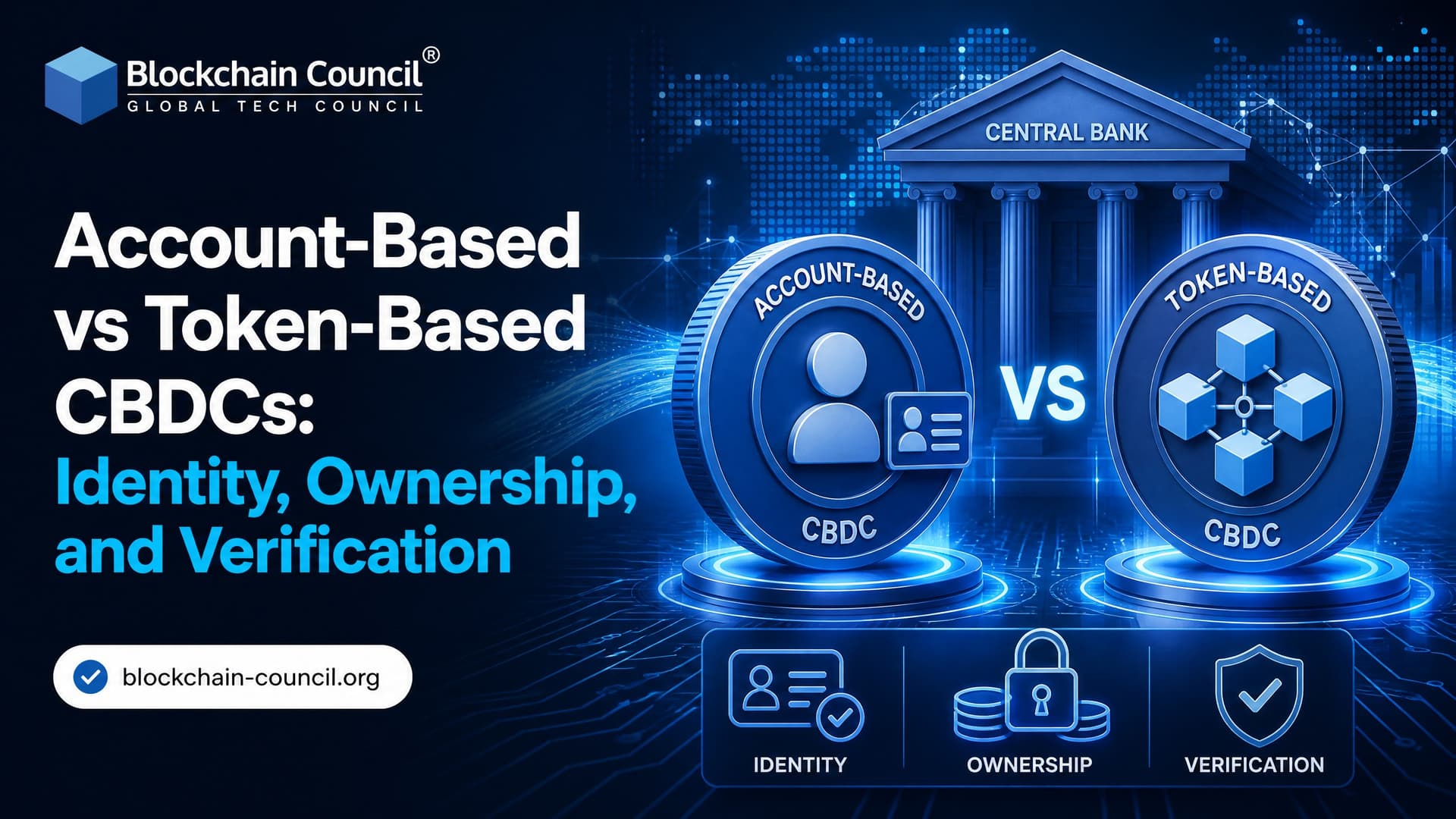
Account-based vs token-based CBDCs is not a naming debate. It decides what a payment system checks before money moves: your identity, your authority over an account, or your control of a valid digital token. That single design choice affects privacy, compliance, recovery, offline payments, and even the legal meaning of ownership.
Central banks rarely pick one model in its pure form. The direction is clearer now. Most retail CBDC work favors account-like or registered wallet systems for mainstream use, while token-like features are being tested for cash-style privacy, offline payments, and lower-value transfers. The Bank for International Settlements, the IMF, the World Bank, and the European Data Protection Supervisor have all framed this as a trade-off between identity, bearer control, and public-policy safeguards. Anyone trying to reason through that trade-off systematically usually benefits from a structured Certified Central Bank Digital Currency (CBDC) Expert foundation before going deeper into account versus token design choices.

What Account-Based vs Token-Based CBDCs Really Means
The cleanest distinction is about verification.
In an account-based CBDC, the system verifies who you are and whether you are allowed to move funds from a specific account or wallet. The ledger records balances against an identifier, usually managed by a central bank, a payment service provider, or both.
In a token-based CBDC, the system verifies whether the digital object is genuine and whether you can prove control over it. That proof may come from a private key, a secure device, or another cryptographic mechanism. The value sits closer to digital cash than to a bank account. Because token-based design borrows so heavily from the wider digital asset world, many professionals pair this study with a Certified Digital Assets Expert background to understand where CBDC tokens diverge from typical crypto assets.
The IMF has summarized the split neatly: account-based systems follow the logic of I am therefore I own, while token-based systems follow I know therefore I own. The first rests on identity. The second rests on knowledge of a secret, such as a private key.
Identity: Who Must Be Known?
Account-based CBDCs need identity infrastructure
Account-based CBDCs usually require identity checks at onboarding. That means know your customer checks, anti money laundering screening, and counter terrorist financing controls. The World Bank has noted that account holders in these models would normally be identified before an account opens.
This is familiar territory for banks and regulated payment firms. A user signs up, proves identity, receives account access, and transactions are recorded against that account. If credentials are lost, access can often be restored through identity verification.
That convenience has a cost. If every payment links to a verified user identifier, the system can build a rich behavioral record. The European Data Protection Supervisor has warned that a digital euro design using unified identifiers across the payment system could create serious privacy and data-protection risks if governance is weak.
To be blunt, account-based CBDCs are easier to supervise, but they are also easier to over-monitor.
Token-based CBDCs can reduce identity at transaction time
Token-based CBDCs can work differently. The protocol may not need your real-world name when you pay. It needs proof that the token is valid and that you control it. The Asian Development Bank describes this in terms familiar to anyone who has used public and private key cryptography. A public key or address identifies where value can be sent, and the private key proves spending authority.
This does not guarantee full anonymity. A jurisdiction can still require KYC when users obtain, load, redeem, or exchange CBDC tokens. In practice, central banks are unlikely to issue unlimited anonymous bearer money at scale. The more realistic design is tiered: lighter identity checks for small-value uses, stronger checks for higher-risk activity.
Ownership: Is It Yours Because of Identity or Possession?
Account-based ownership looks like book money
In an account-based CBDC, ownership is anchored in a legal relationship. Your balance sits in a ledger tied to your identity or account credentials. If something goes wrong, the operator can consult records, apply rules, and potentially reverse errors or restore access.
This is why account-based CBDCs fit better with consumer protection. Lost phone? Forgotten password? Compromised login? There is at least a process. It may be slow, but it exists.
For enterprises, this matters. Treasury teams want audit trails, role-based approvals, limits, reconciliation, and recovery. A pure bearer instrument is usually the wrong fit for large corporate payments unless controls are wrapped around it.
Token-based ownership behaves more like cash
Token-based CBDCs are often described as digital banknotes. The Reserve Bank of Australia has used that framing: whoever holds the token is presumed to control the value, much like the person holding a physical note.
That creates a hard trade-off. Cash-like usability is useful, especially for offline payments or people with limited formal identification. But if the private key or secure device is lost, recovery becomes difficult. Anyone who has supported crypto wallets knows the real support ticket. The user did not lose money because the chain failed. They lost it because they misplaced the seed phrase, reset the phone, or stored the recovery words in a screenshot that was later compromised.
CBDC designers cannot ignore that. A national payment instrument needs stronger consumer safeguards than a self-custody crypto wallet. This is why many token-based proposals include managed wallets, spending caps, recovery mechanisms, or secure hardware.
Verification: What Does the System Check?
Account-based verification checks authority over an account
Account-based CBDC payments follow a familiar sequence:
The payer authenticates with a wallet, bank, or payment service provider.
The system checks that the payer is authorized to use the account.
It confirms that sufficient funds are available.
The ledger debits the payer and credits the recipient.
Records are stored for settlement, compliance, and dispute handling.
Many proposals use a two-tier architecture. The central bank maintains the core settlement infrastructure, while commercial banks or licensed payment firms manage user-facing wallets. This model fits existing compliance workflows and reduces the need for the central bank to handle every retail customer relationship directly.
Token-based verification checks authenticity and control
Token-based CBDC payments focus on different questions:
Is the token genuine?
Has it already been spent?
Can the sender prove control?
Does the transaction meet policy limits?
The hard engineering problem is double-spending, especially offline. In a lab, signing a token transfer is easy. The awkward case is when two devices try to spend the same value while disconnected, then reconnect later. If you have built payment prototypes, you know the real test is not the happy-path signature. It is the replay, rollback, and reconnect scenario.
Designers can reduce this risk with secure elements, transaction counters, online validation, spending limits, and post-sync risk rules. Each choice changes usability. A fully offline token may feel like cash, but it needs strict caps if the issuer wants to control fraud exposure. Engineers working through this kind of offline-sync and secure-element problem often round out their skills with a broader Tech Certification, since double-spend prevention and secure hardware design draw heavily on general embedded and systems engineering rather than blockchain-specific tooling alone.
Privacy and Compliance: The Central Trade-Off
Account-based systems make AML, sanctions screening, tax reporting, and fraud investigations easier. They also concentrate sensitive data. Token-based systems can support privacy and inclusion, but they make policy enforcement harder unless controls are added elsewhere.
This is why hybrid CBDCs are gaining attention. A practical design may include:
Identified accounts for salaries, merchant payments, government transfers, and larger transactions.
Token-like offline wallets for small retail payments, transport, or emergency use during connectivity outages.
Tiered limits where low-value payments collect less data and high-value payments require stronger identity checks.
Selective disclosure so only necessary information is shared with intermediaries or authorities.
The digital euro debate is a good example. European authorities have discussed account-based access for online use and more privacy-preserving bearer-style modes for offline payments, with limits. That is not an accident. It reflects a policy judgment: citizens should not have every small cash-like payment exposed, but regulators still need tools for serious crime and systemic risk.
Which Model Fits Which Use Case?
Use an account-based CBDC when the priority is compliance, recovery, auditability, and integration with banks or payment providers. It is the better fit for government disbursements, payroll, merchant settlement, wholesale CBDC arrangements, and enterprise treasury workflows.
Use a token-based CBDC feature when the priority is cash-like transfer, offline resilience, or privacy for small payments. It fits low-value retail payments, device-to-device transactions, disaster scenarios, and inclusion-focused pilots. It is not the best default for high-value enterprise payments unless strong custody and governance controls exist.
For developers, the mental model is similar to the difference between an account ledger and a bearer asset system. If you have worked with ERC-20 balances, you already know that most token systems still depend on ledger state. CBDC token models may go further by designing bearer-like instruments, offline transfer rules, and issuer-controlled redemption policies. Do not assume a CBDC token will behave like a public blockchain token.
What Professionals Should Learn Next
If you work in payments, banking, compliance, or digital assets, account-based vs token-based CBDCs should be part of your core vocabulary. Architecture choices will shape identity flows, wallet design, privacy controls, cybersecurity requirements, and legal liability.
For a structured learning path, connect this topic with Blockchain Council programs such as the Certified Blockchain Expert, Certified Blockchain Developer, and Certified Cryptocurrency Expert. Developers should also study cryptographic key management, secure wallet architecture, and payment settlement models. Compliance teams should focus on KYC, AML, privacy-by-design, and tiered identity frameworks.
The best next step is practical: map a CBDC payment flow on paper twice. First as an account debit and credit. Then as a token transfer with key-based control and double-spend checks. The differences will show you exactly where identity, ownership, and verification move in the system. And if your role involves explaining that trade-off to policymakers, executives, or the public, a Marketing Certification can help you turn a genuinely technical distinction into a case that lands with a non-specialist audience.
FAQs
1. What is the difference between account-based and token-based CBDCs?
The traditional distinction concerns what must be verified when someone spends central bank digital currency (CBDC).
With an account-based CBDC, the system primarily verifies that the person or entity initiating a payment is authorized to use an account.
With a token-based CBDC, the system primarily verifies the validity and ownership or control of the digital monetary object being transferred.
A useful shorthand is:
Account-based → “Are you authorized to use this account?”
Token-based → “Is this digital value valid, and are you entitled to spend it?”
Real CBDC designs can blur this distinction considerably.
2. How does an account-based CBDC work?
An account-based CBDC records balances against identifiable accounts or account-like records.
A simplified ledger might show:
Alice: 1,000 CBDC
Bob: 600 CBDC
If Alice pays Bob 100:
Alice: 900 CBDC
Bob: 700 CBDC
The system authenticates Alice's authority to initiate the transaction and updates the relevant records.
3. How does a token-based CBDC work?
A token-based CBDC represents value through identifiable digital objects, credentials, or token-like units whose validity and transfer authority can be verified.
Instead of merely asking whether an account balance is sufficient, the system must establish that the digital value being presented is legitimate and can validly be transferred.
This is conceptually closer to transferring an instrument than updating two account balances.
4. Is token-based CBDC the same as physical cash?
Not exactly.
Physical cash is a bearer instrument: possession of a legitimate banknote generally enables spending without consulting a central ledger.
A digital token must solve additional problems, particularly:
Counterfeiting
Duplication
Double spending
Device compromise
Digital ownership or control
Transaction finality
Digital objects, unlike banknotes, can be copied perfectly. Computers are annoyingly talented that way.
5. Does token-based mean anonymous?
No.
Token-based does not automatically mean anonymous.
A token system can still require:
Identity verification
Registered wallets
Transaction monitoring
AML/CFT controls
Spending limits
Audit records
Likewise, an account-based system can potentially incorporate privacy-enhancing technologies and data-minimization rules.
Privacy is a separate design dimension.
6. Does account-based mean the central bank knows everyone's identity?
Not necessarily.
An account-based CBDC could use a two-tier architecture in which banks or payment service providers maintain customer identities while the central bank processes only the information required for monetary and settlement functions.
For example:
User identity → Bank/PSP
CBDC settlement records → Core infrastructure
The actual information visible to each participant depends on system architecture and law.
7. What does identity verification look like in an account-based CBDC?
Users might establish accounts or wallets through regulated providers using:
Government identification
Bank identity records
Digital identity systems
Biometrics
Authentication credentials
Multi-factor authentication
Once enrolled, users authenticate themselves or their authority when initiating transactions.
8. What does ownership verification mean for token-based CBDC?
The system needs a reliable way to determine whether the spender has legitimate authority over the token or value.
This could involve:
Cryptographic keys
Secure hardware
Digital signatures
Wallet credentials
Central validation
Other cryptographic proofs
The precise mechanism depends on the CBDC design. A “token” does not inherently require blockchain.
9. Do token-based CBDCs require private keys?
Not necessarily.
Some token architectures could use public-key cryptography and private keys, but others might use secure hardware, credentials, centralized validation, or different cryptographic mechanisms.
Designers may deliberately hide key management from ordinary users because asking millions of citizens to protect irreversible cryptographic secrets has, historically, produced mixed results.
10. What happens if someone loses access to an account-based CBDC?
Account-based systems can potentially provide familiar recovery mechanisms.
A user might:
Verify identity → reset credentials → regain account access
This can make recovery from lost phones, forgotten passwords, or compromised credentials relatively manageable.
The exact procedure would depend on the CBDC provider and architecture.
11. What happens if someone loses a token-based CBDC wallet?
Recovery can be more complicated if control of value depends directly on cryptographic credentials or secure hardware.
Possible designs could include:
Provider-assisted recovery
Backup credentials
Social or institutional recovery
Reissuance after verification
Central recovery records
Hardware-based restoration
A strictly bearer-like design could make lost credentials equivalent to lost cash, although CBDC designers need not choose that approach.
12. How is double spending prevented?
Account-based systems can prevent double spending by checking and updating authoritative account balances.
Token-based systems must ensure that the same digital value cannot validly be transferred more than once.
Possible mechanisms include:
Centralized validation
Unique token identifiers
Cryptographic protocols
Secure hardware
Online authorization
Offline spending limits and synchronization
Preventing double spending is one of the central technical challenges of digital bearer-like money.
13. Which model works better for offline CBDC payments?
Token-like architectures can be attractive for offline payments because value or spending authorization may be stored locally on devices.
A simplified offline payment could be:
Payer device → local verification → recipient device → later synchronization
However, account-based systems can also support forms of offline payment.
The challenge is limiting fraud and double spending while devices cannot contact the authoritative infrastructure.
14. Which model provides better privacy?
Neither model inherently wins.
An account-based CBDC could offer substantial privacy if intermediaries retain identity information and transaction data are minimized.
A token-based CBDC could provide cash-like privacy for certain transactions, but it could also be designed to produce detailed traceable records.
Important variables include:
Identity requirements + transaction visibility + data retention + legal access + cryptographic design
The account-versus-token label alone tells surprisingly little about actual privacy.
15. Which model is better for AML and compliance?
Account-based architectures can make conventional KYC and transaction monitoring relatively straightforward because users have established relationships with regulated providers.
Token-based systems can also implement compliance controls through registered wallets, transaction limits, programmable restrictions, or intermediary verification.
The challenge is balancing financial-integrity requirements with legitimate expectations of payment privacy.
16. Can account-based and token-based CBDCs coexist?
Yes.
A CBDC system could combine characteristics of both.
For example:
Online payments → account-oriented processing
Offline small-value payments → token-like stored value
A system might also use identity-linked wallets while representing transferable value through cryptographic instruments internally.
Hybrid designs allow architects to select different mechanisms for different use cases.
17. Are token-based CBDCs built on blockchain?
Not necessarily.
Token-based CBDCs could use:
Centralized databases
Distributed ledgers
Secure hardware
Cryptographic token systems
Hybrid infrastructures
Similarly, an account-based CBDC could theoretically use distributed ledger technology.
Token-based versus account-based and centralized database versus blockchain are separate architectural questions.
18. How do the two models compare on cybersecurity?
Account-based systems face risks such as:
Account takeover
Credential theft
Identity fraud
Database compromise
Insider attacks
Service disruption
Token-based systems may face risks such as:
Key theft
Token duplication attempts
Wallet compromise
Double spending
Counterfeit-token attacks
Secure-device exploitation
Neither architecture eliminates cybersecurity risk. It mostly rearranges where engineers get to lose sleep.
19. What are the main differences?
Feature | Account-Based CBDC | Token-Based CBDC |
|---|---|---|
Primary concept | Account/balance | Digital monetary object or value |
Core verification | User/account authority | Validity and spending authority |
Identity linkage | Often stronger operational role | Can vary substantially |
Recovery | Potentially easier | Depends heavily on token design |
Double-spend control | Ledger/balance validation | Token/protocol validation |
Offline potential | Possible | Potentially well suited |
Cash-like characteristics | Generally lower | Potentially higher |
Blockchain required | No | No |
Anonymous by definition | No | No |
These are conceptual differences rather than rigid implementation rules.
20. What is the easiest way to understand account-based versus token-based CBDCs?
Think about what the payment system needs to trust.
For an account-based CBDC:
Identify or authenticate the authorized user → verify balance → authorize transaction → update accounts
For a token-based CBDC:
Validate digital value → verify spending authority → prevent double spending → transfer value
But modern CBDC designs increasingly make this distinction less binary. A system can combine account-like identity controls, token-like offline value, intermediated wallets, and privacy-enhancing cryptography.
The more useful questions are therefore not merely “account or token?” but:
Who verifies the user? Who proves spending authority? Where is value recorded? Who can see transaction data? How is lost access recovered? How is double spending prevented? Can payments work offline?
Those questions reveal far more about how a CBDC would actually behave than whichever tidy architectural label gets attached to the diagram.
Related Articles
View All
Digital Assets
Token-Based CBDC vs Account-Based CBDC: Which Design Protects Privacy Better?
Token-based CBDC usually protects privacy better than account-based CBDC, but real protection depends on identity linkage, data rules, and governance.

Digital Assets
RWA Tokenization and KYC/AML: Identity, Compliance, and Investor Protection
RWA tokenization is moving into regulated markets. Learn how KYC/AML, wallet whitelists, travel rule workflows, and disclosures protect investors.

Digital Assets
RWA Tokenization and CBDCs: What to Expect Next
RWA tokenization and CBDCs are converging around settlement, with tokenized fixed income growing fast and wholesale CBDCs likely to support institutional markets.
Trending Articles
How Blockchain Secures AI Data
Understand how blockchain technology is being applied to protect the integrity and security of AI training data.
What is AWS? A Beginner's Guide to Cloud Computing
Everything you need to know about Amazon Web Services, cloud computing fundamentals, and career opportunities.
How to Install Claude Code
Learn how to install Claude Code on macOS, Linux, and Windows using the native installer, plus verification, authentication, and troubleshooting tips.