

Adversarial AI in Cybersecurity: Poisoning, Evasion, and Prompt-Injection Threats (and How to Mitigate Them)
 Suyash Raizada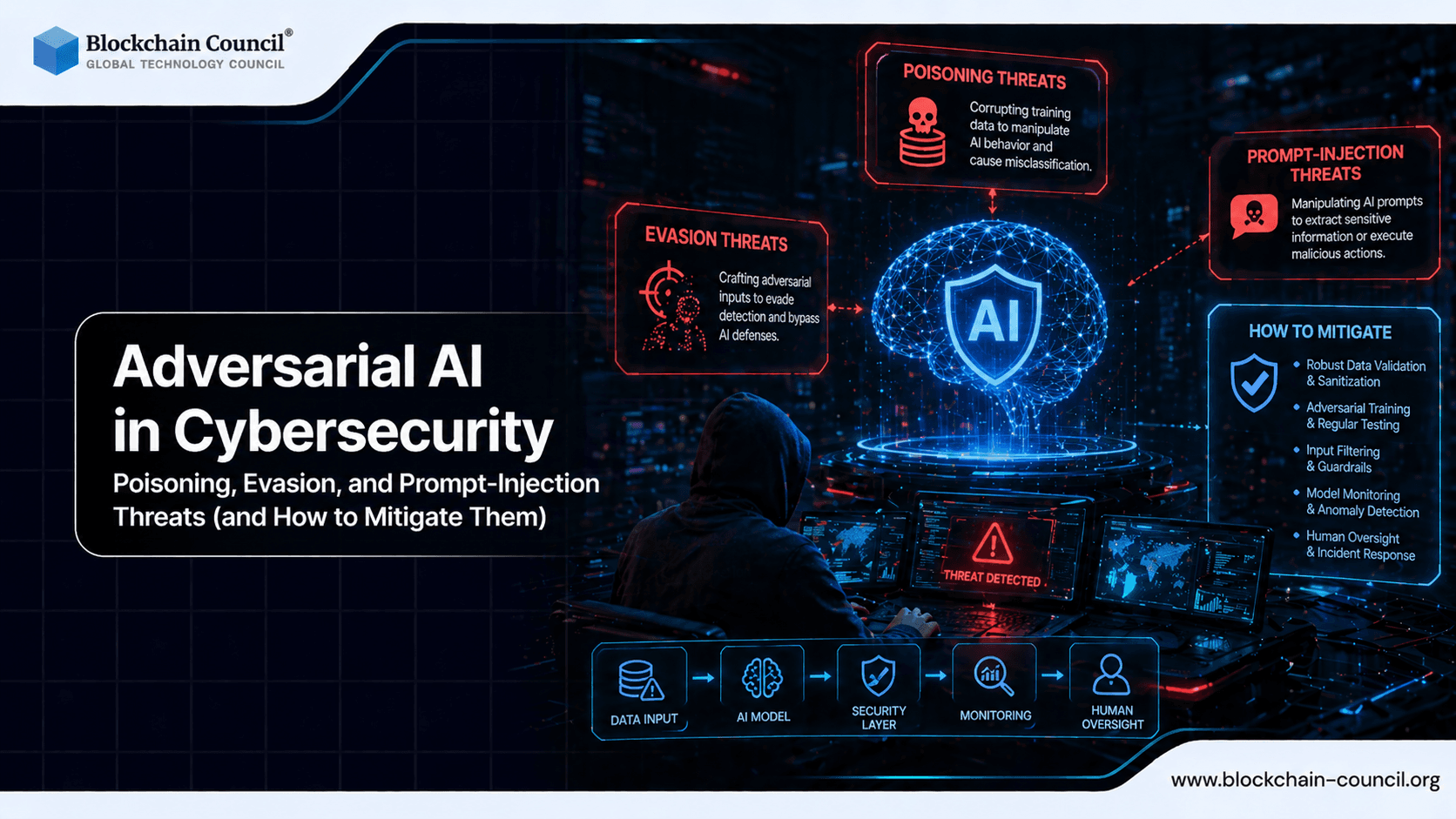
Adversarial AI in cybersecurity is no longer a niche research concern. It is an operational reality where attackers deliberately manipulate machine learning (ML) and generative AI systems so defenses malfunction, often without obvious signs of tampering. As AI becomes embedded across email security, endpoint detection, fraud prevention, and SOC workflows, adversaries are using the same technologies to increase the speed, scale, and sophistication of attacks.
For security practitioners, researchers, and Cybersecurity Experts, understanding adversarial AI is becoming a critical requirement as organizations increasingly rely on AI-driven detection, response, and decision-making systems.

Recent threat reporting indicates AI-enabled adversaries increased attacks by 89% compared to 2024, while zero-days exploited before public disclosure rose 42% year-over-year. Cloud-conscious intrusions grew 37%, and fake CAPTCHA lures surged 563%, reflecting how quickly attackers adapt their tactics when AI is involved. Understanding the core adversarial AI attack categories is now essential for any security program that relies on ML models or uses LLM-based tools.
What Is Adversarial AI in Cybersecurity?
Adversarial AI refers to techniques that intentionally cause AI systems to make wrong decisions. In cybersecurity, that can mean:
Training data is manipulated so a model learns unsafe patterns.
Inputs are crafted so detection models misclassify malicious activity as benign.
LLM tools are coerced via prompt injection to reveal secrets or perform unsafe actions.
This matters because it targets the decision-making layer itself. If your detection pipeline, triage process, or automated response relies on AI, compromising the model can compromise outcomes at machine speed.
The Three Core Threat Categories: Poisoning, Evasion, and Prompt Injection
1) Data Poisoning Attacks
Data poisoning happens when an attacker introduces altered, misleading, or strategically crafted data into a training dataset. The goal is to degrade accuracy, bias outcomes, or create blind spots that persist after deployment.
In security contexts, poisoning can quietly erode protections over time. If a model is trained to detect malicious URLs, an attacker may seed training data with mislabeled examples so the model gradually learns that certain attacker-controlled patterns are safe. The impact can be subtle: fewer detections, more false negatives, and rising analyst workload that resembles normal model drift.
Where poisoning shows up most often:
Threat intel enrichment pipelines that ingest untrusted sources.
Telemetry and labeling workflows where ground truth is weak or delayed.
Federated or collaborative learning setups where participants may be compromised.
2) Evasion Attacks and Adversarial Examples
Evasion attacks manipulate model inputs at inference time using carefully constructed changes that cause misclassification. These are commonly called adversarial examples. Even small modifications to input data can lead an ML system to miss malware, mis-rank alerts, or misclassify user behavior.
Common security examples include:
Phishing and spam manipulation: attackers adjust wording, formatting, or metadata to slip past AI-based filters. A 141% increase in spam emails aligns with adversaries applying sophisticated content variation and optimization techniques.
Malware and payload evasion: code is refactored to avoid known signatures and to confuse behavioral models.
Credential abuse: attackers attempt to make unauthorized access resemble normal user activity, aiming to bypass anomaly detection.
As attackers adopt AI-assisted techniques, evasion becomes more adaptive. Threat actors can iterate rapidly by testing what the model flags and then modifying inputs until the system misclassifies.
3) Prompt-Injection Threats Against LLM Workflows
Prompt injection targets generative AI systems, especially LLMs embedded in enterprise workflows, by supplying instructions that override system intent or extract sensitive information. This is not limited to chatbots. It affects tools that summarize tickets, query knowledge bases, draft emails, generate scripts, or take actions via connected plugins and APIs.
Adversaries have exploited legitimate generative AI tools across organizations by injecting malicious prompts to generate commands used for stealing credentials and cryptocurrency. Attackers have also stood up malicious AI servers that impersonated trusted services to intercept sensitive data. These incidents confirm that prompt injection is both a data security risk and an operational risk when LLM outputs are trusted without validation.
Typical prompt-injection goals:
Exfiltrate secrets from context windows, logs, or connected systems.
Trick the model into producing harmful instructions or code.
Induce unsafe tool actions, such as sending data to attacker-controlled endpoints.
How Adversarial AI Accelerates the Attack Chain
The larger risk is not any single technique in isolation. AI can compress and automate the full intrusion lifecycle.
Initial access: AI-generated, multilingual phishing lures; voice clones for vishing; and deepfakes that impersonate trusted figures.
Reconnaissance: AI agents map networks, identify high-value targets, locate shadow IT, and detect misconfigurations rapidly.
Lateral movement: AI chains exploits and can generate exploit code on the fly, increasing speed beyond human operator capacity.
Payload evasion: Malware behavior and code are refactored based on which defensive tools are detected, weakening signature-based detection.
This helps explain why defenders are seeing faster time-to-impact and more cloud-focused intrusions. Valid account abuse alone accounted for 35% of cloud incidents in recent reporting.
Why Organizations Struggle: Standardization Gaps, Shadow AI, and Legacy Exposure
Defending against adversarial AI is difficult for structural reasons:
Evolving techniques: attackers continuously adapt to new model weaknesses and deployment patterns.
Lack of standardization: many organizations lack consistent guidelines for AI security across teams and vendors.
Shadow AI: unsanctioned employee use of AI tools expands the attack surface and increases the risk of data leakage or prompt-injection exposure. Gartner has projected that misuse of autonomous AI agents will become a material contributor to breaches by the end of the decade.
Legacy systems and edge devices: attackers increasingly target environments with weaker monitoring, and a significant portion of exploited vulnerabilities have provided immediate access via edge devices.
How to Mitigate Adversarial AI in Cybersecurity
Mitigation requires a blend of classic security controls and AI-specific safeguards. The goal is not perfect prevention but resilient detection, response, and adaptation that keeps pace with autonomous and AI-assisted attacks.
1) Protect Training Data and Model Supply Chains
Secure training data: validate sources, enforce provenance checks, and restrict who can add or label training samples.
Harden data pipelines: treat feature stores, labeling tools, and ETL jobs as production assets with access controls, logging, and integrity monitoring.
Vendor and open-source governance: assess third-party datasets and pretrained models, including update mechanisms and dependencies.
2) Build Adversarial Testing into the ML Lifecycle
Traditional validation is not sufficient. Add adversarial testing before deployment and continuously after releases:
Red-team ML evaluation: simulate poisoning and evasion attacks, then measure performance degradation and failure modes.
Robustness benchmarks: track how sensitive the model is to small input changes and distribution shifts.
Canary and rollback strategies: deploy models gradually and revert quickly if anomaly rates spike.
3) Detect Adversarial Manipulation at Runtime
Adversarial example detection: use detectors designed to flag suspicious perturbations or out-of-distribution inputs.
Behavioral analytics: apply user, entity, and workload behavior analytics to catch subtle deviations that rules and signatures miss.
Cross-signal correlation: avoid relying on a single model output. Correlate identity, endpoint, network, and cloud signals.
4) Secure LLM Applications Against Prompt Injection
LLM security spans both application security and governance. Practical controls include:
System and tool boundaries: ensure the LLM cannot directly execute sensitive actions without explicit authorization and validation.
Least privilege for connectors: limit what the LLM can access in email, tickets, code repositories, cloud consoles, and secrets stores.
Input and output filtering: detect attempts to override system instructions, request secrets, or embed exfiltration instructions.
Human-in-the-loop for high-risk actions: require approvals for transfers, credential resets, policy changes, or production commands.
Logging and auditability: retain prompts, retrieved context, tool calls, and outputs for forensics and continuous improvement.
5) Operationalize Defensive AI in the SOC
Attackers are using AI to scale their operations. Defenders need AI to keep pace with triage, prioritization, and response:
AI-assisted alert prioritization to reduce noise and highlight high-risk chains of activity.
Automation and orchestration for containment steps that must happen quickly, especially in cloud environments.
Threat intelligence analysis enhanced by AI to identify patterns across campaigns, including deepfake and phishing infrastructure.
For teams building these capabilities, structured training is an important investment. Blockchain Council offers programs such as Certified AI Security Expert (CAISE), Certified Ethical Hacker, Certified Cybersecurity Expert, and role-aligned learning in Generative AI and prompt engineering to strengthen LLM risk management practices.
Future Outlook: Preparing for Agentic, Always-On Attacks
Security leaders are weighing scenarios ranging from gradual adoption to an inflection point where automated AI attacks become ubiquitous. The most consequential scenario involves widespread access to agentic AI that can autonomously run continuous operations, probing targets around the clock, adapting to defenses, and reducing the time between initial access and objective completion.
Preparation is less about predicting which scenario unfolds and more about ensuring resilient controls that function under rapid iteration and automation.
As adversarial AI reshapes both offensive and defensive security operations, professionals are expanding their expertise beyond traditional cybersecurity disciplines. A Tech Certification can help strengthen knowledge of emerging technologies, AI-enabled systems, cloud infrastructure, and automation frameworks, while a Marketing Certification can help security leaders communicate cyber risks more effectively, align security initiatives with business objectives, and improve stakeholder engagement across the organization.
Conclusion
Adversarial AI in cybersecurity changes the defensive playbook because it targets how security decisions are made, not just the perimeter. Data poisoning can degrade models over time, evasion attacks can bypass detection with carefully crafted inputs, and prompt injection can turn helpful LLM tools into pathways for data theft and unsafe actions.
Mitigation requires securing the ML supply chain, implementing adversarial testing, deploying runtime detection, hardening LLM applications, and using defensive AI to operate at machine speed. Organizations that treat AI systems as high-value assets, applying the same rigor used for identity, cloud, and software supply chain security, will be best positioned to withstand the next phase of AI-enabled threats.
FAQs
1. What is adversarial AI in cybersecurity?
Adversarial AI refers to techniques used to attack or manipulate machine learning systems. These attacks aim to disrupt performance or extract sensitive information. It is a growing concern in modern cybersecurity.
2. What are the main types of adversarial AI attacks?
The main types include data poisoning, evasion attacks, and prompt injection. Each targets a different stage of the AI lifecycle. Together, they expose vulnerabilities in ML systems.
3. What is data poisoning in adversarial AI?
Data poisoning involves injecting malicious data into training datasets. This alters model behavior and reduces accuracy. It can introduce hidden biases or backdoors.
4. What are evasion attacks in machine learning?
Evasion attacks occur during inference when attackers manipulate inputs to fool the model. These inputs appear normal but cause incorrect predictions. They bypass detection systems.
5. What is prompt injection in AI security?
Prompt injection manipulates input instructions to override model behavior. It can bypass safeguards or extract sensitive data. This is common in language model applications.
6. Why are AI systems vulnerable to adversarial attacks?
AI models rely on patterns learned from data and may not handle unexpected inputs well. They lack true understanding of intent. This makes them susceptible to manipulation.
7. What are the risks of adversarial AI in cybersecurity?
Risks include system compromise, data leakage, and incorrect decisions. In critical systems, this can lead to serious operational damage. It also undermines trust in AI.
8. How can organizations detect adversarial attacks?
Detection involves monitoring anomalies, validating inputs, and analyzing model behavior. AI-based detection tools can help identify suspicious patterns. Continuous monitoring is essential.
9. What is adversarial training?
Adversarial training involves exposing models to malicious inputs during training. This helps improve resilience against attacks. It strengthens model robustness.
10. How can data poisoning attacks be mitigated?
Use trusted data sources, validate datasets, and monitor data pipelines. Regular audits and anomaly detection improve security. Robust training methods also help.
11. How do you prevent evasion attacks?
Implement input validation and use robust models trained on diverse data. Monitoring outputs for anomalies can help detect attacks. Defensive techniques reduce vulnerability.
12. What are best practices to prevent prompt injection?
Sanitize inputs, isolate system instructions, and filter outputs. Avoid exposing sensitive data to user inputs. Layered security improves protection.
13. What role does model robustness play in security?
Robust models can handle unexpected or malicious inputs without failing. This reduces the impact of adversarial attacks. Techniques include regularization and adversarial training.
14. How does anomaly detection help in AI security?
Anomaly detection identifies unusual patterns in data or model behavior. It helps detect attacks early. This allows faster response and mitigation.
15. Can adversarial AI affect real-world systems?
Yes, it can impact systems like fraud detection, autonomous vehicles, and cybersecurity tools. Attacks can cause incorrect decisions or system failures. Real-world impact can be significant.
16. What tools are used to defend against adversarial AI?
Tools include monitoring systems, security frameworks, and adversarial testing platforms. These help detect and mitigate threats. Proper tool selection improves defense strategies.
17. How does input validation improve AI security?
Input validation ensures only clean and expected data is processed. It filters out malicious inputs. This reduces the risk of attacks.
18. What is the role of human oversight in adversarial AI defense?
Human oversight helps review and validate AI decisions. It adds an extra layer of control. This reduces the risk of automated errors or attacks.
19. How can organizations test AI systems for vulnerabilities?
Organizations can use red teaming and adversarial testing. These methods simulate attacks to identify weaknesses. Regular testing improves system resilience.
20. What is the future of adversarial AI in cybersecurity?
Adversarial techniques will continue to evolve alongside AI systems. Defense strategies will become more advanced and integrated. Continuous adaptation will be necessary to maintain security.
Related Articles
View All
Cybersecurity
Cybersecurity tips for remote workers
Learn essential cybersecurity tips for remote workers to protect data, secure devices, and avoid online threats while working from home.

Cybersecurity
Cybersecurity companies in Dubai for small business
Find top cybersecurity companies in Dubai offering protection for small businesses against cyber threats.

Cybersecurity
Cybersecurity course for beginners India online
Explore beginner-friendly cybersecurity courses in India to learn ethical hacking and security fundamentals.
Trending Articles
AWS Career Roadmap
A step-by-step guide to building a successful career in Amazon Web Services cloud computing.

Top 5 DeFi Platforms
Explore the leading decentralized finance platforms and what makes each one unique in the evolving DeFi landscape.
How Blockchain Secures AI Data
Understand how blockchain technology is being applied to protect the integrity and security of AI training data.