

Cybersecurity Roadmap for 2026: A Practical Plan for Professionals
 Suyash Raizada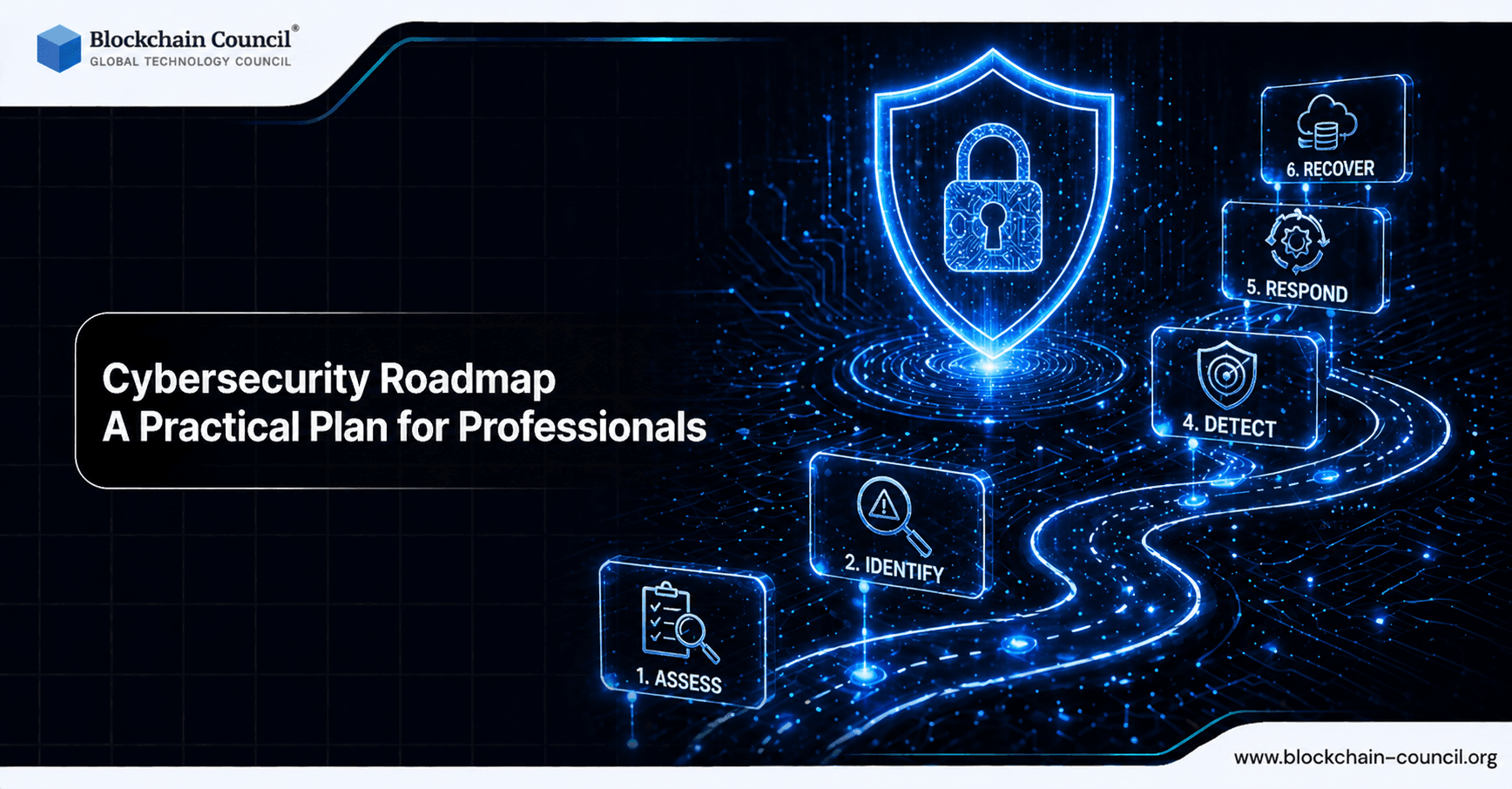
Cybersecurity in 2026 is defined by faster, more automated threats and greater operational complexity. AI now functions as a dual-use force, strengthening defenses while enabling sophisticated phishing, fraud, and malware at scale. Global fragmentation, volatile regulations, and supply chain dependencies raise the stakes further. For professionals, the most reliable response is a structured roadmap that aligns security capabilities with business priorities such as cloud migration, AI adoption, and remote operations.
This guide provides a practical cybersecurity roadmap you can adapt to your organization, focusing on identity-first controls, cloud security, continuous monitoring, and measurable resilience.

A Cybersecurity Certification can help professionals strengthen their understanding of risk management, threat detection, security operations, and modern defense strategies, enabling them to build more resilient and secure digital environments.
Why a Cybersecurity Roadmap Matters in 2026
Industry leaders increasingly treat cybersecurity as a strategic program rather than a reactive function. Several forces are driving this shift:
AI-driven change: 94% of surveyed leaders view AI as the most significant driver of cybersecurity change in 2026, accelerating both attacks and defenses.
Top risks: AI vulnerabilities rank highest, followed by cyber-enabled fraud and phishing, supply chain disruptions, software exploitation, and ransomware.
Sustained geopolitical influence: 66% of organizations have adjusted cybersecurity strategies in response to geopolitics, reflecting continued impact on supply chain risk and operational resilience.
A roadmap converts these pressures into an ordered plan: what to fix first, what to automate, what to measure, and how to demonstrate readiness during audits, incidents, and board reviews.
Core Principles to Anchor Your Cybersecurity Roadmap
Before defining phases and selecting tools, anchor your program on a few non-negotiables that appear consistently across enterprise priorities and expert guidance.
1) Zero Trust as the Default Operating Model
Zero Trust Architecture is now standard for enterprises because it assumes no implicit trust inside the network. Every access attempt is verified using identity controls, multi-factor authentication, segmentation, and continuous monitoring.
Verify explicitly: enforce strong authentication and conditional access.
Least privilege: limit access rights and remove standing privileges wherever possible.
Assume breach: design detection and response as though compromise will occur.
2) Identity-First Security, Including Non-Human Identities
Modern environments include both human users and non-human identities such as service accounts, APIs, workloads, and agents. User access reviews should extend beyond employees to these non-human identities in order to reduce hidden privilege pathways.
3) Execution Over Tools
Many security failures in 2026 stem from gaps in configuration, monitoring, and response rather than from a lack of products. Operational execution matters most, including continuous monitoring across identity, endpoints, cloud, and third parties, supported by Managed Detection and Response when internal capacity is limited.
Cybersecurity Roadmap: A Phased Plan for 2026
Use the following phases as a blueprint. Each phase includes outcomes, recommended initiatives, and metrics to track progress.
Phase 1: Assess and Align (Weeks 0-6)
Goal: Build a clear picture of risk and align security priorities to business objectives such as cloud migration and AI-driven operations.
Key activities:
Asset and data inventory: include cloud workloads, endpoints, SaaS, IoT, and critical third parties.
Threat and vulnerability baseline: run vulnerability scanning, configuration assessments, and identity posture reviews.
Compliance mapping: align to relevant obligations and reporting requirements, including country-specific directives (for example, CERT-In expectations for Indian enterprises).
Third-party and supply chain review: rank vendors by access level and business criticality, then assess contractual security controls and incident notification obligations.
Deliverables:
Cybersecurity vision and principles aligned to business growth
Top 10 risk register with owners and timelines
Target architecture direction: identity-first and Zero Trust
Suggested metrics:
% of critical assets inventoried
% of users and privileged accounts covered by MFA
Number of critical vulnerabilities and median time to remediation
Phase 2: Build Foundational Controls (Weeks 6-18)
Goal: Reduce exposure quickly by implementing controls that address the most common entry paths - identity compromise, misconfiguration, and unpatched software.
Priorities to implement:
Zero Trust foundations: conditional access, device compliance signals, segmentation, and continuous verification.
Identity governance: periodic user access reviews, privileged access management, and least privilege enforcement for both human and non-human identities.
Endpoint and cloud security: EDR, encryption, and cloud security posture management for misconfiguration detection.
SASE approach for hybrid work: secure access patterns that reduce reliance on legacy perimeter models.
Security awareness training: focus on phishing, fraud, and business email compromise, which remain top perceived risks.
Operational note: If 24-7 monitoring is not realistic internally, evaluate an MSSP or Managed Detection & Response partner for real-time SOC response and investigation workflows.
Suggested metrics:
% privileged accounts under PAM controls
% endpoints covered by EDR and monitored health
Cloud misconfiguration findings resolved per sprint
Phishing simulation failure rate trend
Phase 3: Detect, Respond, and Prove Resilience (Weeks 18-36)
Goal: Operate on the assumption that attacks will occur and ensure the organization can detect quickly, contain effectively, and recover with minimal business impact.
Initiatives:
Incident response modernization: clear escalation matrix, playbooks for ransomware, cloud account compromise, and supply chain incidents.
Tabletop exercises and red-team simulations: validate decision-making under pressure and improve coordination across IT, legal, communications, and leadership.
Backup and recovery hardening: enforce immutable or isolated backups and regularly test restore procedures to reduce ransomware impact.
SOAR and automation where justified: automate high-volume actions such as enrichment, triage, and containment for known threat patterns.
Suggested metrics:
Mean time to detect (MTTD) and mean time to respond (MTTR)
% critical systems with tested recovery objectives met
Number of incidents detected internally vs. externally reported
Phase 4: Prepare for What Is Next (Ongoing Through 2026)
Goal: Stay ahead of strategic shifts including agentic AI oversight, regulatory volatility, and post-quantum cryptography planning.
Agentic AI governance: if autonomous or semi-autonomous AI systems are deployed, define oversight protocols, logging requirements, access boundaries, and change control procedures.
Continuous compliance automation: prioritize controls that produce auditable evidence and reduce manual effort.
Post-quantum readiness: begin an inventory of cryptographic dependencies and develop a transition plan for high-value systems.
Supply chain resilience: expand monitoring and contractual controls for third parties that could introduce systemic risk.
Role-Based Focus: How Professionals Can Apply the Roadmap
Cybersecurity outcomes improve when responsibilities are clearly defined.
Security leaders: translate the risk register into funded initiatives, define metrics, and report readiness to stakeholders.
Cloud and DevOps teams: integrate CSPM findings, enforce secure baselines, and reduce secrets sprawl.
IT operations: standardize patching, endpoint configuration, and device compliance.
Security analysts: tune detection, build playbooks, and validate response through exercises.
For skill development, internal training plans can map directly to role requirements. Relevant certifications from Blockchain Council include Certified Ethical Hacker, Certified Cybersecurity Expert, Certified SOC Analyst, and specialized tracks in AI and security governance for professionals working with AI-enabled systems.
Real-World Applications You Can Borrow
Compliance-driven roadmaps: Indian enterprises often structure roadmaps around reporting and operational requirements, while prioritizing third-party risk management in cloud migrations and hybrid work environments.
Sector-specific AI use: financial services organizations commonly prioritize AI-based threat detection, while manufacturing and supply chain-focused businesses emphasize automated security operations to reduce phishing and disruption impacts.
Preparedness in practice: organizations that run red-team simulations and formalize escalation matrices tend to reduce ransomware blast radius through tested backups and faster containment.
A Marketing Certification can help professionals communicate cybersecurity priorities, compliance requirements, and risk management initiatives more effectively, ensuring that security programs remain aligned with business objectives, stakeholder expectations, and organizational resilience goals.
Conclusion: Make Cybersecurity a Measurable Program
In 2026, cybersecurity success depends on disciplined execution: identity-first controls, Zero Trust adoption, continuous monitoring, and tested response capabilities. AI increases both opportunity and risk, making governance, detection, and resilience essential rather than optional. A clear roadmap gives professionals a framework to prioritize investments, demonstrate progress with metrics, and build operational confidence as threats grow more automated and targeted.
Start with assessment and alignment, implement foundational controls promptly, then mature detection and response through exercises and automation. Organizations that treat cybersecurity as an ongoing program will be best positioned to protect trust, maintain uptime, and adapt to the challenges 2026 presents.
FAQs
1. What is a cybersecurity roadmap for 2026?
A cybersecurity roadmap is a structured plan to build skills, tools, and strategies for modern security challenges. In 2026, it focuses on cloud security, AI threats, and zero trust architecture. It helps professionals stay relevant and competitive.
2. Why is a cybersecurity roadmap important for professionals?
Cyber threats are evolving rapidly, and skills can become outdated quickly. A roadmap provides clear direction for learning and career growth. It ensures professionals stay aligned with industry demands.
3. What skills are essential for cybersecurity in 2026?
Key skills include network security, cloud security, threat intelligence, and incident response. Knowledge of AI-driven threats and automation is also important. Strong analytical and problem-solving skills are critical.
4. How should beginners start a cybersecurity career in 2026?
Beginners should start with fundamentals like networking, operating systems, and basic security concepts. Entry-level certifications and hands-on labs are helpful. Building practical skills through projects is essential.
5. What certifications are valuable for cybersecurity professionals in 2026?
Popular certifications include CompTIA Security+, CEH, CISSP, and cloud-specific credentials. These validate skills and improve job prospects. Choosing certifications based on career goals is important.
6. How important is cloud security in 2026?
Cloud security is critical as most organizations rely on cloud infrastructure. Professionals must understand cloud platforms and security best practices. This includes identity management and data protection.
7. What is zero trust architecture and why is it important?
Zero trust is a security model that assumes no user or system is trusted by default. It requires continuous verification of access. This approach reduces the risk of breaches and insider threats.
8. How can professionals stay updated with cybersecurity trends?
Following industry blogs, attending webinars, and participating in communities helps. Continuous learning through courses and certifications is essential. Staying informed about threats and tools is critical.
9. What role does AI play in cybersecurity in 2026?
AI is used for threat detection, anomaly analysis, and automated response. It helps identify patterns and predict attacks. However, attackers also use AI, making it a double-edged tool.
10. What are the key career paths in cybersecurity?
Career paths include security analyst, penetration tester, security engineer, and incident responder. Advanced roles include security architect and CISO. Each path requires specific skills and experience.
11. How important is hands-on experience in cybersecurity?
Hands-on experience is essential for understanding real-world threats and tools. Labs, simulations, and capture-the-flag challenges are valuable. Practical skills are often more important than theory.
12. What tools should cybersecurity professionals learn in 2026?
Common tools include Wireshark, Metasploit, Nmap, and SIEM platforms. Cloud security tools and automation frameworks are also important. Familiarity with multiple tools improves effectiveness.
13. How can professionals transition into cybersecurity from other fields?
They can leverage transferable skills such as IT knowledge or programming. Starting with foundational courses and certifications helps. Building a portfolio of projects demonstrates capability.
14. What are the biggest cybersecurity challenges in 2026?
Challenges include ransomware, AI-driven attacks, and supply chain vulnerabilities. Cloud misconfigurations and insider threats are also concerns. Organizations must adopt proactive security strategies.
15. How does automation impact cybersecurity roles?
Automation reduces repetitive tasks and improves efficiency. It allows professionals to focus on complex threats. However, understanding automated systems is necessary to manage them effectively.
16. What is the importance of threat intelligence in cybersecurity?
Threat intelligence provides insights into potential attacks and vulnerabilities. It helps organizations prepare and respond effectively. This improves overall security posture.
17. How can professionals build a strong cybersecurity portfolio?
They should document projects, labs, and certifications. Participating in bug bounty programs and challenges adds value. A strong portfolio demonstrates practical expertise.
18. What soft skills are important in cybersecurity careers?
Communication, critical thinking, and problem-solving are essential. Professionals must explain complex issues clearly. Collaboration is also important in team environments.
19. What is the future of cybersecurity careers beyond 2026?
Cybersecurity demand will continue to grow due to increasing digital threats. Roles will evolve with new technologies like AI and quantum computing. Continuous learning will remain essential.
20. How can professionals create a long-term cybersecurity roadmap?
They should set clear career goals and identify required skills. Regularly updating knowledge and gaining certifications is important. Tracking progress and adapting to trends ensures long-term success.
Related Articles
View All
Cybersecurity
Cybersecurity tips for remote workers
Learn essential cybersecurity tips for remote workers to protect data, secure devices, and avoid online threats while working from home.

Cybersecurity
Cybersecurity companies in Dubai for small business
Find top cybersecurity companies in Dubai offering protection for small businesses against cyber threats.

Cybersecurity
Cybersecurity course for beginners India online
Explore beginner-friendly cybersecurity courses in India to learn ethical hacking and security fundamentals.
Trending Articles
AWS Career Roadmap
A step-by-step guide to building a successful career in Amazon Web Services cloud computing.
How Blockchain Secures AI Data
Understand how blockchain technology is being applied to protect the integrity and security of AI training data.
What is AWS? A Beginner's Guide to Cloud Computing
Everything you need to know about Amazon Web Services, cloud computing fundamentals, and career opportunities.