

Hot Wallet vs Cold Wallet Security: Which Is Safer for Crypto Storage?

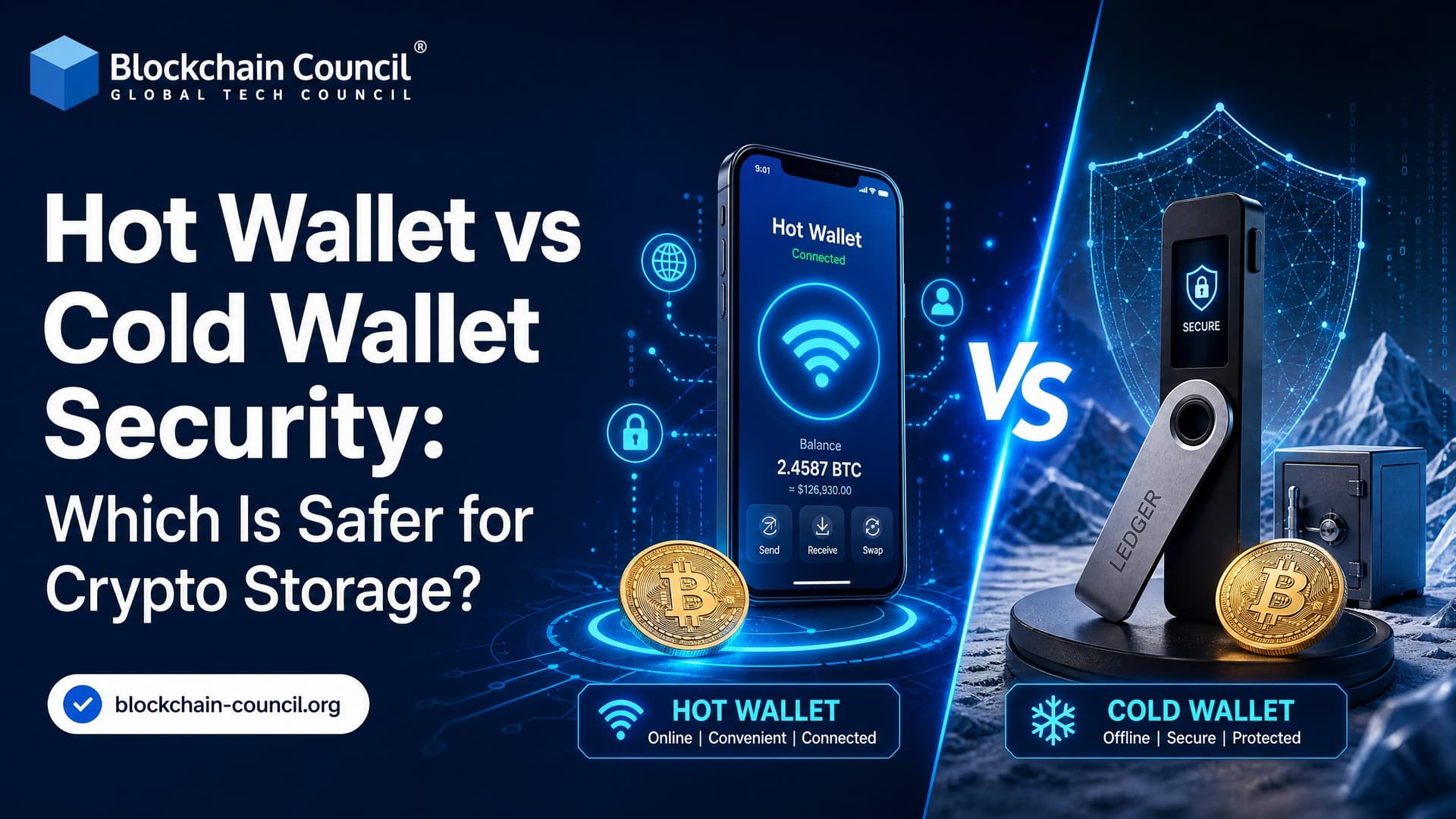
Hot wallet vs cold wallet security comes down to one practical question: are your private keys exposed to an internet-connected environment? If yes, you get speed but higher attack exposure. If no, you get stronger long-term protection but more responsibility for physical custody and recovery.
The safer choice is not the same for every job. For large BTC, ETH, stablecoin treasuries, or valuable NFTs, cold wallets are the safer default. For DeFi, trading, payments, and testing, hot wallets are useful, but they should hold only amounts you can afford to put at risk.

Hot Wallet vs Cold Wallet Security: The Short Answer
Cold wallets are generally safer for long-term crypto storage because private keys stay offline. That removes most remote attack paths: phishing malware, malicious browser extensions, compromised apps, and server-side breaches.
Hot wallets are safer for active use only when the balance is limited and the setup is hardened. Think of a hot wallet as cash in your pocket. Think of a cold wallet as a vault.
Major crypto platforms and custody providers give similar guidance. Binance Academy recommends keeping the majority of funds in cold storage, often around 90 percent or more, with a smaller amount in a hot wallet for daily use. Coinbase explains that hot wallets are convenient for regular transactions, while cold wallets offer a higher level of security because keys are kept offline. Fireblocks makes the institutional version of the same point: online wallets need policy controls, multisig, or MPC because the attack surface is larger.
What Is a Hot Wallet?
A hot wallet is a wallet connected to the internet. It may run as a browser extension, mobile app, desktop app, exchange account, or server-side wallet used by a business.
Common examples include:
- Browser wallets used with DeFi apps and NFT marketplaces
- Mobile wallets for payments and quick transfers
- Exchange wallets used for trading
- Operational wallets used by businesses for payouts
Hot wallets are built for speed. You can connect to a dApp, approve a token swap, mint an NFT, or send USDC in seconds. That convenience is exactly why they carry more risk.
Main Hot Wallet Risks
- Phishing: Fake wallet pop-ups, cloned exchange pages, and malicious recovery sites remain common.
- Malware and keyloggers: If your laptop is infected, the wallet environment is no longer trustworthy.
- Malicious browser extensions: Extensions can read or alter web content, which is dangerous around wallet prompts.
- Bad approvals: A careless ERC-20 unlimited approval can let a malicious spender drain that token. An ERC-721 setApprovalForAll approval can expose an entire NFT collection in that wallet.
- Custodial risk: If you use an exchange wallet, the exchange controls the private keys, not you.
Here is a detail that trips up many users: signing a message is not always harmless. Some signatures are just logins. Others, such as EIP-712 typed data, can authorize actions that have financial consequences. Always read the wallet prompt. If the interface hides details or asks you to sign something you do not understand, stop.
What Is a Cold Wallet?
A cold wallet stores private keys offline. The most common version is a hardware wallet, though air-gapped computers and paper wallets also fall into this category.
With a hardware wallet, the device signs transactions internally. Your computer or phone receives only the signed transaction, not the private key. That distinction matters. Even if the computer is online, the private key should never leave the device.
Examples of cold storage include:
- Hardware wallets used for BTC, ETH, and token storage
- Air-gapped devices that never connect directly to the internet
- Paper wallets, although these are easy to mishandle and are not beginner-friendly
- Institutional cold storage with multiple approvals and controlled physical access
Main Cold Wallet Risks
Cold wallets reduce online risk, but they do not remove all risk. They shift much of it to physical security and operational discipline.
- Seed phrase loss: If you lose the recovery phrase and the device fails, the funds are gone.
- Seed phrase exposure: A photo, cloud note, email draft, or password manager entry can defeat the point of cold storage.
- Fake recovery websites: No legitimate wallet vendor needs your seed phrase to restore or verify a device online.
- Supply-chain risk: Buy hardware wallets from the manufacturer or trusted official channels, not a random marketplace listing.
- Physical theft or coercion: A device plus PIN, or a stolen recovery phrase, can still lead to loss.
Cold storage has a slower workflow. That is the point. A little friction prevents casual mistakes. If you are moving six figures in ETH, having to verify the address on a small device screen is not annoying. It is a control.
Security Comparison: Hot Wallet vs Cold Wallet
| Factor | Hot wallet | Cold wallet |
|---|---|---|
| Connectivity | Online | Offline |
| Best use | Trading, DeFi, payments | Long-term storage |
| Online attack exposure | High | Very low |
| Physical custody risk | Usually lower per wallet | Higher impact if seed is lost or stolen |
| Convenience | High | Lower |
| Recommended balance | Small, active-use funds | Major holdings and reserves |
From a pure storage-security view, cold wallets win. Forbes, Coinbase, Binance Academy, Arculus, and Fireblocks all describe offline key storage as the stronger model for large or long-term holdings. No serious custody professional would recommend keeping your entire portfolio in a browser wallet used for random dApp interactions.
But hot wallets are not bad by default. They are the wrong tool when used as a vault. Use them as operational wallets, and the security model makes sense.
The Best Practice: Use a Hybrid Wallet Model
The most practical answer is a split setup. Keep most funds in cold storage. Keep a smaller working balance in one or more hot wallets.
A simple personal setup might look like this:
- Cold wallet: Long-term BTC, ETH, and high-value NFTs.
- Hot wallet 1: DeFi and NFT activity with limited funds.
- Hot wallet 2: Testing new dApps, airdrops, and mints. Keep this nearly empty.
- Exchange account: Only funds needed for trading or conversion.
This separation limits blast radius. If your minting wallet signs a bad approval, your long-term holdings should not be sitting in the same address.
How Enterprises Should Think About Wallet Security
For companies, hot wallet vs cold wallet security is an operational design issue, not just a technology decision.
A crypto-native business may need hot wallets for payouts, market making, or customer withdrawals. That does not mean a single server should control everything. Institutional setups often use:
- Cold wallets for treasury reserves
- Warm wallets for operations that need human or policy approval
- Hot wallets for automated activity with capped balances
- Multisig to require multiple signers
- MPC to split signing authority so no single machine holds a complete private key
- Whitelists and transaction limits to reduce damage from a compromised workflow
Fireblocks describes this spectrum clearly: the simple hot versus cold split is giving way to policy-controlled custody models. Still, the principle remains the same. The more online and automated the wallet, the stricter the controls must be.
Practical Wallet Security Checklist
For Hot Wallets
- Keep balances small.
- Use a separate wallet for untrusted dApps and new mints.
- Revoke unnecessary token approvals after activity.
- Install only trusted browser extensions.
- Use hardware-backed signing where possible.
- Never type your seed phrase into a website, support chat, or Google form.
- Check the chain and address before signing. Ethereum mainnet uses chain ID 1, and scams often push users to unfamiliar networks.
For Cold Wallets
- Buy directly from the manufacturer or an official reseller.
- Write the recovery phrase offline. Do not photograph it.
- Store backups in separate secure locations.
- Test recovery with a small amount before transferring major funds.
- Verify the recipient address on the hardware device screen, not only in the browser.
- Use a passphrase only if you understand the recovery implications.
One practical habit: send a tiny test transaction first. Yes, it costs a little gas. It also catches wrong networks, copied addresses, and exchange deposit mistakes before they become expensive.
Where Smart Contract Wallets and MPC Fit
Smart contract wallets and MPC wallets are changing the conversation. They can add spending limits, social recovery, session keys, time locks, role permissions, and approval policies. That is useful.
Do not treat them as magic. Smart contract wallets add contract risk. MPC systems add coordination and vendor risk. For advanced teams, these tools are worth studying. For beginners, a well-managed hardware wallet plus a small hot wallet is usually safer than a complex setup nobody fully understands.
If you want to build or audit these systems professionally, consider related Blockchain Council learning paths such as Certified Cryptocurrency Expert™ (CCE), Certified Blockchain Expert™ (CBE), and Certified Blockchain Developer™. Each one covers the fundamentals you need to work confidently with wallets, private keys, token standards, and blockchain security practices.
Which Wallet Is Safer?
For long-term crypto storage, cold wallets are safer. They keep private keys offline and remove most remote attack vectors. For active use, hot wallets are necessary, but they should be treated as limited-risk working accounts.
Use this rule: if losing the balance would seriously hurt, it belongs in cold storage. If the funds are for trading, DeFi, payments, or experiments, use a hot wallet with strict limits.
Your next step is simple. Audit your current wallets today. Move long-term holdings to cold storage, create a separate hot wallet for daily activity, and review every token approval you have granted. If you manage funds for a business, document the approval policy before the next transaction, not after an incident.
Related Articles
View All
Cryptocurrency
Hot Wallet vs Cold Wallet: Which Crypto Storage Option Is Safer?
Cold wallets are safer for long-term crypto storage, while hot wallets are better for trading, DeFi, and payments. Learn which setup fits your risk.

Cryptocurrency
How to Recover Funds Sent to the Wrong Crypto Wallet Address
Learn when mis-sent crypto can be recovered, when it is permanently lost, and the exact steps to take after sending funds to the wrong wallet address.
Cryptocurrency
Crypto Wallet Recovery Guide: How to Regain Access Safely
Learn safe crypto wallet recovery steps for seed phrases, hardware wallets, MetaMask, custodial accounts, Lightning backups, MPC, and recovery services.
Trending Articles
AWS Career Roadmap
A step-by-step guide to building a successful career in Amazon Web Services cloud computing.

Can DeFi 2.0 Bridge the Gap Between Traditional and Decentralized Finance?
The next generation of DeFi protocols aims to connect traditional banking with decentralized finance ecosystems.
Claude AI Tools for Productivity
Discover Claude AI tools for productivity to streamline tasks, manage workflows, and improve efficiency.