

Ethereum Expert Roadmap: Skills and Certifications for Web3 Career Growth
 Suyash Raizada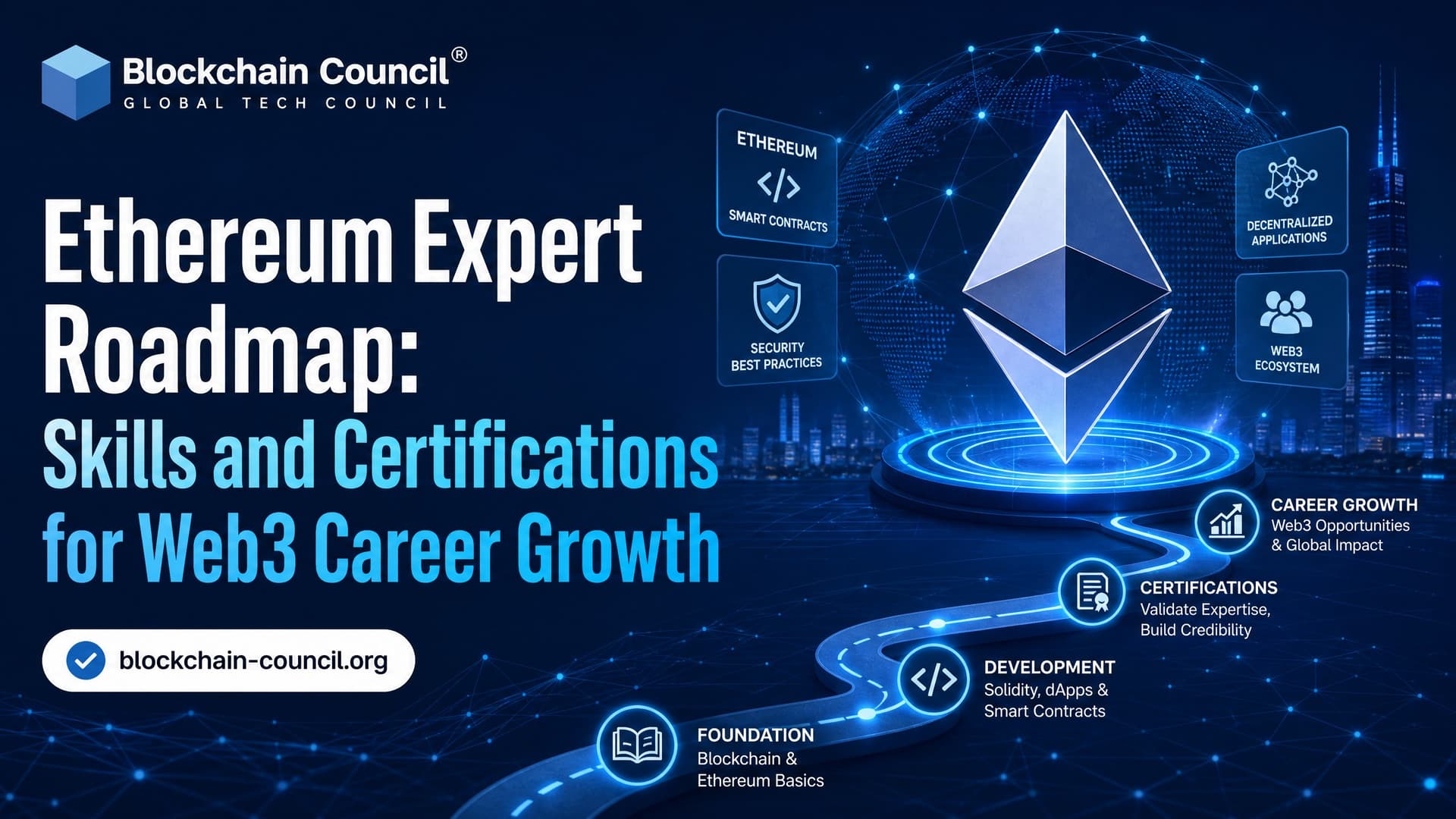
An Ethereum expert roadmap should start with one blunt reality: employers do not hire theory alone. They look for developers, architects, auditors, and consultants who can explain the EVM, ship smart contracts, test failure cases, and defend design choices under security pressure. Certifications help, but only when they sit on top of real projects.
A strong roadmap combines three things: hands-on Ethereum development, security-first engineering, and role-specific credentials such as the Certified Ethereum Professional (CEP) and Blockchain Council's Certified Ethereum Expert. If you want Web3 career growth, build for proof, not just completion.

Why the Ethereum Expert Roadmap Has Changed
Ethereum learning used to mean reading about smart contracts, deploying a token in Remix, and calling yourself a blockchain developer. That is not enough now. Modern teams expect you to understand Solidity 0.8.x, EVM execution, account types, gas behavior, events, contract upgrade risks, wallet flows, and common attack patterns.
Project-based learning has become the standard. The pattern most teaching resources now recommend moves you from basic contracts to audit-ready applications over a fixed window, usually around 90 days, with Solidity, Hardhat, Foundry, security testing, and lower-level EVM work at the center. Certifications can validate Solidity, Vyper, and security practices, which matters in a crowded hiring market.
That matches what you see in real teams. A candidate who has written a mini-DEX with tests, fuzzing, and deployment scripts is easier to evaluate than someone who only lists Web3 keywords on a resume.
Stage 1: Build the Technical Foundation
Start with the basics. Do not skip them. Smart contract bugs often come from weak fundamentals, not exotic attacks.
Core skills to learn first
- Programming: JavaScript or Python is a practical starting point. You will use JavaScript or TypeScript often with Hardhat and frontend tooling.
- Blockchain concepts: blocks, nodes, transactions, decentralization, consensus, and finality.
- Cryptography basics: hashing, public-private keys, digital signatures, and address derivation.
- Ethereum basics: externally owned accounts, contract accounts, gas, logs, events, and the transaction lifecycle.
Use Remix IDE first. It removes setup friction. Deploy a simple storage contract, connect MetaMask, and inspect the transaction on a testnet block explorer. Small step. Useful step.
One practical detail: when you move from tutorials to current OpenZeppelin Contracts versions, watch for breaking changes. In OpenZeppelin Contracts 5.x, Ownable requires an initial owner in the constructor. If you extend it the old way, Solidity may throw an error along the lines of No arguments passed to the base constructor. This is the kind of small version change that burns beginners during contract deployment.
Stage 2: Learn Solidity and the EVM Properly
Solidity is still the main language for Ethereum smart contract engineering. Learn it deeply before jumping into every new chain or framework.
What Solidity competence looks like
- Writing payable functions and handling ETH transfers safely.
- Using mappings, structs, modifiers, events, and custom errors.
- Implementing the ERC-20 and ERC-721 standards correctly.
- Understanding visibility, inheritance, storage layout, and ABI encoding.
- Testing reverts, edge cases, and access control paths.
After Remix, move to Hardhat or Foundry. My take: use Hardhat if you are building with a JavaScript or TypeScript frontend team. Use Foundry if you want faster Solidity-native tests, fuzzing, and a cleaner path into security research. Both are accepted in professional Ethereum workflows.
At the EVM level, learn why gas matters, how storage slots work, what events cost, and why contract calls can fail silently if you do not check return values. Senior Ethereum developers are not just Solidity typists. They understand execution.
Stage 3: Build Portfolio Projects That Prove Skill
Your portfolio should map to real use cases. Avoid toy projects that only show a deployed token. Build systems that force you to handle state, permissions, tests, and user interaction.
Recommended project sequence
- Time-locked piggy bank: Use payable logic, timestamps, withdrawals, and unit tests.
- ERC-721 land registry: Store NFT metadata on IPFS and build a simple frontend with wallet connection.
- Voting or governance dApp: Use events, proposal states, role checks, and clear UI feedback.
- Mini-DEX: Implement swaps, liquidity accounting, fee logic, and slippage limits in a simplified model.
- Audit-ready capstone: Add documentation, threat modeling, test coverage notes, and deployment scripts.
Do not hide your failures. A GitHub issue explaining why a fuzz test found an invariant break can be more impressive than a polished README with no engineering story.
Stage 4: Treat Security as Core Engineering
Security is not a final checklist. It is part of design. Ethereum contracts are difficult to patch after deployment, and upgradeable contracts bring their own risks.
Security tools and practices to add
- Static analysis: Use Slither to catch common Solidity issues.
- Fuzzing: Use Foundry or Echidna to test unexpected inputs.
- Linters: Use Solhint for consistency and basic warnings.
- Threat modeling: Write down attackers, privileged roles, assets, and failure paths.
- Formal verification: Consider it for high-value logic, especially financial contracts.
- Monitoring: Track contract events, privileged calls, and abnormal activity after deployment.
Learn the classic bugs: reentrancy, integer issues, poor randomness, oracle manipulation, signature replay, unsafe delegatecall, and broken access control. Solidity 0.8.x reverts on arithmetic overflow and underflow by default, but that does not make contracts safe. It just removes one class of easy mistakes.
Stage 5: Add Full-Stack Web3 Capability
A Web3 engineer who can connect contracts to users is more useful. Learn frontend integration after you can write and test contracts.
Focus on React or a similar frontend framework, wallet connection through MetaMask, transaction status handling, chain switching, contract reads, contract writes, and IPFS metadata flows. User experience matters. If your app leaves users staring at a wallet popup with no status message, it feels broken even when the contract works.
This is also where many developers learn the painful difference between a successful transaction submission and a confirmed state change. Build UI states for pending, confirmed, reverted, and wrong-network cases.
Stage 6: Choose the Right Ethereum Certification
Certifications work best when they match your role. Do not collect random badges. Pick credentials that support the job you want.
Certification options by career path
- Certified Ethereum Professional (CEP): Offered by the CryptoCurrency Certification Consortium, CEP is useful for consultants, analysts, product managers, and technical professionals who need broad Ethereum fluency.
- Certified Blockchain Developer: A development-oriented credential for professionals who want to validate application design, development, and deployment skills.
- Certified Smart Contract Developer: A structured path focused on smart contract development and testing for production environments.
- Certified Ethereum Expert: Blockchain Council's Ethereum-focused certification is a strong fit for professionals aiming at senior developer, architect, consultant, or Web3 strategy roles.
If you are building a Blockchain Council learning path, pair the Certified Ethereum Expert with related programs such as Certified Blockchain Expert or Certified Smart Contract Developer, depending on your target role. Developers should prioritize smart contract depth. Consultants should add architecture, governance, and enterprise use cases.
Enterprise Ethereum: When Quorum and Private Networks Matter
Not every Ethereum career is public DeFi or NFTs. Enterprise Ethereum remains important in finance, healthcare, government, education, and utilities. Quorum, an Ethereum-derived private and permissioned ledger, was designed for environments that need controlled participation and transaction privacy.
This path suits professionals with distributed systems knowledge, applied cryptography, regulatory awareness, and financial domain experience. It is the wrong path if you only want consumer dApps. It is the right path if you want roles such as Blockchain Consultant, Blockchain Architect, Quorum engineer, or enterprise Web3 solution lead.
A Practical Timeline for Web3 Career Growth
Months 1 to 3: Foundations and first dApps
- Learn programming, blockchain basics, and Ethereum fundamentals.
- Deploy simple contracts using Remix and MetaMask.
- Build a time-locked piggy bank with tests.
- Study for CEP if you want an early conceptual credential.
Months 3 to 6: Professional developer level
- Use Hardhat or Foundry for real workflows.
- Build ERC-20 and ERC-721 projects with a frontend.
- Add Slither, fuzzing, and property-based tests.
- Complete a mini-DEX or governance dApp.
Months 6 to 8 and beyond: Expert specialization
- Study Yul or Huff if you want low-level EVM depth.
- Work on audits, monitoring, and incident response patterns.
- Explore Quorum and enterprise Ethereum if regulated sectors interest you.
- Pursue the Certified Ethereum Expert when your portfolio can back the credential.
Final Step: Build, Then Certify
The best Ethereum expert roadmap is simple but demanding: learn the protocol, write contracts, break your own assumptions with tests, ship visible projects, then validate your knowledge with the right certification. Start with one contract this week. Deploy it, test it, document the mistakes, and decide whether your next credential should be CEP, a developer-focused track, or Blockchain Council's Certified Ethereum Expert.
Related Articles
View All
Cryptocurrency
Career in Crypto Asset Recovery: Skills, Roles, and Opportunities
Explore a career in crypto asset recovery, including key skills, job roles, salary signals, and practical steps to enter blockchain forensics and compliance.

Cryptocurrency
Ethereum Explained: Smart Contracts, Ether, and the Ethereum Ecosystem
Ethereum explained through smart contracts, ETH, DeFi, stablecoins, rollups, tokenization, roadmap upgrades, and practical learning paths for professionals.
Cryptocurrency
The History of Cryptocurrency: From Bitcoin to Web3
A practical history of cryptocurrency, from pre-Bitcoin cryptography and BTC to Ethereum, DeFi, NFTs, DAOs, ETFs, regulation, and Web3 infrastructure.
Trending Articles
AWS Career Roadmap
A step-by-step guide to building a successful career in Amazon Web Services cloud computing.
How Blockchain Secures AI Data
Understand how blockchain technology is being applied to protect the integrity and security of AI training data.
What is AWS? A Beginner's Guide to Cloud Computing
Everything you need to know about Amazon Web Services, cloud computing fundamentals, and career opportunities.