

DeFi Explained: Decentralized Finance, Protocols, and Use Cases

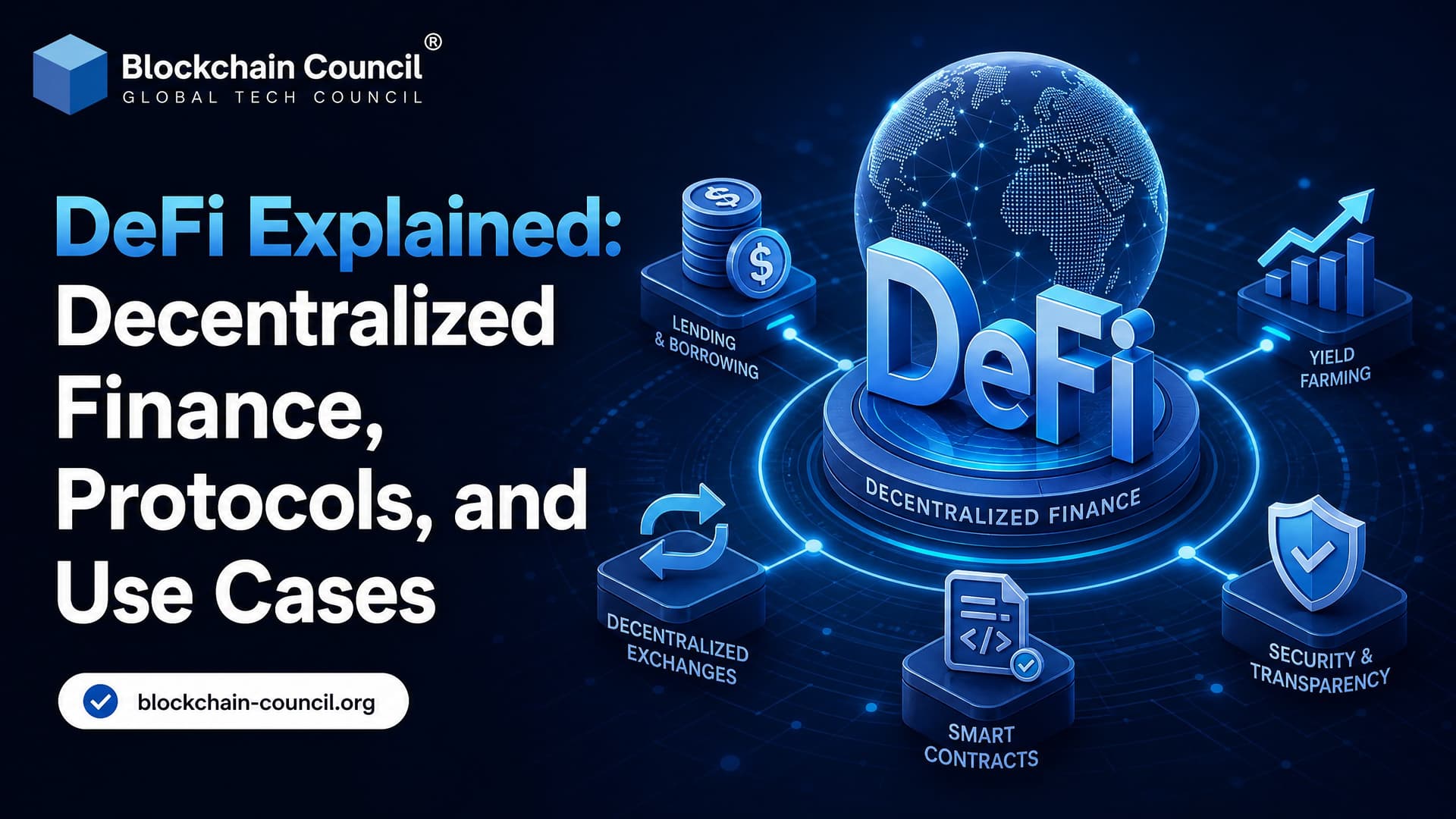
DeFi explained simply: decentralized finance is a blockchain-based financial system where lending, trading, payments, asset management, and insurance run through smart contracts instead of banks, brokers, or payment processors. Most activity still centers on Ethereum and EVM-compatible networks, but the DeFi stack now spans Layer 2 rollups, bridges, stablecoins, tokenized real-world assets, and AI-assisted automation.
The idea sounds abstract until you use it. Connect a wallet, approve a token, sign a transaction, and a smart contract executes the agreement. No bank branch. No market closing bell. Also no help desk if you sign the wrong transaction. That trade-off is the heart of DeFi.

What Is DeFi?
Decentralized finance, or DeFi, refers to financial applications built on programmable blockchains. These applications use smart contracts, which are self-executing programs that enforce rules on-chain. A lending protocol can calculate interest, accept collateral, issue loans, and trigger liquidations without a loan officer. A decentralized exchange can match trades through liquidity pools instead of a central order book.
Core features of DeFi include:
- Open access: Anyone with an internet connection and a compatible wallet can use many DeFi protocols.
- Non-custodial control: You usually keep control of your private keys rather than depositing assets with an exchange or bank.
- Smart contract execution: Rules are coded and visible on-chain, although reading the code still requires skill.
- Composability: Tokens, liquidity positions, lending receipts, and vault shares can interact across protocols.
- 24/7 markets: DeFi does not wait for banking hours or regional settlement windows.
This is why DeFi matters for financial inclusion. The World Bank Global Findex has estimated that about 1.4 billion adults remain unbanked. DeFi cannot solve identity, education, and internet access problems by itself, but stablecoin wallets and open lending markets can reach users who are poorly served by traditional finance.
How DeFi Works: The Technical Layers
Modern DeFi is no longer just a set of Ethereum contracts. The architecture is now better understood as a layered system.
Settlement Layer
This is the base blockchain that records ownership and final settlement. Ethereum is the main reference point, with mainnet chain ID 1 and Proof of Stake consensus. Other chains also host DeFi activity, but Ethereum remains the settlement anchor for many high-value assets.
Execution Layer
Smart contracts and Layer 2 rollups handle transaction logic. Rollups such as Arbitrum, Optimism, Base, and zkSync reduce transaction costs by executing activity off the Ethereum mainnet while posting data or proofs back to Ethereum. This matters because a simple swap on mainnet can be uneconomical during congestion.
Bridging Layer
Bridges and cross-chain messaging protocols move assets or instructions between networks. This creates broader liquidity, but it also adds risk. Bridge exploits have been among the largest loss events in crypto, so do not treat wrapped assets as identical to native assets without checking the issuer and security model.
Smart Account UX Layer
Account abstraction, including ERC-4337 and proposals such as EIP-7702, aims to make wallets safer and easier to use. Features include gas sponsorship, batched transactions, spending limits, session keys, and recovery options. This is where DeFi becomes more usable for normal users.
AI Automation Layer
AI agents are beginning to monitor collateral ratios, scan arbitrage routes, and manage portfolio rules. Be careful here. An AI agent with signing authority is not a chatbot, it is an automated trader. Give it narrow permissions and test it on small balances first.
Major DeFi Protocol Categories
Decentralized Exchanges
Decentralized exchanges, or DEXs, let users trade tokens through smart contracts. Uniswap popularized the automated market maker model, where liquidity providers deposit token pairs and traders swap against the pool. Curve focuses heavily on stablecoin and like-kind asset swaps. Perpetual DEXs such as dYdX support leveraged derivatives trading.
DEXs process tens of billions of dollars in monthly volume, and perpetual DEX activity has grown sharply as traders seek on-chain alternatives to centralized exchanges.
Lending and Borrowing Protocols
Aave and Compound are the best-known examples. You deposit collateral, borrow against it, and pay a variable or fixed-style rate depending on the market design. If your collateral value falls below the required threshold, liquidation can happen automatically.
Here is the beginner mistake I still see in workshops: users approve the wrong token or forget approval entirely, then wonder why the transaction fails with execution reverted: ERC20: transfer amount exceeds allowance. That error usually means the contract is not approved to move the token amount you are trying to supply or swap.
Stablecoins
Stablecoins are the liquidity base of DeFi. They are tokens designed to track external assets, usually the US dollar. USDC, USDT, DAI, and newer regulated stablecoins support payments, lending, liquidity pools, and treasury management. By 2025, stablecoin supply had moved beyond 300 billion dollars according to market aggregators, making stablecoins one of the most practical crypto use cases.
Yield Aggregators
Yield aggregators such as Yearn Finance route deposits into strategies that seek better returns across lending markets and liquidity pools. They save time, but they also add another smart contract layer. Higher yield often means higher complexity. Read the strategy description, not just the annual percentage figure.
Derivatives and Synthetic Assets
DeFi derivatives include perpetual swaps, options, structured vaults, and synthetic assets. Synthetix helped pioneer tokenized exposure to external price feeds. These products are powerful, but they are not beginner products. Funding rates, oracle delays, liquidation rules, and slippage can hurt you quickly.
Insurance and Risk Hedging
Protocols such as Nexus Mutual offer coverage for selected smart contract failures or protocol events. Coverage is useful, but it is not a magic shield. Check exclusions, claims history, and whether the exact protocol version is covered.
Real-World DeFi Use Cases
- Payments and remittances: Stablecoins can move across borders in minutes using non-custodial wallets, often at lower cost than correspondent banking routes.
- Crypto-backed borrowing: Users can borrow stablecoins against ETH, BTC derivatives, or other crypto assets without selling their holdings.
- On-chain trading: DEXs let traders access spot markets, liquidity pools, and derivatives without giving custody to a centralized exchange.
- Asset management: Index products such as the DeFi Pulse Index and portfolio tools such as Set Protocol allow transparent on-chain strategies.
- Flash loan arbitrage: Traders borrow and repay within one transaction. If repayment fails, the whole transaction reverts. Useful, but highly competitive.
- Real-world asset tokenization: Protocols and asset managers are bringing Treasury bills, private credit, funds, and receivables on-chain.
DeFi Market Size and Institutional Growth
DeFi has moved far beyond the 2018 and 2019 experiment phase. Total value locked was around 43 billion dollars in April 2023. By 2025, several aggregators and infrastructure reports placed multi-chain DeFi TVL above 150 billion dollars, with later estimates still above 130 billion dollars despite market cycles.
Institutional activity is most visible in real-world asset tokenization. MakerDAO and Centrifuge helped connect on-chain capital to off-chain collateral such as trade receivables and US Treasury exposure. BlackRock and Franklin Templeton have also pushed tokenized funds and on-chain settlement into the mainstream conversation. Boston Consulting Group has projected that tokenized assets could reach 2 to 4 trillion dollars by 2030.
Risks You Should Not Ignore
DeFi removes intermediaries, but it does not remove risk. It changes where the risk sits.
- Smart contract bugs: A single logic flaw can drain a pool.
- Oracle failures: Bad price data can trigger unfair liquidations or mispriced trades.
- Bridge risk: Cross-chain systems can fail through validator, relayer, or contract weaknesses.
- Governance concentration: Token voting can be dominated by large holders or insiders.
- Regulatory uncertainty: MiCA in the European Union and proposed US stablecoin laws such as the GENIUS Act show that policy is catching up, but rules differ by jurisdiction.
- User security: Phishing signatures, fake token approvals, and compromised seed phrases remain common loss sources.
To be blunt, DeFi is a poor place to learn security by trial and error with large funds. Use a hardware wallet, inspect approvals, start with small transactions, and separate your testing wallet from long-term storage.
How to Start Learning DeFi
If you are a professional, developer, analyst, or enterprise decision-maker, learn DeFi in this order:
- Understand Bitcoin, Ethereum, wallets, gas, and private keys.
- Study ERC-20, ERC-721, automated market makers, over-collateralized lending, and EIP-1559 fee mechanics.
- Use testnets and small-value mainnet or Layer 2 transactions.
- Read audits and protocol documentation before depositing funds.
- Build a small project, such as a dashboard that reads Aave positions or Uniswap pool data.
For structured learning, Blockchain Council programs such as Certified Blockchain Expert™, Certified Blockchain Developer™, Certified Cryptocurrency Expert™, and Certified Smart Contract Developer™ connect blockchain fundamentals with DeFi protocol design and smart contract security.
The Future of DeFi
The next stage of decentralized finance will be less about flashy token launches and more about infrastructure. Expect more tokenized Treasury products, regulated stablecoins, account abstraction, intent-based trading, and AI agents that manage narrow financial tasks.
Still, the best DeFi users will not be the ones chasing the highest advertised yield. They will be the ones who understand contracts, collateral, liquidity, governance, and risk. Your next step: open a test wallet, study one protocol deeply, and trace a single deposit or swap from wallet signature to on-chain execution. That exercise teaches more than a dozen market predictions.
Related Articles
View All
Cryptocurrency
Governance Tokens Explained: Voting Rights in Decentralized Protocols
Governance tokens give holders voting rights over protocol upgrades, treasury spending, fees, and DAO rules. Learn how models, risks, and voting systems work.
Cryptocurrency
Utility Tokens Explained: Use Cases, Value, and Token Design
Utility tokens provide access, payments, governance, rewards, and staking inside blockchain ecosystems. Learn how value and tokenomics really work.

Cryptocurrency
Smart Contract Exploits Explained: How Hackers Drain DeFi Protocols
Smart contract exploits now target DeFi logic, bridges, governance, oracles, and keys. Learn how attacks work and how teams can reduce protocol risk.
Trending Articles
What is AWS? A Beginner's Guide to Cloud Computing
Everything you need to know about Amazon Web Services, cloud computing fundamentals, and career opportunities.

Can DeFi 2.0 Bridge the Gap Between Traditional and Decentralized Finance?
The next generation of DeFi protocols aims to connect traditional banking with decentralized finance ecosystems.
Claude AI Tools for Productivity
Discover Claude AI tools for productivity to streamline tasks, manage workflows, and improve efficiency.