

DCA in Crypto: A Beginner-Friendly Dollar-Cost Averaging Strategy

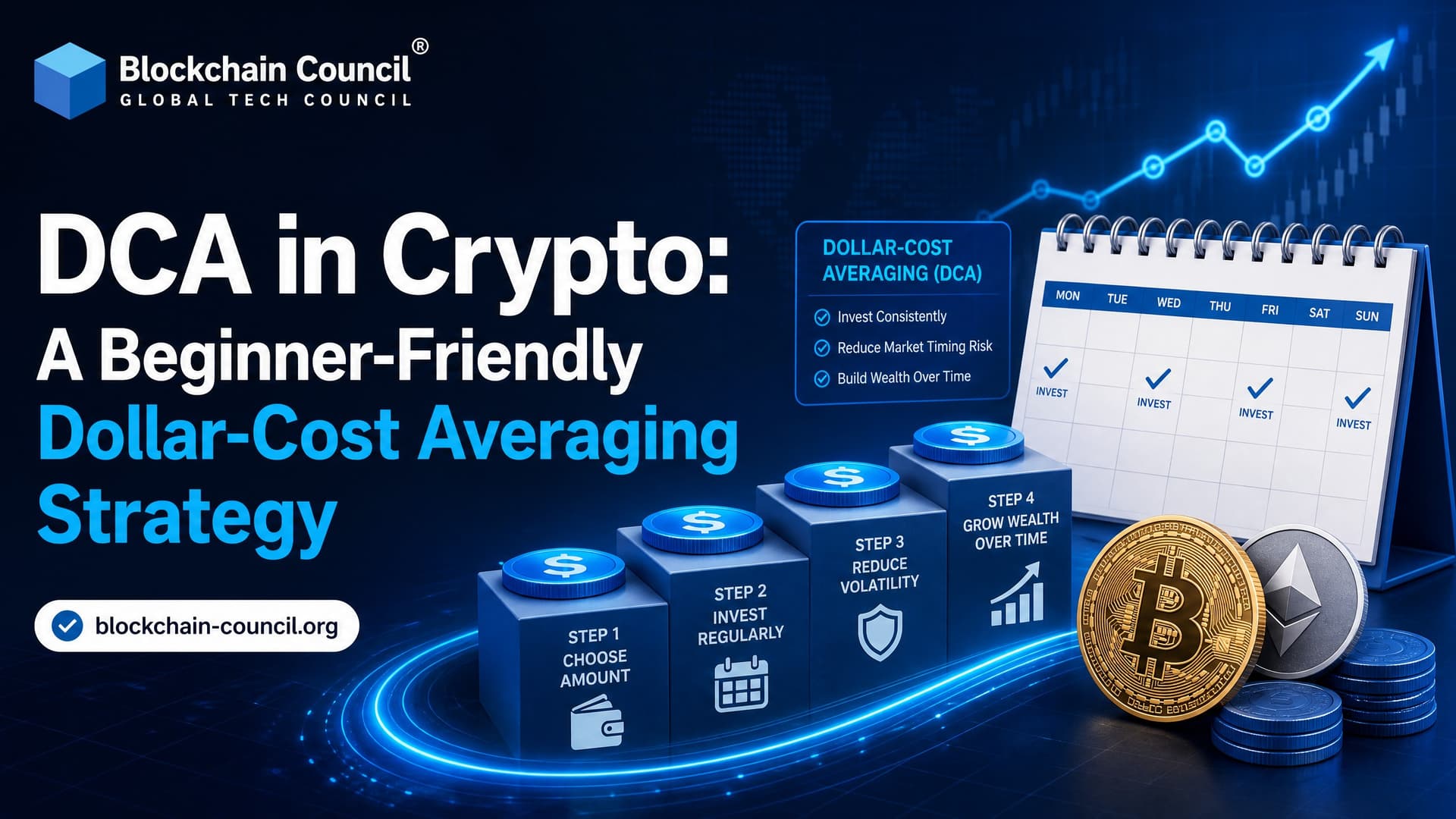
DCA in crypto, or dollar-cost averaging, means investing a fixed amount into a cryptocurrency on a fixed schedule, regardless of price. Instead of trying to guess the perfect entry, you buy consistently - weekly, fortnightly, or monthly - and let time smooth out some of the market noise.
It is simple. That is the point. Crypto markets can move 10% in a day, sometimes for no clear reason beyond liquidity, macro news, or forced liquidations. DCA gives you a process before emotion takes over. It does not guarantee profit, and it will not turn a weak asset into a good investment. But for beginners building long-term exposure to Bitcoin or Ethereum, it is one of the most practical starting points.

What Is Dollar-Cost Averaging in Crypto?
Dollar-cost averaging is a strategy where you invest the same amount of money at regular intervals. For example, you might buy 50 dollars of Bitcoin every Friday or 200 dollars of Ethereum on the first day of each month.
When prices are lower, your fixed amount buys more units. When prices are higher, it buys fewer units. Over time, this can reduce the impact of buying everything at one unlucky price.
Here is a basic example:
- Week 1: You invest 100 dollars when BTC is 100,000 dollars, so you buy 0.001 BTC.
- Week 2: You invest 100 dollars when BTC is 80,000 dollars, so you buy 0.00125 BTC.
- Week 3: You invest 100 dollars when BTC is 125,000 dollars, so you buy 0.0008 BTC.
Your total investment is 300 dollars, but your average purchase price is spread across three market conditions. You did not need to predict the bottom. Good, because most people cannot.
Why Beginners Use DCA in Crypto
DCA is popular because it solves a real beginner problem: hesitation. Many new investors wait for a crash, then freeze when it happens. Others buy after a rally because social media gets loud. Both behaviors are common. Both are expensive.
A recurring purchase plan helps you separate the decision to invest from the emotion of the day. Coinbase, Kraken, Fidelity, Crypto.com, and other major platforms describe DCA as a beginner-friendly approach because it creates discipline and reduces the pressure to time the market.
It Works Best as a Behavioral Tool
To be blunt, DCA is not magic. Its biggest value is psychological. It helps you keep buying during ugly periods, such as the 2018 crypto crash, the March 2020 pandemic sell-off, and the 2022 market decline after the FTX collapse.
That matters. The hardest trades are often the most valuable ones. Buying when the chart looks terrible is easier when the purchase is already scheduled.
It Can Reduce Timing Risk
Crypto has high volatility compared with most traditional assets. If you invest a large lump sum right before a major drawdown, the emotional pressure can be intense. DCA spreads that entry point over time, which can make large price swings easier to handle.
Still, DCA reduces timing risk. It does not remove market risk. If the asset goes down for years, or fails completely, your scheduled buys simply accumulate losses more gradually.
DCA vs Lump-Sum Investing: Which Is Better?
This is where beginners need an honest answer. Lump-sum investing often wins in strongly rising markets because more money is invested earlier. That result holds across most historical crypto backtests: in a market that trends up over the holding period, putting capital to work sooner usually beats spreading it out.
The size of the gap depends on timing and frequency. In powerful bull markets, lump-sum investors can end with meaningfully more crypto than DCA investors. Daily DCA tends to lag by only a small margin, while monthly DCA can lag much further when prices rise quickly, because the cash sits idle longer between buys.
So why use DCA at all? Because real investors are not spreadsheets. If you are unlikely to invest a lump sum confidently, or you might panic sell after a 30% drop, DCA may lead to better real-world behavior. The best strategy is the one you can follow without sabotaging yourself.
What the Data Says About Bitcoin DCA
Historical Bitcoin DCA results have been strong, although past performance is not a promise. Over long multi-year windows, a disciplined weekly DCA into Bitcoin has produced large gains despite multiple severe drawdowns of 70% or more. Bitcoin has also outperformed traditional assets like gold and major stock indices across several of those periods.
Some analyses find that monthly Bitcoin DCA has been profitable over most 5-year holding periods, including entries made near previous cycle peaks. That is worth understanding, but read it carefully. The key word is historical. Bitcoin has a longer track record and deeper liquidity than most crypto assets, yet it remains volatile. Altcoins can be far less forgiving.
How to Start a Crypto DCA Plan
If you want to use DCA in crypto, keep it boring. Boring is useful.
- Choose the asset. Beginners usually start with Bitcoin or Ethereum because they have higher liquidity, broader institutional adoption, and longer public histories than most tokens.
- Set a fixed amount. Pick an amount you can afford without affecting rent, debt payments, emergency savings, or business cash flow.
- Choose a schedule. Weekly DCA is common. Monthly DCA is simpler, but it deploys capital more slowly.
- Automate the purchase. Use recurring buy tools if your exchange supports them. Automation reduces second-guessing.
- Track your cost basis. Every buy creates a tax lot in many jurisdictions. Do not leave this until year-end.
- Review quarterly, not daily. Check whether the asset still fits your thesis. Do not change the plan because of one red candle.
A practical detail from working with beginners: small recurring buys can create a messy tax record. If you buy weekly for two years, that is more than 100 purchase lots before you even sell. Export your exchange CSV files regularly and store them. Also watch withdrawal fees. Moving 20 dollars of ETH from an exchange during a gas spike can be irrational if the network fee eats a large part of the balance.
Which Assets Are Best for DCA?
DCA works best for assets you believe can survive multiple market cycles. That usually means prioritizing:
- Liquidity: Can you buy and sell without large slippage?
- Market history: Has the asset survived at least one full bear market?
- Security model: Is the network widely used and tested?
- Developer activity: Is there real maintenance and adoption?
- Regulatory risk: Could the asset face listing or compliance pressure?
For most beginners, Bitcoin-first or Bitcoin plus Ethereum is more sensible than spreading 25 dollars across ten small tokens. DCA into a low-quality asset is still a bad plan. You are just making the mistake slowly.
Pros and Cons of DCA in Crypto
Advantages
- Simple to follow: You do not need advanced charting or trading signals.
- Reduces emotional buying: You buy on schedule, not because a token is trending.
- Helps during bear markets: You keep accumulating when prices are lower.
- Good for salary-based investing: It matches how many professionals receive income.
- Easy to automate: Most major exchanges support recurring purchases.
Limitations
- Can underperform lump sum: If the market rises sharply, waiting to deploy capital can cost you.
- Does not fix bad asset selection: A failing token can keep falling.
- Fees matter: Frequent small buys can be expensive on some platforms.
- Requires patience: DCA is designed for multi-year investors, not short-term traders.
Common DCA Mistakes to Avoid
New investors often make the same errors. Avoid these:
- Changing the amount every time price moves: That turns DCA into emotional trading.
- Using money you may need soon: Crypto can stay down longer than your cash buffer allows.
- Buying illiquid tokens: Low volume can make exits painful.
- Ignoring fees: Compare exchange fees, spread, and withdrawal costs.
- Stopping during bear markets: If your thesis is still valid, bear markets are where DCA matters most.
Where DCA Fits in Professional Crypto Education
DCA is a beginner strategy, but it also connects to deeper topics: portfolio construction, custody, tax reporting, token risk, Bitcoin market cycles, and investor psychology. If you want a structured path, Blockchain Council's Certified Cryptocurrency Expert™ is a relevant learning option for crypto market fundamentals. For broader distributed ledger concepts, consider the Certified Blockchain Expert™. If your focus is Bitcoin specifically, the Certified Bitcoin Expert™ can help you understand the asset beyond price charts.
For developers and enterprise teams, DCA is not just a retail habit. Treasury teams may phase into crypto exposure to manage governance risk, board approvals, and accounting review. MicroStrategy, now Strategy, is often cited as a high-profile example of repeated Bitcoin acquisition over time rather than a single purchase.
Is DCA in Crypto Right for You?
DCA in crypto is a strong fit if you have a long time horizon, steady income, and no desire to trade actively. It is also useful if a lump-sum investment would make you anxious enough to sell at the wrong time.
It is the wrong fit if you are trying to maximize returns in a confirmed bull market and already have the capital, conviction, and risk tolerance to invest immediately. It is also wrong if you use it as an excuse to avoid research.
Start with a small, fixed amount. Use Bitcoin or Ethereum before experimenting with smaller assets. Track every purchase. Then build your knowledge through a structured program such as Blockchain Council's Certified Cryptocurrency Expert™ so your DCA plan is based on understanding, not hope.
Related Articles
View All
Cryptocurrency
The Future of Crypto: Regulation, Institutional Adoption & Digital Assets
Explore the Future of Crypto, from regulation and spot ETFs to stablecoin payments, CBDCs, and tokenised assets. A clear, up-to-date guide for beginners and professionals.

Cryptocurrency
Beyond Bitcoin: DeFi, Stablecoins, NFTs & the Expanding Crypto Ecosystem
Go Beyond Bitcoin and explore DeFi, stablecoins, NFTs, DAOs, tokenisation, and Web3. A clear guide to how the expanding crypto ecosystem works and how its parts connect.

Cryptocurrency
Understanding the Crypto Market: Prices, Volatility & What Moves Crypto
Understanding the Crypto Market made simple. Learn how crypto prices are set, what market cap and liquidity mean, why volatility happens, and which factors move prices.
Trending Articles
The Role of Blockchain in Ethical AI Development
How blockchain technology is being used to promote transparency and accountability in artificial intelligence systems.
How Blockchain Secures AI Data
Understand how blockchain technology is being applied to protect the integrity and security of AI training data.
What is AWS? A Beginner's Guide to Cloud Computing
Everything you need to know about Amazon Web Services, cloud computing fundamentals, and career opportunities.