

Rug Pull vs Exit Scam: Key Differences Crypto Investors Must Understand

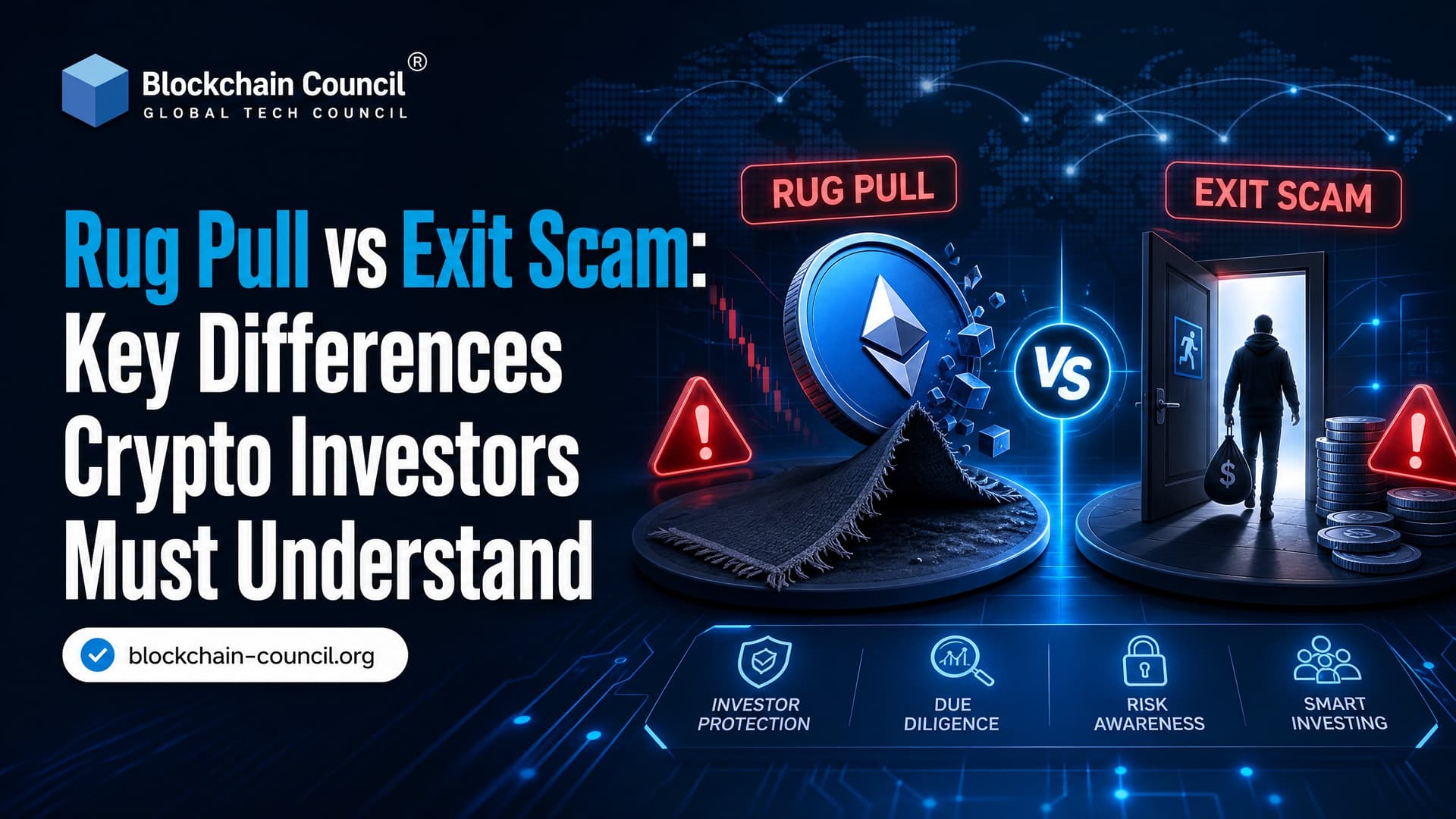
Rug pull vs exit scam is not just a wording debate. A rug pull is usually a DeFi-native exit, often carried out through liquidity removal or malicious smart-contract logic. An exit scam is broader: an ICO, exchange, NFT project, or crypto service raises or holds funds, then the operators disappear.
The result feels similar for investors. Funds vanish. Tokens crash. Telegram goes quiet. But the mechanics differ, and those mechanics decide what you should inspect before you put capital at risk.

Rug Pull vs Exit Scam: The Short Version
Think of a rug pull as a subset of exit scams. Industry sources describe rug pulls as scams where project insiders abandon the project and take value from investors, commonly by draining liquidity pools, dumping large token holdings, or using smart contracts that were designed to trap buyers.
An exit scam is older and wider. It can happen in crypto, dark markets, exchanges, ICOs, custodial platforms, and NFT drops. The operator presents a legitimate business, collects customer or investor funds, then stops honoring obligations and disappears.
- Rug pull: usually token-based, DeFi-focused, and visible through on-chain liquidity or contract activity.
- Exit scam: any insider abandonment where operators run off with investor funds, customer deposits, or project treasury assets.
- Relationship: most rug pulls are exit scams, but not every exit scam is a rug pull.
How a Rug Pull Works
Most rug pulls depend on control. Control of liquidity. Control of minting. Control of transfer rules. If one wallet can change the rules after buyers arrive, you are not buying into a fair market. You are trusting an admin key.
Liquidity pool rug
In a classic decentralized exchange rug pull, developers create a token and pair it with ETH, BNB, USDT, or another liquid asset in a DEX pool. Marketing starts. The chart climbs. Buyers add demand.
Then the team removes the paired asset from the pool. Holders still own the project token, but there is no real market left. The token price often collapses to near zero within minutes.
This is why liquidity lock status matters. If liquidity can be withdrawn by one externally owned account, you should treat the project as high risk, no matter how polished the website looks.
Honeypot or malicious transfer logic
Some rug pulls are coded into the token from day one. Analysts have documented tokens that allow buying but block selling, permit unlimited minting, or let owners impose extreme fees that route value to insiders.
A practical detail: when you test a suspicious token sale through a Uniswap V2-style router, a honeypot may fail with an error like TransferHelper: TRANSFER_FROM_FAILED. That error is not proof by itself, but it is a real warning if buys succeed and sells repeatedly revert while the owner wallet can still trade.
Look for risky Solidity 0.8.x patterns such as:
- Owner-only mint functions with no hard supply cap.
- Blacklist mappings that can block specific wallets from transferring.
- Fee variables that can be changed to very high percentages.
- Trading enable switches controlled by a single owner.
- Upgradeable proxy contracts without transparent governance.
Hype, insider dumping, and liquidity withdrawal
Not every rug uses exotic code. Some teams use fake partnerships, bot-driven volume, influencer posts, and aggressive yield claims to drive buyers into a shallow market. Insiders then dump their allocation or remove liquidity after the price spikes.
To be blunt, a token with a locked comment section, anonymous founders, no product, and a 10,000 percent annual yield is not early alpha. It is usually bait.
How an Exit Scam Works
An exit scam may have little to do with DeFi mechanics. It can be entirely off-chain. The key issue is custody or control: the operator holds user funds or raised capital, then refuses to return it.
ICO or token sale exits
During the 2017 ICO boom, one widely cited industry estimate suggested that roughly 80 percent of ICOs were scams. Many followed the same path: publish a whitepaper, raise funds, promise a platform, then never build it.
Research on DeFi rug pulls frames exit scams as projects that promise goods or services but abandon delivery once funds are collected. The scam is not always hidden in code. Sometimes it is hidden in the roadmap.
Centralized exchange exits
Centralized platforms can exit by halting withdrawals while deposits remain open. Users see maintenance notices, delayed support replies, and changing explanations. Then the website goes offline.
The Thodex case is often cited as a major centralized exchange exit scam, with the founder accused of fleeing after withdrawal problems. Darknet market cases show the same pattern outside standard crypto investing. The Wall Street Market administrators were accused of stealing roughly 14.2 million USD in cryptocurrency before authorities intervened.
NFT and service-based exits
NFT projects can also drift into exit-scam territory. Buyers fund a collection based on promised utility, prizes, games, metaverse access, or revenue-sharing style benefits. Then updates stop. The team disappears or moves to a new brand.
Anti-money-laundering bodies have warned that influencer marketing, unrealistic returns, and vague utility claims can pull buyers into projects they do not fully understand. That warning applies equally to NFTs, staking products, and yield farming campaigns.
Key Differences Investors Should Know
| Factor | Rug Pull | Exit Scam |
|---|---|---|
| Scope | Mostly DeFi tokens, DEX pools, yield farms, and smart contracts | ICOs, exchanges, NFT projects, marketplaces, custodial services, and DeFi |
| Main method | Liquidity removal, malicious transfer logic, unlimited minting, admin abuse | Operators abandon the project and take raised funds, deposits, or treasury assets |
| Technical footprint | Often visible on-chain through contract calls and liquidity withdrawals | May involve both on-chain transfers and off-chain silence or shutdowns |
| Timing | Often sudden after a hype phase | Can be sudden or slow, with weeks of excuses before disappearance |
| Best defense | Contract review, liquidity analysis, holder distribution checks | Custody review, team verification, treasury transparency, legal and operational due diligence |
What the Data Says
The scale is larger than many investors assume. Solidus Labs reported that 8 percent of Ethereum ERC-20 tokens and 12 percent of Binance Smart Chain BEP-20 tokens in its analysis were designed as rug pulls. That is a serious signal for anyone trading long-tail tokens.
Earlier research counted 24 rug pulls in 2021 and 262 in 2022, but Solidus argued these figures undercounted the true number. Academic work cataloged 101 rug pulls across six types of DeFi services, with many happening within six months of launch.
Exit scams have also caused severe losses, with public estimates putting the total above 4.3 billion USD in 2019 alone. These are not edge cases. They are a recurring risk pattern in permissionless and lightly regulated markets.
Real Examples That Show the Difference
- Squid Game (SQUID) token: widely reported as a rug pull after buyers found selling difficult and the token collapsed when insiders exited.
- AnubisDAO: described by major crypto education sources as a DeFi rug pull after substantial funds vanished from the project.
- Luna Yield: a Solana yield-farming project where developers allegedly drained investor funds and disappeared.
- Meerkat Finance: first discussed as a hack, then widely viewed as a possible insider rug after funds were drained shortly after launch.
- Thodex: a centralized exchange case that fits the exit scam model because users depended on the platform to honor withdrawals.
Red Flags Before You Buy or Deposit
Rug pull red flags
- The owner can mint unlimited tokens.
- The contract can block selling or blacklist wallets.
- Trading fees can be changed without limits.
- Liquidity is not locked, or the lock is short and controlled by the team.
- The token has very few holders and one wallet controls a large supply.
- No credible audit exists for a complex DeFi protocol.
- The project pushes extreme APY without explaining where yield comes from.
Exit scam red flags
- The team is anonymous, unverifiable, or uses stock photos.
- The roadmap is ambitious but technically vague.
- Withdrawals are delayed with inconsistent explanations.
- Social channels disable comments or ban basic questions.
- Custody of ICO funds, exchange deposits, or NFT sale proceeds is unclear.
- Influencer promotion is stronger than product evidence.
A Practical Due Diligence Checklist
Use this before buying a new token or depositing into a platform:
- Check the contract on a block explorer. On Ethereum, use Etherscan. On BSC, use BscScan. Confirm whether the source code is verified.
- Review owner privileges. Search for terms like mint, blacklist, setFee, pause, and excludeFromFee.
- Inspect liquidity. See whether LP tokens are locked, burned, or held by a deployer wallet.
- Test small sells first. If you cannot sell a tiny amount, do not assume you can sell a larger amount later.
- Check token distribution. A few insider wallets holding most of the supply can crush the market.
- Verify claims outside the project website. Partnerships, audits, exchange listings, and team credentials should be independently confirmable.
- Avoid custody you cannot assess. If a platform controls your funds and offers no proof of reserves, audit trail, or governance clarity, size your risk accordingly.
Where Education Fits
Tools help, but they do not replace judgment. If you work in crypto compliance, product, investing, or development, you need to understand how token contracts, liquidity pools, custody models, and governance controls interact.
This topic works as a practical bridge into related learning paths such as the Certified Cryptocurrency Expert™, Certified Blockchain Expert™, and Certified Smart Contract Developer™ programs from Blockchain Council. If your goal is investing or advisory work, start with cryptocurrency fundamentals and market-risk analysis. If your goal is technical review, learn Solidity, ERC-20 behavior, Uniswap-style AMM mechanics, and smart-contract security basics.
Final Takeaway: Follow the Control
The easiest way to separate a rug pull from an exit scam is to ask one question: who controls the money, and how can they take it?
In a rug pull, that control is often in the liquidity pool or smart contract. In a broader exit scam, it may sit with an ICO treasury, centralized exchange wallet, NFT sale wallet, or private company account.
Your next step is simple. Before you invest, trace the control points: contract ownership, liquidity custody, treasury access, withdrawal terms, and team accountability. If you cannot identify who can move the funds, assume they can move them against you.
Related Articles
View All
Cryptocurrency
Public Key vs Private Key: Crypto Keys Explained for Beginners
Public key vs private key explained for crypto beginners, including wallet addresses, transaction signing, seed phrases, and private key security basics.

Cryptocurrency
Cryptocurrency vs Blockchain: Key Differences Every Beginner Should Know
Understand cryptocurrency vs blockchain in plain terms, including how ledgers, tokens, regulation, use cases, and market risks differ for beginners.

Cryptocurrency
How Crypto Gains and Losses Are Taxed: A Simple Guide for Investors
A practical guide to how crypto gains, losses, swaps, staking rewards, mining income, and new reporting rules affect investor taxes.
Trending Articles
What is AWS? A Beginner's Guide to Cloud Computing
Everything you need to know about Amazon Web Services, cloud computing fundamentals, and career opportunities.

Can DeFi 2.0 Bridge the Gap Between Traditional and Decentralized Finance?
The next generation of DeFi protocols aims to connect traditional banking with decentralized finance ecosystems.
Claude AI Tools for Productivity
Discover Claude AI tools for productivity to streamline tasks, manage workflows, and improve efficiency.