

A Practical Guide to Building a Crypto Compliance Program for Startups

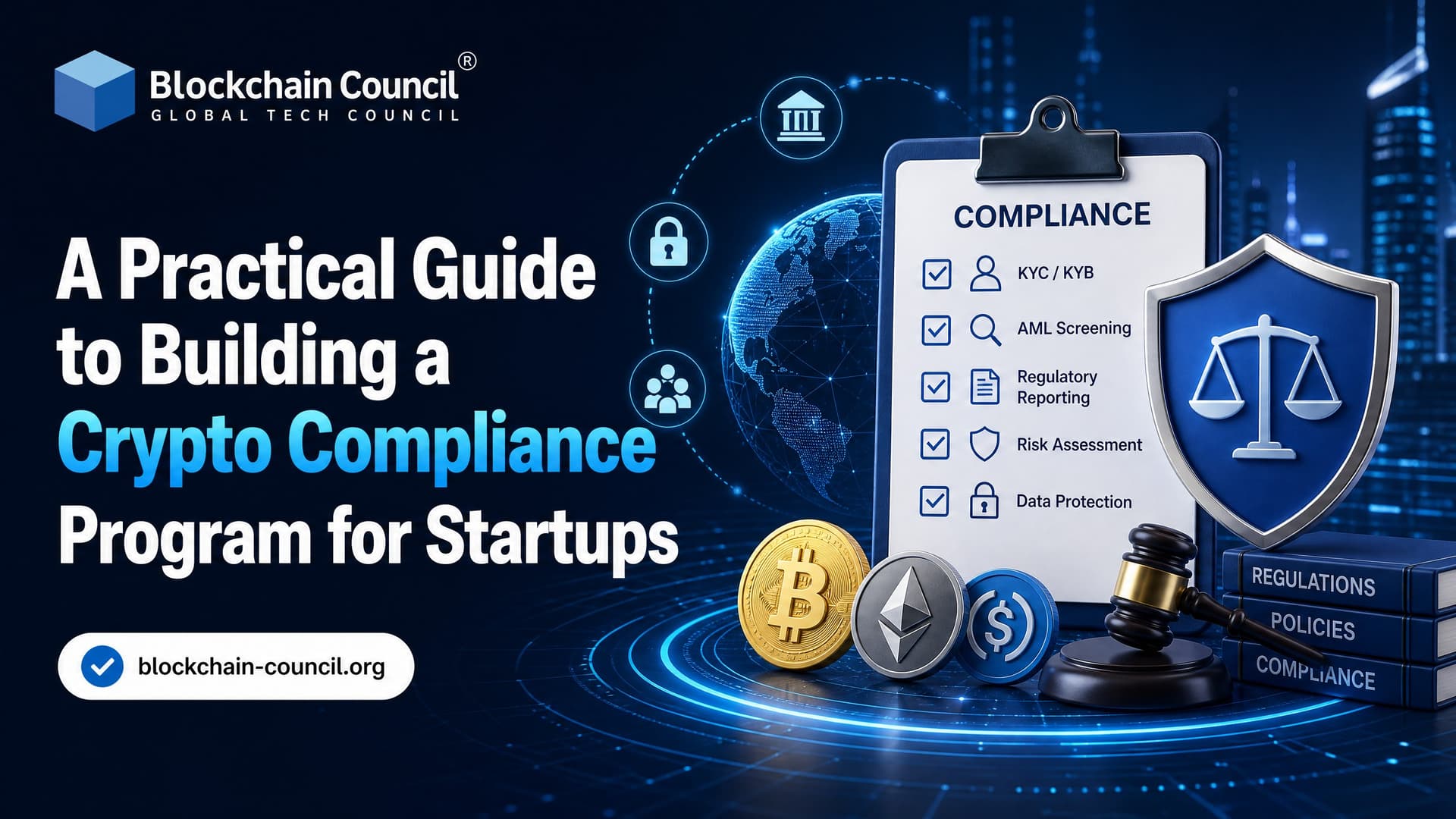
A crypto compliance program is not something you bolt on after product-market fit. If your startup touches customer funds, wallets, token transfers, fiat ramps, or exchange activity, regulators, banks, and institutional partners will expect clear AML, sanctions, and governance controls from day one.
The hard part is sizing it right. A seed-stage team does not need a 30-person compliance department. It does need a written view of its regulatory perimeter, a focused risk assessment, basic KYC and sanctions controls, and proof that people are making documented, risk-based decisions.

Why Crypto Compliance Has Changed for Startups
Regulatory expectations for crypto firms now look a lot like those applied to traditional financial institutions. The Financial Action Task Force treats many crypto businesses as virtual asset service providers, or VASPs, which can trigger KYC, AML monitoring, Travel Rule, and reporting duties. In the European Union, MiCA is now the central framework for many crypto-asset service providers, while AML rules still sit alongside it.
In the United States, you may face overlapping expectations from FinCEN, OFAC, the SEC, the CFTC, and state money transmission regulators. OFAC's 2021 sanctions compliance guidance for the virtual currency industry specifically recommends ongoing sanctions risk assessments, blockchain analytics, geolocation tools, and documented controls.
To be blunt, many startups underestimate the banking angle. A partner bank or payment processor often asks tougher operational questions than a regulator does in your first year. They want to know who your customers are, how you screen wallets, what you do with alerts, and whether you can prove any of it.
Step 1: Define Your Regulatory Perimeter
Start with a written perimeter memo. Keep it short, but make it specific. Map what the product actually does, not what the pitch deck says.
- Do you custody crypto assets or only provide software?
- Do users exchange one asset for another?
- Do you touch fiat through cards, ACH, SEPA, or payment partners?
- Do you issue a token, operate a marketplace, or run a DeFi front-end?
- Which countries can users access from day one?
This exercise helps you work out whether you may be a VASP, money services business, broker-dealer, investment adviser, payment institution, or a non-custodial software provider. Labels matter, but activity matters more.
A common founder mistake is launching globally because the app is technically accessible globally. Do not do that by accident. Use jurisdiction blocking, app store controls, terms of service, and onboarding rules to match your actual licensing strategy.
Step 2: Run a Focused AML and Sanctions Risk Assessment
Your first risk assessment should not be a 90-page document copied from a bank. It should answer one question: where could this product be misused?
Assess the main risk categories
- Customer risk: retail users, institutional clients, high-risk industries, politically exposed persons, and beneficial ownership complexity.
- Product risk: custody, swaps, privacy features, stablecoins, cross-chain bridges, and high-value transfers.
- Geographic risk: customer location, counterparty location, IP address, sanctioned jurisdictions, and high-risk corridors.
- Transaction risk: velocity, unusual size, rapid in-and-out flows, mixer exposure, darknet links, scam proceeds, and ransomware typologies.
- Delivery channel risk: APIs, affiliates, embedded wallets, third-party brokers, and mobile-only onboarding.
Turn the assessment into control decisions. If your app supports withdrawals to unhosted wallets, decide which risk score triggers manual review. If you support stablecoin transfers, decide whether a large USDT deposit followed by an immediate withdrawal should create a velocity alert.
One practical detail: wallet analytics alerts get noisy fast. A wallet with indirect exposure to a mixer several hops away does not deserve the same action as a direct deposit from a sanctioned address. Write that distinction into your escalation rules, or your team will either over-block good users or miss the serious cases.
Step 3: Set Governance Before You Buy Tools
Tools do not own regulatory decisions. People do.
At minimum, designate a compliance owner. In an early startup, that may be the general counsel, CFO, COO, or a founder. Give that person authority to pause launches, reject high-risk customers, and escalate issues to the board or lead investors.
Your governance pack can be simple:
- A compliance charter with responsibilities and reporting lines.
- A customer acceptance policy.
- An escalation matrix for sanctions hits, suspicious activity, and law enforcement requests.
- A log of exceptions and approvals.
- Board or founder meeting notes showing compliance oversight.
This documentation matters. Enforcement actions tend to show the same pattern: the firm had tools, but decisions were poorly recorded, ownership was unclear, and alerts sat unresolved.
Step 4: Build KYC, KYB, and Onboarding Controls
Risk-based onboarding is the core of a crypto compliance program. Do not collect unnecessary data, but do collect enough to understand who is using your product and why.
For individual customers
- Verify identity with government ID checks and liveness where needed.
- Screen against sanctions lists, PEP databases, and adverse media sources.
- Collect source of funds or source of wealth for higher-risk users.
- Use geography, product use, and transaction thresholds to assign risk ratings.
For business customers
- Verify legal registration and operating status.
- Identify ultimate beneficial owners and control persons.
- Screen the entity, directors, signers, and owners.
- Understand the business model, expected volumes, and source of funds.
Do not bury compliance at the end of the user journey. If a user can deposit funds before identity checks clear, your operations team will eventually deal with frozen balances, angry tickets, and awkward reporting decisions.
Step 5: Monitor Wallets, Counterparties, and Transactions
Blockchain analytics and know-your-transaction (KYT) systems are now baseline expectations for many crypto startups. Regulators know these tools exist. Bank partners know it too.
Your monitoring setup should cover:
- Wallet screening: identify exposure to sanctioned addresses, mixers, darknet markets, scams, stolen funds, ransomware, and high-risk services.
- Counterparty risk: distinguish hosted wallets, unhosted wallets, exchanges, DeFi protocols, bridges, and smart contracts.
- Transaction monitoring: detect unusual velocity, structuring, rapid layering, cross-chain movement, and behavior inconsistent with the user profile.
- Sanctions controls: screen customers, wallets, IP data, and geolocation signals before allowing prohibited activity.
- Case management: record alert review, analyst notes, evidence, decisions, and escalation outcomes.
A good beginner rule: start with fewer, sharper scenarios. Direct sanctions exposure, deposits from known illicit clusters, high-risk jurisdiction access, and abnormal rapid withdrawals make better first controls than twenty vague rules no one can tune.
Step 6: Plan for the Travel Rule
If your startup sends or receives qualifying virtual asset transfers, the Travel Rule may require originator and beneficiary information to travel with the transaction between VASPs. The exact threshold and data fields vary by jurisdiction, so get legal analysis before launch.
Your Travel Rule plan should specify:
- Which transfers are in scope.
- What customer and beneficiary data you collect.
- How you identify counterparty VASPs.
- Which messaging network or vendor you use.
- How you handle missing, mismatched, or rejected data.
Do not treat the Travel Rule as a legal footnote. It affects product design, user prompts, API calls, data retention, and transaction approval workflows.
Step 7: Use a Crawl-Walk-Run Maturity Model
A startup compliance program should mature with the business. Trying to build a bank-grade function before launch can slow the company without improving real risk coverage. Doing nothing is worse.
Crawl
- Regulatory perimeter memo.
- Initial AML and sanctions risk assessment.
- Named compliance owner.
- Basic KYC, sanctions screening, and wallet monitoring.
- Simple alert review and documentation process.
Walk
- Formal AML, sanctions, Travel Rule, and recordkeeping policies.
- Customer risk scoring and enhanced due diligence triggers.
- Case management workflows and metrics.
- Staff training by role.
- Periodic rule tuning and risk assessment updates.
Run
- Independent testing of AML and sanctions controls.
- Internal audit or external review.
- Advanced analytics and model governance.
- Board-level compliance reporting.
- Licensing-ready evidence packs for regulators and banking partners.
Step 8: Track Metrics and Keep Audit-Ready Records
Policies are not enough. You need evidence that the controls actually work.
Track simple metrics from the beginning:
- Number of onboarding approvals, rejections, and manual reviews.
- Alert volume by scenario.
- False positive rate.
- Average time to close alerts.
- Number of escalations and suspicious activity reports, where applicable.
- Sanctions hits investigated and final outcomes.
Keep memos for hard decisions. If you allow a high-risk customer, record why. If you block a market, record why. If you tune a monitoring threshold, record the data behind the change. Six months later, no one remembers the Slack thread.
Common Mistakes to Avoid
- Buying tools without policies: vendors can detect risk, but your company must define the action.
- Copying bank templates: long policies that do not match your product fail in practice.
- Ignoring engineers: product and engineering teams need to understand sanctions blocks, data capture, audit logs, and edge cases.
- Manual monitoring for too long: spreadsheets break when transaction volume grows.
- Poor recordkeeping: undocumented decisions look careless, even when the decision was reasonable.
Skills Your Team Should Build
Founders and compliance leads should understand AML fundamentals, sanctions screening, wallet risk scoring, and crypto market structure. Technical teams should understand how controls map into APIs, smart contracts, custody flows, and data pipelines.
For structured learning, Blockchain Council's Certified Cryptocurrency Expert™ (CCE) gives teams a grounding in crypto business fundamentals. Teams that need deeper blockchain architecture context can explore the Certified Blockchain Expert™ (CBE). Developers working near smart contracts should consider the Certified Smart Contract Developer™ so compliance controls are not treated as an afterthought in product design.
Founder Checklist for a Crypto Compliance Program
- Have you mapped your activities and target jurisdictions?
- Do you know whether you may be a VASP, MSB, money transmitter, or another regulated category?
- Have you completed a written AML and sanctions risk assessment?
- Is a named person accountable for compliance?
- Do KYC and KYB controls match your customer risk?
- Are wallets and transactions screened using blockchain analytics?
- Do you have a Travel Rule position where applicable?
- Are alerts documented in a case workflow?
- Do staff receive role-specific training?
- Can you show metrics, testing plans, and decision records to a bank partner or regulator?
Next Step
Build your first version this week. Write the perimeter memo, complete a one-page risk assessment, appoint a compliance owner, and define your first five monitoring scenarios. Then train the team. If you plan to scale across markets, pair that buildout with formal crypto education through Blockchain Council certifications so founders, developers, and compliance staff share the same operating language.
Related Articles
View All
Cryptocurrency
Crypto Compliance and Asset Recovery: Why KYC, AML, and Forensics Matter
KYC, AML, and blockchain forensics now drive crypto compliance and asset recovery by linking wallets, monitoring risk, and supporting investigations.
Cryptocurrency
Crypto Wallet Recovery Guide: How to Regain Access Safely
Learn safe crypto wallet recovery steps for seed phrases, hardware wallets, MetaMask, custodial accounts, Lightning backups, MPC, and recovery services.

Cryptocurrency
What Is Crypto Asset Recovery? A Complete Beginner's Guide
Learn what crypto asset recovery means, how blockchain forensics and legal tools work, and how to avoid fake recovery services after theft or wallet loss.
Trending Articles
How Blockchain Secures AI Data
Understand how blockchain technology is being applied to protect the integrity and security of AI training data.

Can DeFi 2.0 Bridge the Gap Between Traditional and Decentralized Finance?
The next generation of DeFi protocols aims to connect traditional banking with decentralized finance ecosystems.
How to Create Claude Skills?
Claude Skills are one of the most important features Anthropic has introduced for users who want automation that is structured, consistent and reusable. Instead of giving Claude long instructions ever