

Crypto Asset Recovery: How Exchanges, Law Enforcement, and Experts Work Together

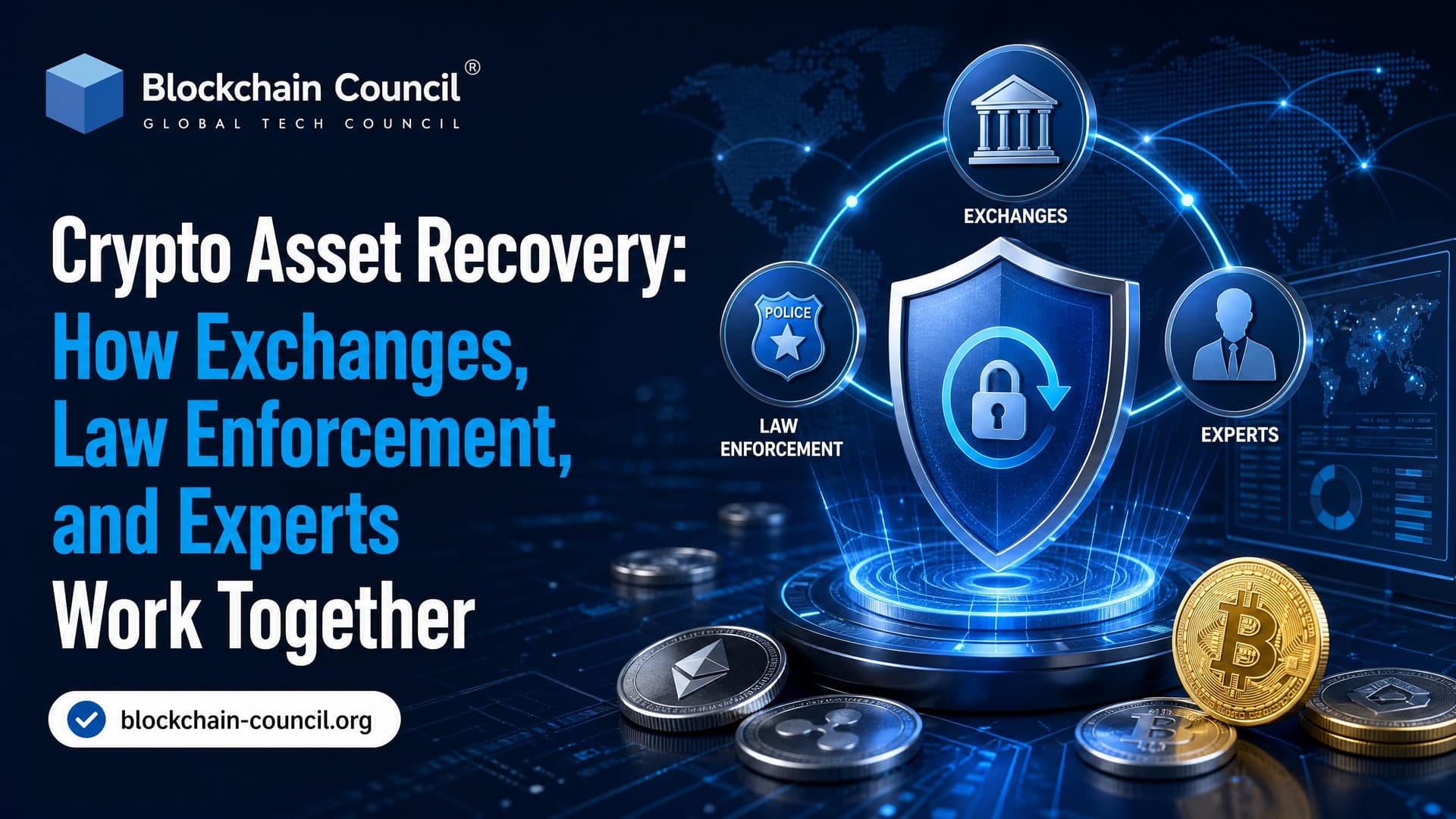
Crypto asset recovery works best when three groups move fast and share evidence: exchanges, law enforcement, and specialist recovery experts. Drop any one of them and the odds usually fall. Exchanges can freeze funds. Police can compel records and seize assets. Experts trace transactions and shape a legal strategy that courts will actually accept.
That sounds simple. It is not. A stolen token can pass through five wallets, a bridge, a decentralized exchange, and a custodial exchange before the victim finishes the first incident report. Speed matters. So does knowing who can really do what.

What Crypto Asset Recovery Looks Like Today
Crypto asset recovery is now a defined practice area. It sits where blockchain forensics, cybercrime investigation, civil litigation, and seized-asset management meet. Law firms seek freezing orders for digital assets. Investigators trace on-chain flows across Ethereum, Bitcoin, TRON, and other networks. Governments are building procedures for seizure, custody, and disposal.
Policy work from groups such as the Royal United Services Institute has pushed jurisdictions to improve their recovery frameworks. The Basel Institute on Governance has written about the hard questions around DeFi asset confiscation, including what public authorities should do with yield-bearing assets or governance tokens once seized.
The hard truth: recovery is far easier when stolen funds touch a regulated centralized exchange. It gets much harder when assets stay in self-custody, run through privacy tools, or land in non-cooperative jurisdictions.
The Three-Pillar Model of Crypto Asset Recovery
Modern recovery usually rests on three pillars:
- Exchanges, which act as custodians, compliance gateways, and fiat off-ramps.
- Law enforcement and regulators, which bring investigative authority, warrants, subpoenas, and cross-border cooperation.
- Recovery experts, including forensic investigators, lawyers, litigation funders, and asset managers.
Each group has limits. Working together, they can turn a wallet trail into a freeze, a disclosure order, and sometimes a real return of assets.
The Role of Exchanges in Crypto Asset Recovery
Centralized exchanges are the main chokepoints
Centralized exchanges are often the first realistic place to stop stolen crypto. If traced funds land at a compliant exchange, the compliance or financial crime team may restrict withdrawals while the matter is reviewed.
In practice, exchanges ask for specific material before they act. Expect to provide:
- Transaction hashes, not just screenshots
- Victim wallet addresses and suspected destination addresses
- Token type, network, amount, and UTC timestamp
- A short incident narrative
- A police report number or formal law enforcement reference
- A court order, if you are asking for transfer or return of assets
Here is a detail that catches victims out: an exchange may freeze an account but still refuse to return funds directly to you. That is not always obstruction. Usually it is due process. Without a police report, subpoena, freezing order, or final court order, the exchange risks paying the wrong person or breaking local law.
KYC and off-chain records matter
Self-hosted wallets hold no names or passports. Regulated exchange accounts usually do. They may carry KYC records, login IPs, device fingerprints, bank account links, withdrawal addresses, and support tickets. Those records connect blockchain activity to a person or company.
That is why investigators hunt for off-ramp points. A wallet trail is useful. A wallet trail that ends at a KYC exchange account is far stronger.
Where exchanges cannot help
Exchanges only have power once assets enter their systems. If funds stay in non-custodial wallets, move through decentralized exchanges, or sit in a smart contract that no party controls, an exchange cannot freeze them.
There is a jurisdiction problem too. A court order from one country may not bind an exchange incorporated somewhere else. Some exchanges cooperate quickly with properly formatted requests. Others need a local order, a mutual legal assistance request, or direct contact from domestic law enforcement.
The Role of Law Enforcement and Regulators
Police reports are more than paperwork
Victims sometimes treat law enforcement as optional because blockchain data is public. That is a mistake. A police report often gives exchanges the legal basis to hold a freeze in place. It also opens a formal path for subpoenas, warrants, and international cooperation.
Law enforcement can do things private parties cannot, including:
- Compel exchanges and hosting providers to disclose records
- Seize hardware wallets, seed phrases, servers, and phones
- Coordinate with foreign agencies
- Support confiscation after criminal proceedings
- Preserve evidence for prosecutors and courts
In cross-border fraud, that authority is often the line between knowing where funds went and being able to act on it.
Blockchain analytics is now part of financial crime work
Cybercrime units increasingly use blockchain analytics platforms and private forensic support. The workflow is familiar to anyone who has traced ERC-20 transfers: identify the victim transaction, follow token movements, separate exchange deposits from self-custody hops, and document every assumption.
Small technical errors can sink a case. A native ETH transfer on Ethereum mainnet, chain ID 1, does not emit an ERC-20 Transfer event. If your report treats it like a token transfer, a competent defense expert will catch the slip. Good recovery work keeps raw transaction hashes, explorer links, decoded function calls, and confidence levels clearly separated.
Capacity gaps still slow cases
Many agencies are improving, but gaps remain. Some police departments lack staff trained in digital asset custody. Some prosecutors are still working out how to present wallet clustering evidence. Some jurisdictions have unclear rules on whether seized crypto should be held, sold, auctioned, or converted to fiat.
Volatility adds pressure. If an agency seizes a token worth $2 million and it drops 40 percent before disposal, who owns the risk decision? This is one reason seized-asset management has grown into its own specialist field.
The Role of Crypto Recovery Experts
Experts turn traces into legal action
Recovery experts include blockchain forensic firms, specialist law firms, cyber investigators, litigation funders, and digital asset custodians. The good ones do not just draw lines between wallets. They build an evidence package that supports a freeze, disclosure request, injunction, settlement, or prosecution.
Typical expert work includes:
- Tracing funds across wallets, bridges, mixers, and DeFi protocols
- Identifying exchange deposit addresses and service clusters
- Preparing affidavits or expert reports
- Helping counsel seek freezing and disclosure orders
- Advising on civil claims, criminal complaints, or a combined approach
- Supporting custody, liquidation, or auction of recovered assets
To be blunt, a colorful flow chart is not enough. Courts want a clear method, reproducible findings, and an honest account of uncertainty.
Civil litigation, criminal complaints, or both?
The right route depends on the case. Civil litigation can move quickly for emergency freezing orders, especially where a known exchange holds the assets. Criminal complaints bring stronger investigative powers and international channels. Many serious cases use both.
A common pattern is simple: use forensic tracing to identify an exchange, file a police report, notify the exchange, then seek legal orders for disclosure or freezing. If defendants are identifiable, civil claims may follow. If funds tie back to organized crime, criminal enforcement takes the lead.
Recovery scams are a real threat
The growth of crypto asset recovery has pulled in fake recovery companies. Many run advance-fee tactics: they promise to retrieve stolen Bitcoin, ask for payment, then vanish. Worse, some send a so-called recovery tool that is actually wallet-draining malware.
Check credentials before you share anything. A legitimate provider should show verifiable company details, named professionals, legal or investigative qualifications, a written scope of work, and a process that involves law enforcement where appropriate. Never share a seed phrase. No serious recovery expert needs it to trace funds.
Why Coordination Matters in Cross-Border Cases
Most meaningful recoveries are coordinated. Picture a business email compromise where an employee sends USDT to a fraudster. The funds move from TRON to an exchange, out to Ethereum through a bridge, then into a second exchange.
In that case:
- The forensic team traces movements and identifies exchange deposit points.
- The victim files police reports in the relevant jurisdiction.
- Lawyers prepare urgent exchange notices and court papers.
- Exchanges freeze accounts where possible.
- Law enforcement seeks records and supports cross-border requests.
If the victim waits two weeks, funds may be withdrawn to self-custody or split across hundreds of addresses. Recovery is still possible, but the practical chances shrink fast.
Emerging Trends in Crypto Asset Recovery
More formal exchange processes
Major exchanges are likely to standardize freeze requests, law enforcement portals, and court order handling. That should cut delays, though smaller platforms will probably stay inconsistent.
Better DeFi tracing, but not magic
Analytics tools keep improving for cross-chain bridges, liquidity pools, and decentralized exchanges. Still, tracing is not the same as control. If no custodian exists and no key holder is identified, a victim may win a judgment but struggle to enforce it.
Clearer legal treatment of crypto assets
Courts in several jurisdictions increasingly treat crypto as property that can be frozen, traced, and made subject to proprietary claims. That trend matters. Clear property status makes legal remedies more predictable.
Professional seized-asset management
Governments and large claimants need secure custody, valuation, liquidation planning, and audit trails. Expect more specialist providers to support agencies that seize crypto but do not want to manage private keys in house.
What You Should Do After a Crypto Theft
If you are handling an incident, work in this order:
- Preserve evidence. Save transaction hashes, wallet addresses, emails, chat logs, domain names, and timestamped screenshots.
- Do not contact the scammer from your main wallet. You may expose more data or trigger further loss.
- File a police report. Get a reference number as soon as you can.
- Notify relevant exchanges. Provide precise transaction data and the police reference.
- Engage qualified experts. Use regulated lawyers and credible forensic investigators.
- Plan for litigation if funds are located. A freeze is temporary. Recovery usually needs a formal legal step.
Skills Professionals Need in This Field
Crypto asset recovery is now a serious career path for compliance teams, cyber investigators, lawyers, and blockchain analysts. You need to understand wallet models, token standards such as ERC-20 and ERC-721, exchange compliance workflows, chain analytics, and the basics of digital evidence.
If you are building these skills, look at Blockchain Council learning paths such as Certified Cryptocurrency Expert™ (CCE), Certified Blockchain Expert™ (CBE), and Certified Blockchain Developer™. For security-focused roles, pair blockchain knowledge with practical cybersecurity training and hands-on incident response practice.
Final Takeaway
Crypto asset recovery is not a solo effort. Exchanges can stop funds once assets enter custody. Law enforcement can compel records and coordinate across borders. Recovery experts connect the technical trail to legal action and safe asset handling.
Your next step is practical: build an incident response checklist before you need one. If you work in compliance, investigations, or digital asset security, strengthen your foundation with a recognized blockchain or cryptocurrency certification and practice tracing real public transactions on a block explorer.
Related Articles
View All
Cryptocurrency
How Does Crypto Asset Recovery Work? Step-by-Step Process Explained
Learn how crypto asset recovery works, from tracing stolen funds and freezing exchange accounts to wallet password recovery and victim restitution.

Cryptocurrency
How to Become a Certified Crypto Asset Recovery Expert
Learn how to become a certified crypto asset recovery expert through blockchain forensics, AML training, seizure skills, and real case experience.

Cryptocurrency
Career in Crypto Asset Recovery: Skills, Roles, and Opportunities
Explore a career in crypto asset recovery, including key skills, job roles, salary signals, and practical steps to enter blockchain forensics and compliance.
Trending Articles
The Role of Blockchain in Ethical AI Development
How blockchain technology is being used to promote transparency and accountability in artificial intelligence systems.
AWS Career Roadmap
A step-by-step guide to building a successful career in Amazon Web Services cloud computing.

Top 5 DeFi Platforms
Explore the leading decentralized finance platforms and what makes each one unique in the evolving DeFi landscape.