

Bridging Risk Audits: How to Audit Cross-Chain Bridges for Security and Liquidity Vulnerabilities
 Suyash Raizada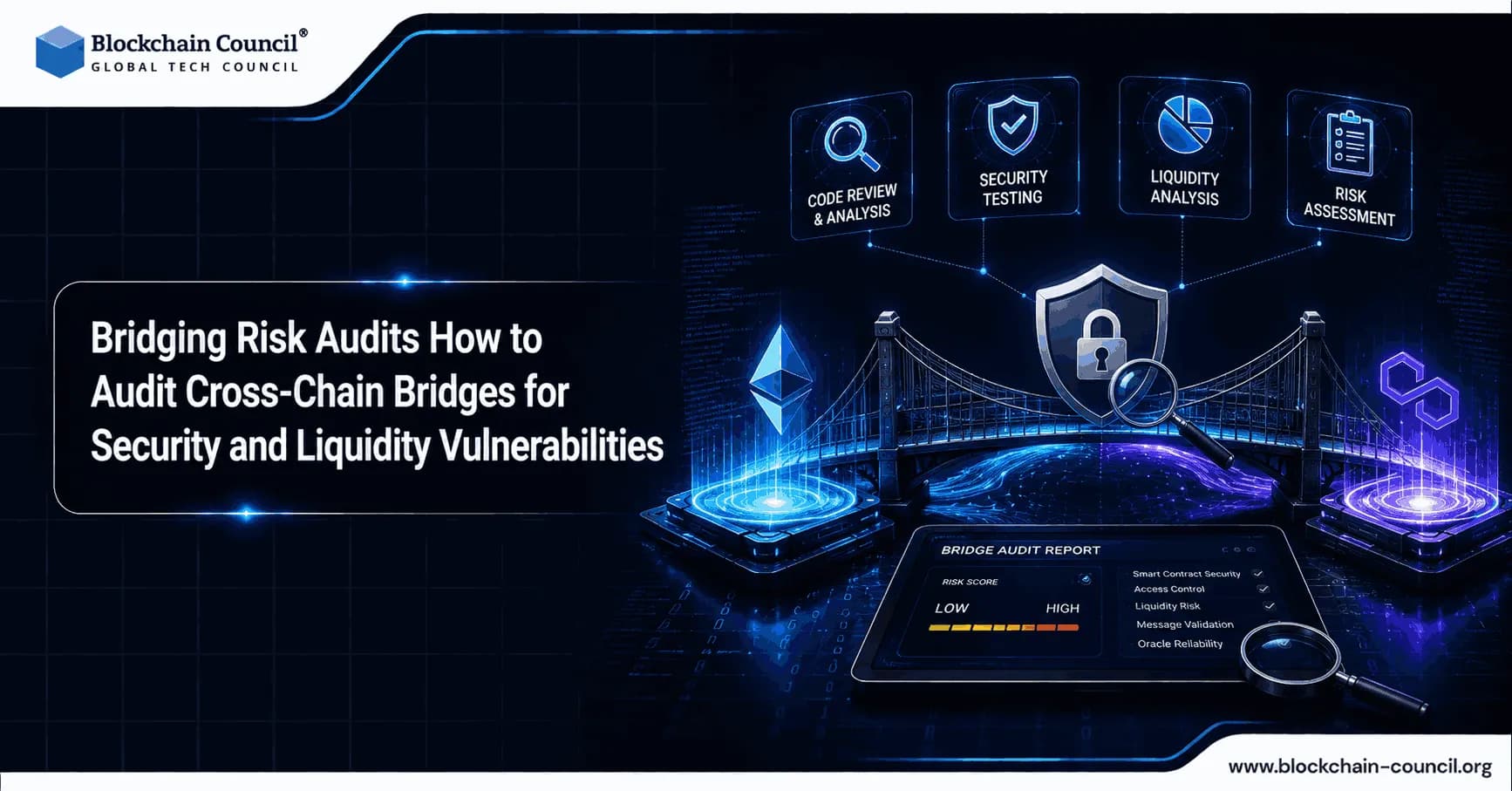
Bridging risk audits are now a core requirement for DeFi teams because cross-chain bridges concentrate value, complexity, and trust assumptions in one place. Bridges typically lock assets on one chain and mint or release a representation on another, which creates large attack surfaces across smart contracts, validator or relayer networks, and operational controls. Chainalysis reported that by August 2022, roughly $2 billion had been stolen across 13 bridge hacks, representing 69% of all funds stolen in crypto hacks in 2022 up to that point. Academic surveys from ACM in 2024 and a 2025 SoK review of 2023 bridge hacks similarly emphasize that bridges remain one of the highest-risk components in the ecosystem.
This guide explains how to audit cross-chain bridges for security vulnerabilities and liquidity vulnerabilities, with a practical methodology you can adapt to different bridge designs.

As cross-chain infrastructure becomes more complex, professionals need a solid understanding of blockchain architecture, consensus mechanisms, smart contracts, and decentralized protocols. A Certified Blockchain Expert credential helps build these practical skills, providing a strong foundation for evaluating bridge security and understanding the operational risks of modern blockchain ecosystems.
Why Cross-Chain Bridges Are High-Risk Systems
Most bridge failures cannot be explained by a single bug category. They reflect the reality that a bridge is an inter-chain system with multiple points of failure. Common risk multipliers include:
Concentrated TVL: bridge contracts and custodians can become honeypots.
Multi-chain state complexity: assumptions about message ordering, finality, and chain reorganizations often break.
External dependencies: oracles, relayers, validator sets, multisigs, and frontends expand the attack surface.
Operational centralization: small signer sets and admin keys can be attacked, coerced, or socially engineered.
Identifying weaknesses across smart contracts, operational controls, and digital asset flows requires specialized auditing expertise. A Certified Cryptocurrency Auditor credential helps professionals develop practical knowledge of blockchain auditing methodologies, transaction analysis, security controls, and risk assessment techniques that are directly applicable to cross-chain bridge reviews.
Bridge Designs and What Changes in an Audit
A robust bridging risk audit begins by classifying the bridge architecture, since the dominant risks differ by design family.
Lock-and-Mint / Burn-and-Release Bridges
Assets are locked on chain A and a wrapped asset is minted on chain B. Audits focus on collateral accounting, mint authorization, replay protection, and administrator controls.
Canonical Native Bridges
These are maintained by an L1 or L2 ecosystem - for example, rollup canonical bridges. Audits must thoroughly evaluate the bridge's relationship to the chain's consensus or validator set, upgrade processes, and any privileged roles.
Light Client and ZK-Based Bridges
These verify source chain events via on-chain light clients or proofs. The trust model improves, but audit complexity increases sharply. Auditors must validate proof verification, finality handling, and the correctness of cryptographic assumptions.
Liquidity Network and Router Bridges
These route transfers using liquidity providers rather than strict lock-and-mint mechanics. Smart contract security audits still matter, but liquidity and solvency become the primary concerns, including pool exhaustion, adverse selection, and depeg risk.
Audit Scope: Security Vulnerabilities and Liquidity Vulnerabilities
Cross-chain bridge audits should be multi-dimensional. Industry taxonomies, including Chainlink Labs' classification of key bridge vulnerabilities and multiple academic surveys, consistently show that exploit paths span several layers.
Core Security Attack Surfaces to Test
Smart contract vulnerabilities: reentrancy, unsafe external calls, input validation failures, incorrect accounting, and upgradeability pitfalls.
Message verification failures: forged messages due to compromised validators, flawed quorum logic, or incorrect event validation.
Key and signer compromise: weak custody practices, missing HSM requirements, poor key rotation, and social engineering exposure. Chainalysis has highlighted the role of sophisticated threat actors in major bridge thefts.
Finality and reorg assumptions: incorrect confirmation thresholds, failure to handle chain reorganizations, and unsafe assumptions about the weakest connected chain.
Oracle and data dependencies: mispriced fees or incorrect settlement when an oracle can be manipulated or is excessively centralized.
Cryptographic implementation risks: flawed signature verification, proof verification bugs, or misuse of cryptographic primitives.
Governance and admin controls: centralized upgrades, unsafe emergency functions, and parameter misconfiguration risk.
Integration and UI layers: malicious frontends and incorrect third-party integrations that route funds to attacker-controlled addresses.
Liquidity and Solvency Risks to Model
Liquidity mismatches: insufficient destination liquidity can cause delays, slippage, or stuck transfers, particularly in router designs.
Depegging of wrapped assets: if backing collateral is stolen, frozen, or redemption rules change, the wrapped asset can trade below par.
Liquidity fragmentation: multiple bridged versions of the same asset complicate redemption and increase systemic risk.
Cross-market contagion: depegs propagate into lending markets and collateral systems, triggering cascading liquidations.
Under-collateralization and insolvency: off-chain custodians or LP entities can fail, introducing credit risk similar to that of centralized intermediaries.
A Bridging Risk Audit Methodology (Step-by-Step)
Below is a practical audit workflow that combines threat modeling, code security review, cryptoeconomic analysis, and operations assessment.
1) Architecture Discovery and Threat Modeling
Start by treating the bridge as an inter-chain state machine.
Classify the bridge model and list all dependencies (validators, relayers, multisigs, oracles, custodians, frontends).
Map message flows end-to-end: lock, attest, relay, verify, mint, burn, release. Document every contract on each chain.
Define safety and liveness properties:
Safety: no unbacked minting, no double-release, no unauthorized withdrawals.
Liveness: users can redeem within defined conditions, no permanent fund lock.
Build an adversary model: single relayer compromise, quorum collusion, admin compromise, chain reorgs, and social engineering against signers.
2) Smart Contract Audit: Invariants First
Manual review is essential, but it should be guided by explicit invariants.
Asset accounting invariants: wrapped supply must not exceed backing collateral (net of fees and pending withdrawals). Validate decimals, rounding, and fee deductions.
Message uniqueness: every cross-chain message needs a unique ID, strict replay protection, and domain separation (chain ID, bridge ID, and contract address checks).
State transition correctness: verify that messages cannot be executed out of order when sequence matters, and that failure states cannot be abused.
Upgradeability safety: verify proxy admin access, upgrade authorization, storage layout safety, and timelocks where applicable.
Rate limits and circuit breakers: enforce caps per period, per route, or per asset to limit blast radius. Post-mortems from multiple incidents recommend defense-in-depth controls here.
3) Automated Testing: Static Analysis, Fuzzing, and Property Tests
Use automated tools to search for both common bugs and bridge-specific invariant failures.
Static analysis: tools such as Slither or MythX can flag unsafe patterns and suspicious control flows.
Fuzzing and invariant testing: Echidna and Foundry's fuzzing capabilities can test properties such as "no mint without a verified message" or "total minted never exceeds collateral".
Cross-chain simulation: build test harnesses that simulate message delays, duplicated messages, partial execution, and reorg-like conditions.
4) Formal Verification for High-Value Paths
For bridges with large TVL or systemic importance, formal verification is justified for the most critical properties. Recent academic work increasingly recommends formalizing bridge protocols because cross-chain complexity makes informal reasoning fragile.
Prove: no double-mint, no double-release, correct authorization checks, and correct handling of message finality conditions.
Verify cryptographic checks: signature validation logic and proof verification routines.
5) Validator, Relayer, and Key Management Review
Many catastrophic bridge failures involve compromised signers or weak governance. The Ronin bridge incident is a widely cited example where validator key compromise enabled a massive theft, and industry reporting has linked multiple large bridge incidents to sophisticated social engineering attacks.
Quorum analysis: evaluate signer count, threshold, independence, and operational separation. A 2-of-3 signing model is rarely appropriate for large-scale value at risk.
Key custody: require hardware-backed signing, enforce separation of duties, and implement rotation and recovery processes.
Finality model: ensure confirmation thresholds align with source chain risk. A bridge cannot be more secure than the weakest chain it connects to.
Evaluating complex blockchain infrastructure also benefits from broader expertise in cloud computing, cybersecurity, software engineering, and distributed systems. A Tech Certification helps professionals strengthen these complementary technical skills, enabling them to assess and secure blockchain applications within larger enterprise technology environments.
6) Liquidity and Solvency Audit: Stress Testing and Depeg Scenarios
Liquidity vulnerabilities often appear non-technical but can create significant user losses and systemic contagion.
Collateral reconciliation: continuously reconcile on-chain collateral against wrapped supply across chains. Identify any off-chain custody arrangements and the controls around them.
Redemption stress tests: model mass withdrawals, liquidity shocks, and route imbalance scenarios for router bridges.
Depeg modeling: simulate a confidence shock where wrapped tokens trade at a discount, and analyze the impact on DeFi protocols using them as collateral.
Incentive review: verify that fees and rewards do not encourage risky behavior, MEV exploitation, or validator collusion.
7) Governance, Monitoring, and Incident Response
Enumerate privileged roles: identify who can upgrade contracts, pause operations, or change signers and thresholds.
Timelocks and transparency: require timelocks for sensitive upgrades and publish clear on-chain metrics for collateralization ratios and message queue health.
Monitoring: configure alerting for abnormal mints, large releases, repeated message failures, and collateral ratio deviations.
Incident response: maintain written playbooks and escalation paths, including coordination with exchanges when asset freezing is an option.
Lessons from Major Bridge Incidents
Three widely discussed incidents illustrate distinct failure modes:
Nomad (2022): an initialization bug enabled message spoofing, demonstrating why initialization logic, default values, and upgrade flows demand extreme scrutiny, and why rate limits meaningfully reduce blast radius.
Wormhole (2022): a signature verification bypass led to unbacked minting of approximately $320 million in wrapped ETH, underscoring the need for rigorous verification logic reviews and proof validation testing.
Ronin (2022): validator key compromise reduced effective security to operational practices alone, emphasizing the importance of signer decentralization, secure key management, and anti-social engineering training.
Conclusion: What Strong Bridging Risk Audits Look Like
Bridging risk audits succeed when they treat a bridge as a full-stack socio-technical system: smart contracts, message verification, chain finality, signer operations, governance, and liquidity dynamics all require scrutiny. The strongest audits make assumptions explicit, enforce measurable invariants, stress test liquidity and redemption paths, and validate that operational controls are at least as robust as the value at risk demands.
As bridge designs move toward light-client and zk-based verification, audits will increasingly require deeper cryptography review, formal methods expertise, and production monitoring. Teams looking to strengthen internal capability can complement external audits with structured training in smart contract auditing, blockchain security, and DeFi risk management.
Beyond technical security, successful blockchain initiatives also depend on effective governance, stakeholder communication, and strategic planning. A Marketing & Business Certification helps professionals strengthen these business-focused capabilities, enabling them to communicate security findings more effectively and align blockchain risk management with broader organizational objectives.
FAQs
1. What is a cross-chain bridge security audit?
A cross-chain bridge security audit is a comprehensive assessment of a bridge's smart contracts, architecture, operational processes, validator mechanisms, liquidity management, and governance controls. The objective is to identify vulnerabilities, reduce security risks, and improve the reliability of cross-chain asset transfers.
2. Why are bridge audits important?
Cross-chain bridges often secure significant amounts of digital assets and have historically been targeted by sophisticated attacks. Regular audits help identify coding errors, design weaknesses, operational risks, and governance issues before they can be exploited.
3. What are the main security risks for cross-chain bridges?
Common risks include smart contract vulnerabilities, compromised validator keys, faulty consensus mechanisms, replay attacks, oracle failures, bridge message manipulation, insufficient access controls, liquidity shortages, governance attacks, and software implementation errors.
4. What does a bridge audit typically examine?
A comprehensive audit reviews smart contract code, validator architecture, cryptographic assumptions, key management, transaction verification logic, liquidity mechanisms, access controls, emergency response procedures, governance models, monitoring systems, and compliance documentation where applicable.
5. Why are smart contract audits essential?
Smart contracts execute bridge operations automatically, making code quality critical to security. Audits examine contracts for vulnerabilities such as reentrancy, integer overflow or underflow, improper authorization, signature validation errors, and logic flaws that could lead to asset loss or unauthorized transfers.
6. How do auditors assess validator security?
Auditors review validator selection, decentralization, consensus thresholds, multi-signature requirements, key management practices, validator rotation policies, fault tolerance, and resistance to collusion or compromise. Strong validator security reduces the likelihood of unauthorized cross-chain transactions.
7. What is liquidity risk in cross-chain bridges?
Liquidity risk arises when a bridge lacks sufficient assets to process transfers efficiently or honor redemption requests. Auditors evaluate reserve management, liquidity provider incentives, concentration risk, and stress scenarios that could affect bridge availability.
8. How are bridge reserves evaluated?
Auditors assess whether reserves are adequately backed, transparently managed, regularly reconciled, and protected through secure custody mechanisms. For bridges using locked collateral, reserve verification helps ensure that issued assets remain appropriately backed according to the bridge's design.
9. What role do oracles play in bridge security?
Some cross-chain bridges rely on oracles to provide external data or validate cross-chain events. Auditors evaluate oracle decentralization, redundancy, data integrity, update frequency, and resilience against manipulation because inaccurate oracle data can affect bridge operations.
10. What are replay attacks in cross-chain bridges?
Replay attacks occur when a valid transaction or message is maliciously reused on another blockchain or network. Auditors verify that bridges implement protections such as unique transaction identifiers, chain-specific signatures, and replay prevention mechanisms.
11. How is governance evaluated during a bridge audit?
Governance reviews examine administrative privileges, upgrade mechanisms, voting systems, emergency controls, timelocks, multi-signature requirements, and decentralization. Effective governance reduces operational risk while limiting excessive control by any single party.
12. What role does penetration testing play?
Penetration testing simulates real-world attack scenarios against bridge infrastructure, APIs, validator nodes, wallets, and supporting systems. It complements smart contract audits by identifying weaknesses beyond the blockchain code itself.
13. What tools are commonly used for bridge security audits?
Auditors commonly use tools such as Slither, Mythril, Echidna, Foundry, Hardhat, Tenderly, Manticore, Certora, Halmos, and static or dynamic analysis frameworks. Manual code review, threat modeling, and formal verification may also be incorporated depending on the bridge architecture.
14. What are the signs of a well-audited bridge?
Indicators include publicly available audit reports, independent third-party assessments, responsible disclosure programs, bug bounty initiatives, transparent governance, active security monitoring, incident response procedures, and regular security updates following protocol changes.
15. What common mistakes increase bridge risk?
Common issues include centralized validator control, weak private key management, inadequate smart contract testing, insufficient reserve transparency, missing emergency procedures, poor access controls, delayed software updates, and failure to monitor evolving security threats.
16. What are best practices for auditing cross-chain bridges?
Best practices include conducting independent security audits, performing formal verification where appropriate, testing bridge logic under stress conditions, validating reserve management processes, implementing continuous monitoring, reviewing governance controls, maintaining bug bounty programs, and reassessing security after major protocol upgrades.
17. How do bridge audits support institutional adoption?
Institutional participants often require documented security reviews, operational risk assessments, governance transparency, and reserve validation before interacting with blockchain infrastructure. Independent audits can strengthen confidence among enterprises, custodians, regulators, and financial institutions.
18. How do regulations affect bridge security?
Regulatory expectations differ across jurisdictions but may influence governance, operational resilience, cybersecurity, risk management, anti-money laundering (AML), sanctions compliance, and disclosure practices. Organizations should evaluate bridge operations within the legal and regulatory frameworks applicable to their activities.
19. What trends are shaping bridge security audits in 2025-2026?
Emerging trends include zero-knowledge interoperability, intent-based bridge architectures, automated continuous security monitoring, AI-assisted vulnerability detection, multi-party computation (MPC), decentralized validator networks, cross-chain messaging standards, stronger formal verification methods, and real-time liquidity monitoring.
20. What is the future of cross-chain bridge audits?
Cross-chain bridge audits are expected to become increasingly rigorous as blockchain interoperability expands and larger amounts of value move across multiple networks. Future auditing practices will likely combine automated analysis, formal verification, continuous monitoring, governance assessments, and liquidity stress testing to strengthen bridge resilience and reduce systemic risk. Moving assets across blockchains is becoming easier every year, but verifying that the bridge beneath them is actually sturdy remains considerably wiser than admiring how fast the traffic is flowing.
Related Articles
View All
Cryptocurrency
Liquidity Mining Explained: How Crypto Users Earn Protocol Incentives
Liquidity mining lets crypto users supply assets to DeFi pools and earn fees plus token incentives. Learn how it works, where rewards come from, and the risks.
Cryptocurrency
Crypto Options Trading: Calls, Puts, and Risk Management
Learn how crypto options trading works through calls, puts, Greeks, hedging strategies, and practical risk management rules for volatile markets.

Cryptocurrency
Crypto Margin Trading Explained: Leverage, Liquidation, and Risk
Crypto margin trading explained with leverage, liquidation, funding costs, and risk controls for traders who want practical, evidence-based guidance.
Trending Articles
The Role of Blockchain in Ethical AI Development
How blockchain technology is being used to promote transparency and accountability in artificial intelligence systems.

Can DeFi 2.0 Bridge the Gap Between Traditional and Decentralized Finance?
The next generation of DeFi protocols aims to connect traditional banking with decentralized finance ecosystems.
Blockchain in Supply Chain Provenance Tracking
Supply chains are under pressure to prove not just efficiency, but also authenticity, sustainability, and fairness. Customers want to know if their coffee really is fair trade, if the diamonds are con