

DeFi Protocol Crypto Audit Framework: Assessing Risks in Liquidity Pools, Oracles, and Governance

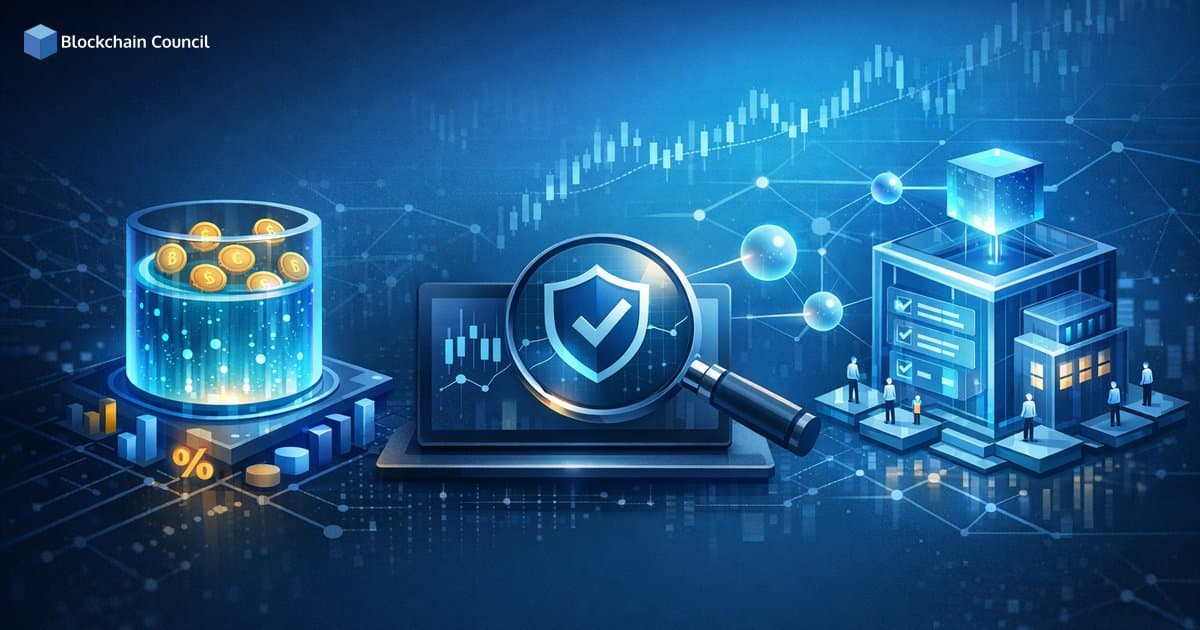
DeFi protocol crypto audit framework is no longer just a checklist for smart contract bugs. As DeFi total value locked has fluctuated in the tens of billions of dollars since 2023, risk has increasingly shifted toward economic design, oracle dependencies, and governance controls. Industry and academic research also points to a hard truth: audits are necessary, but they do not guarantee against future breaches. A large academic analysis of 8,195 audit reports across 1,575 DeFi protocols found little evidence that audits alone materially reduce future security incidents, even though they correlate with better market outcomes and resilience during adverse shocks.
This article provides a practical, end-to-end audit approach focused on the three highest-impact domains for most protocols: liquidity pools, oracles, and governance. It draws on common audit practice and established risk frameworks, including the Enterprise Ethereum Alliance DeFi Risk Assessment Guidelines and Galaxy Digital's SeC FiT PrO model, alongside continuous security practices such as monitoring and bug bounties.

Why a DeFi Protocol Crypto Audit Framework Must Go Beyond Code Review
Traditional audits emphasize code correctness through manual review and tooling such as static analysis, fuzzing, and symbolic execution. That remains essential, but real-world DeFi losses often involve system interactions rather than a single isolated bug: thin liquidity enabling price manipulation, oracle edge cases creating flawed collateral valuations, or governance privileges allowing unsafe upgrades.
Modern risk guidance reflects this shift. The EEA guidelines categorize DeFi risk across domains including smart contract risk, governance and key management, and market and liquidity risk. Galaxy's SeC FiT PrO model evaluates smart contract risk alongside economic design, centralization, financial risk, and transparency. An institutional-grade audit process increasingly resembles a risk assessment framework, not simply a code review.
Phase 1: Discovery and Scoping
Effective audits start by defining what is in scope and identifying which assets are truly critical.
Key Scoping Outputs
- Protocol archetype: AMM-DEX, lending, liquid staking, derivatives, yield aggregator, or synthetic assets.
- System map: contracts, upgradeability pattern, admin roles, governance modules, oracle contracts, cross-chain components, and third-party integrations.
- Critical assets: liquidity pools, collateral reserves, protocol-owned liquidity, treasury, insurance funds, and governance token controls.
For teams building audit capability in-house, training in smart contract security and Web3 threat modeling is valuable. Relevant learning paths include Blockchain Council's Certified Blockchain Security Professional and smart contract focused courses, particularly for developers involved in protocol design and code review.
Phase 2: Code and Architecture Review
This phase establishes whether the implementation matches the intended design and whether dependencies introduce hidden risk.
Smart Contract Security Checks
- Access control: enumerate roles, privileges, and modifier correctness; validate multisig boundaries.
- Reentrancy and external calls: confirm checks-effects-interactions patterns and the use of reentrancy guards where appropriate.
- Accounting and share math: pool share mint-burn logic, fee calculations, rounding behavior, and withdrawal paths.
- Upgradeability: proxy admin controls, upgrade authorization, storage layout safety, and upgrade timelocks.
Architecture and Dependency Analysis
- Oracle dependency mapping: which feeds drive collateral valuation, liquidations, or pool pricing.
- Cross-protocol integrations: routers, aggregators, stablecoins, and external vault strategies.
- Cross-chain risk: bridges and messaging layers used for state or price imports.
Phase 3: Liquidity Pool Risk Assessment
Liquidity pools are foundational to AMMs, DEX routing, and many yield strategies. They also create a convergence point for technical, economic, and composability risk.
1) Pool Design and Invariants
Start by identifying the pricing model and invariants the system must maintain.
- AMM formula: constant product, stableswap, hybrid curves, or concentrated liquidity.
- Invariant testing: simulate extreme conditions such as 99 percent liquidity removal, sharp price moves, and highly imbalanced pools.
- Parameter safety: fee ranges, amplification factors, tick spacing for concentrated liquidity, and admin-set bounds.
2) LP Token Behavior and Accounting Integrity
- Mint and burn correctness: confirm that LP shares cannot be inflated via rounding, race conditions, or fee edge cases.
- Withdrawal logic: validate proportional redemption across assets, especially for multi-asset pools.
- Downstream usage: if LP tokens are used as collateral, assess liquidation assumptions and illiquidity risk.
3) MEV, Sandwiching, and Slippage Risk
Correct code can still be economically unsafe if execution is consistently exploited by sophisticated actors.
- User protection controls: maximum slippage settings, transaction deadlines, and safer routing defaults.
- Protocol mitigation: batch auction designs, pricing guards, or private transaction routing where appropriate.
- Attack surface review: identify functions where predictable ordering creates extractable value.
4) Liquidity Depth, Manipulation, and Correlated Failures
- Thin liquidity flags: pools used for collateral valuation or oracle feeds should have minimum depth requirements.
- Caps and guardrails: leverage limits, borrow caps, and exposure limits for shallow assets.
- Composability risk: evaluate how a pool drain would propagate to lending markets, vaults, or structured products holding LP tokens.
Phase 4: Oracle Risk Assessment
Oracle failures are a common root cause in DeFi incidents, particularly in lending and derivatives. The audit goal is to ensure the protocol cannot be pushed into unsafe states by manipulated, stale, or unavailable data.
1) Oracle Type and Architecture
- Source model: DEX-based onchain feeds, off-chain aggregated feeds, custom oracles, or cross-chain imported data.
- Decentralization: number of independent operators and data sources, and concentration risk.
2) Manipulation Resistance
- TWAP vs spot: confirm whether time-weighted pricing is used and whether the window length is attack-resistant.
- Liquidity thresholds: require minimum onchain liquidity if DEX prices are referenced.
- Deviation checks: maximum change per update, outlier handling, and cross-source sanity checks.
- Circuit breakers: conditions under which borrowing, minting, or liquidation is paused.
3) Liveness, Staleness, and Fallback Behavior
- Heartbeat and update frequency: align with asset volatility and liquidation sensitivity.
- Stale data handling: explicit staleness thresholds and safe defaults.
- Fallback sources: documented, tested, and governance-controlled failover logic.
4) Governance Control Over Oracles
- Who can change feeds: ensure changes require timelocks and transparent proposals.
- Independent assurance: oracle contracts and adapters should be audited as first-class components.
5) Cross-Chain Oracle and Bridge Exposure
When price or state data crosses chains, the security model extends to the bridge and the consensus assumptions of both chains. Given the history of major bridge exploits, auditors should explicitly classify cross-chain oracle reliance as a high-impact risk factor.
Phase 5: Governance and Control Assessment
Governance determines who can change the rules. For enterprises and institutions, governance risk is often as significant as code risk, because privileged control can override technical safeguards.
1) Admin Keys, Upgrades, and Privileged Functions
- Role inventory: owner, admin, guardian, emergency operator, proxy admin, and risk committee roles.
- Privilege mapping: upgrades, pausing, parameter changes such as fees and collateral factors, oracle configuration, and treasury movements.
- Alignment with decentralization claims: document gaps between stated claims and onchain reality.
2) Timelocks and Safe Change Management
- Timelock coverage: upgrades and high-impact parameter changes should be delayed by default.
- Emergency powers: ensure pause rights are constrained, logged, and accompanied by a public incident process.
3) Voting Design and Economic Governance Attacks
- Concentration risk: quorum design, delegation patterns, and top holder influence.
- Borrowed voting power: reduce flash-loan style influence through snapshot rules, staking requirements, or time-based voting power mechanics.
- Bribery markets: evaluate whether incentive structures can systematically distort governance decisions.
4) Token Distribution and Vesting
- Allocation review: team, investors, community, and treasury allocations.
- Vesting and lockups: assess whether unlock schedules create predictable governance capture risk.
5) Compliance and AML Overlay
DeFi is increasingly intersecting with AML audit practices that include onchain analytics, transaction pattern analysis, and governance oversight. Where a protocol includes permissioned pools or controlled front-ends, audits should review how sanctions screening, monitoring, and escalation are implemented, and what governance authority exists to respond to legal obligations.
Phase 6: Operations, Continuous Monitoring, and Bug Bounties
Because audits do not eliminate exploit risk, protocols and risk teams should treat security as an ongoing discipline rather than a one-time exercise.
Recommended Operational Controls
- Real-time monitoring: TVL shocks, large liquidity withdrawals, oracle deviations, and unusual governance actions.
- Incident response: clear playbooks, on-call responsibilities, and predefined pause criteria.
- Bug bounty programs: well-scoped and adequately funded bounties. Academic findings suggest that protocols benefiting from decentralized auditors and bounty hunters show better security outcomes in practice.
- Periodic re-audits: after upgrades, new asset listings, oracle changes, or major parameter shifts.
Practical Audit Deliverables and Scoring Approach
To make the framework actionable for enterprises and investors, produce outputs that can be compared across protocols:
- Risk register organized by liquidity pools, oracles, and governance.
- Threat scenarios such as thin-liquidity price manipulation leading to bad debt accumulation.
- Control effectiveness assessment: timelocks present, oracle fallbacks tested, and invariants covered by fuzzing.
- Residual risk rating aligned with recognized models such as EEA categories or Galaxy-style risk factors.
Conclusion
A robust DeFi protocol crypto audit framework must treat liquidity pools, oracles, and governance as interlocking risk systems. Liquidity pools require invariant testing, MEV and manipulation analysis, and composability stress tests. Oracles require a thorough review of manipulation resistance, liveness, and governance control over feed changes. Governance requires explicit mapping of admin privileges, timelocks, voting attack surfaces, and operational emergency powers, alongside consideration of compliance and AML requirements.
Industry frameworks from the EEA and Galaxy Digital highlight why holistic risk assessment is becoming the standard, particularly for institutional participants. Academic research analyzing thousands of audits reinforces that audits correlate with better market outcomes and resilience, but do not reliably prevent future breaches. The practical implication is clear: pair audits with continuous monitoring, disciplined governance, and ongoing bug bounty coverage to reduce both the probability and impact of security failures.
Related Articles
View All
Cryptocurrency
Crypto Lending and Borrowing Explained: DeFi Loans, Rates, and Risks
Crypto lending and borrowing lets users earn yield or access liquidity through DeFi loans, but rates, collateral rules, and liquidations matter.

Cryptocurrency
Liquidity Mining Explained: How Crypto Users Earn Protocol Incentives
Liquidity mining lets crypto users supply assets to DeFi pools and earn fees plus token incentives. Learn how it works, where rewards come from, and the risks.
Cryptocurrency
Yield Farming Explained: DeFi Returns, Risks, and Strategies
Yield farming explained for DeFi users: how returns work, why APYs change, key risks, and practical strategies from stablecoin lending to LRTs.
Trending Articles
The Role of Blockchain in Ethical AI Development
How blockchain technology is being used to promote transparency and accountability in artificial intelligence systems.
AWS Career Roadmap
A step-by-step guide to building a successful career in Amazon Web Services cloud computing.
How Blockchain Secures AI Data
Understand how blockchain technology is being applied to protect the integrity and security of AI training data.