

Using Claude AI to Write API Documentation
 Suyash Raizada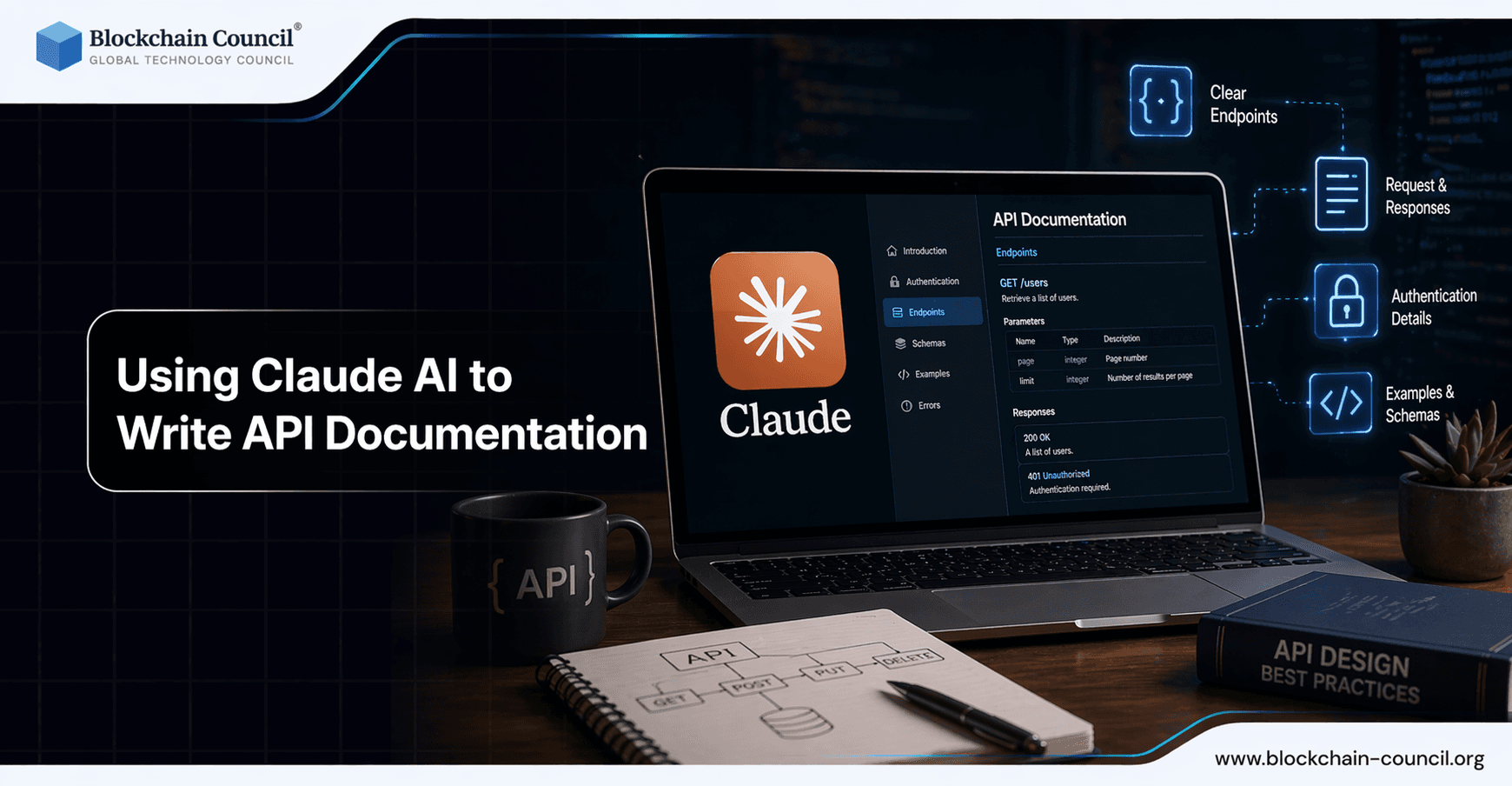
Using Claude AI to write API documentation is a practical approach for teams that need accurate docs shipped faster, particularly when documentation must stay aligned with fast-moving codebases. Modern Claude models, including Claude Opus 4, are optimized for coding and technical writing workflows, making them well-suited for drafting OpenAPI specs, generating runnable examples, and producing SDK notes that developers actually use. Using Claude AI to Write API Documentation improves clarity and consistency in technical documentation. Claude can generate structured docs quickly. However, maintaining accuracy and usability requires proper workflows. The Claude Code Certification helps you refine these practices.
Why Use Claude AI for API Documentation
API documentation is rarely just a reference page. High-quality docs include authentication guidance, error handling patterns, pagination rules, and code examples in the languages your users prefer. Claude can help automate these layers by reading existing code and producing structured documentation artifacts in multiple formats.

Teams commonly use Claude via:
Claude API for custom documentation pipelines and internal tooling integrations
Claude Code as an AI coding agent that assists with documentation generation and ongoing maintenance
Specialized workflows such as an API Docs Generator that discovers endpoints, extracts models, and generates examples
Generate clear and structured API documentation with AI assistance by mastering system design through an AI certification, automating workflows using a Python certification, and improving developer adoption via a Digital marketing course.
Core Outputs: OpenAPI Drafts, Examples, and SDK Notes
1) OpenAPI Drafts That Match Real Endpoints
A persistent problem in API teams is that OpenAPI specifications drift from the actual implementation. With the right inputs - routes, controllers, request validators, and model definitions - Claude can draft an OpenAPI document that includes:
Paths and operations for REST endpoints, with summaries aligned to real behavior
Schemas derived from data models and request/response payloads
Auth schemes such as API keys, bearer tokens, and OAuth flows, as described in your code and middleware
Error responses with consistent structure and status codes
Pagination conventions, including cursor-based and page-based parameters alongside response metadata
For teams with large codebases, Claude's long-context capability is useful when you need consistent naming, shared schema references, and cross-endpoint behaviors documented once and reused throughout the spec.
2) Working Examples in Multiple Languages
Well-crafted examples reduce support load and shorten time-to-first-call. Claude can generate and normalize examples across common developer preferences, including:
cURL snippets with headers, authentication, and realistic payloads
JavaScript examples using fetch or popular HTTP clients
Python examples using requests or async clients where appropriate
When using an API Docs Generator workflow, example generation can be paired with endpoint discovery and model extraction so each endpoint gets at least one runnable request plus a sample response.
3) SDK Notes Developers Rely On
Even with solid reference docs, most consumers will interact with your API through an SDK. Claude can help produce SDK notes that connect raw HTTP behavior to idiomatic usage, covering:
Method naming conventions and parameter mapping (snake_case vs. camelCase)
Typed models and how they correspond to API schemas
Retry behavior and rate limit handling recommendations
Versioning notes and backward compatibility expectations
Migration guidance for deprecated fields and endpoints
Recommended Workflow for Using Claude AI to Write API Documentation
A reliable documentation workflow combines automation with targeted human review. A practical, repeatable approach looks like this:
Collect inputs: route definitions, controllers, request/response models, auth middleware, error classes, and any existing docs.
Generate an OpenAPI draft: prompt Claude to produce spec-first output covering paths, schemas, auth, and errors, and ask it to flag ambiguities for review.
Create examples: request cURL, JavaScript, and Python examples for each endpoint, including at least one error case per endpoint.
Add SDK notes: generate language-specific guidance and document common integration pitfalls.
Validate and test: lint the OpenAPI spec, run example requests in CI, and confirm error responses match production behavior.
Publish and iterate: push updates to your developer portal and tie doc refresh to CI/CD to reduce spec drift over time.
To support governance and consistency, many teams maintain a documentation philosophy prompt that defines tone, error format, naming conventions, and example standards across services.
Model Selection Guidance for Documentation Quality and Speed
Model choice affects accuracy, reasoning depth, and throughput. For complex APIs with nuanced behaviors, Claude Opus 4 is often preferred due to its strong reasoning, technical accuracy, and long-context handling. For faster generation where latency matters, Claude Sonnet 4 serves as a balanced option. For high-volume tasks such as bulk endpoint summaries or repetitive updates, Claude Haiku 3.5 can be appropriate when speed is the priority.
Claude's knowledge cutoff means very recent standards or tooling released after its training window may not be reflected. In practice, you can address this by supplying your organization's current OpenAPI rules, lint configurations, and internal patterns as explicit inputs in your prompts.
Quality and Risk Controls to Add Before Shipping
Automated documentation is only useful if it is correct. Add lightweight controls that catch common failure modes:
Spec validation: run OpenAPI linters and schema validators to catch structural errors before publishing.
Example verification: execute generated examples against a staging environment to confirm they work as written.
Security review: ensure examples do not encourage unsafe defaults such as overbroad scopes, missing TLS, or logging sensitive values.
Consistency checks: enforce naming conventions, shared error formats, and pagination rules across all endpoints.
Skills and Training for Teams Adopting AI Documentation Workflows
Documentation automation works best when engineers understand both API design and the AI workflow. Teams often pair documentation initiatives with structured learning, including role-aligned programs such as the Certified AI Professional (CAIP) and Certified Prompt Engineer certifications to improve prompt design, output evaluation, and governance. For organizations building Web3 or security-sensitive APIs, blockchain and cybersecurity certifications can also help teams apply secure-by-design principles to their documentation practices.
Simplify technical writing and maintain consistent API standards using AI by combining expertise from an Agentic AI Course, enhancing backend logic through a machine learning course, and promoting tools via an AI powered marketing course.
Conclusion
Using Claude AI to write API documentation can significantly reduce the manual overhead involved in producing OpenAPI drafts, multi-language examples, and SDK notes, while improving consistency across services. The best results come from combining Claude's automation capabilities - endpoint discovery, model extraction, and example generation - with validation gates such as OpenAPI linting and executable examples in CI/CD. With a standardized documentation philosophy and the right model choice for each task, teams can keep docs accurate, current, and genuinely useful for developers.
FAQs
1. What is Using Claude AI to Write API Documentation?
Using Claude AI to Write API Documentation helps automate the creation of clear and structured API docs. It improves readability and reduces manual effort for developers.
2. How does Using Claude AI to Write API Documentation work?
Using Claude AI to Write API Documentation analyzes code and generates endpoint descriptions. It ensures consistent formatting and accurate explanations.
3. Why should developers use Using Claude AI to Write API Documentation?
Using Claude AI to Write API Documentation saves time and enhances documentation quality. It allows developers to focus more on coding.
4. Can Using Claude AI to Write API Documentation improve productivity?
Yes, Using Claude AI to Write API Documentation speeds up documentation processes. It reduces repetitive writing tasks.
5. Is Using Claude AI to Write API Documentation suitable for beginners?
Using Claude AI to Write API Documentation is beginner-friendly. It simplifies technical writing and helps new developers learn faster.
6. What tools are needed for Using Claude AI to Write API Documentation?
Using Claude AI to Write API Documentation requires access to Claude AI and code repositories. Integration with development tools is helpful.
7. Can Using Claude AI to Write API Documentation generate code examples?
Yes, Using Claude AI to Write API Documentation can create sample requests and responses. This improves developer understanding.
8. Does Using Claude AI to Write API Documentation support multiple languages?
Using Claude AI to Write API Documentation supports various programming languages. It adapts documentation accordingly.
9. How accurate is Using Claude AI to Write API Documentation?
Using Claude AI to Write API Documentation is highly accurate when given correct input. Validation is still recommended.
10. Can Using Claude AI to Write API Documentation update existing docs?
Yes, Using Claude AI to Write API Documentation can refine and update documentation. It keeps content aligned with code changes.
11. Is Using Claude AI to Write API Documentation secure?
Using Claude AI to Write API Documentation is secure if used with trusted environments. Sensitive data should be handled carefully.
12. How does Using Claude AI to Write API Documentation improve clarity?
Using Claude AI to Write API Documentation simplifies technical jargon. It produces easy-to-understand explanations.
13. Can Using Claude AI to Write API Documentation reduce errors?
Yes, Using Claude AI to Write API Documentation minimizes human errors. It ensures consistent terminology.
14. What industries benefit from Using Claude AI to Write API Documentation?
Using Claude AI to Write API Documentation is useful in software, fintech, and SaaS industries. It supports scalable development.
15. Does Using Claude AI to Write API Documentation support versioning?
Using Claude AI to Write API Documentation can help maintain versioned documentation. It ensures accurate updates.
16. Can teams collaborate using Using Claude AI to Write API Documentation?
Using Claude AI to Write API Documentation supports team collaboration. It standardizes documentation workflows.
17. How to start Using Claude AI to Write API Documentation?
To start Using Claude AI to Write API Documentation, connect your codebase and generate drafts. Review and refine outputs.
18. What are limitations of Using Claude AI to Write API Documentation?
Using Claude AI to Write API Documentation may require manual edits for complex APIs. Human review ensures accuracy.
19. Can Using Claude AI to Write API Documentation integrate with tools?
Yes, Using Claude AI to Write API Documentation integrates with tools like GitHub. This improves workflow efficiency.
20. What is the future of Using Claude AI to Write API Documentation?
Using Claude AI to Write API Documentation will evolve with smarter automation. It will become essential for development teams.
Related Articles
View All
Claude Ai
Using Claude Sonnet 5 for Web3 Content Creation, Community Management, and Automation
Learn how Claude Sonnet 5 supports Web3 content creation, community management, governance reporting, and automation with safe, practical workflows.

Claude Ai
Claude for Developers: Integrating the Anthropic API into Web Apps, Agents, and Workflows
Learn how to integrate Claude via the Anthropic API into web apps, tool-using agents, and workflows with best practices for prompts, security, governance, and cost.

Claude Ai
How to Use Claude Fable 5.1 for Free
Find out whether Claude Fable 5.1 is available for free, which Claude plans provide access, and what users need to know before trying Anthropic’s latest AI model.
Trending Articles
The Role of Blockchain in Ethical AI Development
How blockchain technology is being used to promote transparency and accountability in artificial intelligence systems.
AWS Career Roadmap
A step-by-step guide to building a successful career in Amazon Web Services cloud computing.
How Blockchain Secures AI Data
Understand how blockchain technology is being applied to protect the integrity and security of AI training data.