

Fable 5 vs Claude Mythos: Same Model, Different Rules

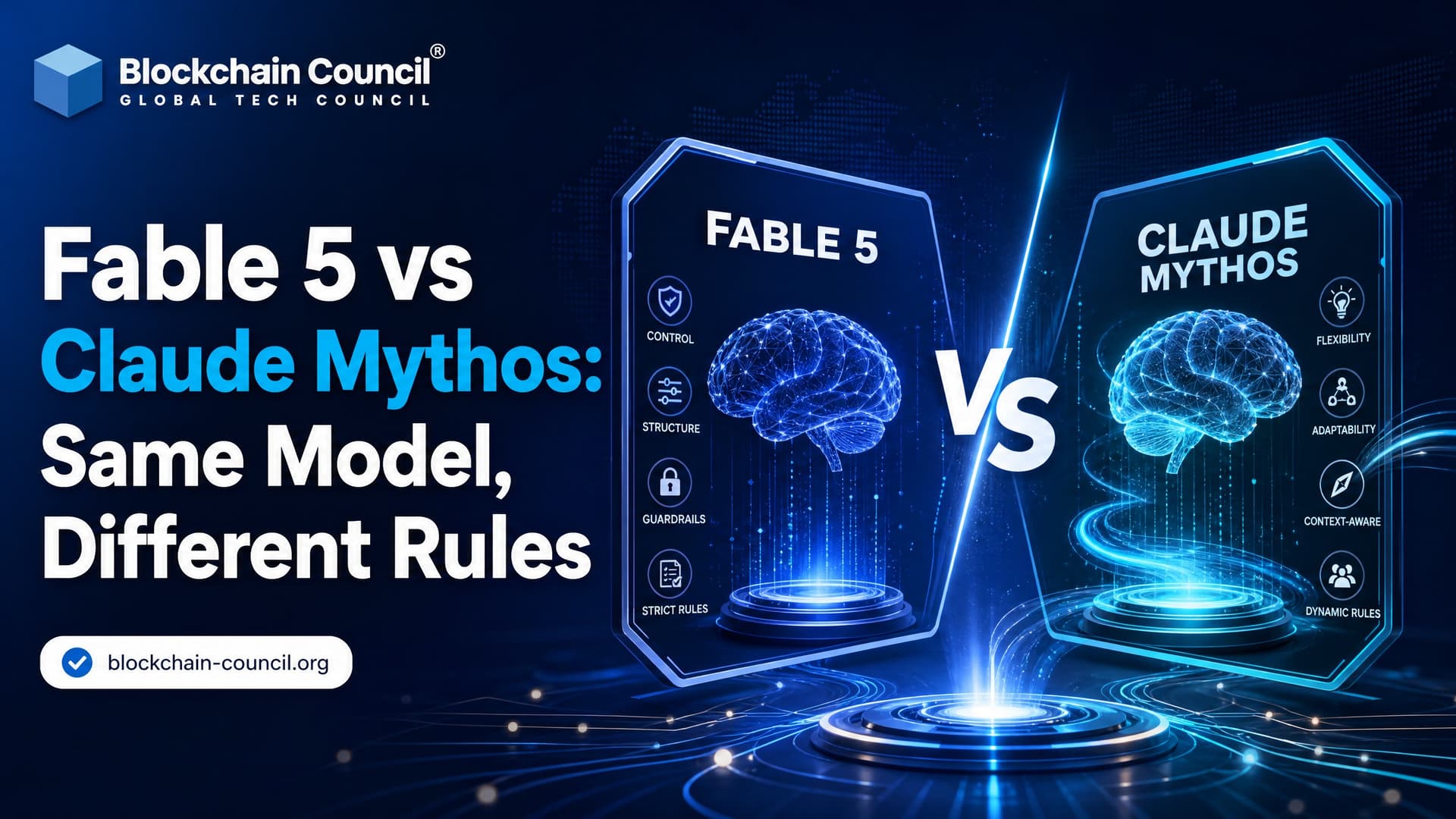
Fable 5 vs Claude Mythos is not a normal model comparison. You are not choosing between two different intelligence levels in the usual sense. Claude Fable 5 and Claude Mythos 5 are described as the same underlying Mythos-class frontier model, but Fable 5 is the public, safety-gated version, while Mythos 5 is the restricted variant for vetted cyber-defense and scientific partners.
That distinction matters. A lot. If you are an enterprise developer, AI architect, blockchain engineer, or security lead, the practical question is not "which one is smarter?" It is this: which version can you access, what will it refuse, when will it fall back to another model, and what governance burden comes with it?

Fable 5 vs Claude Mythos: The Short Answer
Claude Fable 5 is the most powerful Claude model broadly available through normal Anthropic access channels, including the Claude API endpoint claude-fable-5 and enterprise plans. Claude Mythos 5 is not generally available. It is reserved for approved users through Project Glasswing and related trusted-access programs.
The models share the same core capability. The difference is exposure. Fable 5 has safety classifiers for cybersecurity, biology, chemistry, and model-distillation requests. Mythos 5 removes or relaxes those safeguards for approved high-risk environments.
- Use Fable 5 for enterprise software engineering, coding agents, data analysis, non-sensitive research, Web3 product development, and general AI workflows.
- Use Mythos 5, if you can access it, for approved cyber-defense, critical infrastructure, and tightly governed scientific work.
- Do not assume Mythos 5 is a better everyday assistant. On ordinary tasks, the base model is the same.
What Is Claude Fable 5?
Claude Fable 5 is Anthropic's first Mythos-class model cleared for general use. In Anthropic's release framing, Mythos-class sits above the earlier Opus tier in capability. Fable 5 is positioned as the public version of that new tier.
It is designed for broad deployment, which means it carries safety controls. When a request hits sensitive categories such as cybersecurity, biology, chemistry, or model distillation, Fable 5 can route the request to Claude Opus 4.8 instead of answering with the full Mythos-class model. Reported testing puts this fallback at under 5% of sessions.
Here is the detail that will bite teams in production: the fallback is not just a policy footnote. It changes output behavior and billing. Fallback requests are billed at Opus 4.8 rates, not Fable 5 rates. Anthropic also notifies users when a fallback occurs, so log those notices if you are building an agentic workflow.
What Is Claude Mythos 5?
Claude Mythos 5 is the restricted version of the same underlying model. Anthropic positions it for government-grade cybersecurity and sensitive scientific domains. Initial access is tied to Project Glasswing, a program involving US government cyber defenders and critical-infrastructure providers, with planned expansion to select biomedical research organizations.
Mythos 5 is treated as a high-risk tool because the very capabilities that make it useful for defenders can also be misused. Cybersecurity is the clearest case. Anthropic has described Mythos 5 as having the strongest cybersecurity capabilities of any model in the world. That is not the kind of system you simply expose to every API account with a credit card.
Capability Comparison: Where They Match
For neutral work, the Fable 5 vs Claude Mythos debate is simple. They are effectively equal because they share the same base model. The published differences are about safety routing, access rules, and domain restrictions.
Coding and agentic software work
Fable 5 and Mythos 5 reportedly score 80.3% on SWE-Bench Pro, ahead of Claude Opus 4.8 at 69.2% and GPT-5.5 at 58.6% in the cited benchmark analysis. SWE-Bench Pro is useful because it measures practical software repair and agentic coding behavior, not just short autocomplete skill.
Anthropic and reviewers also cite a 50-million-line Ruby codebase migration completed in one day. That is the sort of result that changes how engineering leaders think about backlog planning. Still, be careful. A model that can modify millions of lines can also create millions of lines of subtle risk if you skip tests, dependency checks, and human review.
Vision and multimodal tasks
Fable 5 has been reported to rebuild web app source code from screenshots and play Pokemon FireRed from raw screenshots alone. Those examples sound playful, but the enterprise implication is serious. Screenshot-to-code, dashboard interpretation, UI regression review, and design-to-implementation workflows all become more realistic.
If you work in blockchain or Web3, this can help with wallet interface prototypes, explorer dashboards, DAO governance panels, and DeFi analytics screens. But do not let it write production transaction flows without review. A beautiful front end that signs the wrong payload is still a security incident.
Scientific reasoning
Anthropic's protein-design experts reported around a 10x acceleration in parts of drug-design workflows, including binding-site selection, tool orchestration, and recovery from failed attempts. Fable 5 exposes some of that scientific reasoning, but biology and chemistry safeguards can limit sensitive outputs. Mythos 5, or a planned trusted biology track, is where more direct access may appear for approved researchers.
Where Fable 5 and Mythos 5 Differ
The real split is governance.
- Fable 5: Publicly accessible, safety-gated, API-ready, suitable for normal enterprise adoption.
- Mythos 5: Restricted, high-risk, intended for vetted cyber defenders, critical infrastructure teams, and selected scientific organizations.
- Fable 5 fallback: Sensitive cyber, bio, chemistry, or distillation queries may route to Claude Opus 4.8.
- Mythos 5 response path: The model answers directly in domains where Fable 5 is constrained, subject to trusted-access controls.
To be blunt, most companies should not plan around Mythos 5 access. Build on Fable 5 unless you are already in a category that Anthropic or government-linked access programs would consider trusted and mission-critical.
Pricing: Is Fable 5 Worth the Cost?
Both Fable 5 and Mythos 5 are priced at $10 per million input tokens and $50 per million output tokens, according to the cited pricing analyses. That is double Claude Opus 4.8, which is listed at $5 per million input tokens and $25 per million output tokens.
So yes, Fable 5 is expensive. But per-token price is the wrong metric for hard work. If a coding agent solves a migration in three passes instead of twenty, the higher model price can still reduce total cost. For simple summarization, do not use Fable 5. Use a cheaper model. For messy codebase refactors, long-context debugging, or complex architecture planning, Fable 5 is much easier to justify.
Implications for Blockchain, Web3, and Security Teams
For Blockchain Council readers, the practical takeaway is clear. Fable 5 is the model you can realistically use for AI-assisted blockchain engineering today. Mythos 5 is mainly relevant if you operate at the level of national cyber defense, critical infrastructure, or approved research.
Good Fable 5 use cases for blockchain teams
- Refactoring large TypeScript, Rust, Go, or Solidity-adjacent codebases.
- Reviewing smart contract test coverage and suggesting missing edge cases.
- Generating first-pass documentation for protocol integrations.
- Turning UI mockups into Web3 front-end prototypes.
- Building AI coding agents that run tests, inspect failures, and propose patches.
Here is a practitioner warning: never treat a frontier model as a smart contract auditor. It can help you spot reentrancy patterns, unsafe external calls, missing access control, or flawed assumptions around ERC-20 return values. It can also miss a one-line invariant break. Keep Slither, Foundry tests, Echidna fuzzing, manual review, and formal methods in the workflow where money is at stake.
If you are building skills in this area, Blockchain Council's Certified Blockchain Developer™, Certified Smart Contract Developer™, Certified AI Expert™, and Certified Cybersecurity Expert™ are natural learning paths to connect with this topic.
Decision Guide: Which Model Should You Use?
Choose Claude Fable 5 if you need broad enterprise AI
Pick Fable 5 if you need top-tier coding, reasoning, multimodal work, or AI agents under a public access model. It is the right default for product teams, developer platforms, AI transformation groups, and blockchain engineering teams.
Choose Claude Mythos 5 only if your work justifies restricted access
Pick Mythos 5 only if you are an approved cyber-defense organization, critical-infrastructure operator, or trusted scientific research group that needs capabilities Fable 5 intentionally gates. If you are asking whether you qualify, you probably do not yet.
Use Opus 4.8 or cheaper models for routine work
Do not burn Fable 5 tokens on simple extraction, classification, or short summaries. Use cheaper models for that. Reserve Fable 5 for tasks where failure is costly, context is messy, and iteration time matters.
What to Do Next
If you are comparing Fable 5 vs Claude Mythos for an enterprise roadmap, start with Fable 5. Build a small pilot around one hard workflow: a legacy code migration, a smart contract test review, or a screenshot-to-prototype task. Track fallback events, token cost, test pass rates, and human review time.
Then train your team. Pair model experimentation with structured learning in AI, blockchain development, and cybersecurity. For most organizations, that combination will deliver more value than waiting for Mythos 5 access that may never be granted.
Related Articles
View All
Claude Ai
Anthropic's New Claude Fable 5.1 and Mythos 5.1 Update: What's New?
Anthropic’s Claude Fable 5.1 and Mythos 5.1 update brings stronger coding, long-running agentic workflows, research, vision, and knowledge-work capabilities. Fable 5.1 is generally available and introduces cheaper cache reads, potentially reducing typical workload costs by about 25% and highly agentic workloads by up to 45%. Mythos 5.1 uses the same underlying model but offers expanded cybersecurity and biology capabilities to vetted organizations through trusted-access programs.

Claude Ai
Fable 5 vs Claude vs ChatGPT: Which AI Model Should You Choose?
Compare Fable 5, Claude, and ChatGPT across coding, research, DevOps, cost, context, and governance to choose the right AI model.

Claude Ai
Claude Fable 5 vs Sonnet 5: Which Model Should You Use?
A practical comparison of Claude Fable 5 and Sonnet 5, covering model tier, access, safety, pricing, coding use cases, and enterprise fit.
Trending Articles
AWS Career Roadmap
A step-by-step guide to building a successful career in Amazon Web Services cloud computing.
How Blockchain Secures AI Data
Understand how blockchain technology is being applied to protect the integrity and security of AI training data.
What is AWS? A Beginner's Guide to Cloud Computing
Everything you need to know about Amazon Web Services, cloud computing fundamentals, and career opportunities.