

Fable 5 for Students: Study, Writing, and Productivity Use Cases

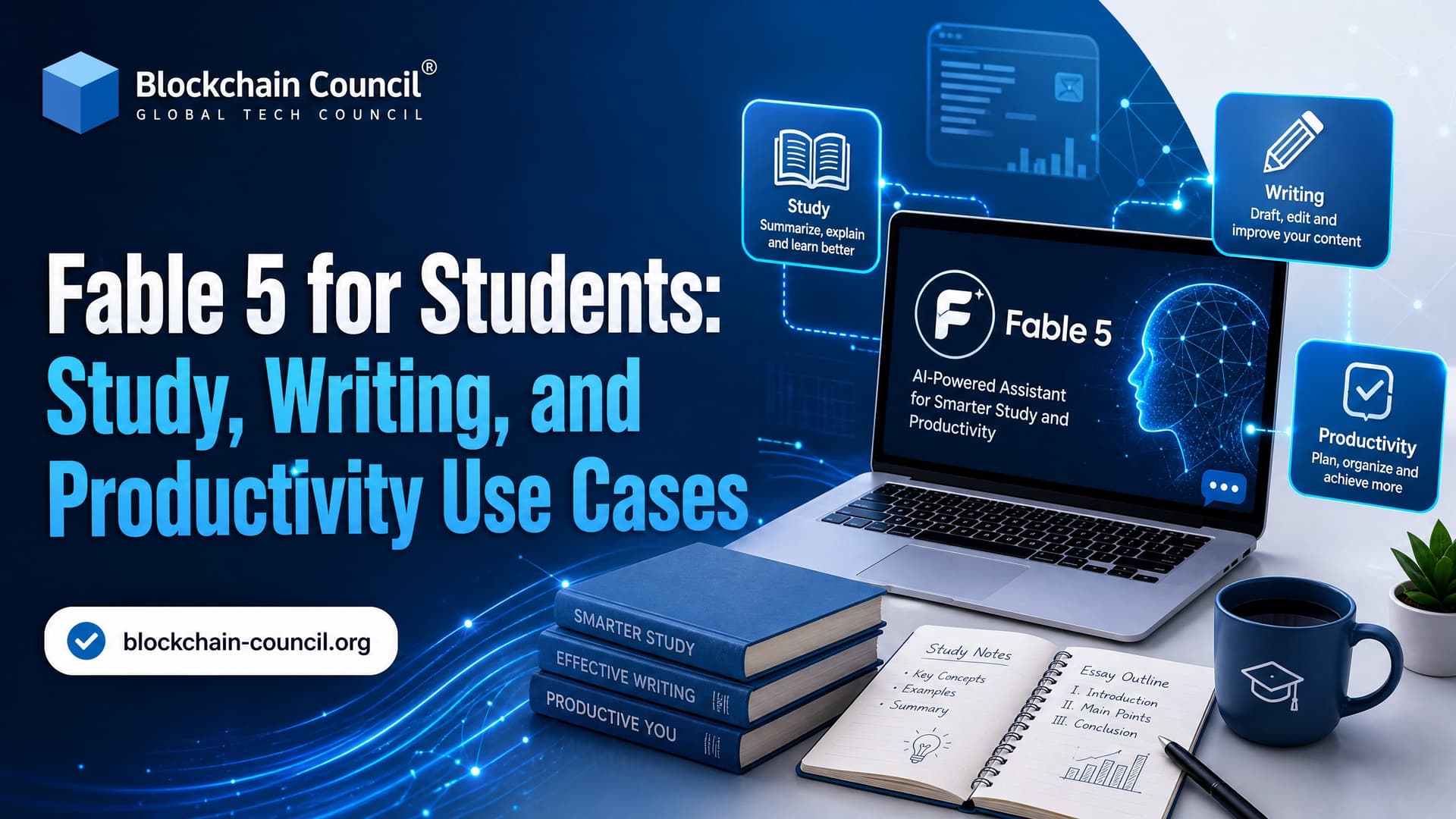
Fable 5 for students works best as a long-horizon study and work assistant, not just another chatbot for quick summaries. Anthropic positions Claude Fable 5 as a high-capacity model for ambitious projects, with strengths in coding, knowledge work, vision, document analysis, and computer use. For students, that translates into practical help with dense readings, writing projects, research organization, coding assignments, and weekly planning.
Here is the short version. Fable 5 earns its keep when the task has moving parts. A five-page article summary? Many models handle that fine. A semester-long research project with PDFs, notes, diagrams, rubrics, draft chapters, and shifting feedback from your supervisor? That is where Fable 5 starts to look different.

What Makes Fable 5 Different for Learning?
Anthropic describes Claude Fable 5 as a Mythos-level model adapted for public use with additional guardrails. It is built for long-running projects, careful reasoning, and self-checking. Early reviewers have focused less on simple Q&A and more on its ability to hold instructions across long sessions.
Wharton professor Ethan Mollick reported that Fable outran other public models he had tested and could work autonomously for up to 12 hours on long instructions. The productivity publication Every described it as a model you can hand a complex task, then return later expecting real progress. GitHub's early testing also highlighted its ability to handle complex, long-horizon coding work with more autonomy than previous models.
That matters in education because real student work is rarely one prompt. You read. You revise. You forget where a quote came from. Your professor changes the rubric. Your groupmate uploads the wrong version of the slides. The model has to cope with mess.
Fable 5 Study Use Cases
1. Reading PDFs, diagrams, charts, and tables
One of the strongest Fable 5 study use cases is document-heavy learning. Anthropic has emphasized the model's ability to read diagrams, charts, and tables embedded in files and PDFs. That helps in courses where the hard part is not just reading text, but connecting text to visual evidence.
You can use it for:
- Explaining figures in research papers
- Comparing textbook diagrams with lecture slides
- Summarizing tables from economics, finance, biology, or analytics papers
- Turning lab handouts into step-by-step prep notes
- Checking whether a chart actually supports the claim made in a paragraph
A practical tip: do not upload a 90-page PDF and ask, explain this. That usually produces a polished but shallow answer. Ask for page-based work instead. For example: Using pages 12 to 18, explain Figure 3, list the assumptions behind the model, and create five exam questions with answers. You get a better result because the task has boundaries.
2. Building self-tests and flashcards
Fable 5 can turn notes, slides, or assigned readings into practice questions. This is one of the least flashy uses, and often the most valuable. Passive summaries feel productive. Retrieval practice actually helps you learn.
Ask Fable 5 to create:
- Multiple-choice questions with explanations for each wrong answer
- Short-answer questions based on lecture objectives
- Flashcards grouped by topic difficulty
- Case-style questions for law, medicine, cybersecurity, or business classes
- A mistake log after you answer a practice set
The last one matters. If you only ask for questions, you are outsourcing the easy part. Ask the model to track your wrong answers and classify them as vocabulary gaps, reasoning errors, formula mistakes, or careless reading.
Fable 5 for Academic Writing
Fable 5 can help with academic writing, but do not treat it as a ghostwriter. That is the wrong use case. Use it as an editor, planner, critic, and structure checker. Your argument still needs to be yours.
Brainstorming and outlining
For essays and reports, Fable 5 can break down assignment prompts and rubrics. Give it the prompt, marking criteria, word count, citation style, and your rough position. Then ask for three possible outlines with trade-offs.
A useful prompt pattern is:
Here is my assignment prompt and rubric. I want to argue X, but I am not sure the evidence is strong enough. Give me two possible thesis statements, one safer structure, one more original structure, and the risks of each.
That kind of request forces comparison. It also keeps the model from producing the bland five-paragraph essay structure that too many students accept too quickly.
Draft revision and consistency
Fable 5 suits long-form revision because early experiments show it can preserve corrections as standing rules. For students, that means you can define preferences once, then reuse them across chapters or drafts.
For example, you might tell it:
- Use British spelling.
- Do not change quoted text.
- Flag unsupported claims instead of inventing citations.
- Keep my voice direct and concise.
- Apply APA 7 formatting checks only after the argument is clear.
This is where stronger models save real time. In weaker tools, I keep seeing the same annoying behavior: the model fixes grammar, then quietly changes the meaning of a technical sentence. For academic work, that is dangerous. Always ask for a change log after revision.
Productivity and Planning for Students
Fable 5 also works as an AI productivity tool for students. The best setup is simple: give it your syllabi, deadlines, weekly availability, exam dates, and current commitments. Then ask it to build a plan that reflects real constraints.
Good productivity prompts include:
- Semester planning: Create a week-by-week study plan from these syllabi and mark high-risk weeks.
- Deadline triage: Rank these assignments by urgency, effort, and grade impact.
- Group projects: Turn this project brief into tasks, owners, dependencies, and meeting agendas.
- Second brain cleanup: Audit these notes and suggest a folder or tag structure.
- Weekly review: Compare what I planned with what I finished and adjust next week.
To be blunt, AI planning fails when students pretend they have unlimited focus. Tell Fable 5 the truth. If you work part-time on weekends or lose energy after 9 p.m., include that. A realistic plan beats an elegant one you will abandon by Wednesday.
Fable 5 for Coding and STEM Learning
Anthropic describes Fable 5 as state-of-the-art for coding and complex developer workflows. It has been discussed in relation to CursorBench, GitHub testing, and large codebase work. One referenced Stripe case study described Fable being pointed at a 50 million line Ruby codebase for a migration that would normally take a team far longer.
For students in computer science, engineering, data science, and robotics, that opens several use cases:
- Explaining unfamiliar codebases
- Writing unit tests before refactoring
- Debugging with a clear reproduction path
- Generating simulations or visual prototypes
- Reviewing architecture choices in capstone projects
Still, do not paste an assignment and submit the answer. You will learn less, and many institutions treat that as academic misconduct. A better approach is to ask Fable 5 to explain the bug class, write test cases, or compare two implementation approaches.
Concrete example: if your Solidity contract fails because you compiled with Solidity 0.8.x but copied an older tutorial that assumed unchecked arithmetic, ask the model to explain what changed in Solidity 0.8.0, why arithmetic overflow now reverts by default, and how to write a Foundry test for it. That teaches the concept instead of hiding it.
If you want a structured path for AI-assisted development, Blockchain Council's Certified AI Developer™, Certified Prompt Engineer™, and Certified Generative AI Expert™ connect directly to this work.
Creative and Media Assignment Use Cases
Fable 5 is not only for essays and code. Early tutorials and experiments show it working with content calendars, slide generation, campaign analysis, landing pages, and app prototypes. That fits business, marketing, design, communication, and media coursework.
You can ask it to:
- Analyze why a campaign works using a course framework
- Create alternative ad concepts for different audiences
- Turn research notes into a slide outline and speaker notes
- Review a landing page against accessibility and clarity criteria
- Generate interview questions for a user research assignment
One caveat: reviewers note that Fable 5 is stronger at serious analysis than playful humor. If your assignment depends on cultural timing, satire, or a very human brand voice, use the model for structure and critique, then write the final version yourself.
Limitations, Safety, and Academic Integrity
Fable 5 ships with strong guardrails. Reporting on the model notes locked-out areas for topics such as cybersecurity exploits and harmful biological materials. Some users may also hit over-filtering, especially in fields where legitimate coursework sits close to dual-use risk.
For most students, those guardrails are not a problem. For advanced security, bioengineering, or policy research, they can be frustrating. If a request is blocked, narrow the question to defensive, educational, or high-level analysis. For example, ask for threat modeling principles rather than exploit instructions.
You should also verify outputs. Fable 5 can be excellent and still wrong. Check citations, formulas, legal claims, medical statements, and code. In academic writing, ask it to separate claims supported by your uploaded sources from general background knowledge. That one instruction catches a lot of problems.
Best Practices: How to Use Fable 5 Without Losing Your Own Skills
- Start with your own attempt. Write a rough thesis, solve part of the problem, or outline the chapter first.
- Give source material. Upload the rubric, notes, datasets, or code instead of asking from memory.
- Ask for critique, not replacement. Use prompts like find weaknesses, test my reasoning, and show what is missing.
- Require traceability. Ask which page, paragraph, function, or table supports each point.
- Keep a learning log. Record what you asked, what changed, and what you learned.
This keeps Fable 5 in the right role: a demanding study partner, not a shortcut around thinking.
What Students Should Learn Next
Fable 5 for students pays off most when you know how to frame tasks, check outputs, and use AI ethically. If you are studying AI, software development, blockchain, cybersecurity, or digital business, build a small workflow this week: upload one syllabus, one reading, and one assignment brief. Ask Fable 5 to create a study plan, quiz you, and critique your first draft.
Then go deeper. For structured professional learning, explore Blockchain Council's Certified Prompt Engineer™ if your goal is better AI interaction, Certified Generative AI Expert™ if you want broader model literacy, or Certified AI Developer™ if you plan to build AI-enabled applications.
Related Articles
View All
Claude Ai
Fable 5 vs Gemini: Features, Performance, Pricing, and Use Cases Compared
Compare Fable 5 vs Gemini across features, benchmarks, pricing, multimodal support, coding, agents, and enterprise use cases.

Claude Ai
Fable 5 API Guide: Integration, Use Cases, and Developer Best Practices
A practical Fable 5 API guide covering integration paths, effort tuning, long-running agents, enterprise use cases, pricing, and production best practices.

Claude Ai
Fable 5 for Image and Text Workflows: Multimodal AI Use Cases Explained
Learn how Fable 5 supports image and text workflows, from document extraction and dashboard analysis to agentic AI systems and enterprise governance.
Trending Articles
What is AWS? A Beginner's Guide to Cloud Computing
Everything you need to know about Amazon Web Services, cloud computing fundamentals, and career opportunities.

Can DeFi 2.0 Bridge the Gap Between Traditional and Decentralized Finance?
The next generation of DeFi protocols aims to connect traditional banking with decentralized finance ecosystems.
Claude AI Tools for Productivity
Discover Claude AI tools for productivity to streamline tasks, manage workflows, and improve efficiency.