

Fable 5 Context Window Explained: How Much Can It Remember and Process?

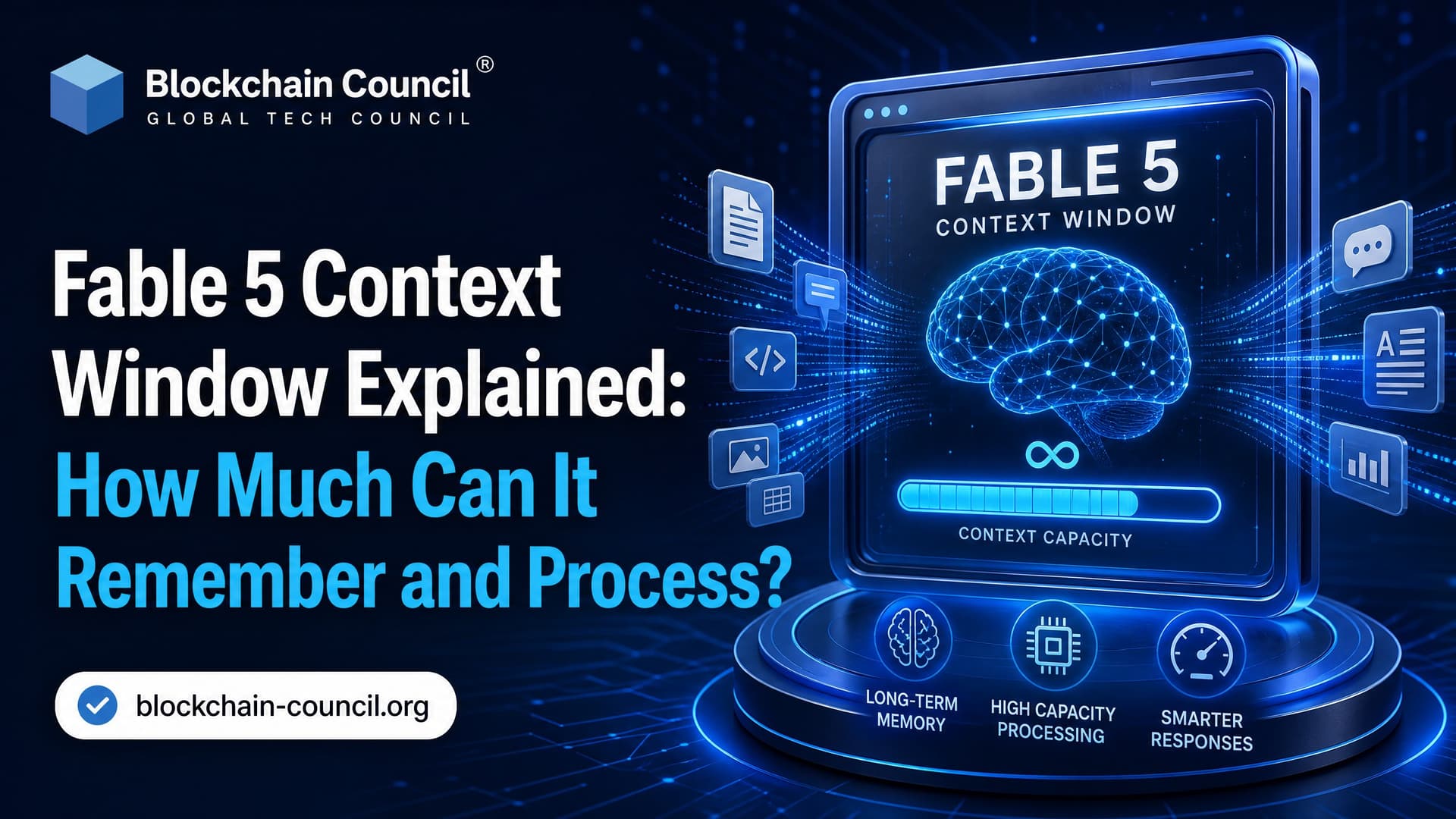
The Fable 5 context window is the amount of information Claude Fable 5 can keep in view during a single request. Anthropic lists Fable 5 with a 1 million token context window by default, plus up to 128,000 output tokens. In plain terms, that is roughly 555,000 words or about 2.5 million Unicode characters. The safer working range sits closer to 800,000 tokens once you account for overhead, compaction, and recall quality.
That is large enough for work that used to demand careful retrieval pipelines: full code repositories, long incident logs, PDF-heavy policy packs, and multi-step research tasks. Do not treat 1 million tokens as photographic memory, though. At the far end of the window, precision drops. Anthropic's documentation describes this length-related degradation as context rot.

What Is a Context Window in Fable 5?
A context window is the model's working memory for the current request. It includes:
- Your latest prompt
- Earlier conversation turns
- Files, documents, images, or PDF pages added to the request
- System and tool instructions
- The model's generated output
This is different from training data. Training data is what the model learned before deployment. The Fable 5 context window is what it can see right now while answering you.
Here is the part that trips up many teams: output tokens count too. If you ask Fable 5 to produce a very long response, that response has to fit inside the total request budget. A 128,000 token answer sounds attractive for a large report, but it leaves less room for source material and intermediate reasoning.
Fable 5 Context Window Specs
Token, Word, and Character Capacity
Fable 5 supports a 1,000,000 token context window. Independent analysis of Anthropic's documentation maps that to about 555,000 words or 2.5 million Unicode characters. Token counts vary by language and formatting. Code, tables, JSON, and logs often burn through tokens faster than plain English prose.
In practice, this capacity can hold:
- Several technical books
- A large monorepo with tests and documentation
- Multiple microservice repositories
- Long legal, compliance, or policy document sets
- Operational logs from extended incidents
Multimodal Capacity
The 1 million token window also applies to mixed text and vision inputs. Developer testing based on Anthropic's docs suggests a single request can include up to around 600 images or PDF pages, depending on page density and extracted content.
Maximum Output
Fable 5 can generate up to 128,000 output tokens in one response. That makes it useful for long reports, multi-file code patches, research syntheses, and detailed migration plans. Be careful, though. Very long output is expensive, slower, and harder to review.
How Much Can Fable 5 Really Remember?
The official number is 1 million tokens. The practical number is lower. For coding workflows, long-context practitioners often budget around 800,000 to 830,000 live tokens. That leaves room for platform overhead, tool outputs, auto-compaction buffers, and the final answer.
To be blunt, the last 150,000 tokens are not where you want your most important facts hiding.
When the window fills, Fable 5 can still reason over a huge amount of material, but exact recall gets less reliable, especially for low-salience details near the start of the context. Ask it a broad architectural question and it may do well. Ask it for the exact wording of a clause buried on page 412 of a PDF you loaded 900,000 tokens ago, and you should verify the answer.
Context Rot: The Hidden Limit
Context rot is the decline in accuracy and recall as the amount of context grows. The model has not exceeded its formal limit, but quality still slips. This shows up across long-context large language models, not just Fable 5.
You will notice it in three ways:
- Older details fade: recent material is usually handled more accurately than early material.
- Low-signal text gets compressed: repeated logs, boilerplate, generated files, and long appendices may be summarized internally.
- Fine-grained retrieval weakens: exact line numbers, clause wording, and tiny config differences need extra care.
In code review, I usually strip out node_modules, build artifacts, generated protobuf files, coverage reports, and large lockfiles unless the lockfile is the point of the investigation. Beginners often paste the whole repository as-is, then wonder why the model misses the one hand-written file that mattered. The context was big, but not clean.
Pricing: Long Context Is Not Free
Anthropic states that Fable 5 uses standard per-token pricing across the full 1 million token window. The reported rates are $10 per million input tokens and $50 per million output tokens, with no separate long-context surcharge.
That pricing structure matters. A 900,000 token request is not hit with a special long-context premium, but it is still billed for 900,000 input tokens. Large prompts also add latency. If you send the same reference corpus repeatedly, prompt caching and batch processing can cut cost in supported workflows.
Best Use Cases for the Fable 5 Context Window
Whole-Repository Software Engineering
Fable 5 fits repository-scale tasks well: architecture review, migration planning, dependency analysis, security review, and cross-file refactoring. It can compare implementation details across services without forcing you to pre-select every file.
This does not mean retrieval-augmented generation is dead. For huge or constantly changing codebases, RAG still helps. A good pattern is to retrieve the most relevant files, add architecture notes and recent incident reports, then use Fable 5 for deeper reasoning over that curated working set.
Log and Incident Analysis
Long logs are painful for humans. Fable 5 can scan multi-day exports, cluster repeated failures, identify event sequences, and suggest monitoring improvements. Keep timestamps, service names, trace IDs, and error codes intact. Remove repeated noise where you can.
Policy, Legal, and Research Synthesis
For analysts, the Fable 5 context window can hold dozens or hundreds of documents in one task. That supports obligation extraction, gap analysis, regulatory comparison, and thematic literature reviews. For legal or compliance work, verify final claims against source passages before acting on them.
Agentic Workflows
Fable 5 also suits long autonomous workflows where the model calls tools, reads outputs, adjusts plans, and continues. The value is not only raw context size. It is the ability to keep prior decisions, tool results, and working notes visible over a long run.
Best Practices for Using the Fable 5 Context Window
- Stay below 800,000 tokens when possible. Leave headroom for new instructions, tool output, and final responses.
- Put critical instructions at the top and near the end. Repeating key constraints in a short final checklist helps.
- Remove junk context. Strip repeated logs, boilerplate, generated files, vendor folders, and irrelevant appendices.
- Use layered summaries. Summarize large batches first, then use those summaries for final synthesis.
- Ask for citations to source sections. For documents, request page names, headings, clause labels, or file paths.
- Use RAG for massive or changing corpora. One million tokens is large, but not a substitute for good information architecture.
- Budget for output. Do not request a 100,000 token response unless you truly need it.
Fable 5 vs Earlier Claude Context Windows
Earlier Claude models such as Sonnet 4.5 are commonly associated with 200,000 token windows. Fable 5 moves the default ceiling to 1 million tokens, which changes system design. Workloads in the 200,000 to 830,000 token band can often shift from multi-step retrieval to single-pass in-context reasoning.
That shift cuts orchestration complexity. It also creates new risks. Teams may load too much and skip source selection entirely. That is a mistake. Bigger windows reward better curation, not laziness.
Where Blockchain and AI Professionals Should Focus
If you work in AI engineering, security review, blockchain analytics, or enterprise automation, long-context models change how you design workflows. Smart contract audits, for example, can combine Solidity 0.8.x contracts, Foundry tests, deployment scripts, incident notes, and architecture docs in one review packet. The model may catch cross-file assumptions that a narrow prompt would miss.
For structured learning, you can pair this topic with Blockchain Council programs such as the Certified Prompt Engineer™, Certified Generative AI Expert™, and Certified AI Expert™. If your work spans AI and decentralized systems, add blockchain security and smart contract fundamentals so you can judge model output instead of accepting it blindly.
Final Takeaway
The Fable 5 context window is genuinely large: 1 million tokens by spec, roughly 555,000 words, and around 800,000 tokens as a safer working budget. It can process entire repositories, long logs, dense research packs, and complex agentic workflows in a single request.
Your next step: test it with one real workload. Start with a 200,000 token document or repo set, strip out obvious noise, ask for source-grounded findings, then scale toward 800,000 tokens only if quality holds. If you are building production AI systems, study prompt engineering and evaluation methods before you bet critical workflows on maximum context size alone.
Related Articles
View All
Claude Ai
Fable 5 for Image and Text Workflows: Multimodal AI Use Cases Explained
Learn how Fable 5 supports image and text workflows, from document extraction and dashboard analysis to agentic AI systems and enterprise governance.

Claude Ai
How to Use Fable 5 for Free: Claude Access Options Explained
Learn how to use Fable 5 for free through Claude plan promotions, Claude Code, and GitLab Duo trials, plus limits, pricing, and smart test cases.

Claude Ai
Claude Fable vs Llama: Open-Source Flexibility vs Proprietary AI Performance Explained
Claude Fable vs Llama explained: compare proprietary Claude performance with Llama open-weight flexibility for coding, agents, cost, and enterprise AI.
Trending Articles
The Role of Blockchain in Ethical AI Development
How blockchain technology is being used to promote transparency and accountability in artificial intelligence systems.

Top 5 DeFi Platforms
Explore the leading decentralized finance platforms and what makes each one unique in the evolving DeFi landscape.
Claude Code Vs Cursor
Claude Code vs Cursor compares two AI coding tools based on features, automation, and developer workflows.