

Anthropic's New Claude Fable 5.1 and Mythos 5.1 Update: What's New?

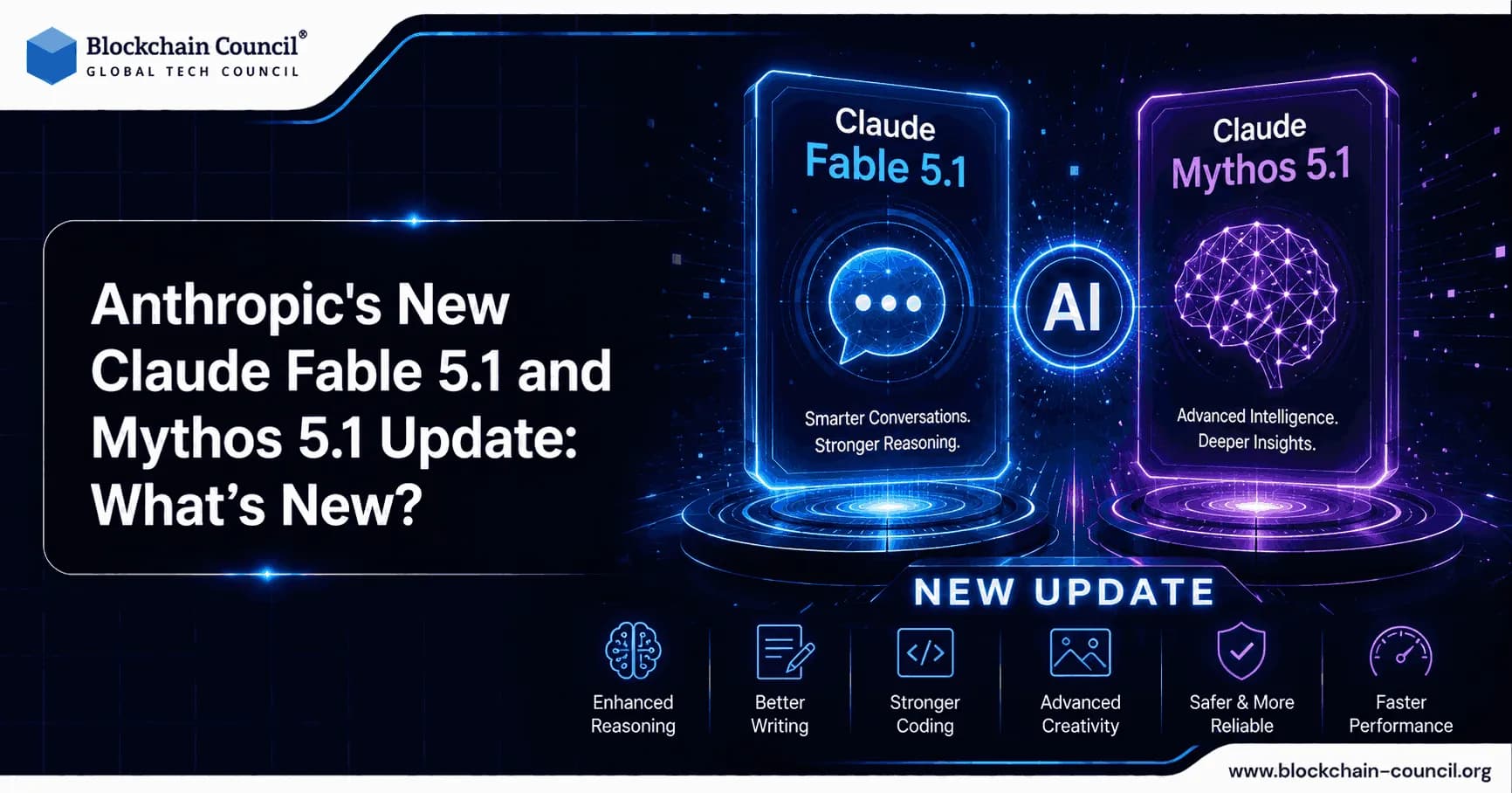
Claude Fable 5.1 landed on September 1, 2026, alongside its restricted sibling Mythos 5.1, marking Anthropic's first update to the Mythos-class model line since Fable 5 first launched back on June 9. The release comes roughly three months after that original launch, a period that also included an eighteen-day export-control shutdown of the entire model family. This guide breaks down exactly what changed, how Fable and Mythos actually differ, what the new pricing looks like, and whether switching makes sense, written clearly enough for a beginner while offering real depth for developers and technical decision-makers. For professionals who want to build verified, structured expertise on Claude specifically, a Certified Claude AI Expert certification offers a practical way to stay current as Anthropic continues shipping updates at this pace.
What Launched: Fable 5.1 and Mythos 5.1, Same Model, Different Safeguards
Anthropic describes Fable 5.1 and Mythos 5.1 as the same underlying model with different safety filters applied on top, rather than two separate architectures built independently. The company is calling them the world's most advanced models for coding and knowledge work, positioning this release around three core use cases: long-horizon coding tasks, multistep research, and dense document processing.

Fable 5.1 is the broadly available version, accessible to anyone with a paid Claude plan or an API account, and it also appears through AWS Bedrock. Mythos 5.1 is the more tightly controlled sibling, currently limited to vetted U.S. organizations participating in Anthropic's trusted access programs, covering both cybersecurity defenders and life scientists through a newly introduced Life Sciences Verification Program. Anthropic has said open enrollment for scientists is coming soon but has not given a firm date for broader Mythos access.
Understanding the underlying concepts that separate these model tiers, including how safety filtering actually works inside a large language model, becomes considerably easier with a solid foundation in the field. A Certified Artificial Intelligence (AI) Expert certification covers exactly this kind of grounding, helping both technical and non-technical professionals make sense of releases like this one as they happen.
What Actually Changed vs. Fable 5
The table below summarizes the most significant differences between Fable 5 and Fable 5.1 based on Anthropic's own published figures and reporting following the launch.
Area | Fable 5 | Fable 5.1 |
Context window | 1 million tokens | 1 million tokens, unchanged |
Output limit | 128,000 tokens | 128,000 tokens, unchanged |
Knowledge cutoff | Roughly January 2026 | Extended to around June 2026 |
Input pricing | $10 per million tokens | $10 per million tokens, unchanged |
Output pricing | $50 per million tokens | $50 per million tokens, unchanged |
Cache read pricing | $1.00 per million tokens | $0.25 per million tokens, a 75 percent cut |
Benchmark performance | Baseline | Beats Opus 5 on every benchmark Anthropic published |
Scientific research benchmark | 24.7 percent | 52.6 percent, more than double |
Cybersecurity filter false positives | Baseline | Roughly 60 percent fewer per session in Claude Code |
Biology filter false positives on medical questions | Baseline | Roughly 85 percent fewer |
Mid-conversation effort control | Not available | New beta feature |
Content provenance watermarking | Not present | Present, tied to EU AI Act requirements |
The headline number most coverage has focused on is the scientific research benchmark jump, where Fable 5.1 more than doubled its predecessor's score. Beyond raw benchmark gains, two smaller but practically useful additions stand out. The first is mid-conversation effort adjustment, which lets a user dial how hard the model works on a specific step without needing to start an entirely new session. The second is content tracking through an embedded watermark, a feature tied directly to compliance with the EU AI Act's transparency requirements, with a separate detection API currently in private preview for eligible regulators, media organizations, researchers, and EU civil society groups.
Fable vs. Mythos, Explained Simply
The distinction between these two model names causes genuine confusion, so it helps to break it down in plain terms. Fable 5.1 and Mythos 5.1 are not two different models trained separately. They are the exact same underlying system, with Anthropic applying different levels of safety filtering depending on which version a person or organization has access to.
Fable 5.1 declines or redirects requests that touch on cyberattacks or dangerous biology, and this is the version essentially everyone interacts with, whether through Claude.ai, the Claude API, or a paid subscription plan. Mythos 5.1 loosens those specific filters, but only for a narrow, vetted group. On the cybersecurity side, this means Mythos 5.1 can help identify software vulnerabilities as part of legitimate defensive security work. It still will not write functional exploits, since penetration testing and exploit generation specifically get redirected to Anthropic's Opus model line regardless of which Mythos-class version a user has access to. On the biology side, Mythos 5.1's expanded capabilities are reserved specifically for legitimate life sciences research through the new verification program, while advanced biology research more broadly continues to route through Opus 5 as well.
In short, think of Fable 5.1 as the version built for everyone, and Mythos 5.1 as the same core intelligence with the safety guardrails adjusted specifically for a small number of trusted, verified professional use cases, not a more powerful or more capable model in any general sense.
Pricing and Cache-Cost Breakdown, With Real Numbers
For developers and businesses evaluating cost, the actual per-token pricing for Fable 5.1 has not changed from Fable 5. Input tokens remain priced at ten dollars per million, and output tokens remain priced at fifty dollars per million. Where the real savings show up is in cache read pricing, which dropped seventy-five percent, from one dollar per million tokens down to twenty-five cents per million tokens.
This cache pricing change matters more than the flat sticker price suggests, particularly for workloads that repeatedly reference the same context, such as long coding sessions or multistep research tasks that revisit earlier parts of a conversation. Anthropic states this translates into roughly a twenty-five percent cost reduction for typical workloads, and savings of up to forty-five percent for more heavily agentic workloads that make frequent, repeated calls against cached context. Teams running high-volume coding agents or long document-analysis pipelines are likely to see the largest practical benefit from this specific change, even though the headline input and output rates look identical to before.
For marketing and business teams evaluating how to communicate cost savings like this to clients or leadership, pursuing a Marketing Certification helps translate technical pricing changes into clear, persuasive business language that non-technical stakeholders can actually act on.
AI & Technology
As artificial intelligence continues to transform education, students are getting more opportunities to explore technology beyond traditional classroom learning. A Tech Olympiad can help students develop their understanding of AI, logical reasoning, problem-solving, and other technology skills through structured competition.
For professionals building broader technical literacy alongside model-specific knowledge, a general Tech Certification provides comparable foundational grounding, helping teams understand releases like this one within the wider context of how large language models and safety systems evolve over time.
Should You Switch? Migration Notes
For most existing Fable 5 users, moving to Fable 5.1 requires little to no manual migration work, since Anthropic has positioned this as a direct, drop-in upgrade within the same model family rather than a structurally different system requiring new integration work. Context window and output limits stayed exactly the same, at one million tokens of context and one hundred twenty-eight thousand tokens of output, meaning existing prompt structures and application logic built around those limits should continue working without modification.
The practical reasons to switch center on the concrete improvements this update actually delivers. Teams running coding-heavy workloads should notice meaningfully stronger benchmark performance, particularly for long-horizon, multistep tasks. Teams working in security or biology-adjacent fields, even on the Fable side rather than Mythos, should notice a real drop in unnecessary refusals or redirects, given the reported reductions in false positive filtering on both the cybersecurity and biology safety systems. Cost-sensitive teams running agentic workflows with heavy cache usage stand to gain the most from the pricing change, given the potential forty-five percent reduction on that specific cost category.
The main reason to hold off migrating immediately would be workflows built around highly specific behavior patterns from Fable 5 that a team has already tuned around carefully, since any model update, even one described as a targeted refinement rather than a full rebuild, can shift subtle output behavior in ways worth testing before fully committing production traffic. Running a side-by-side evaluation on your own representative tasks before a full cutover remains sound practice regardless of how minor Anthropic's own benchmarks suggest the transition should be.
Conclusion
Claude Fable 5.1 represents a targeted but genuinely substantial refinement over Fable 5, delivering stronger benchmark performance, a significantly cheaper cache pricing structure, fewer unnecessary safety refusals, and new features like mid-conversation effort control, all while keeping context window, output limits, and headline token pricing unchanged. Mythos 5.1 remains the same underlying model with loosened filters reserved specifically for vetted cybersecurity and life sciences professionals rather than a more broadly capable alternative. For teams and professionals looking to stay ahead of releases like this one, combining hands-on testing with a Certified Claude AI Expert credential offers a structured way to keep pace as Anthropic continues iterating quickly across its model lineup.
Frequently Asked Questions
1. What are Claude Fable 5.1 and Mythos 5.1?
Claude Fable 5.1 and Claude Mythos 5.1 are Anthropic's newest AI models designed for advanced coding, knowledge work, research, cybersecurity, and scientific applications. Anthropic describes Fable 5.1 as its most capable generally available model for demanding, long-running work, while Mythos 5.1 is focused on advanced cybersecurity and biology research.
2. What is new in Claude Fable 5.1?
Claude Fable 5.1 improves long-running problem solving, coding, agentic workflows, research, document analysis, and visual understanding. It is designed to work on complex tasks for extended periods, use multiple tools, recover from failures, and provide progress updates during autonomous workflows.
3. What is Claude Mythos 5.1 designed for?
Claude Mythos 5.1 is designed for advanced cybersecurity and biology research. It provides capabilities intended for highly specialized scientific and defensive security work, but access is currently restricted to vetted organizations through Anthropic's trusted access programs.
4. Are Fable 5.1 and Mythos 5.1 the same model?
Yes. Anthropic says Fable 5.1 and Mythos 5.1 are the same underlying model with different safeguards. Fable 5.1 is designed for broader availability, while Mythos 5.1 provides more advanced capabilities to approved users working in sensitive research areas.
5. How much better is Claude Fable 5.1 than Fable 5?
Anthropic reports substantial improvements across several coding, research, and reasoning evaluations. For example, Fable 5.1 scored 52.6% on Terminal-Bench-Science 0.1 compared with 24.7% for Fable 5, although benchmark results should be interpreted within the limitations of each evaluation.
6. Is Claude Fable 5.1 better for coding?
Yes. Coding is one of the primary use cases for Fable 5.1. The model is designed for large codebases, complex feature development, code reviews, performance improvements, debugging, testing, and multi-step autonomous coding projects.
7. Can Claude Fable 5.1 perform autonomous tasks?
Yes. Fable 5.1 is designed for long-running agentic workflows that can span hours and multiple applications. It can plan tasks, use available tools, recover from failed steps, and continue working with limited human supervision.
8. What makes Fable 5.1 useful for knowledge work?
Fable 5.1 can handle complex, multi-stage knowledge tasks such as research, analysis, document processing, and creating deliverables. Its ability to work through longer assignments makes it particularly useful for projects that require sustained reasoning rather than short responses.
9. Does Claude Fable 5.1 have better vision capabilities?
Yes. Fable 5.1 can analyze diagrams, charts, tables, files, and PDFs. Anthropic also highlights its ability to use visual information when evaluating coding outputs against a design or intended result.
10. How much does Claude Fable 5.1 cost?
Anthropic lists Fable 5.1 at $10 per million input tokens and $50 per million output tokens. The major pricing change is a 75% reduction in cache-read pricing to $0.25 per million tokens, which Anthropic estimates can reduce typical workload costs by about 25% and highly agentic workload costs by up to approximately 45%.
11. Is Claude Fable 5.1 available to everyone?
Fable 5.1 is generally available to Pro, Max, Team, and Enterprise users and is also offered through Anthropic's developer platform and selected cloud marketplaces. Developers can access the model through the Claude API using the claude-fable-5-1 model identifier.
12. Who can access Claude Mythos 5.1?
Mythos 5.1 is currently available only to a small group of vetted organizations through Anthropic's trusted access programs. This restricted access reflects the model's advanced capabilities in areas such as cybersecurity and biology.
13. What are the main safety changes in Fable 5.1?
Anthropic has introduced updated safeguards for cybersecurity and biology-related tasks. When a request triggers these safeguards, some workloads may be routed to other Claude models with appropriate capabilities and safety controls rather than being completed directly by Fable 5.1.
14. Can Claude Fable 5.1 find software vulnerabilities?
Yes. Anthropic says Fable 5.1 can be used to identify software vulnerabilities. However, its safeguards are designed to limit assistance that could facilitate the development of exploits or enable harmful cyber activity.
15. How does Anthropic's fallback system work in Fable 5.1?
When certain requests trigger cybersecurity or biology safeguards, Anthropic can route them to another Claude model. According to Anthropic, cybersecurity requests may be routed to Claude Opus 4.8, while biology-related requests may be routed to Claude Opus 5.
16. Is Claude Fable 5.1 cheaper than Fable 5?
For many workloads, yes. Although the standard input and output token prices remain the same, Anthropic significantly reduced cache-read costs. This can make long-context and highly agentic workloads considerably less expensive than using Fable 5.
17. What industries could benefit from Claude Fable 5.1?
Fable 5.1 can support industries that rely on complex coding, research, analysis, and document-heavy workflows. Potential applications include software development, finance, legal services, enterprise research, analytics, architecture, and technical operations.
18. How could Mythos 5.1 impact scientific research?
Mythos 5.1 could help approved researchers work on complex problems in areas such as biology and cybersecurity. Its restricted availability allows Anthropic to evaluate these advanced capabilities in controlled environments while studying how powerful AI systems can contribute to scientific and defensive research.
19. What is the biggest difference between Fable 5.1 and Mythos 5.1?
The biggest difference is not the underlying model but the level of access and safeguards. Fable 5.1 is the generally available version for coding and knowledge work, while Mythos 5.1 is restricted to vetted users who need advanced capabilities for sensitive cybersecurity and biology research.
20. Why is the Claude Fable 5.1 and Mythos 5.1 update important?
The update shows how AI development is moving beyond simple chatbots toward autonomous systems capable of completing long-running coding, research, and knowledge-work tasks. The combination of stronger capabilities, lower cache costs, updated safeguards, and restricted access for sensitive applications also highlights the growing importance of balancing AI performance with cost, safety, and responsible deployment.
Related Articles
View All
Claude Ai
Fable 5 Reviews: What Anthropic's Claude Fable 5 Gets Right and Where It Still Falls Short
Fable 5 Reviews show Anthropic's Claude Fable 5 excels at autonomous coding and long-context work, but cost, latency, and precision remain key concerns.
Claude Ai
Fable 5 vs Claude Mythos: Same Model, Different Rules
Fable 5 and Claude Mythos 5 share the same core model. This guide compares access, safety routing, pricing, benchmarks, and enterprise use cases for AI teams.

Claude Ai
Claude Fable 5 and Claude Mythos 5: Capabilities, Access, and Enterprise Impact
Claude Fable 5 and Claude Mythos 5 bring Mythos-class AI to coding, analytics, and restricted cyber defense, with major implications for enterprises.
Trending Articles
How Blockchain Secures AI Data
Understand how blockchain technology is being applied to protect the integrity and security of AI training data.

Can DeFi 2.0 Bridge the Gap Between Traditional and Decentralized Finance?
The next generation of DeFi protocols aims to connect traditional banking with decentralized finance ecosystems.
Claude AI Tools for Productivity
Discover Claude AI tools for productivity to streamline tasks, manage workflows, and improve efficiency.