

Connecting Claude to Enterprise Data via an MCP Server: RAG Pipelines, Permissions, and Compliance


Connecting Claude to enterprise data via an MCP server is quickly becoming a practical architecture for organizations that want AI assistance without sacrificing governance. The Model Context Protocol (MCP) provides a standardized way for Claude to call tools and access data sources, while Retrieval-Augmented Generation (RAG) helps ground answers in approved knowledge. When you add identity, permissions, and compliance controls at the MCP layer, you get an enterprise-ready pattern for secure AI access to internal systems.
This article breaks down how MCP works in the Claude ecosystem, how it complements RAG, and how to design permissions, auditability, and compliance into your AI data access layer.

What Is an MCP Server in the Claude Ecosystem?
Model Context Protocol (MCP) is an open protocol and server specification that lets models like Claude connect to external tools and data sources through a consistent interface. In enterprise environments, an MCP server typically acts as the controlled gateway between Claude and systems such as:
- Databases and data warehouses
- Lakehouse and semantic layers
- Enterprise search and knowledge platforms
- SaaS systems like CRM and ITSM tools (for example, Salesforce and ServiceNow)
MCP commonly uses JSON-RPC over stdio, which makes it straightforward to run MCP servers as local processes, remote services, or controlled workloads inside an enterprise perimeter. Claude clients can discover available tools, interpret tool schemas and descriptions, and plan multi-step workflows that chain tool calls to complete tasks.
MCP vs RAG: Where Each Fits for Enterprise Data Access
MCP and RAG are often compared, but they address different problems and work best in combination.
RAG is for grounded answers from unstructured knowledge
Retrieval-Augmented Generation (RAG) retrieves relevant text from a curated corpus - policies, runbooks, product documentation, and support tickets - and injects selected passages into Claude's context. RAG is well-suited for static or semi-static knowledge where the goal is accurate, citeable answers that reflect internal documentation.
MCP is for tool and system integration, including actions
MCP connects Claude to tools and systems so natural language can be translated into machine operations such as SQL queries, REST API calls, or workflow steps. This is especially valuable for dynamic and transactional data, where results change constantly and where you may want Claude to do more than answer questions.
The enterprise pattern: combining MCP and RAG
Most production designs use both:
- RAG for unstructured knowledge (policies, technical documentation, support articles).
- MCP for structured systems and operations (warehouse queries, ticket creation, CRM updates, approvals).
- Governance controls wrapped around both so results are permissioned, minimized, and auditable.
Reference Architecture: Connecting Claude to Enterprise Data via an MCP Server
A common enterprise architecture follows this structure:
- Claude client (for example, a desktop client or an IDE integration) is configured to access one or more MCP servers.
- MCP server layer exposes a set of approved tools such as search_knowledge, run_sql, get_customer, or create_incident.
- Connectors and backends include data platforms, search indexes, document stores, and SaaS APIs.
- Security and governance are enforced at both the backend and the MCP layer via authentication, authorization, logging, and data filtering or redaction.
Enterprises increasingly treat MCP as the single official integration surface for AI access. This reduces the risk of ad hoc, point-to-point integrations that bypass policy controls.
Building RAG Pipelines Behind an MCP Server
RAG pipelines typically include ingestion, indexing, retrieval, and generation. MCP can wrap the retrieval component so Claude only receives governed results.
Typical enterprise RAG pipeline components
- Ingestion: Connectors pull content from sources such as intranets, document repositories, wikis, email archives, and ticketing systems. Documents are normalized and chunked.
- Indexing: Chunks and metadata are stored in a search system, often with vector embeddings and access-control metadata.
- Retrieval: Hybrid retrieval combines vector similarity with keyword search and filters such as department, repository, region, or classification.
- Generation: Retrieved chunks are passed to Claude so responses are grounded in enterprise-approved content.
Two common MCP and RAG integration patterns
- RAG via MCP: The MCP server exposes a tool like search_enterprise_knowledge that performs retrieval internally and returns only authorized snippets.
- Hybrid retrieval and actions: Claude retrieves policy or runbook guidance via RAG first, then calls action tools (ITSM, CRM, database) via MCP to execute subsequent steps.
Enterprise retrieval platforms are positioning MCP endpoints as a way to offer secure, relevance-optimized retrieval to multiple AI agents, not just a single model or vendor.
Permissions and Access Control: The Foundation of Enterprise MCP Deployments
Centralizing permissions and governance is the primary reason enterprises adopt the pattern of connecting Claude to enterprise data via an MCP server.
Authentication: tie MCP to enterprise identity
Common approaches include:
- Service accounts for controlled, non-human access where the MCP server authenticates to backends with tightly scoped credentials.
- User-delegated access where the MCP layer maps a user identity from the Claude client to backend entitlements.
- SSO and OAuth-based flows for SaaS connectors, aligned with existing enterprise identity providers.
Authorization: enforce least privilege at multiple layers
Strong authorization typically combines:
- Backend-enforced controls: Row-level, column-level, object-level, or repository-level access enforced by the system of record.
- Semantic and catalog governance: Exposing curated datasets and business-friendly views rather than raw tables reduces the risk of sensitive data leakage and improves query reliability.
- Tool-level permissions: Separate read tools from write tools. For example, expose search_tickets broadly but restrict update_ticket or create_customer to specific roles.
Data minimization and PII handling
Even with correct permissions in place, enterprises should minimize what is sent back to Claude. Common controls at the MCP layer include:
- Query-time filtering based on role, repository, and classification.
- Field-level redaction for PII and sensitive financial or health data.
- Selective context building where only the smallest necessary excerpts or aggregates are returned.
Auditability and Compliance: Making AI Access Defensible
Regulated organizations typically need to demonstrate who accessed what, when, and why. MCP supports this because tool calls and responses can be controlled and logged at the server boundary.
What to log for compliance and forensics
- Tool invocation logs: tool name, parameters, timestamps, and initiating user or service identity.
- Backend queries: SQL statements or API calls, with sensitive parameters masked where appropriate.
- Results metadata: record counts, classifications, and whether redaction was applied.
- Policy decisions: allow or deny outcomes and the rule that triggered the decision.
Data residency and sovereignty
Many enterprises need to keep data within a specific region or network boundary. Running MCP servers inside the enterprise perimeter or in a designated cloud region supports residency requirements by ensuring systems of record remain in place and only permitted outputs are shared with the model workflow.
Real-World Enterprise Use Cases
Conversational analytics on governed data
Data platforms have demonstrated how Claude can query curated datasets through MCP, generating SQL and returning results while respecting the data platform's existing governance model. Using a semantic layer is particularly effective because it constrains AI-generated queries to approved business definitions.
Enterprise knowledge assistants with secure retrieval
An MCP-exposed retrieval tool can return only the documents a user is authorized to see, improving both compliance and relevance. This pattern is commonly paired with RAG so answers are grounded in internal sources rather than generic web content.
Workflow automation across SaaS and line-of-business tools
MCP can provide a single integration surface for orchestrating multi-step tasks across CRM, ERP, and ITSM systems. Examples include summarizing incidents, generating follow-up tasks, or updating records based on validated inputs and role-based permissions.
Implementation Checklist for Connecting Claude to Enterprise Data via an MCP Server
- Keep MCP servers inside the trusted boundary and restrict network egress.
- Expose only curated tools and separate read operations from write operations.
- Use curated datasets and semantic layers instead of raw tables for analytics tools.
- Apply security trimming for RAG retrieval and enforce repository-level access.
- Redact and minimize before returning results to Claude.
- Centralize logging and integrate with SIEM for monitoring and incident response.
- Review and approve new tools as part of your change management process.
Skills and Training for MCP and RAG Enterprise Implementations
Implementing MCP servers, RAG pipelines, and governance controls requires cross-functional expertise across data engineering, security, and applied AI. For teams building production systems, structured learning paths covering AI integration patterns, data governance, and secure development are a practical investment.
Blockchain Council offers certification programs in Generative AI, AI engineering, data science, cybersecurity, and blockchain and Web3 that are relevant for technology leaders focused on governed AI implementation.
Conclusion
Connecting Claude to enterprise data via an MCP server is establishing itself as a reliable blueprint for secure, governed AI in production environments. MCP provides the integration contract for tools and data access, RAG provides grounded retrieval for unstructured knowledge, and enterprise controls - including IAM, authorization, redaction, and audit logging - make the system compliant and defensible.
Organizations that standardize on MCP as the official AI access layer can reduce integration sprawl, improve policy enforcement, and build agentic workflows that are both capable and appropriately governed.
Related Articles
View All
Claude Ai
Troubleshooting MCP Server for Claude Integrations: Common Errors and Fixes
Learn troubleshooting MCP server for Claude integrations with common errors, a proven debugging workflow, and practical fixes for Desktop, Code, Unity, and API setups.

Claude Ai
Deploying an MCP Server for Claude in Production: Docker, Kubernetes, Monitoring, and Scaling Guide
Learn how to deploy an MCP server for Claude in production using Docker and Kubernetes, with RBAC, observability, autoscaling, and safety controls.
Claude Ai
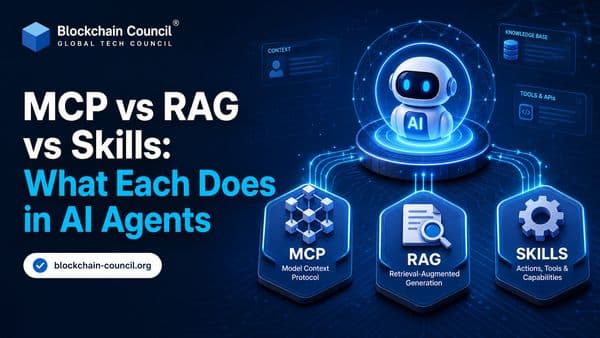
MCP vs RAG vs Skills: What Each Does in AI Agents
MCP, RAG, and Skills serve different roles in AI agents: connectivity, knowledge retrieval, and reusable workflows. Learn when to use each.
Trending Articles

Top 5 DeFi Platforms
Explore the leading decentralized finance platforms and what makes each one unique in the evolving DeFi landscape.
How Blockchain Secures AI Data
Understand how blockchain technology is being applied to protect the integrity and security of AI training data.

Can DeFi 2.0 Bridge the Gap Between Traditional and Decentralized Finance?
The next generation of DeFi protocols aims to connect traditional banking with decentralized finance ecosystems.