

Claude New Updates 2026: Complete Breakdown of New Features, Models, and Pricing


Claude new updates 2026 mark a shift from a capable chat assistant into a full-stack platform for professional AI work. By early-to-mid 2026, Claude is widely regarded as one of the leading AI assistants used daily by developers and enterprises, particularly where safety, reliability, and long-context reasoning are priorities. This breakdown covers the 2026 model lineup, major new capabilities including million-token context and Agent Teams, Claude Code developer tooling, and what pricing looks like across subscriptions and the API.
Claude in 2026: What Changed and Why It Matters
Claude's 2026 positioning is strongly enterprise-oriented, with emphasis on dependable behavior, governance-friendly workflows, and integrations that fit real business stacks. Three trends define the year:

- Long-context workflows: Support for up to 1M tokens on higher-end models changes how teams handle codebases, policies, and logs.
- Coding-first improvements: Competitive performance on SWE-bench Verified, plus a Claude 5-series coding specialist.
- Tooling and integrations: Claude Code in the terminal, Google Workspace integration, and standardized connectors via MCP.
For professionals building production systems, these changes affect architecture decisions (reduced chunking and retrieval complexity), cost planning (token economics), and governance (agentic workflows and tool access control).
Claude Model Lineup (2026): Haiku vs Sonnet vs Opus vs Sonnet 5
Anthropic's production lineup in 2026 centers on three tiers (Haiku, Sonnet, Opus), plus a new Claude 5-generation model designed specifically for coding. The practical decision follows a clear principle: select the most cost-efficient model that reliably meets your quality requirements, scaling up only for harder reasoning, deeper coding, or large-context needs.
Haiku 4.5: Fast, Low-Cost, High-Throughput
Haiku 4.5 is designed for speed and cost efficiency, making it a strong fit for latency-sensitive and high-volume applications.
- Best for: lightweight summarization, basic Q&A, high-volume chat, simple agents, and real-time user experiences.
- Context: approximately 200K tokens.
- API price (approx.): $1 per 1M input tokens and $5 per 1M output tokens.
For teams building customer support assistants that require instant responses, or pipelines processing thousands of short documents, Haiku typically offers the most predictable unit economics.
Sonnet 4.6: The 2026 Workhorse for Most Teams
Sonnet 4.6 is widely described as Claude's best price-to-performance default. Released February 17, 2026, it targets production applications that need strong reasoning and coding capability without flagship-tier cost.
- Benchmarks: 79.6% on SWE-bench Verified; 72.7% on OSWorld (computer-use).
- Context: typically 200K tokens, with extended options reaching up to 1M tokens in some configurations.
- API price (approx.): $3 per 1M input tokens and $15 per 1M output tokens.
- Best for: internal knowledge assistants, production chatbots, document analysis, mainstream coding workflows, and tool-using agents.
Sonnet 4.6 is the recommended starting point for most enterprise and developer deployments, particularly when paired with proper evaluation and prompt testing.
Opus 4.6: Flagship Reasoning Plus Agent Teams
Opus 4.6 is Claude's deep reasoning model, suited for complex analysis, high-stakes synthesis, and tasks that benefit from parallel agent coordination.
- Benchmarks: 80.8% on SWE-bench Verified; 91.3% on GPQA Diamond.
- Context: 1M tokens, with up to 128K output tokens in some configurations.
- Key feature: Agent Teams to spawn multiple sub-agents in parallel and coordinate results.
- API price (commonly cited in 2026 guides): $5 per 1M input tokens and $25 per 1M output tokens.
Some sources report higher Opus pricing in certain channels or negotiated enterprise contracts. Teams should verify current rates in Anthropic's official API documentation before finalizing budgets.
Sonnet 5 (Fennec): Claude 5-Series Coding Specialist
Sonnet 5, released February 3, 2026, is the first widely available Claude 5-generation model and is tuned heavily for software engineering tasks.
- Coding benchmark: 82.1% on SWE-bench Verified, surpassing Opus 4.6 on that specific coding metric.
- Context: designed for 1M-token workflows, supporting large codebase comprehension.
- Best for: multi-file edits, large-scale refactors, test generation and repair, and agentic coding via Claude Code.
A Claude 5 Opus model is anticipated later in 2026, though it is not yet broadly available as a standard production option.
New Features in Claude 2026
1M-Token Context: Simpler Systems, Less Chunking
Practical access to million-token context on higher-end models (notably Opus 4.6 and Sonnet 5) is one of the most consequential changes in the 2026 lineup. For teams, this can reduce reliance on complex retrieval pipelines because large inputs can be handled directly:
- Loading large monorepos or multi-service codebases into a single session.
- Analyzing entire policy libraries, SOPs, and compliance documents at once.
- Processing months of logs, tickets, or business records without aggressive chunking strategies.
This does not eliminate retrieval-augmented generation in every scenario, but it simplifies architecture and reduces failure modes caused by missing context slices.
Agentic Coding and Computer Control
Claude's 2026 capabilities support agentic workflows where the model plans, uses tools, and iterates autonomously. Sonnet 4.6's OSWorld performance reflects stronger computer-use behavior when properly integrated with tools and permissions.
For complex tasks, Agent Teams in Opus 4.6 can parallelize work across specialized sub-agents. A practical engineering setup might include:
- Implementation agent: proposes code changes and patch structure.
- Testing agent: generates or repairs tests and checks edge cases.
- Docs agent: updates README files, migration notes, and API documentation.
- Coordinator: merges outputs and resolves conflicts.
Enterprises should pair agentic setups with strong controls: tool allowlists, audit logging, and staged environments for execution.
Claude Code: Terminal-Native Development Workflows
Claude Code is a CLI that runs in the terminal and connects to Anthropic models via subscription access or API billing. It is typically used for multi-file edits, refactors, debugging, and test creation. There is no free Claude Code tier; access requires at least a Pro subscription or API credits.
Claude Code pairs naturally with:
- Sonnet 4.6 for everyday production coding assistance.
- Sonnet 5 for maximum coding performance on complex repositories.
- Opus 4.6 for deeper reasoning and large-scale architectural work.
Professionals building skills around agentic coding workflows can explore Blockchain Council's Certified AI Developer and Certified Prompt Engineer programs, alongside AI governance training designed for enterprise deployments.
Multimodal Input and Structured Outputs
Claude supports multimodal input (text plus images) and structured outputs for automation workflows. This is relevant for enterprise use cases such as:
- Extracting data from long documents into JSON or YAML for downstream systems.
- Processing screenshots, diagrams, and forms as part of support and operations pipelines.
- Standardizing compliance reporting from unstructured source materials.
Teams aligning AI automation with security practices will find relevant learning paths in Blockchain Council's Certified Cybersecurity Expert program and governance-oriented AI courses.
Integrations: Google Workspace and MCP Connectors
The 2026 release cycle introduced significant integration updates. Key highlights include:
- Google Workspace integration (Docs, Sheets, Gmail) included in the Pro tier.
- Remote MCP connectors to link Claude to external tools and data sources via a standardized interface.
- Desktop and mobile availability to support enterprise adoption beyond the browser.
Claude Pricing 2026: Subscriptions and API Costs
Claude Subscriptions (claude.ai): Free, Pro, Max
Subscription tiers are aimed at individuals and teams that want a managed experience in claude.ai, including integrated features like Workspace connectivity.
- Free: limited usage quotas with restricted access to advanced features.
- Pro: commonly cited at $20/month (some guides cite lower effective monthly rates on annual billing). Includes Claude Code, projects, and Google Workspace integration.
- Max: typically $100/month (approximately 5x Pro usage) or $200/month (approximately 20x Pro usage), plus priority access and better performance during peak periods.
Claude API Pricing (per 1M Tokens)
API pricing is pay-as-you-go and varies by model, with additional cost controls such as batch processing and prompt caching to reduce repeated spend. Commonly cited 2026 rates include:
- Haiku 4.5: approximately $1 input and $5 output per 1M tokens
- Sonnet 4.6: approximately $3 input and $15 output per 1M tokens
- Opus 4.6: commonly listed at $5 input and $25 output per 1M tokens, with some reports of higher rates in certain enterprise contexts
Anthropic's billing is token-based and, in official documentation, can also be represented through CCUs priced at $0.01 per CCU. For accurate budgeting, teams should model workloads using realistic output sizes, as output tokens frequently dominate cost in agentic or code-generation scenarios.
How to Choose the Right Claude Model in 2026
This decision framework can guide model selection for 2026 deployments:
- Start with Sonnet 4.6 for most production apps, coding assistants, and knowledge tools.
- Use Haiku 4.5 when unit economics and latency are the primary constraints.
- Move to Sonnet 5 for advanced software engineering, large repository refactors, and multi-file agentic coding.
- Reserve Opus 4.6 for the most demanding reasoning tasks, long-context synthesis, and Agent Teams parallelization.
Conclusion: What Claude's 2026 Updates Mean for Developers and Enterprises
Claude's 2026 updates represent a platform-level shift rather than isolated feature additions: million-token context for whole-repository and whole-policy workflows, stronger agentic behavior through integrated tools, and a clearer model tiering strategy anchored by Sonnet 4.6 as the production default and Sonnet 5 for coding-intensive work. For enterprises, disciplined adoption is the key variable - evaluate model selection against measurable task requirements, design tool access with governance controls in place, and reduce token spend through batching and caching where practical.
For professionals building production capability around these systems, structured training in AI development, prompt engineering, and security governance bridges the gap between experimentation and reliable deployment. Blockchain Council certifications including Certified AI Developer, Certified Prompt Engineer, and AI governance and cybersecurity programs align directly with the skills required to implement Claude-based solutions responsibly at scale.
Related Articles
View All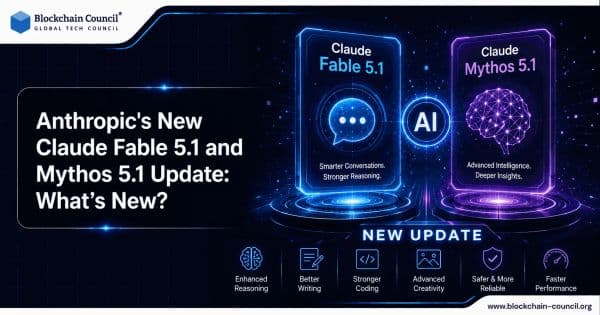
Claude Ai
Anthropic's New Claude Fable 5.1 and Mythos 5.1 Update: What's New?
Anthropic’s Claude Fable 5.1 and Mythos 5.1 update brings stronger coding, long-running agentic workflows, research, vision, and knowledge-work capabilities. Fable 5.1 is generally available and introduces cheaper cache reads, potentially reducing typical workload costs by about 25% and highly agentic workloads by up to 45%. Mythos 5.1 uses the same underlying model but offers expanded cybersecurity and biology capabilities to vetted organizations through trusted-access programs.

Claude Ai
Fable 5 vs Gemini: Features, Performance, Pricing, and Use Cases Compared
Compare Fable 5 vs Gemini across features, benchmarks, pricing, multimodal support, coding, agents, and enterprise use cases.

Claude Ai
Claude Sonnet 5 Explained: Key Features, Capabilities, and Use Cases
Claude Sonnet 5 brings 1M-token context, adaptive reasoning, stronger agent workflows, and enterprise safety controls for coding and knowledge work.
Trending Articles

Top 5 DeFi Platforms
Explore the leading decentralized finance platforms and what makes each one unique in the evolving DeFi landscape.
What is AWS? A Beginner's Guide to Cloud Computing
Everything you need to know about Amazon Web Services, cloud computing fundamentals, and career opportunities.

Can DeFi 2.0 Bridge the Gap Between Traditional and Decentralized Finance?
The next generation of DeFi protocols aims to connect traditional banking with decentralized finance ecosystems.